Feeds:
Posts
Comments

Archive for the ‘Favorite Things’ Category

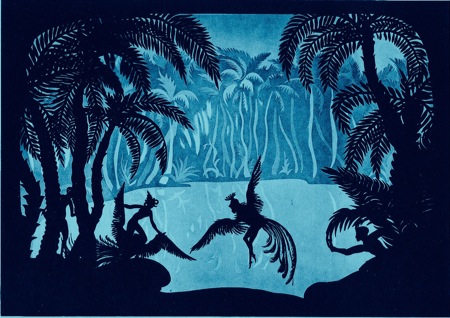
I wrote about Lotte Reiniger on this blog several years ago.  In this world that is filled now with fantastic computer generated  animations, her work still has the power to amaze me. The idea that this person armed with little more than a pair of sharp scissors and some paper could create these worlds of wonder is thrilling to me, an incredible manifestation of the creative vision. I thought I’d rerun the post from back in 2010 and add another of her films, Daumelinchen, from a bit later in her life. Made in 1955, it tells the story of Thumbelina. Take a look and try to remember that these are just papercut silhouettes.

The Adventures of Prince Achmed (1926)

I first saw a film, The Adventures of Prince Achmed,  from Lotte Reiniger several years ago in a series about early silent films.  It was made in 1926 Germany and was one of the first animated films made.  It’s a form of animation that Reiniger pioneered and mastered, based on Eastern shadow theatre.   Using silhouette figures, each is painstakingly cut and hinged then  filmed in small movements with time lapse photography to produce motion in the film.  This film took three years to complete.

Lotte Reiniger At Work

In this telling of the Arabian Nights stories, I was immediately struck by the beauty and movement of the colors in the film.  Each cell was tinted by hand to produce intense bursts of color that gave the film a gorgeous surreal quality.  The movements of the figures in the film are smooth and natural,  very subtle.  I found myself so taken with watching the movements and changes that I found myself not following the story.  But I didn’t care.  It was beautiful to see and sparked the imagination.

Lotte Reiniger (1899-1981), born in Germany and living most of her post-WW II life in Britain,  left quite a body of work from a career that spanned over 50 years, including one of the first film versions of Hugh Lofting’s Doctor Dolittle. She’s pretty much unknown in popular culture which is a great shame.  Her work is marvelous and deserves to be seen.

Here’s a small clip of Prince Achmed:

And here is Daumelinchen or Thumbelina.
Read Full Post »

I am kind of at ease this morning. It’s nice to not have any big obligations directly ahead of me after finishing yesterday’s Gallery Talk at the Principle Gallery. It lets me unwind from the anxiety that those kind of events create, the kind that is always there even though I try to appear at ease when speaking in front of groups of people. Fortunately, the folks who come to my talks are really good people who make it as easy as possible.

I want to thank everyone who came out on such a gorgeous day with so many other things going on to spend a little time with me at the talk. It was wonderful speaking with so many friends that I only get to see once in a great while and to meet so many new people. It was a good day all the way around and I hope everyone there felt that the time was spent well. I’ve said this before but their willingness to open themselves to me makes it easy to open myself up to them.

And that is a gift to me.

Speaking of gifts, of course, the highlight of the talk came at the end when I get to share a gift or two with them. I can’t explain how much pleasure I get out of this part of the talk. I’m sure other artists think I am crazy for giving away my work but the way I look at it is that it’s just a small pay back for all they have given me. Without their support, without their encouragement and interest through the decades, there is no telling where I would be or what I might be doing. Of if I would even be at all.

So, in my eyes I am playing with house money and just sharing a bit with my friends. Thank you so much to everyone at the talk yesterday and thanks to my good friends at the Principle Gallery– Michele, Clint, Pam, Taylor and Pierre– for allowing me to be a part of their wonderful gallery. I am so grateful–thank you.

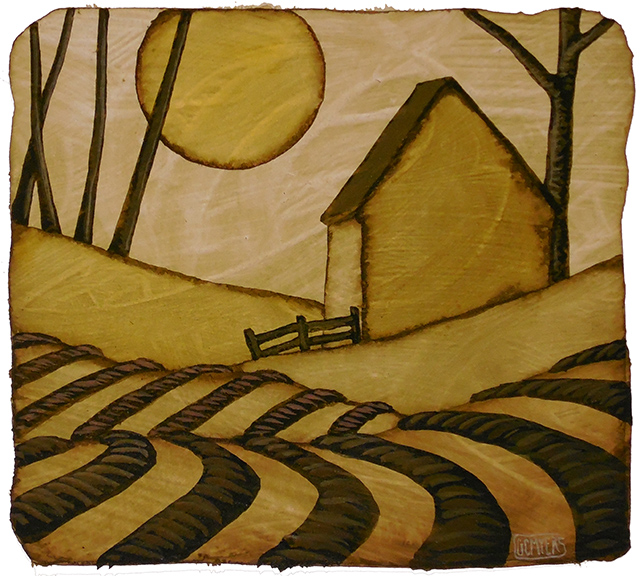
Now for this Sunday’s musical selection I was looking at the new painting above, Back in Time, and wanted an old song. While shuffling through older music I settled on the old folk tune, House of the Rising Sun. This version from the great Odetta came late in her life and delivers to the song great weight and grace. Just a great performance.

Enjoy and have a great day.

And thank you…

Read Full Post »

Four Front -2003

Yeah, you read that right, I’m willing to sell off some orphans.

Don’t worry, I’m not really a heartless bastard. I’m talking about a handful of my paintings that have shuffled around the country over the years and somehow found their way back to the studio. I consider these paintings my orphans.

A Time For Reflection-2002

There is a special small group of paintings that are accompanying me tomorrow when I head down to Alexandria for my Gallery Talk at the Principle Gallery. They are primarily older pieces that, while I like having them around here in the studio, I would like to have a home where they can get the attention that I feel they deserve from fresh and appreciative eyes that look at them on a regular basis.

A home where they can do the job they were meant to do, to fulfill their purpose

Some of these paintings in their first trips through the galleries were saddled by framing that didn’t suit the work. Tow had thick, heavy frames and extra wide mats that created a distraction from the actual work and overwhelmed the images.

A couple are favorites of mine that just never caught the right person’s eye.

And a couple have been with me for so long that I can’t figure out why they’re still here. For instance, the painting at the top of this page, Four Front from back in 2003, falls into this category.

These paintings are only going to be there for my time in the gallery on Saturday and are specially priced. If they don’t find a new home, they come back to the orphanage–er, studio.

Look at these little guys and tell me that they don’t deserve a home to call their own.

You Can Win This Painting!

So, try to get into the Principle Gallery tomorrow, Saturday, September 16. The orphans will be on display along with new work from the studio. The Gallery Talk begins at 1 PM and concludes with a free drawing for those in attendance for the painting shown here, The Warmth of Breath. Plus, there are a few more surprises that I don’t want to divulge here.

I am anticipating a good time with good questions and a lively conversation so I am hoping you can take part tomorrow. I suggest getting there early for a good seat. Plus, you can take a look at my orphans. Look forward to seeing you there!

In the Window: The Vigil 2005

In the Eye of Grace- 2006

No Mail- 2010

Call to Waking- 2011

The Journey- 2006

Read Full Post »

NC Wyeth Again

I am busy this morning but it’s never too hectic to ignore taking a look at the work of NC Wyeth. Below is a post from back in 2009 that I have updated with a few more images and a nice video of Wyeth’s painting. Just great stuff…

NC Wyeth The Giant NC Wyeth , who lived from 1882 until 1945, was the father of Andrew Wyeth and head of the artistic Wyeth family. He was also the preeminent illustrator of the early 20th century, illustrating some of the great books of the time.

Throughout his life, he wanted to be known not as an illustrator but as an easel painter, a fine artist.  There seemed to be this fine distinction that because an illustrator brought the scenes and ideas of others’ stories to life that they were somehow below the work of those who painted solely their own ideas.  I never understood that concept because it was still Wyeth who composed the paintings and created the colors and brushstrokes that distinguished the work.  Wasn’t this very much the same as many Renaissance artists who painted many of their great works for the Church?  Are they not considered fine artists?

NC Wyeth- Rip Van WinkleI’ve always been attracted to the work of NC Wyeth having seen it innumerable times in print.  There was a real dynamic quality, punch, in his paintings.  However, it wasn’t until I saw his work in person that I truly appreciated how beautiful his work truly was.

He treated many of his illustrations as fine paintings, with glorious paint appplication that created beautiful surfaces within the painting.  His colors were complex, hardly ever a pure single color.  His blues often had glazes of red, his whites tinged with yellows.  All of his colors had an  earthy base that gave them a dark edge and weight. His compositions were bold and inventive, highly contrasting and dramatic to best illustrate many of the adventure stories on which he worked.  In person, many of these paintings are even more stunning than on the printed page.

His non-illustrative work was much more mundane, less dramatic but well executed.  His real spark seemed to be from the stories he was bringing to life.  The Arthurian legends, the Leatherstocking tales of Cooper, the pirates of Robert Louis Stevenson–  all seemed fresh and new in his paintings.  Unlike many artists, I think being freed from having to create a narrative of his own actually gave him the opportunity to fully exploit all the knowledge of technique and composition he held.  As though having the decision of what to paint taken from his hands allowed that energy that would be expended to be used on making the painting stronger.  Whatever the case, whether you choose to call it fine art or illustration, the resulting work was memorable and deserves a nod.  It continues to inspire to this very day.


NC Wyeth Blind PewNC Wyeth
NC Wyeth

Read Full Post »

It’s the first of September and I let out a sigh of relief that August is behind me. I have confessed my dislike of August here in the past. For me, it’s usually a month of heat and anxiety, a month in which every bad thing seems to find me.

But this August was kinder and gentler and I am truly thankful. I know that this has not been the case for others across the country. Most notably, a storm of biblical proportions named Harvey that swept across the Gulf Coast of Texas and Louisiana. You know the story too well.
If you can, reach into your pocketbooks and send what you can to help them out in some way. It’s the right thing to do.

September always gets me a little melancholy but in a good way. More wistful and nostalgic than sad. It’s a feeling that seems more pronounced as I find myself actually in what could be the September of my life. When this time comes I feel like looking at black and white photos and listening to September Song, which, if you think about it, is a very black and white song.

I acme across this photo of my old studio which stands up the hill from my home and current studio. It is slowly being reclaimed by the forest around it and will someday no longer exist. I like that idea of impermanence for this studio. It was almost meant to be that way as an indicator of how small we are in the face of nature, as Harvey is currently showing us.

I have included an early blog entry from 2008 that describes it along with this year’s version of September Song, which is from Johnny Hartman, jazz vocalist that is probably unknown to most of you. I know that he was off my radar. But his voice is beautifully strong and smooth and this is a lovely, faithful version of the iconic song.

  This is a photo from a book, In Their Studios: Artists & Their Environment  from the photographer, Barbara Hall Blumer.  It was a project that she carried out in 2007 documenting the studios of visual artists in the general area of the southern Finger Lakes, centering on Corning, NY, which has a vibrant artistic community.  The result was a beautiful book that gives insight into the work spaces and habits of many artists.  For me it was interesting to be able to peek into a bit of other artists’ lives.  I highly recommend the book for anyone interested in the process of art.

This is my first studio, one that I built in 1997 and worked in until January of this year [2008], when I moved into a much larger and slightly better appointed studio.  This first studio was located in the woods that above my home and gave me what I called the best commute around, a short walk each morning up the hill through dense and fairly young forest of mixed hardwoods and white pines.  Sometimes I would stop and wonder at my good fortune to have the luxury and pleasure of this walk each day.

It was a very rustic space without running water (and the facilities associated with running water!) or a lot of heat for that matter but it served me well for ten years and its setting had a presence in much of my work.  It was very tranquil and from its windows I had great views of the woods and wildlife–  deer, gray and red fox, coyotes, raccoons (who at one point made their way into my roof) and even a weasel chasing after a rabbit. In the winter it would be spectacular as the snow would cling to the white pine branches almost to the ground.

Again, I wondered how I was so lucky…

Read Full Post »

We here in the US often tend to be a little narrow in the scope in which we regard art. We often don’t take enough time or make much of an effort to seek out the art that is not purely westernized, not European or American in its origin. But there is a world of expression out there and much of it is remarkable and universal in what it has to convey to us. And, most likely, we are not aware of it.

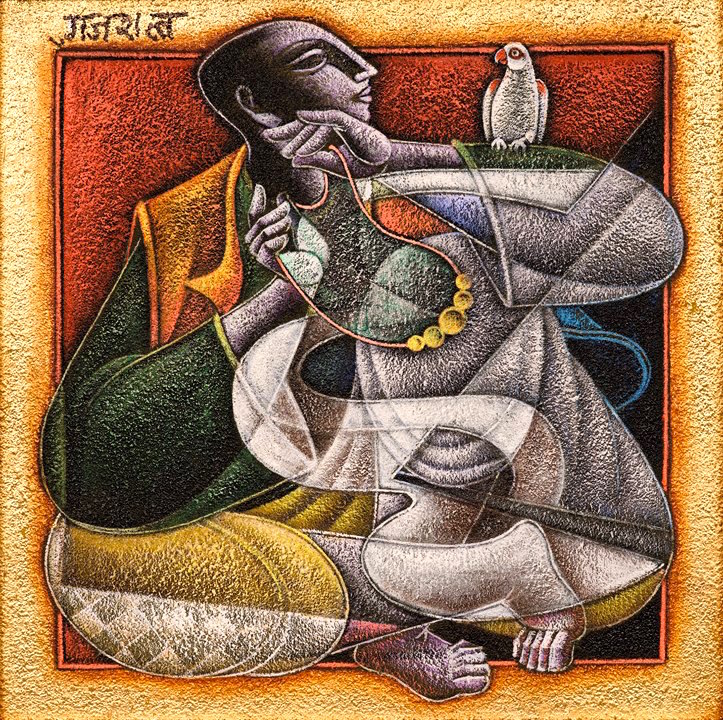
Take for instance Indian painter Satish Gujral. Born in 1925, Gujral is a painter, sculptor, muralist, graphic designer, writer and architect. He may be India’s best known living artist. And he did it all while suffering from deafness caused by an illness at age 10. His deafness was later, at age 72, reversed by surgery.

There is a lot to tell about him including him as a young man with no knowledge of English or Spanish and an inability to hear either, traveling to Mexico in the early 50’s to study with Diego Rivera. Or the fact that his brother became Prime Minister of India. Or the social commentary behind his work. I will leave finding more on the particulars of his life up to you.

For me, it was the pure and broad appeal of his work that drew me in. I love his imagery, his use of color and form in his paintings. He has had a long and varied career producing a large body of work in many fields but through it all, his voice is consistent– of his culture but in a universal tongue that speaks to all. Take a look at the images and video below to judge for yourself.

Read Full Post »

I was going through my files, looking at some work from several years ago. It’s something I do on a pretty regular basis as a way to charge my batteries. I see things in these older pieces that reignite ideas that have been swept away to the folds of my brain. Sometimes an idea, like a new composition, comes in a flash that seems exciting, something that tells me that I need to followup on it. Then hours later it is gone or has turned hazy, replaced by the work at hand.  

Oh, sometimes I write them down, rough sketches on loose bits of paper but more often than not they go into that heap that resides somewhere deep inside me. Sometimes they come back on their own, happily for me. Other times, they need a little coaxing, a prod of my memory that sometimes takes place when I revisit older work. Seeing this earlier work in sequence, grouped together, kicks off memories and these older ideas sometimes jump forward. Old friends.

I had that feeling just this morning. I wasn’t going to write anything, was just going to get to work on some things that needed finishing and maybe start a new piece with the hope that the work would create its own inspiration. That is often the case. But I came across a piece from a group of work that I did back in 2011, sepia toned interiors with landscape seen distantly through windows. It excited me on many levels to see the whole group together and I had flashes of other ideas that had either been hiding or were newly forming. It energized me greatly.

Here’s one of those pieces from back in 2011 and what I wrote at the time:

This is a painting I recently finished, a small piece, only 4″ square on paper.  It’s a mix of landscape and very uncomplicated still life with stark but distinct elements throughout.  There’s a simplicity that runs through this scene that covers a depth of feeling, a pang from the heart.

I sat this aside for a day or two after finishing it and found myself coming back to it.  There was a familiar tone to it that reminded me of something that I couldn’t quite identify until this morning when I walked into the studio.  I looked at it as I sat down and instantly said to myself, “Far From Me.”

It was the old John Prine song from his first album which came out forty years back, in 1971. There was something in this piece that filled me the feeling of Prine’s lyrics of gradual loss:

And the sky is black and still now

On the hill where the angels sing

Ain’t it funny how an old broken bottle

Looks just like a diamond ring

But it’s far, far from me

This piece will probably always be that song now for me, a personal avatar for a song buried deep inside and often forgotten.  Funny how things work…

Read Full Post »

“I feel I change my mind all the time. And I sort of feel that’s your responsibility as a person, as a human being – to constantly be updating your positions on as many things as possible. And if you don’t contradict yourself on a regular basis, then you’re not thinking.” 

― Malcolm Gladwell

*********************

I am using these words from Malcolm Gladwell today because it fits well with my feelings on the painting I am showing here. By that I mean that this is a piece on which my mind has changed over the years, from feeling it was okay at first to loathing to grudging acceptance to now actually liking it quite a bit.

It’s a small painting, something like 7″ by 8″ on paper,  from 2006 that is titled In the Eye of Grace. When I first finished this piece it felt pretty good and evoked an emotion that hit a mark for me. It wasn’t blessed with that initial giddy excitement that often comes when finishing a painting but it felt right. It was good and I felt confident in showing it in the galleries.

So it was framed and sent out. It never found a home and came back to me a year or two later where it has been ever since. After being with it for a while, I began to actually dislike this painting. It bugged the hell out of me and I could never determine why that was the case.

I finally decided that it might be the way it was framed, set in a very wide mat and an extra heavy wide frame. It was a cumbersome setting for a small piece and I began to realize that I didn’t like– actually, I hated– the grandiose feeling of the frame for such a quiet small painting. It was like having a small simple gem placed in the middle of an overly large and ornate setting. Overwhelmed and eclipsed.

So I began to accept that I was letting my judgement be swayed by its setting. I no longer cringed when I came across it in the studio. It felt okay enough.

But in the past several months I placed this painting, still in its fat frame, in a place where I saw it while doing my morning workout. I began to really look at it and my doubts and distaste faded away. It was like I had disregarded the title I had given the painting years ago, In the Eye of Grace. It did have a simple grace that was easy to overlook.

It became a favorite in my morning ritual. I determined that I would change the frame to one that would let its grace shine through a little more easily. It’s funny how things sometime change, how even my own perception of a piece of myself can transform in several directions through the years even while that piece of self remains the same.

We are sometimes strange creatures living with moments of grace that we fail to see…


Read Full Post »

I am busy this morning and thought I would replay a post from several years ago. No reason except that I came across it yesterday and it really caught my eye again. The work of Arcimboldo always does.  But I did add a video that shows more of his work so it’s really a replay plus. Take a look– I think you’ll like it.

****************

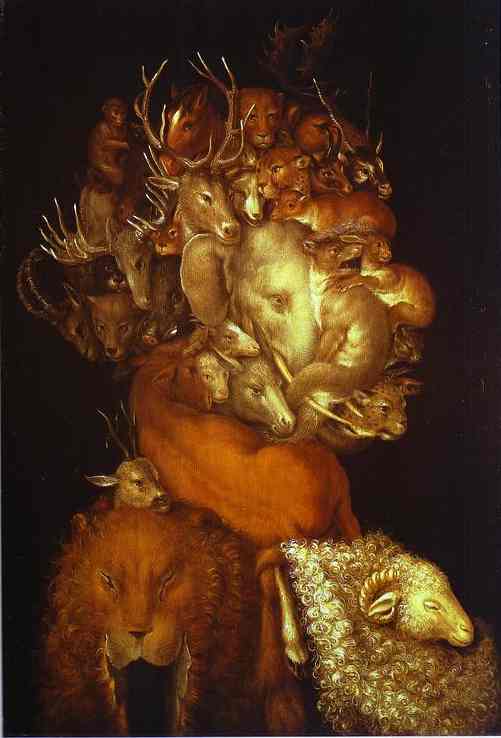
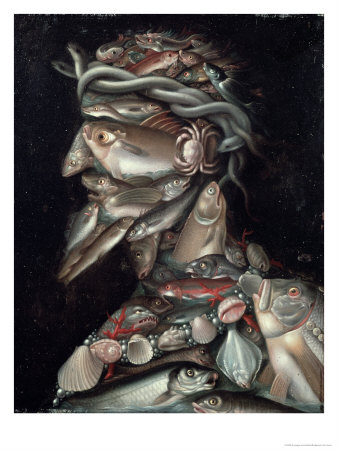
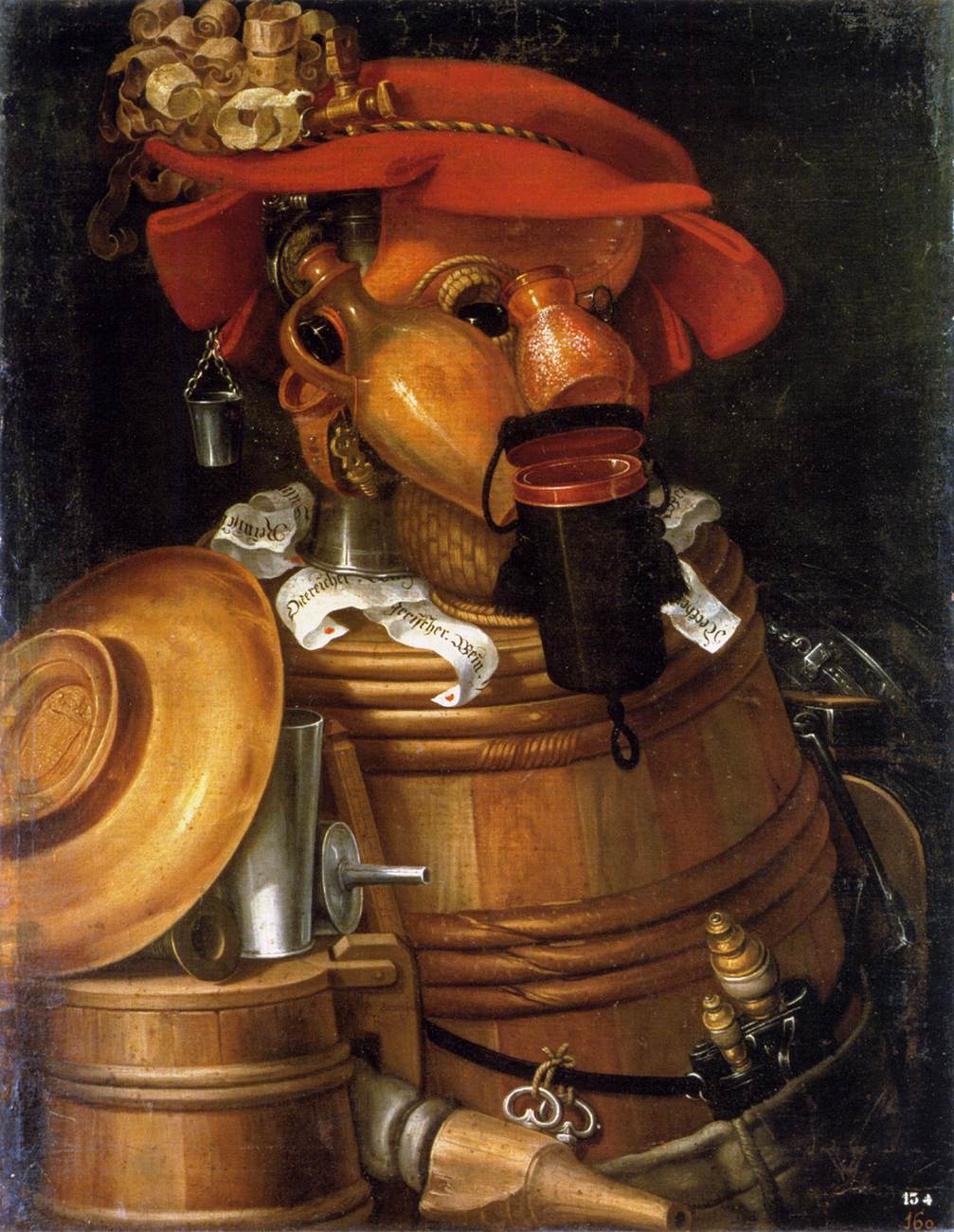
You don’t often think of work of art from an Italian Renaissance painter as being whimsical. Generally, they seem to focus on themes of religion and myth or on portraiture of wealthy patrons of the time, most beautifully painted.  Then there is the work of Guiseppe Arcimboldo, who was born in Milan in 1527 and died there in 1593, although much of life was spent in the service of  the Hapsburg courts of Vienna and Prague.

Arcimboldo was trained as stained glass designer and painter and initially worked in these fields in a traditional manner.  Much of the work from this time has faded into oblivion, although there are examples of his windows and a fresco or two.  However, it was his other work that gained him fame in his time and which has came through the ages as a constant source of fascination.

Arcimboldo-Winter 1573

Arcimboldo- Winter 1573

The other work was creating portraits, sometimes of his patrons such as the portrait at the top of Rudolf II, Holy Roman Emperor from 1576 until 1612 , that are composed using all sorts of objects to create the figure and features of the subject.  He used fruits, vegetables, birds, books, fish and many other objects in creating these unusual figures.  The final result was always striking, colorful and whimsically imaginative.  And sometimes grotesque, even a bit spooky– I’m thinking here of a series of pieces that Arcimboldo created portraying the Winter season as a person, such as this example on the right, painted in 1573.

Arcimboldo’s work always brings a smile to my face while also stirring my interest in how he must have worked at the time and how he was perceived in that era.  I am sure he was both admired and disliked for his unique work.  Whatever the case, the work remains a fascination.  I am showing several example here but you can go  a site– Guiseppe Arcimboldo: The Complete Works— that features a broader view of his work.  Very interesting.

Arcimboldo-TierraArcimboldo-The WaiterArcimboldo-AirArcimboldo- The LibrarianArcimboldo- The Admiralarcimboldo-winter_1563

Read Full Post »

I have been thinking about the work of the German painter George Grosz, who was born in 1893 and died in 1959. Maybe it’s the tone of these recent days in this country, darkly ominous and tinged with potential violence, that bring his work to mind. His work definitely dealt with the tenor of his time, mirroring the mood of  the two world wars and the rise of fascism in Europe and Hitler in Nazi Germany to which he was a witness. I thought I would replay an earlier blog post about Grosz that ran six years back. I’ve added a few more examples of his work as well as a video slideshow. The music in it is Andre Rieu playing a selection from The Merry Widow which adds a slightly lighter touch to the film.

***********

I woke up in the dark this morning after a fitful night of sleep filled with horrible dreams.  I don’t want to go into the details but they were awful and constant, each sweeping from desperate scene into yet another.  Dark and tinged in deep colors of black and red.  Hopeless in the scope of their finality and, though I am hesitant to use the word, there was a sense of apocalypse.  I was shaken.  I’ve had many horrifying dreams over the years but they seldom felt so vast and desperately final.

 As I trudged down to pick up my newspaper I tried to sort out the dream and try to find an equivalence in imagery that I know that captured in some way the feel of these dreams.  As I neared the studio the dark paintings of George Grosz done in Germany in the years before World War I came to mind.  They were forebodingly dark and angry and just the overall look of them made me think of the darkest corners of man’s mind.  The red tones and the way they filled the picture plane along with the chaotic nature of the compositions brought to mind the nightmarish feel of my dreams.

Grosz’s work changed over the years, especially after fleeing Hitler’s Germany, moving to the New York in the 1930’s where he lived until the late 1950’s when he returned to Berlin, dying there in 1959.  His American work is often considered the wekest of his career, less biting and more esoteric.  There were exceptions during the war such as 1944’s  Cain, Or Hitler in Hell, shown here, which reverts back to the colors and nightmare feel of his early work.  Very powerful work that may not sooth one’s soul but rather documents the darker aspects of human existence.

I don’t know if my own nightmares have an effect on my work.  Perhaps they come out in work that seems the antithesis of them, work that seeks to calm and assure.  I don’t really know to be honest.  I know that I want to put last night’s visions behind me.  To that end, I think I should get to work and let my nightmares only dwell in the work of Grosz for now.


Read Full Post »

« Newer Posts - Older Posts »