Feeds:
Posts
Comments

Archive for the ‘Favorite Things’ Category


Let Us Now Praise...


Opportunity is missed by most people because it is dressed in overalls and looks like work.

      – Thomas Edison

**************

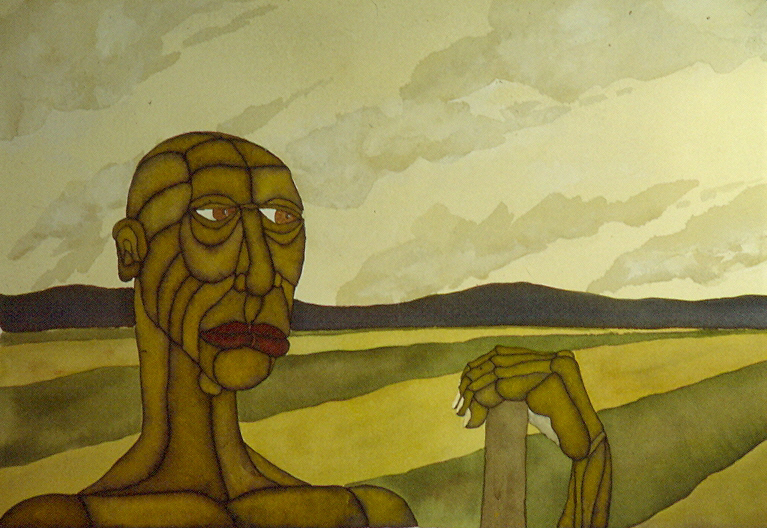
I was going through old blog posts recently and I noticed that I had used the painting above a number of times in my earliest posts. It’s part of my Exiles series from back in 1995 and is titled Let Us Now Praise Famous Men, borrowed from the title of a group of Depression-era photos of sharecroppers in the American dust bowl shot by photographer Walker Evans.

I never really wrote about this painting except in what I saw as it’s similarity to what I saw in those photos of Depression era workers. I always felt a connection to this piece but thought it was an outer connection, one that simply had to do with my reaction to form and color and not with anything I might see of it in myself.

Maybe that was my hope.

But it is a painting that I find has more meaning for me than I might want to let on. It’s a piece to which I always return, again and again, to study closely. While I sometimes see it as apart from me, more and more as I live with it, part of me feels like I am that man, standing alone in his landscape.

A sometimes self portrait.

It’s not a flattering self portrait. I used to see this figure as sad or regretful, world weary. But that has changed over time.  There is some sadness, some regret but more than anything, I now see him as resigned, neither happy or sad. He is in his place with work behind him and much more work to do. It still has a weariness in it, but not from a physical standpoint. It is more a sense of tiredness from working to stay ahead of the world’s constant encroachment, the world’s constant erosion. But while it appears tired there is also a sense of implied strength and determination to stay on task.

The hand here is important to me, a symbol of the bond of a working mind and working hands. Ideas set in motion and realized.

It’s a painting that means more and more to me as times passes and the world works its erosive qualities on my self and my world, my landscape. Maybe I am that dirt farmer, looking back with pride in his work along with an apprehension that it will someday be carried away like dry soil in the wind.

I am not going to be around Sunday so here’s a little music for the morning, a day early. It fits pretty well in tone and substance to the painting above. It’s the immortal Otis Redding with I’ve Got Dreams to Remember.

Have a good weekend.


Read Full Post »

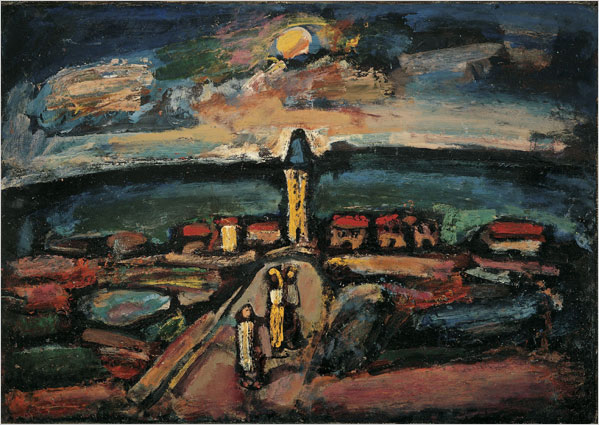
Rouault

Georges Rouault -Christ in the Suburbs 1920-24I am a believer and a conformist. Anyone can revolt; it is much more difficult to obey our inner promptings.

Georges Rouault

******************

I’ve been a big fan of French painter/printmaker Georges Rouault  (1871-1958) from the moment many years ago when I stumbled across a copy of Miserere, a book of his deeply expressionistic etchings. The title translates as Mercy and it contained raw and expressive work that dealt with deeply personal and religious themes along with those inner promptingsas he calls them in the quote above. It was a work that was very influential on my early Exiles series.

His entrance into the world of art was serving, at the age of fourteen, as an apprentice glass painter and restorer which shows itself in his mature work which resembles leaded glass windows with its dark dividing lines and glowing colors that feel sometimes as though they are lit from behind with the light shining through. Both are qualities that excited me and made me want to emulate in my own work. Not to mention the purity a of the emotional feeling throughout.

Now, if only I can obey my own inner promptings…

This is kind of a replay of a blog entry from a couple of years back. I changed some of the wording and added a video that better shows the work of Rouault. Here is that video with more of his work:

Georges Rouault Sunset 1937georges-rouault-christ-and-the-fishermen-1939-Georges Rouault The Old King

Read Full Post »

I may be an admitted liar but I swear this is the truth: I had a good time at yesterday’s Gallery Talk at the West End. Plus, I think most everybody there did as well. At least, nobody threw anything or cursed at me or stormed out of the gallery. But even beyond those low standards, most everyone seemed pleased with what I will label as an enjoyable hour or so spent talking about art and other things.

It was a great turnout and it was good to see so many old friends along with many new faces. I want to extend a very heartfelt thank you to all in attendance. I know that there are a lot of other things that you could have been doing on a nice summer weekend day and the fact that you chose to spend it listening to me blather on is something I do not take for granted.

Thank you for your great warmth,openness and acceptance. And your great questions and observations. These are things that make standing up there in front of you much easier even in those moments when I am struggling to say something.

I hope you found it worth your time and hope that you will come back again next year.

I will work on new material. A little hint: it may involve tap-dancing.

Or not.

Thank you.

Okay, let’s have this week’s Sunday Morning Music. I have chosen an old Kinks song from back in 1968 that I think fits today’s entry. It’s their classic Days.
Have a great day of your own.


Read Full Post »

Maybe it’s a morning for daydreaming. There’s a sharp crispness in the air this morning that reminds me of autumn mornings, gloriously cool and bright. But we’re lingering in July with the gauzy summer days of August still before us, so there is still a bit of time before those fall mornings arrive. So I’ll daydream of those days ahead.

I guess this leads me to today’s musical selection. I thought I’d carry on the daydreaming theme with a classical piece from Claude Debussy. It is titled Reverie which is just another way of saying daydream.  I chose this version from Eugene Ormandy and the Philadelphia Orchestra because it features a nice slideshow of Maxfield Parrish paintings, all of which easily fall into the category of daydreams.

Give a look and a listen. Let your mind float for a bit and have a good day.


Read Full Post »

I first read the poem The Second Coming by William Butler Yeats over forty years back and it left a mark. Cut and scarred me. Its first verse still resonates in my mind, especially that last line– the best lack all conviction, while the worst/ Are full of passionate intensity. It just reeks of the current political bog in which we are mired.

After putting the final touches on the piece above, a 12″ by 36″ canvas, I began examining the painting, trying to discern what it held for me. Immediately, the image from Yeats’ poem came to mind of a world in disarray,  spinning out of control in dark chaotic clouds and rising tide that overtakes and drowns all hopes.

But instead of Yeats’ forewarning that the center ( or centre, as is in his Irish version) cannot hold, I saw the Red Tree standing strong and resolute against the troubles swirling around it.  It holds tight to its core, not allowing the madness surrounding it to overtake it or alter those values of goodness that it holds dearly as definitions of its own humanity. It will die before it will succumb to becoming part of the blood-dimmed tide, as Yeats put it.

I am calling this painting The Center Holds.

I think this is a strong piece although I am not sure the photo above captures everything in it, its depth and contours. It’s coming with me to the West End Gallery for my Gallery Talk there next Saturday, August 5. Stop by and check it out for yourself.

Meanwhile, here’s Yeats’ The Second Coming:

Turning and turning in the widening gyre   
The falcon cannot hear the falconer; 
Things fall apart; the centre cannot hold; 
Mere anarchy is loosed upon the world, 
The blood-dimmed tide is loosed, and everywhere   
The ceremony of innocence is drowned; 
The best lack all conviction, while the worst   
Are full of passionate intensity.                                                                                                                                                                               .
Surely some revelation is at hand; 
Surely the Second Coming is at hand.   
The Second Coming! Hardly are those words out   
When a vast image out of Spiritus Mundi 
Troubles my sight: somewhere in sands of the desert   
A shape with lion body and the head of a man,   
A gaze blank and pitiless as the sun,   
Is moving its slow thighs, while all about it   
Reel shadows of the indignant desert birds.   
The darkness drops again; but now I know   
That twenty centuries of stony sleep 
Were vexed to nightmare by a rocking cradle,   
And what rough beast, its hour come round at last,   
Slouches towards Bethlehem to be born? 

Read Full Post »

I wrote about late artist Dale Nichols (1910-1995) a few years back after being completely charmed by his paintings of snowy scenes from his home state of Nebraska. In that blog entry I mentioned that there wasn’t a huge amount of info on the artist. The only book was a book that accompanied a show of his work from back in 2011 at a small but not unimportant museum, the Bone Creek Museum of Agrarian Art, in his hometown of David City, Nebraska. I was shocked to find that this book was selling for $458 on Amazon which is a testament to the lack of literature on this wonderful artist. Happily, I found a copy at a normal price at the museum’s online gift shop.

I came across a nice short called The Forgotten Artist from Nebraska public television that features Nichols’ work and the Bone Creek Museum. It is a charming look at his work and the relationship he had with his niece. I thought I’d rerun the article I ran earlier along with the video. Maybe it will help make Dale Nichols a little less forgotten.

**************************

Dale Nichols- Company for SupperMost likely prompted by the recent weather here as well as a desire to try a slight change of palette, I have been doing a small group of snow paintings recently.  I thought I would look at several other artists, especially those with a distinct personal style,  to see how they handle snow in their work.  One of the artists whose snow works really stuck out  was Dale Nichols, who was born in Nebraska in 1904 and died in Sedona, AZ in 1995.  He is considered one of the American Regionalists,  that loosely defined group of painters whose work  for which I have long expressed my admiration.

Dale Nichols- After the Blizzard 1967His biography is a bit sparse with but Nichols lived a long and productive life, serving as an illustrator, a  college professor and the Art Editor of the Encyclopedia Brittanica.  He also spent a lot of time in Guatemala which resulted in a group of work with Meso-American forms that is quite different from his Regionalist work.

But Nichols is primarily known for his rural snow scenes and it’s easy to see why.  The colors are pure and vivid.  The snow, put on in multiple glazed layers with watercolor brushes has a luminous beauty.  The stylized treatment of the crowns of the bare trees adds a new geometry to the paintings.   There is a pleasant warmth, a nostalgic and slightly sentimental glow, to this work even though they are scenes that depict frigid winters on the plains of Nebraska.  Free of all angst, they’re just plain and simple gems.

You can see a bit more of Dale Nichols other work on a site  devoted to him by clicking here.

Dale Nichols- The SentinelDale Nichols- Silent Morning 1972Dale Nichols- Mail Delivery 1950Dale Nichols- Bringing Home the Tree


Read Full Post »

I ran the post below a number of years back and thought I’d revisit it and add a video slideshow that shows a bit more of Wolfli’s works accompanied by music that he composed.

Fascinating stuff…

I’ve written here before about some of my favorite Outsider artists, those untrained artists who follow their obsessive need for expression even as they suffer hardships such as illness, extreme poverty and mental disabilities.  People like Martin Ramirez, the Mexican-born artist who was committed to an asylum in his thirties and spent the rest of his life, 30+ years, locked away as he created an amazing intricately designed world in his art.

There was another artist years before Ramirez whose road was very similar and who work was as deeply designed and engaging.  It was the Swiss artist Adolf Wolfli who was born in 1864 and died in 1930, about the time Ramirez was committed.  Wolfli was considered one of the first acknowledged Art Brut artists, as Outsiders are called in Europe and, like Ramirez, he had a difficult life that ended with him living the greater part of his life locked away.

Wolfli, an orphan at the age of 10, was physically and sexually abused throughout his childhood.  He suffered from severe mental illness which manifested itself in violent outbursts and hallucinations.  It was this and a series of child molestation charges that led to his committal in 1895.  He was about 31 years old.  He never left.

He began to draw at some point during his life in custody, it soon becoming a true obsession as his inticate drawings covered every scrap of paper he could lay his hands on.  Walter Morgenthaler, a doctor at the psychiatric hospital who documented Wolfli case in a book, wrote this about the extent of Wolfli’s obsession:  Every Monday morning Wölfli is given a new pencil and two large sheets of unprinted newsprint. The pencil is used up in two days; then he has to make do with the stubs he has saved or with whatever he can beg off someone else. He often writes with pieces only five to seven millimetres long and even with the broken-off points of lead, which he handles deftly, holding them between his fingernails. He carefully collects packing paper and any other paper he can get from the guards and patients in his area; otherwise he would run out of paper before the next Sunday night. At Christmas the house gives him a box of coloured pencils, which lasts him two or three weeks at the most.

Wolfli’s work incorporated musical notations that were woven into the designs, an odd looking notation that seemed purely ornamental but was later proven to be an actual  idiosyncratic notation sysytem that could indeed be played.  Wolfli would sometimes play the music on a paper trumpet he had crafted.

Wolfli produced a prodigious body of work in his years in the asylum, including a semi-autobiographical epic that was a massive 45 volumes in size.  It consisted of over 25000 pages and 1600 illustrations.  His work has been largely kept together as a collection which is in the Museum of Fine Arts in Bern, Switzerland.  There is also the Adolf Wolfli Foundation which was formed in 1975 to bring his work to the attention of the public through education on and exhibitions of his works.

Like many of these artists about which I write, Wolfli’s work is new to me.  But it is so immediately grabbing in its design and its harmony of color and form that I am enthralled by it.  When I clicked on the Google images page for his work, there was such a gorgeous continuity that ran through every image on the page that I found it hard to choose which image to explore first.  Such beauty revealed in the dark recesses of a life spent locked away.

Read Full Post »

I don’t really want to write anything today, just want to decompress a little bit. Or decompose. Or deconstruct.

Decontaminate? Depose? Defect?

Some de-word so long as it isn’t debilitate or defibrillate.

But it is Sunday and, as it remains a pleasant monkey on my back, I habitually play a piece of music every Sunday morning. This week is We Belong Together from Rickie Lee Jones. It’s from her great 1981 album, Pirates. I can’t believe this has been around that long but we can never fool time no matter how hard we try. It’s been a favorite of mine for that long and makes a nice accompaniment to the little piece shown here, In Amethyst Light,  that is part of my current West End Gallery show.

Give a listen and have a good day. Maybe even a de-lightful one…

Read Full Post »

Gratitude bestows reverence, allowing us to encounter everyday epiphanies, those transcendent moments of awe that change forever how we experience life and the world.

–John Milton, Paradise Lost
*******************

Here’s another piece from my show, Self Determination, which opens next Friday at the West End Gallery. This 8″ by 8″ painting on panel, titled The Gratitude, is one of those pieces that just seemed to flow out on its own with little thought or effort from me.

I just had to hold the brush and make sure I didn’t drop it.

Those paintings, rare enough that they are a true delight when they do appear, seem to be in the end about transcendent moments, about coming to peace with one’s place in the world and being thankful for it.

It seems it’s as though during the process I am able to clear away everything –my fears, my trivial concerns, my inner biases and all those pesky things that haunt my waking mind — for that short period of time when I am at work on the painting. And the gratitude I feel for being rid of those things, if only for that short time, comes through in the painting.

And while I would like that feeling to stay with me for a longer time, I treasure that short moment of gratitude.


Read Full Post »

We’re in the Fourth of July weekend here but I am pretty busy, with still much to do to finish up work on my show, Self Determination,  for the West End Gallery that opens in less than two weeks, on July 14.

I’m pretty locked in and didn’t even realize until just the other day that the holiday was approaching. I probably will work through the holiday but that doesn’t bother me. It’s my choice, my preference, my freedom to choose to do so.

Maybe that’s what the holiday is about, after all.

I was reading from David McCullough‘s book, 1776, earlier today. His description of our citizen soldiers at the onset of the American Revolution made me feel closer to that spirit of independence. He described them as unkempt and undisciplined, displaying little or no respect for taking orders from anyone but willing to work tremendously hard toward a goal.

I can identify with that.

I thought for this Sunday I would share another favorite song, one that contains some good advice for this divided nation on it’s most unifying of holidays. It’s Let’s Work Together from the seminal 60’s blues-boogie band, Canned Heat. Words to heed and a great rolling rhythm to carry you through the holiday.

I love this video from 1969 on a German music show of the time, Beat-Club. It’s kind of cheesy with bad angles and an audience that seems like they were instructed to under no circumstances show any reaction to the music. And the band is hardly the most photogenic. But it shows the band in its original glory, with lead sing Bob “Bear” Hite and guitarist Alan “Owl” Wilson,  both of who died much too early, Wilson  a year later in 1970 and Hite in 1981.

Give a look and a listen and have a great day.

Read Full Post »

« Newer Posts - Older Posts »