 Busy day. But there’s always time for a little Shel Silverstein.
Archive for the ‘Favorite Things’ Category
Listen to the Mustn’ts
Posted in Favorite Things, Poetry, tagged Poem, Shel Silverstein on February 15, 2017| 2 Comments »
Because the Night
Posted in Current Events, Favorite Things, Photography, tagged Bruce Springsteen, Fred Lyon, Music, Patti Smith, Photography, Video on February 5, 2017| Leave a Comment »
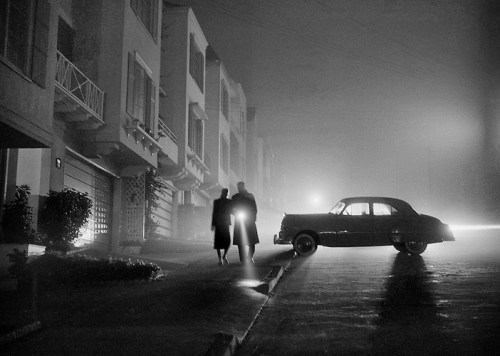 Sunday morning. Time for a little music.
I saw this photo online earlier. It’s from the great San Francisco based photographer Fred Lyon who is still active at age 91. His photos of San Francisco from the 40’s and 50’s are wonderful. This image, called Foggy night, Land’s End, San Francisco, 1953, really captured my imagination. It just seems filled with all sorts of stories that are begging to be told. Magnificent shot. See more of Fred Lyon’s work at his website by clicking here.
I wanted to come up with a song that might come out of this photo and I settled on Because the Night. It was written by Bruce Springsteen for Patti Smith in 1977 and she had her biggest success with that song. Great version. But I personally prefer the Springsteen version. This particular performance is from Largo, MD in 1978. Hard to believe it’s been that many years.
I also just wanted to take a moment to talk about the refugee controversy in this country. I know you’re probably sick to death dealing with everything that is going on but I just wanted to remind ourselves that the thing that have long separated us from other countries around the world is not based on power, It was never about military strength. It wasn’t about our wealth and the privileged few that control it.
It was about us. It was about our music, our films, our literature which reflected our entrepreneurial spirit– that every person had a value and a purpose and was free to make the most of it. The freedom with with we expressed these things was the rare thing that made us the desired landing place for the disenfranchised people around the world.
You see it in our films. Think about just about any Frank Capra movie– who was an Italian immigrant, by the way. Those values he so lovingly extolled in his films are the very things that have defined America around the world. The people who rail against refugees and immigrants out of fear, ignorance, selfishness or hatred go against these values, the very things that have made us special.
It’s the freedom to define yourself, to mold yourself into what you think you should be.
It’s still there and it is still the beacon, the light in the darkness, that draws people to our shores. Fear and ignorance can end that freedom, extinguish that light. And when we no longer attract the world, we have lost our real power, our real strength.
Sorry. You most likely don’t need to hear any more diatribes but sometimes they need to be said if only for the speaker’s sake. And I needed to say that.
Give a listen and have a good day. And keep your eyes open!
Movie Day
Posted in Current Events, Favorite Things, tagged Alexa Meade, Barack Obama, Bowling Green Massacre, Jon Boogz, Kellyanne Conway on February 4, 2017| 6 Comments »
 Most of us most likely find ourselves still reliving that fateful day, thinking about where we were and what we doing when we first came aware of it. You know what I’m talking about.
The Bowling Green Massacre.
So many of us fell on that day, that terrible February 30th. We remember how, in the aftermath as we tried to get our bearings and find a way forward, Frederick Douglass came forward to rally and steady us with his powerful words. It was good work that he did that day. You hear about it, more and more.
2/30. We cannot forget. We will not forget. No, we have historians like Kellyanne Conway that will continue to tell that tale.
And so many others, I am sure.
Sigh.
It’s getting harder to sort yourself out when you wake up in the morning and you’re not sure which dimension of reality you are in on that particular day. So today I’m calling for a movie day and will share two short films.
The first is Color of Reality made by filmmaker Alexa Meade who is known for her perspective-altering technique that combines sets and people that take on a painterly appearance. Movement Artists Jon Boogz and Lil Buck create compelling dance moves that make this film a thoughtful call to action.
The second is an animation set to President Obama‘s telling of how his campaign’s “Fired Up, Ready to Go” slogan came to be. It’s both funny and inspiring. If you need a reason to get fired up (and many of us do these days, given the events taking place before our eyes) give this a look and a listen.
Have a good day. Hope you’re fired up and ready to go. I am.
The Longshoreman Philosopher/ Replay
Posted in Current Events, Favorite Things, tagged Eric Hoffer on January 17, 2017| 1 Comment »
I picked up a copy of The True Believer by Eric Hoffer several years ago. First published in 1951, it contains thoughts from the self-taught philosopher on the nature of fanaticism and mass movements, from the early Christians up through the world altering political movements of the first half of the 20th century such as Communism, Nationalism and Fascism. With the election of he-who-will-not-be named, this book has come back into the public discussion and I have seen it cited in a number of articles. It’s finally next up on my reading list.
Hoffer (1898-1983) was a self-taught thinker with a knack for seeing the tides and patterns that swirl beneath the surface of history. He was also a working man with a natural distrust for bosses and those who hold power over others. We could use him today. A most fascinating guy.
***********************
 Power corrupts the few, while weakness corrupts the many. Hatred, malice, rudeness, intolerance and suspicion are the fruits of weakness.
–Eric Hoffer ( The Ordeal of Courage 1963)
************
I read the above quote and was captivated by the idea behind it and tried to fit its content into what I observe. There was a certain resonance and I wanted to know more about its writer, Eric Hoffer. I am ashamed to say I knew nothing of his life or his work, this man who died in 1983 known as the Longshoreman Philosopher. But thanks to the internet, there is a wide array of available resources including several sites who focus solely on the work of Hoffer. Below is the short bio from the website of The Eric Hoffer Project:
Former migratory worker and longshoreman, Eric Hoffer burst on the scene in 1951 with his irreplaceable tome, The True Believer, and assured his place among the most important thinkers of the twentieth century. Nine books later, Hoffer remains a vital figure with his cogent insights to the nature of mass movements and the essence of humankind.
Of his early life, Hoffer has written: “I had no schooling. I was practically blind up to the age of fifteen. When my eyesight came back, I was seized with an enormous hunger for the printed word. I read indiscriminately everything within reach—English and German.
“When my father (a cabinetmaker) died, I realized that I would have to fend for myself. I knew several things: One, that I didn’t want to work in a factory; two, that I couldn’t stand being dependent on the good graces of a boss; three, that I was going to stay poor; four, that I had to get out of New York. Logic told me that California was the poor man’s country.”
Through ten years as a migratory worker and as a gold-miner around Nevada City, Hoffer labored hard but continued to read and write during the years of the Great Depression. The Okies and the Arkies were the “new pioneers,” and Hoffer was one of them. He had library cards in a dozen towns along the railroad, and when he could afford it, he took a room near a library for concentrated thinking and writing.
In 1943, Hoffer chose the longshoreman’s life and settled in California. Eventually, he worked three days each week and spent one day as “research professor” at the University of California in Berkeley. In 1964, he was the subject of twelve half-hour programs on national television. He was awarded the Presidential Medal of Freedom in 1983.
“America meant freedom and what is freedom? To Hoffer it is the capacity to feel like oneself. He felt like Eric Hoffer; sometimes like Eric Hoffer, working man. It could be said, I believe, that he as the first important American writer, working class born, who remained working class-in his habits, associations, environment. I cannot think of another. Therefore, he was a national resource. The only one of its kind in the nation’s possession.” – Eric Sevareid, from his dedication speech to Eric Hoffer, San Francisco, CA, September 17, 1985
I think I have found some new reading material for the winter…
A Change Is Gonna Come
Posted in Current Events, Favorite Things, Music, Video, tagged John Lewis, Music, Otis Redding, Sam Cooke on January 15, 2017| 3 Comments »
 I have been struggling with the prospect of this coming week for some time. I thought at one point after the election that I would just sit back and just watch the whole thing unfold, maybe give them a chance to prove that my doubts were unfounded. For a short period of time –actually, several fleeting instances– he-who-shall-not-be-named-here acted almost conciliatory and I thought I might just keep this wait and see attitude.
But in the two months since, he-who-shall-not-be-named-here has shown with his words and actions just what he is and will continue to be. And that is an absolute reflection of our worst self in every possible way. There is nothing he has done or said that I would advise a child to emulate. Try as I might, I can not come up with a single quality in his shown character that is admirable in any way. Every aspect of this person is ugly in spirit. Even his limited acts of charity are done selfishly, done only because it somehow benefits him and is seen as a cost of doing business.
This is not a person who is taking the weight of this nation upon his shoulders so that all in this nation will benefit. He doesn’t care about you or me. He doesn’t care about coal miners in Kentucky or farmers in Iowa– they were simply a cost of doing business. No, he’s putting this country on a butcher block in front of him and is trying to figure how to carve off an even larger and juicier portion for himself and his money buddies.
I agree with John Lewis when he says that he-who-shall-not-be-named-here is not a legitimate president and applaud his courage for saying those words. But John Lewis is a man of courage and a man who has always worked to lift others. This is a man who has truly worked to change America for the better and who has consistently stood on the right side of history.
And he is seeing a person coming to power who seeks to weaken the rights and freedoms for which he has bled. A person who is poised to push us on to the wrong side of history, who is willing to trade away the idealism that has long been our strength and foundation for the benefit and self interests of a precious few.
So, on this weekend marking the Martin Luther King, Jr. holiday I thought my Sunday morning musical choice should reflect that. It’s A Change is Gonna Come from the great Sam Cooke, a song that was written by Cooke at the height of the civil rights struggle in response to his arrest in Louisiana after protesting a Holiday Inn‘s refusal to honor his reservations at that hotel.
It’s a great and powerful song with a message that resonates for both then and now. I am also including the Otis Redding version just because I absolutely love this performance. Give a real listen and try to have good day.
Legendary Heart/ Update
Posted in Favorite Things, Opinion, tagged GC Myers, Red Tree on December 27, 2016| 6 Comments »
I don’t think I would be out of line in saying that there has been a coarsening of our public discourse over the past decade or so. Compassion, empathy and compromise, cornerstones of the history and growth of our nation, have somehow become a symbols of weakness. We have taken the bait and allowed our wildest fears to dictate our actions, make us accept the craziest propositions and set aside our reason and logic.
We have lost sight of the fact that our strength was never about simple brute force. Our strength came from our idealism– things like equality and opportunity– and our courage in doing what was right. Heroic qualities.
But it seems we have lost all sense of the heroic.
I thought I’d share this post from about 8 years back that features a favorite painting of mine and addresses those heroic qualities.

This is a painting from a few years back that always sticks in my memory. There are many things I like about this piece, many things which I think make it notable but the part that sticks most with me is its title. It’s Legendary Heart.
I suppose the title visually came from the shape of the tree’s crown or maybe it was something in the atmosphere of the piece that suggested the name. I’m not sure exactly except to say that I have always seen something quite heroic in this piece.
What do I mean by that? What is heroic?
Oh, it’s easy to define heroism in terms of combat or competition, the obvious examples for displays of courage and bravery. Soldiers racing forward through a hail of bullets to capture an enemy or save his comrades, a fireman climbing into a burning building to rescue a child or even a competitor fighting through injury to bring about a victory– all are truly heroic.
To me however, this piece speaks to the root form of heroism, the element that defines all heroism, from the most glorious to the most mundane everyday variety that often goes unnoticed.
I’m talking about self-sacrifice.
Heroism is the giving of yourself to and for others. Whether it’s a soldier or rescuer risking their safety so that others may be saved, a parent putting aside their own self interests for the benefit of their children or person who sacrifices their time and fortune for the betterment of those who truly need their help– all are heroic in terms of self-sacrifice.
Heroism is not about amassing accolades or wealth. It’s about amassing a wealth of spirit and that that can only be achieved, paradoxically, through giving, not taking. It’s about shedding the greed and meanness of spirit that dwells deep within us, side by side with our sense of charity and courage, in some cases pushing aside these better traits and overtaking our characters. We are living in a time where this has happened all too often.
The heroic is in compassion and empathy, not in domination of any sort. It is in having the courage to let the better parts of our character shine.
We could all use a little of this courage. I think many of us are always on a sort of hero’s journey, trying to find this bit of good while fighting back our baser demons. Occasionally, even momentarily, it appears to us and we feel nourished, strengthened enough to continue forward.
That’s what I see when I look at this painting. Oh, it’s a striking image but it’s the message that I glean from it that makes it stand out and whenever I see this painting, on a computer screen or in my mind, I am reminded to keep moving forward, to hold strongly to my own compassion and empathy.
Riu Riu Chiu
Posted in Favorite Things, Music, tagged Bston Camerata, Christmas, Music, The Monkees on December 22, 2016| 1 Comment »
 A few years back I played a version of the song Riu Riu Chiu, an early 16th century song from the Iberian Peninsula that is about the Nativity story. That version was a surprisingly lovely a capella version from the Monkees. I say surprising because it was part of a really bad Christmas episode of their television show from the 1960’s. Watching it made me question my taste in television when I was a kid. But at least this song was there to somewhat make up for the bad parts.
I thought I would share another version today, this one from the Boston Camerata, which is, according to their website, “America’s preeminent early music ensemble.” I obviously can’t speak to that but I do like this version of the song very much.
Enjoy.
Slippin’ Into Christmas
Posted in Favorite Things, Music, tagged Christmas Music, David Bowie, Leon Russell, Turner Classic Movies on December 20, 2016| 4 Comments »
 I saw a short segment on TCM (Turner Classic Movies) that they run between their films at this time of year. It’s their look back at all of the people associated with filmdom who have died this past year. Every year it seems that I find myself being surprised at the number of well known actors, directors, composers, etc who have passed away in that year.
This year was no different.
But they flashed a shot of David Bowie and it reminded me of the musical talents that passed away this year. Bowie. Prince. Leonard Cohen and so many more that some were lost in the shuffle.
One who slipped away somewhat unnoticed in those surreal days after the election [sic] was musician and songwriter Leon Russell. A wonderful writer and a gifted pianist, he collaborated with just about everybody in the recording industry in a career that spanned almost 60 years.
I never thought he got his rightful appreciation after his death so I thought I’d share a Christmas song of his that also goes under the radar in the great flood of holiday music that overwhelms every year at this time. It’s called Slippin’ Into Christmas and has a bluesy edge that kind of fits this year.
In a Blue Place
Posted in Favorite Things, Painting, Quote, tagged Blue, Christopher Moore, GC Myers, New Painting, Quote, Red Tree, Sacre Bleu on December 13, 2016| 3 Comments »

You cannot get a grip on blue.
Blue is the sky, the sea, a god’s eye, a devil’s tail, a birth, a strangulation, a virgin’s cloak, a monkey’s ass. It’s a butterfly, a bird, a spicy joke, the saddest song, the brightest day.
Blue is sly, slick, it slides into the room sideways, a slippery trickster.
This is a story about the color blue, and like blue, there’s nothing true about it. Blue is beauty, not truth. ‘True blue’ is a ruse, a rhyme; it’s there, then it’s not. Blue is a deeply sneaky color.
― Christopher Moore, Sacré Bleu: A Comedy d’Art
************************
He’s right, blue is a deeply tricky color.
Even looking now at the new painting above on this screen, an 8″ by 8″ panel that I call In a Blue Place, I can’t be sure that it is the same blue that I see when I look at the actual painting. And that change of hue can alter the reality of the painting, the feeling that comes from it.
Each person sees blue in a different way, some absorbing the overall tone of it while others latch on to the subtler tones within it. If I say blue the blue that might spring to your mind may be so much different than the one I am trying to describe that they might be entirely different colors.
As Moore says: How do you know, when you think blue — when you say blue — that you are talking about the same blue as anyone else?
It can mean and be so many different things. And maybe this multiplicity is the basis in the lure of blue for me.
Blue is also tricky to properly capture in an image. A painting like this particular piece is a nightmare to edit for me with all of its varying blues and tones and darknesses. I know that the image that you’re looking at is not the same one that I am looking at beside me at this moment.
The one on the screen took me about an hour of editing to get to the point where on the screen it is only a mile away from the original. I like it on the screen now but it is still a pale facsimile to the real thing. There are whole hues of blue that aren’t showing in this image above and I’m not sure if I will ever be able to proplerly capture them.
I like that elusiveness, that slippery quality that comes with blue. Yes, it is a color filled with meaning and emotion but it doesn’t want to be contained. And that is the thrill of working with it.
And that I will continue to do.
Nature Boys
Posted in Favorite Things, Music, Video, tagged eden ahbez, Ella Fitzgerald, jazz, Miles Davis, Music, Nat King Cole, Nature Boy, Ros Lukman on December 11, 2016| Leave a Comment »
 It’s Sunday morning and I want to play one of my all-time favorite songs, Nature Boy. It’s an extraordinary song from an unusual character by the name of eden ahbez, who I have written about before here on the blog, who wrote the song specifically for Nat King Cole. The story of ahbez and how the song came into the hands of Nat King Cole is really interesting but the result was a glorious rendition of the song by Cole that remained locked on the charts at #1 for eight weeks in 1948.
Spare and elegant, it is an absolutely gorgeous song which I think is evidenced by the many, many fine versions of it through the years by a wide range of artists. I thought for today I would stray from the Nat King Cole performance, as perfect as it is, to focus on versions by two other giants of jazz, Ella Fitzgerald and Miles Davis. The first video is a wonderful piece of animation from artist Ros Lukman that has the inimitable Ella Fitzgerald accompanied by guitarist Joe Pass. Just a great version as is Miles Davis’ interpretation which is immediately below it.
Relax and give a listen. Have a good Sunday…
 Redtree Times