Feeds:
Posts
Comments

Archive for the ‘Favorite Things’ Category

Blues Twilight Cover Richard BoulgerMost  mornings in the studio I will click on to the Pandora site for a little music while I write the blog.  Normally I will choose the  Chet Baker channel which is a blend of his music along with many others in a wide variety of jazz styles.  I find that it’s a great sound to drive my thoughts without overpowering them, energetic and moody at once.  Being able to step in and out of the music while I am thinking make it a great soundtrack to work by in the morning.

Listening to this has exposed me to a lot of artists and their music that were unknown to me beforehand.  Can’t say I know much about jazz or its history, primarily a few of the better known tracks from the legends.  But I try to keep an open mind and don’t turn myself off to it because of my own lack of knowledge, an attitude I hope a lot of folks who say they know nothing about art will maintain as well.  Try it on– maybe it will fit you better than you might think.

So, for this week’s Sunday music I chose a piece from a musician that was totally unknown to me not too long ago, Richard Boulger.  His horn work is beautiful and his compositions flow really well.  I heard this piece one morning and was totally taken by it and now find myself listening to it once or twice a day now while I paint.  It just fits me well.

Here’s Miss Sarah from Boulger’s 2008 album Blues Twilight.  Hope you’ll enjoy it and have a great Sunday.


Read Full Post »

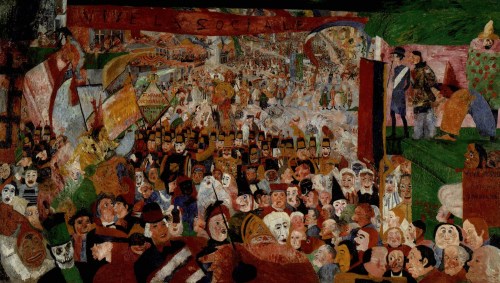
James Ensor Christs Entry Into Brussels in 1889I’ve been spending some time recently looking at the work of painter the Belgian painter James Ensor who lived from 1860 until 1949 in the seaside town of Ostend.  It’s not a name that you probably recognize and even seeing the work may not ring a bell for you.  I know that it didn’t for me.  But the work did excite me, especially given the context of the time in which much of it was created.   He began creating his visionary and sometimes macabre world in the 1880’s when the Impressionists were still taking shape.  Given the look and subject matter, it came as no surprise that he is considered a major influence on the Surrealists and Expressionists of later generations.

James Ensor Christs Entry Into Brussels in 1889 DetailBut it was new to me and captivated me at once, especially the piece at the top of this page , Christ’s Entry into Brussels in 1889.  It is a massive piece, over 8 foot tall and 14 foot  in length.  It is a Mardi Gras parade ( Happy Fat Tuesday, by the way– bon temps rouler!) of caricatured figures escorting Christ into modern day Brussels in 1889.  It is loud and aggressive and roughly painted, so unlike the prevailing style of the time.  Filled with energy, it is a treasure trove for the eye.

Here is the description from the Getty Center in LA where it now resides and is shown:

James Ensor took on religion, politics, and art in this scene of Christ entering contemporary Brussels in a Mardi Gras parade. In response to the French pointillist style, Ensor used palette knives, spatulas, and both ends of his brush to put down patches of colors with expressive freedom. He made several preparatory drawings for the painting, including one in the J. Paul Getty Museum’s collection.

Ensor’s society is a mob, threatening to trample the viewer–a crude, ugly, chaotic, dehumanized sea of masks, frauds, clowns, andcaricatures. Public, historical, and allegorical figures along with the artist’s family and friends made up the crowd. The haloed Christ at the center of the turbulence is in part a self-portrait: mostly ignored, a precarious, isolated visionmary amidst the herdlike masses of modern society. Ensor’s Christ functioned as a political spokesman for the poor and oppressed–a humble leader of the true religion, in opposition to the atheist social reformer Emile Littré, shown in bishop’s garb holding a drum major’s baton leading on the eager, mindless crowd.

After rejection by Les XX, the artists’ association that Ensor had helped to found, the painting was not exhibited publicly until 1929. Ensor displayed Christ’s Entry prominently in his home and studio throughout his life. With its aggressive, painterly style and merging of the public with the deeply personal, Christ’s Entry was a forerunner of twentieth-century Expressionism.

Looking at this piece sends my mind whirling and makes me want to break free of my comfort zone, to think outside of the box in which I have been comfortably residing for a while now.  It rekindles old ideas that have laid dormant, untouched, for many years and makes me wonder if I have the nerve to execute them now.  For me, this excitement to expand is true validation of the power and energy of this work.

Now to decide how to use that inspiration…


Read Full Post »

GC Myers 992-141-small1It’s another cold day here in the northeast,  -5° this morning when I walked out the door.  By the time I got over here to the studio after my short commute ( a stroll through the woods) I was ready for a little heat.  Turned on the computer to look up an old piece and immediately came across this small triptych from 2002 which was always a favorite of mine. It’s a little anomaly comprised of three small squares, each about 4″ by 4″.  I always liked the surface of these pieces — they had a smooth, almost burnished look that I haven’t used in many years.

Seeing this piece made me want to revisit that surface treatment once more, thirteen years later.  It also made me want to feel that heat in the form of a very distinct song.  Fire from Jimi Hendrix.  Talk about going back in time.  Are You Experienced? in 1967.  This song will be fifty years old in a couple more years which seems crazy– it’s timeless heat.

So, Jimi, on this frigid morning, let me stand next to your fire.


Read Full Post »

Rothko Number 14Art to me is an anecdote of the spirit, and the only means of making concrete the purpose of its varied quickness and stillness.

–Mark Rothko

*****************

I don’t think there is anything that I can add to this except to nod silently in agreement.

Have a great day.

Read Full Post »

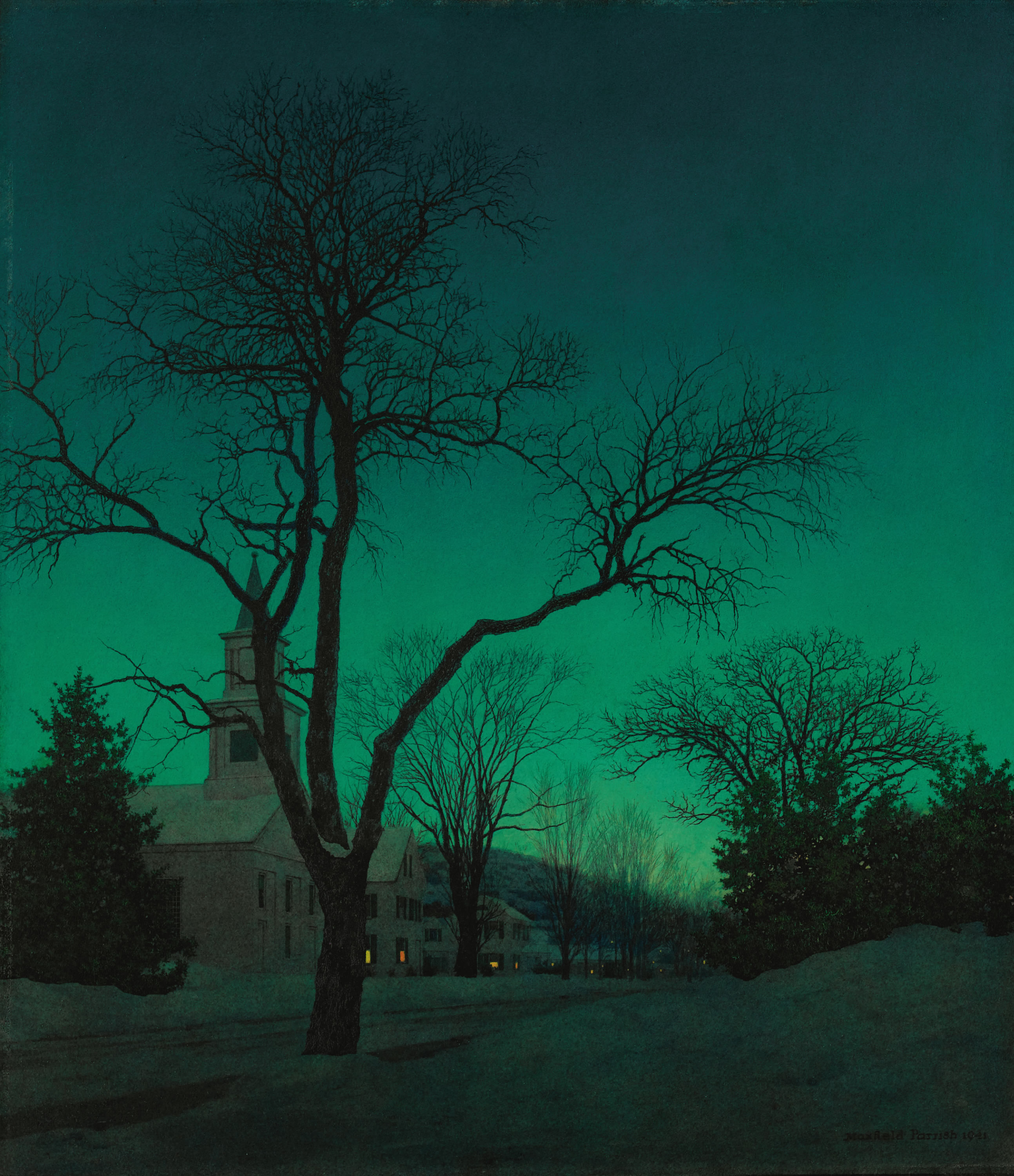
Maxfield Parrish- Daybreak

Maxfield Parrish- Daybreak

I saw this year’s schedule for the Fenimore Art Museum in Cooperstown and was excited to see that on it there was  an exhibit of work from the great Maxfield Parrish. Titled Maxfield Parrish: The Art of Light and Illusion, this show opens May 23 and features 45 pieces– paintings, prints and sketches– as well as some of the props for which he was well known for using.  Here is how the Fenimore describes Parrish’s career on their site:

As one of the most popular American artists of the twentieth century, Maxfield Parrish created fantastic images of fairy-tale figures and idyllic landscapes in a style that was all his own. Through a prolific career that spanned from the 1890s through the 1960s, Parrish became one of America’s first truly “public” artists. The mass reproduction of his paintings—originally intended as book and magazine illustrations, advertisements, calendars, and murals—ensured his reputation as one of the most widely-known figures in the history of art. It has been said that in 1925 a lithograph of his most well-known painting Daybreak [seen at the top of this page] could be found in one out of every four American homes.  Parrish’s magical artwork continues to capture the imagination and inspire today’s artists, musicians, and filmmakers.

Maxfield ParrishI have written here before that he was an influence on my work, especially in the luscious quality of color that he used in almost all of his work.  I liked his better known works, such as Daybreak, here at the top, but it was his lesser known work, quiet landscapes with compositions that intensified the quietness of the solitude they portrayed, that were my favorites.  But I have never seen many of his pieces in person and am really looking forward to being able to closely examine them in the intimate space of the Fenimore.  There is something about seeing the hand of the artist on the surface of a painting that makes me feel somehow connected to the artist, that allows me to imagine them at work at that particular moment when they made that mark.

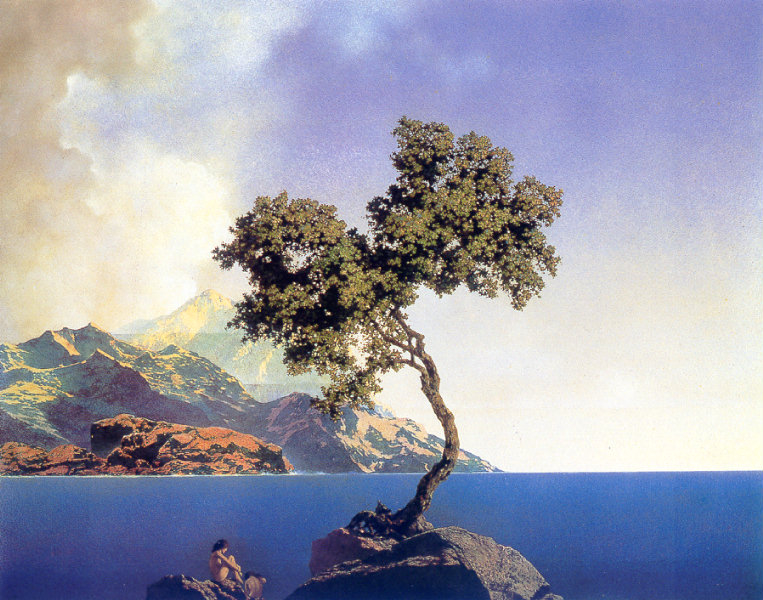
If you have seen much of my work you will probably recognize Parrish’s influence that I took from the painting below, Aquamarine.  The shape of the tree and the promontory on which it stands, the proportions  of sky and sea, and the way the land sits on the horizon all found their way into my own vocabulary.  More than those obvious elements was the emotional tone that I saw in it and wanted for my own work.

Just great work and a show to which I am really looking forward to seeing up close.

maxfield-parrish-aquamarine


Read Full Post »

 GC Myers- The Song We Carry smIt’s a gray winter morning and what better way to shake off the cold blahs this Sunday than with a little flamenco guitar music.  I am featuring a performance by guitar master Juan Martin of a piece titled Rumba Nostalgica that has a little heat to warm any old bones.

I was talking with someone at the Little Gems opening the other night who commented on the fact that I often show guitarists in my work.  I explained about how I thought the shape of the guitar and the way the player cradled it had a very sensual feel, something very emotional in the way the player’s hands almost stroked the instrument to create its music. Its form and the inherent emotional weight it carried made it a wonderful subject.

I think you’ll see this if you watch the hands of Juan Martin in this performance video.  I myself love watching acoustic stringed instruments being played– everything is right there for you to behold.  The movement of the hands.  The snap of the strings. The rhythm of the two hands working to create something quite extraordinary.

Take a look and just enjoy the moment.  Hope the rest of your Sunday is as bright…


Read Full Post »

GC Myers  The Blue Cool This is another small painting that is part of  the Little Gems exhibit opening this coming Friday at the West End Gallery.  This is a little 3″ by 5″ piece on paper that I call The Blue Cool.  I guess that it arose from the current frigid temps that we are in here in the Northeast.  The sky here is in three blocks of an aqua blue color that has a transparency that makes them seem like thin slabs of ice.  I don’t know if this quality shows up on the computer screen  but when this piece was in the studio I always felt like holding it up to the light to see light shine through the ice that I felt like I was seeing.

It’s a simple meditative piece, what I like to typically see in these small works.  The small scale lends itself to simplicity.  Maybe this built-in restraint is one of the reasons why I enjoy painting these small pieces and why I feel they often work so well.

I don’t know for sure.  And I think that uncertainty or puzzlement  is sometimes a good thing.  It creates a sense of wonder and surprise and that is always a good thing.

I thought for this week’s Sunday music I would stick with the Blue theme and some blue cool jazz from one of my favorites, the late great Chet Baker.  The song is Born to be Blue which is also the title of a film currently in production about Baker’s life with Ethan Hawke portraying the gifted but tragic trumpeter.  His story reads like a screenplay– Golden Boy of jazz with movie-star looks loses everything to drug addiction and violence and tries to find redemption.  I’ve thought for years that it was meant to be a film and now it is, hopefully one that does the story justice.

When I listen to Baker’s music, I hear it with that same sense of uncertainty and puzzlement I alluded to above.  There’s just something natural and right in it that can’t be, or shouldn’t be, defined.  It just is.  Give a listen and have a great Sunday.

Read Full Post »

roller skating house theboatlullabiesOne of my favorite things to do online is to browse through some of the sites that feature found photographs, images that have been lost or abandoned by their original owners and picked up by others at flea markets, yard sales, etc.  Almost all are by amateurs and feature many day-to-day scenes of friends and families, some remarkable and some not so much.  Some a little bit too personal.  But there is something quite beautiful in the sum of them, an artfulness that is naturally gained and not thought out, much of it unintended.

I find a lot of inspiration in going through these images.  There is often a tangible sense of emotion in these images, something that makes me wonder how something that obviously meant something to someone at some point could be just set adrift.   How many of my own family’s photos are out there like these, lost ancestors floating around in some flea market bin?

Some, like the one shown here, which I call the Roller Skating House (obviously a house in the midst of being moved), are just neat images that pique my interest and imagination.  I found this at The Boat Lullabies which is a great site ran by the person behind Square America, a site that is now down but was an amazing collection of vernacular photography.  You can still find Square America on Facebook— a great page to follow.  Another great collection of found images is at FoundPhotographs.com.

Check out some of these sites.  They are fun and often thought provoking.


Read Full Post »

GC Myers- Storms Are on the OceanI’ve been working recently on some very small pieces for the upcoming Little Gems show at the West End Gallery in Corning.  I’ve mentioned here before that this particular show is always  a sentimental favorite of mine as it was in this show that I first publicly showed my work twenty years ago.  It represents the first step on to the path that I now follow and that makes it special for me.  Plus I enjoy working in the smaller scale for a bit.  It allows for easily easing back into older themes and forward into newer ones.

One of these pieces that just finished yesterday is shown here at the top.  It’s a 4″ by 6″ painting that I call Storms Are on the Ocean.  I haven’t done a boat painting in some time and thought the smaller format would be the perfect opportunity to re-visit the theme.  I am always drawn to the motion in these pieces and the billow of the sail.  It reminds me of a fable or a dream in some way that I find appealing.

I thought this would be the perfect match for this week’s Sunday morning music which is the song after which this painting is titled.  It’s The Storms Are on the Ocean, a song first done by the legendary Carter Family back in the late 20’s.  This version is from June Carter Cash‘s last album, Wildwood Flower, which was released in the year, 2003, after her death.  Like the final recordings of her husband, the great Johnny Cash, this album shows her in a fragile state of health which adds greatly to the emotional impact of the songs.

It definitely comes through on this lovely song with its haunting chorus:
The storms are on the ocean
The heavens may cease to be
This world may lose its motion, love
If I prove false to thee

Enjoy and have a great Sunday.

Read Full Post »

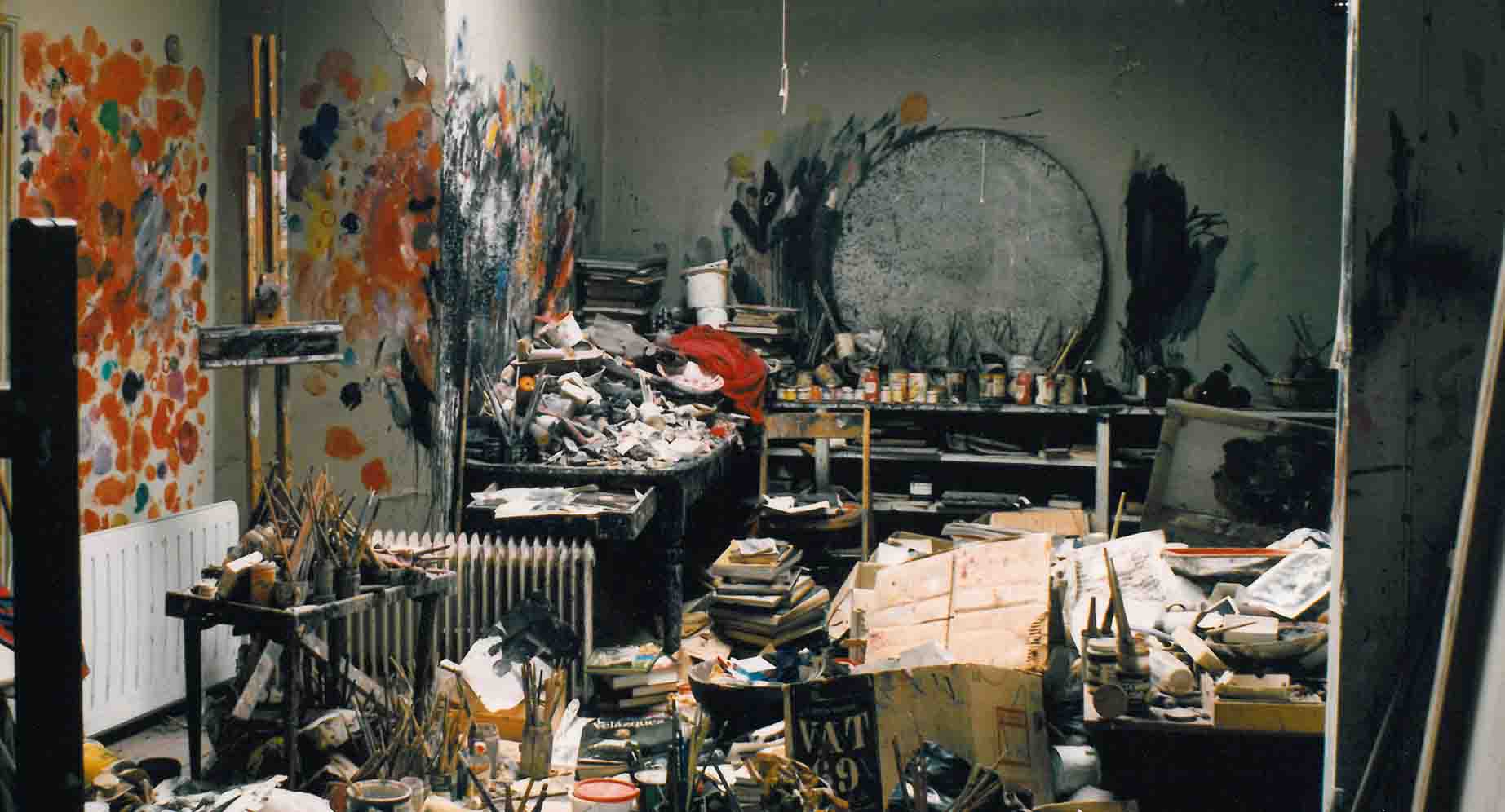
bacon-s-studio-1This is not my studio.

Although sometimes when I am in a really good groove of painting my studio does get progressively more and more cluttered.  At first, it doesn’t bother me at all that the floor didn’t get swept or that piles of papers are beginning to pile high on the stone kneewalls that separate the spaces in the studio.  Tubes and bottles of paint and old yogurt containers with brushes in varying degrees of wear all over the place.  New paintings propped against any available wall space so that I can freely see and consider them and a few old pieces and raw canvasses ready to be worked on stacked off to the side, creating a new wall in themselves.

bacon-studioBut at a certain point, the feeling of chaos begins to creep in and I can’t take it anymore. I have to organize at least a bit to calm the drone that the chaos has brought on in my head before it breaks into my painting rituals too much.  So, I re-stack paintings and paper, cleans some brushes and containers, put away some books and maybe vacuum.

Maybe.

Maybe not.

bacon-reece-mews-studioBut I feel a little lighter and my mind is clearer so I can easily fall back into that groove.  Plus my current studio is, even in its most cluttered state, less chaotic than my old studio in the woods above our home.  It was very rustic and I regularly purged the paints I soaked up in my process from my brushes on to the floor, creating a huge black spot of paint and ink.  Plus, being much smaller than the current studio made the space always seem filled and in a somewhat messy state even after I would pick up.

But even that space didn’t compare with the studio of Francis Bacon, the Irish born painter known for work that is sometimes violent and disturbing in nature.  The shots shown here are from his old London studio that was left intact after his death in 1992 at the age of 82.  It was moved exactly as it was, with every bit of dust and debris intact, to the Hugh Lane Gallery in Dublin where it is on permanent display.

bacon_study1953I remember seeing these photos years ago and feeling so much better about my studio.  The huge black paint stain on my floor didn’t seem so bad.  But I wondered if I could function in his space.  I guess the concentration required to block out the mounds of debris would have to be incredible.  Maybe that is part of the painting obsession- to be so engrossed in what is before you that all else is pushed far off into the background.  Bacon did view his painting as an obsession, saying, “I have been lucky enough to be able to live on my obsession. This is my only success.”  

Bacon was an incredibly interesting character and one whose words often ring true for me.  He was self taught and talked in terminology that I understand, earthy and straightforward.  Very little artspeak.

The piece shown here from Bacon is one of my favorites, Study After Velazquez’s Portrait of Pope Innocent X, and is very representative of the style of much of his work.  You can find a lot on Bacon and his work online.

Well, got to go– I think I better pick up a bit…

Read Full Post »

« Newer Posts - Older Posts »