There are some pieces in my studio that will always be with me , some because they are very personal pieces, virtual parts of my memory. Others because they are somewhat lacking and I wouldn’t want them out in the world. Then there are some that stay simply because I want them here. This piece is one of those.
It is painted on a piece of our old upright piano , the lid that opened on its top. It’s about 8″ tall by 62″ long. You might think that this painting is about the heavy clusters of Red Roofs but for me this is a piece of escape. That cool blue ribbon of water that cuts through this painting, shown only in snips, is freedom to me, a rushing current to carry me away from the noise and chaos of the gathered village. Or better yet, I could become the river and move easily and forever– hopefully– through the land, joined with the other waters of the world.
I find myself thinking a lot when I look at this piece, which I do most everyday as it is mounted above the large window in my studio. It gives me pause and makes me think about being quiet internally, stilling the spinning wheels. But most of all, it makes me wish I was that river.
I call this piece Wish I Was a River, sort of after the Joni Mitchell song, River. However, her chorus goes “ I wish I had a river…” Maybe I’m being greedy here but I want to be the river. Maybe I’d let her skate away on me. I don’t know.
I came across this photo from Julia Margaret Cameron, a Victorian era British photographer whose work I find tremendously interesting and forward leaning. I have featured her work here before, with photos titled Sadness and Iago. This photo from 1865 is titled Whisper of the Muse/Portrait of GF Watts once again shows off the painterly eye that marks Cameron’s work as she portrays the renowned painter of the time amid two young girls.
I liked the image and it piqued my interest as to GF Watts‘ work. I had heard the name but couldn’t recall his work so I decided to give a quick look. An interesting guy, one who fell from favor at one point after his death and has found renewed interest. Some of his work is Pre-Raphaelite in its appearance, very appealing and beautiful but falling into the genre to the point it became hard to distinguish it from other painters working in the same time.
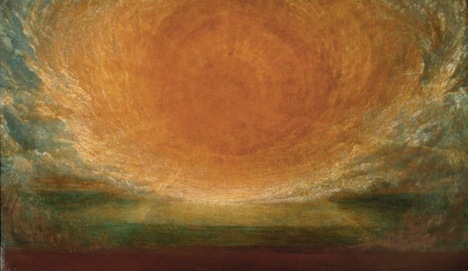
But there was a piece that really captured my eye. Titled After the Deluge (The Forty-First Day) it is an almost abstract depiction of the world after the biblical flood, the sun dominating in bursts of warm tones . It was such an anomalous and powerful piece, more Van Gogh and modern in feel than Pre-raphaelite. It evokes Mark Rothko, to bring it even further into the future. I found it just amazing. It was on display at the National Galleries of Scotland last year in an exhibit titled Van Gogh to Kandinsky/ Symbolist Landscape in Europe 1880-1910. This is how they described Watts’ work:
George Frederic Watts took his role as an artist to a high calling, stating: ‘I paint ideas, not things’. For him, landscape provided elements which he could transform to project profound meaning via natural grandeur, as in his large, imposing painting After the Deluge: The Forty-First Day. This simple image – a vast sun hanging over an expanse of calm, unbroken water – is far from a mere sunset; it evokes the cosmic energy of a star.
I love the quote– I paint ideas, not things. Something to hold to. Here’s the painting in question:
Sometimes songs get stuck in my head for a long time and I find myself humming or singing them without thinking for many weeks. Sometimes it can be irritating when the song is one that begins to grate on my nerves but stays on because of a catchy melody or verse. But lately, there have been two songs that keep popping up quite unexpectedly, both early 70’s soul classics with positive messages that I find myself glad in having them stick around.
The first is Be Thankful for What You Got from William DeVaughn, who I guess would fall into the category of one-hit wonder. While it may seem to celebrate the gangsta lifestyle of Cadillacs and street-cruising, it’s message is that you don’t need material possessions to hold your head high if you can simply be thankful for what you got. A very simple message but one that holds true and strengthens through the infectious beat and chorus plus its Curtis Mayfield-like vocal stylings. This is an extended version with some great cool vibraphone work and a video of striking imagery.
The second is Ooh Child from the Five Stairsteps, a family band from Chicago that preceded the Jackson Five and was for a while the first family of soul. This song was a huge hit and has been covered by a number of artists. Another simple message that really resonates.
Have a great Sunday and be thankful for what you got…
I came across these photos by Dutch artist Teun Hocks (b. 1947) which reminded me very much of the work of Robert and Shana ParkeHarrison, which I have featured here twice before. Actually, it was on this same day last year that I last featured them– perhaps I am looking for an alternate reality on this date as opposed to trying to relive in some way that morning twelve years ago. The ParkeHarrisons create elaborate but real backdrops against which they photograph their Everyman in allegorical scenes– there is no digital manipulation. It is more like the worlds created in the earliest days of cinema when what was seen had to made real in some way, even the most fantastic scenes.
Teun Hocks works in very much the same vein except that he creates a painted backdrop against which he photographs himself as the sometimes comical but deadpan Everyman. Think Buster Keaton here. He then creates oversize gelatin silver prints on which he paints in oils, treating his original photo as an underpainting. The result is a beautiful image with a painterly feel that is imbued with both humor and pathos. You can’t but help feel some sort of connection with Hooks’ character as he faces a sometimes puzzling reality. Don’t we all?
I’m showing just a handful of the work of this prolific artist here as well as a YouTube video showing a larger group. Hope you’ll enjoy this on this day.
We went to Cooperstown this past Monday to catch the last day of the Wyeth Family exhibit at the Fenimore Art Museum. It was a great show featuring work from patriarch NC Wyeth, son Andrew, grandson Jamie, daughter Henriette and daughter Carolyn as well as Henriette’s husband, Peter Hurd and NC’s primary influence Howard Pyle. That’s a lot of talent to jam into a relatively intimate space. You might think that it would be less than satisfying but the curating of this show was masterful, showing each artist in a truly representative manner that gave a real taste of their body of work. Just a wonderful show. I am glad I got to see it if only to see a few of NC Wyeth’s gorgeous works and to discover more about his son-in-law, Peter Hurd, whose work is wonderful, bringing to mind the regionalist painters such as Grant Wood.
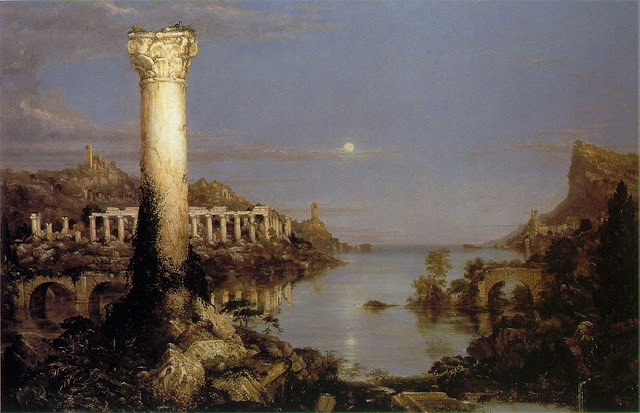
Thomas Cole- The Course of Empire- Destruction
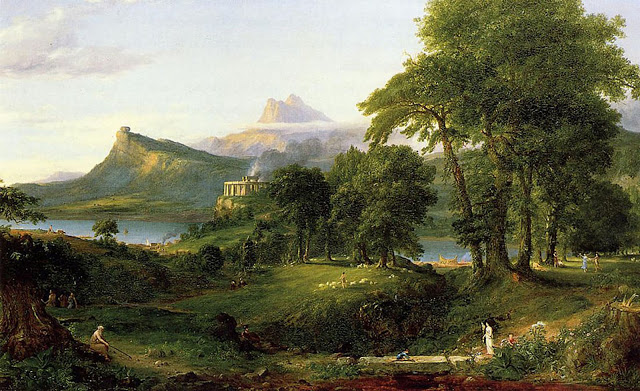
Of course, there was also the spectacular Thaw Collection of American Indian Art to see. As always, it was a thrill to see the beautiful aesthetic of the native culture. And as good as both the Wyeth show and the Thaw Collection were, I was truly bowled over by the current show, The Hudson River School: Nature and the American Vision, featuring works from the Hudson River painters of the 19th century, Just beautiful and strong examples from the genre, highlighted for me by the works of Asher Durand and the spectacular Thomas Cole series of five paintings, The Course of Empire , which features the rise and fall of an empire in the landscape, a rocky peak with a precariously perched boulder standing as a constant witness. You have probably seen some of the paintings from this series but to see them together in their full scale is to really get a great appreciation for their power. It hangs at the Fenimore until September 29, so if you can, take a trip and see some incredible work.
Orphans is the word I use to describe the paintings that don’t find a home. I’ve been fortunate in my career that there haven’t really been that many so that the ones that do keep coming back to me take on a special significance, especially the ones that I felt were somehow special beforehand. It may be the extra time I get to spend with them, examining them again and again to see if there is some inherent flaw or lack of fire that keeps someone from making it their own, that gives it this significance. I spend much more time with these orphans than those paintings that quickly find a home.
Ode to Whitman is such an orphan, it being a piece has toured the country and has yet to find a home. It saddens me a bit when I look at this painting because I do see the spirit of Walt Whitman in this piece, at least as he translates into my own psyche. Though quiet in nature, the Red Tree here is celebrating its very being and could be embodying Whitman’s verse:
I too am not a bit tamed,
I too am untranslatable,
I sound my barbaric yawp over the roofs of the world.
These were words that were very influential in the formation of my artistic voice. They dared me to stand apart. They challenged me to reveal my inner self to the world, to let my light shine. To let my yawp go free.
And that is what I see in this piece. It as though once the yawp has been released, even as the surrounding trees seem to be recoiling from its sound and fury, a placid pall has come into the center of its being. It is calm now that it knows who it is, what it is.
As you can tell, I see and feel a lot in this simple painting. I guess that is why it pulls at me to think of it as orphan. That’s why I am going to give this piece a home and this is going to be the painting that will be given awayat the Gallery Talk this coming Saturday at the Principle Gallery, which starts at 1 PM. I know that it will find a good home in this way because someone who didn’t like my work would not spend an hour of their time listening to me talk about it.
So I hope you can make it to the talk and that, if you’re the one who takes Ode to Whitman home , you realize the feeling that it carries with it.
Here’s another bit of Whitman that like, from the preface to his landmark Leaves of Grass:
“This is what you shall do; Love the earth and sun and the animals, despise riches, give alms to every one that asks, stand up for the stupid and crazy, devote your income and labor to others, hate tyrants, argue not concerning God, have patience and indulgence toward the people, take off your hat to nothing known or unknown or to any man or number of men, go freely with powerful uneducated persons and with the young and with the mothers of families, read these leaves in the open air every season of every year of your life, re-examine all you have been told at school or church or in any book, dismiss whatever insults your own soul, and your very flesh shall be a great poem and have the richest fluency not only in its words but in the silent lines of its lips and face and between the lashes of your eyes and in every motion and joint of your body.”
I was looking around my studio, taking in some of the work hanging on the walls throughout the house. There are pieces from other artists, including some notables such as David Levine and Ogden Pleissner, but most of it is older work of my own. There are a few orphans, paintings that showed extensively but never found a home. In some I see flaws that probably kept someone from taking it home but most just didn’t find that right person with which to connect. Most of the other hanging work is work that I won’t part with, work that somehow has deeper meaning for me. Work that just stays close.
One of these paintings is the one shown here, The Sky Doesn’t Pity, a smallish watercolor that’s a little over 4″ square. It was painted in 1995 after I had started publicly showing my work for the first time at the West End Gallery in Corning, NY, not too far from my home. The gallery has been what I consider my home gallery for 18 years now, hosting an annual solo show of my work for the last eleven years. This year’s show, Islander, ends next Friday.
But when this piece was done I was still new there, still trying to find a voice and a style that I could call my own. I had sold a few paintings and had received a lot of encouragement from showing the work at the gallery but was still not sure that this would lead anywhere. I entered this painting in a regional competition at the Gmeiner Art Center in Wellsboro , a lovely rural village in northern Pennsylvania with beautiful Victorian homes and gas lamps running down Main Street.
It was the first competition I had ever entered and, having no expectations, was amazed when I was notified that this piece had taken one of the top prizes. I believe it was a third but that didn’t matter to me. Just the fact that the judges had seen something in it, had recognized the life in it, meant so much to me. It gave me a tremendous sense of validation and confidence in moving ahead. Just a fantastic boost that opened new avenues of possibility in my mind.
I still get that same sense even when I look at this little piece today, a feeling that would never let me get rid of this little guy. I can’t tell you how many times I have glimpsed over at this painting and smiled a bit, knowing what it had given me all those years ago.
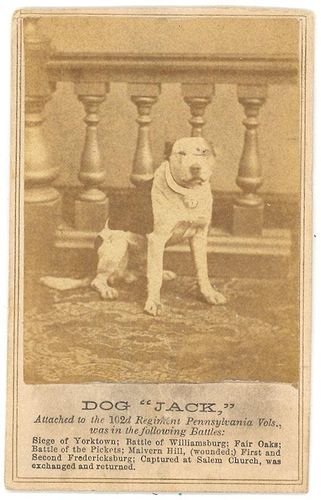
I’ve been cat-sitting in the studio for a few days, bringing the total of felines ( all strays or discards) around here to four. While I love and appreciate these cats with their distinct personalities, having four around has made me yearn for a dog once more. While zipping through images, anything resembling a dog makes me stop, including this old cabinet card for a mascot, Jack, for the 102nd Regiment Pennsylvania Volunteers from the Civil War. The card lists the battles that jack took part in with the regiment as well as listing his capture by the Confederates and his subsequent exchange for opposing troops. Quite a resume and the fact that the regiment made the effort to have the photo and card made speaks to Jack’s rank in the regiment.
I knew that dogs have been used in combat for ages, in modern times serving as detectors of bombs and corpses. But the mascots of the Civil War intrigued me. Jack here, for instance, was a stray who wandered into a Pittsburgh firehouse and , through his tenacity, eventually worked his way into the firefighter’s hearts, joining them as they enlisted as a unit for the war. He would march with the troops and would stand at the end of the firing line during combat, barking furiously at the opposing troops. Jack served for over three years, including six months in a Confederate prison camp where it is said he gave great comfort to the Union prisoners there . He was wounded a number of times and finally disappeared in December of 1864 near Frederick, MD. Jack was never found but it is thought he was probably killed for the expensive silver collar his comrades had awarded him.
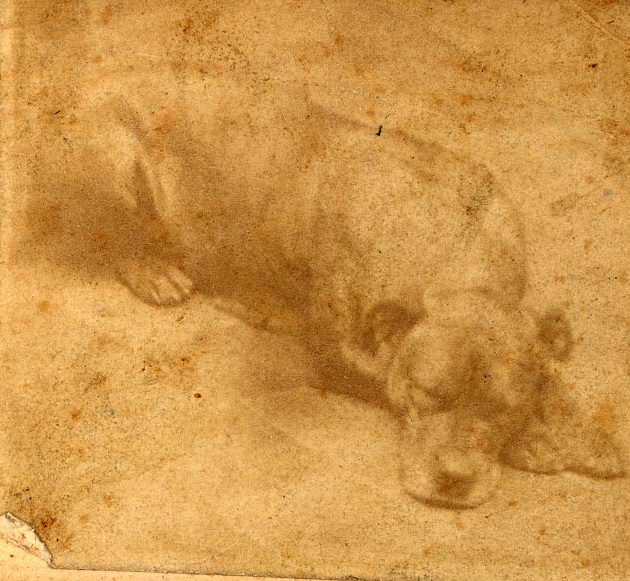
The only known photo of Sallie
Jack was one of the more famous of the Civil War dogs, having portraits painted of him that still hang today as well as a recent movie giving a fictionalized account of his life. But my favorite is undoubtedly the story of Sallie, the mascot of the 11th PA Volunteers from around West Chester, PA. Given to the regiment’s captain as a four or five week old pup, Sallie (named after one of the local beauties) became the apple of the regiment’s collective eye. She trained with the men, responding to reveille and roll calls with great discipline. She was affectionate with her troops, who she knew even out of uniform, and proved to be fearless when they entered the fray.
Her combat record was remarkable. She served for nearly the duration of the war, receiving wounds including a severe shoulder wound that did not deter her from her duty to her comrades. It is said that after the surgeon was unsuccessful in removing the gun’s ball from her shoulder (it later emerged after working itself to the surface), Sallie was back on duty , tearing the seat out of the pants of a soldier who was trying to flee the battle. After the battles, including Gettysburg, , Sallie would lick the hands and faces of the wounded and would guard the dead until their comrades would come for them. It is said that during a review of the troops in Fredericksburg, VA, Abraham Lincoln even doffed his stovepipe hat to Sallie as she passed, much to the delight of her fellow troops.
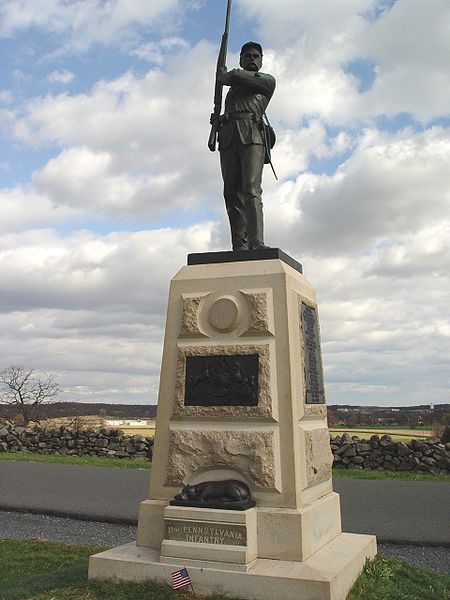
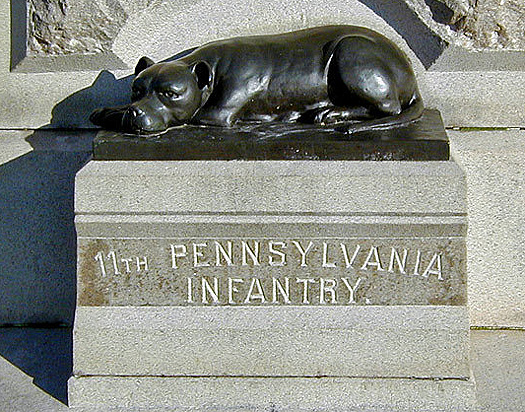
Sallie’s Place at the Foot of the 11th PA’s Monument
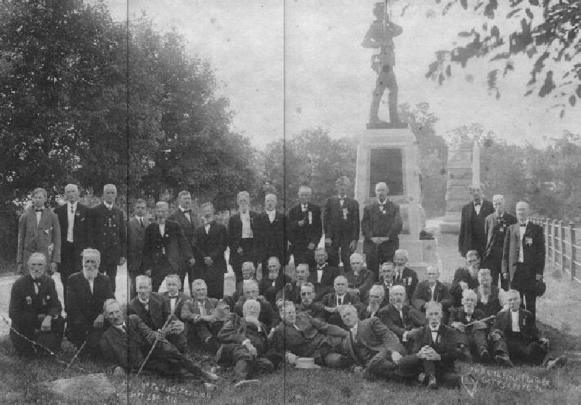
But, like most war stories, there was no happy ending. In February of 1865, two months before the war’s end, Sallie was killed in combat at Petersburg. While the battle raged around them, her regiment took on the task of burying her on the battlefield. The affection that these troops had for this canine warrior was so strong that when they erected a regimental monument at the Gettysburg battlefield in 1890, they chose have a likeness of Sallie watchfully laying at the foot of the larger monument. I think it’s telling that when the regiment had a reunion at the battlefield in 1910, the group photo was shot so that there was space so that the statue of Sallie was among them.
I can only imagine the value of the affection and warmth Sallie and other less known canine mascots offered these men while they struggled to get through the war. A dog’s unconditional love is a wonder.
I love to watch the hands of guitarists or pianists when they are playing. Maybe it’s just a desirous envy for a talent and dexterity that I will never attain or maybe it’s just the particular rhythm of the two hands working to create this sound that has a harmony and life of its own. I don’t really know but whenever I see films of piano or guitar players I am mesmerized.
I saw Stevie Ray Vaughan at a show in Utica, NY back in 1986, I believe. It was a great show although the quality of the sound was not great, poorly mixed with a lot of distortion. From what I understand, this wasn’t uncommon for SRV shows. I just wish we had better seats to better see his playing hands.
I came across this video on YouTube of Stevie Ray Vaughan playing acoustically for a French interview from 1982. It’s shot in just the way I like, with the hands highlighted in a way that shows their syncopated dance. Just wish it were longer.
PS–The image at the top is an older oddity, an experiment from the mid-90’s, painted in watercolor and a Sharpie marker. The figure was a simplified and stylized representation of the way in which the figures from my early Exilesseries were painted, composed from blocks of color. It was never meant to be seen outside my studio but I like this for some reason …
I have been listening to my young friend Michael Mattice‘s debut CD, Comin’ Home, quite a bit lately. It’s been really well received, putting him regularly near the top of the “hot releases” in acoustic blues list from Amazon. The mp3 album has been as high as #18 on their top 100 and currently sits at #84 in acoustic blues. A really prodigious start for a self-produced album with no real promotion outside of the word of mouth created by Mike’s shows. Like I said here before, based not on sheer talent (of which he has loads) but on his devotion and drive, I see big things for him.
But the point of this is that listening to Mike brought me back to one of my first musical loves, the late blues great John Lee Hooker. Oh, I had favorite bands and songs but it was John Lee who I felt first spoke to me directly. I remember coming across an old beaten up copy of one of his albums from the 50’s when i was in my teens. It was a revelation, a sonic slap in the face with distorted electric wails coming from his guitar, all in a mesmerizing rhythm.
I didn’t know anything about the man at the time, didn’t know that he couldn’t read or his place in the history of the blues. Didn’t even know of his rebirth a few years before my finding his album as a result of the British Invasion of the 1960’s, when youngs Brits discovered and brought the music of the great bluesmen to the world’s attention, giving them new and greater fame than they had had in their primes.
None of that mattered. It was just the groove on that album that counted.
I found and listened to more of John Lee’s music over the years. I was intrigued by the constancy of much of it, the driving rhythm that is his signature which pervades most of his work. Some might call it repetition. I didn’t see it that way. It was all about nuance and subtle explorations within the form and performance. You know a John Lee Hooker song immediately but each is different and carries its own weight and emotion.
I carried that thought with me when I began painting and hoped that my work would operate in that same way. I wanted to have that repetitive quality so that the work would be easily identified as mine but to have the differentiation occur in the individual performance of the act of painting. By limiting what I painted I was able to go deeper into an exploration of the subtle aspects of the composition. They sometime looked similar but were often widely different in tone and emotion.
When it works I feel like John Lee Hooker must have when he was in his groove. One of my favorite lines from one of his albums, I believe it was a live set from Soledad Prison, was- “If you can’t dig this, you got a hole in your soul… and that ain’t good”
Here’s a video from the 60’s when he was in midst of being found by the youth around the world. It’s one of his trademark songs, Boom Boom.
Late addition: Here’s the song from Soledad Prison– Boogie Everywhere I Go. Be careful– it’s a deep groove.
 There are some pieces in my studio that will always be with me , some because they are very personal pieces, virtual parts of my memory. Others because they are somewhat lacking and I wouldn’t want them out in the world. Then there are some that stay simply because I want them here. This piece is one of those.







 Redtree Times