I am certain about what I will never do – but not about what my art will render.
–Odilon Redon
***************
When I came across this quote from the great French Symbolist painter/printmaker Odilon Redon, I found myself nodding in agreement. There are many things I know that I will never do with my work mainly because these things don’t inspire me to take the time to make the effort. But about those things where I do make the the effort, I am never quite sure where they will take me or how they will surprise me or how they will reach out to others in ways I never imagined.
And that is the thing, the driving force, that keeps me coming back to this studio each morning: the hope that this will be the day that brings that next surprise, that next thing that remains a wonder to myself.
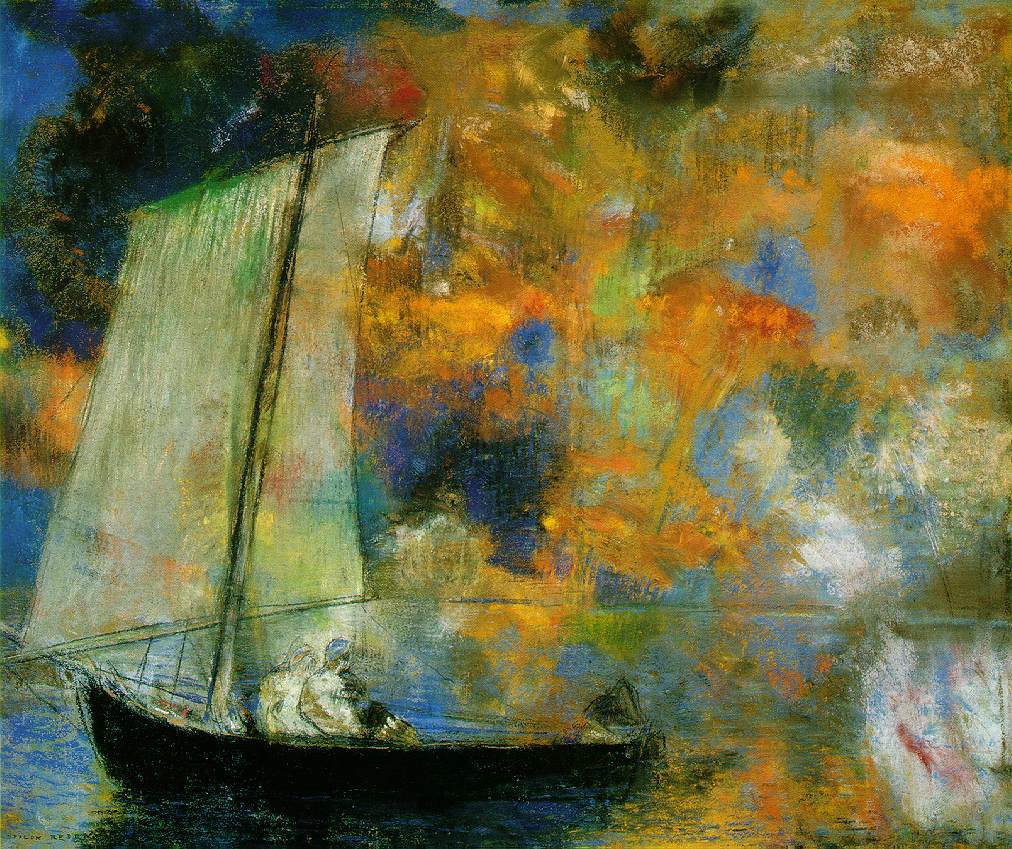
By the way, you should really take a few moments and check out the work of Odilon Redilon. He was one of the most influential painters around the turn of the 20th century and set the groundwork for a lot of modern movements. Plus, his prints and paintings are just plain interesting to take in, with a mysterious twist and symbolism that feels both psychological and spiritual. The eye in the sky is a recurring form in his work as you see in the painting at the top, The Cyclops. His one-eyed creature has a different feel than that of the more terrifying one in Homer’s Odyssey. Redon’s has an almost protective, paternal feel. It feels odd but inviting.
Here is a site ( click here)with most of his known paintings although not much if any of his print work. It’s worth a look.
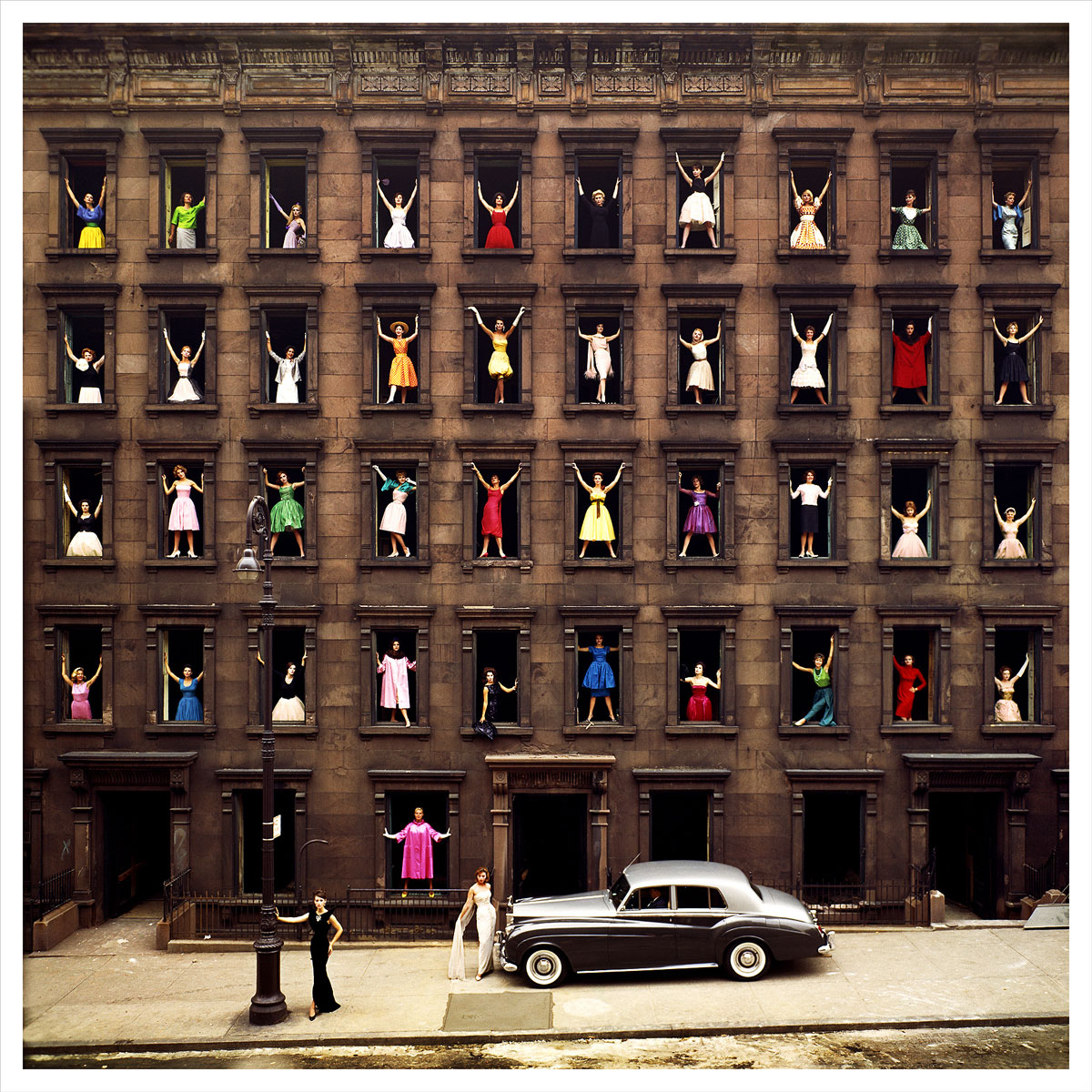
Ormond Gigli is an American photographer born in 1925 who is famous for his photos of celebrities from the worlds of stage, screen and fashion. I recently came across his most famous photo (above) which is called Girls In the Windows. It is considered to be one of the great fashion shots of the 1960’s and just a great photo in any category.
The photo came about in 1960 when a group of brownstones in Manhattan were being demolished across the street from Gigli’s East 58th Street studio. Gigli wanted to capture those brownstones on film and had a vision of 43 fashion-clad women adorning the windows. Working quickly, arrangements were made to get permissions, models and the Rolls-Royce in place so that the photo could be taken during the workmen’s lunch break before the buildings hit the ground. Some of the models couldn’t stand on the windowsills as they were so crumbly.
It’s a stunning visual. You never know what will inspire something new in your own work and looking at a photo like this triggers all sorts of reactions within my mind. I am sure this was the same for others who sort of borrowed from this photo in the years after it was taken. For instance, I am pretty sure the artist who did the cover for Led Zeppelin‘s 1975 album, Physical Graffiti was inspired in some way by Gigli’s photo to place iconic images in the windows of a crumbling apartment building.
Ormond Gigli has a website devoted to his work and the stories behind some of his more famous shots that you can visit by clicking here.
When I was in Alexandria for my annual Gallery Talk last weekend, I ran into an old friend, the wonderful painter painter Scott Coulter. I hadn’t seen in many years and had a chance to briefly catch up with him while he manned his booth at the very busy King Street Art Festival. Canadian-born Scott Coulter was one of the first painters I connected with when I began my career when he was still living in this area, the Finger Lakes region of New York. He now divides his time between Florida and Minnesota when he’s not traveling around the country to display his work and to capture some of the natural splendor that he paints so well.
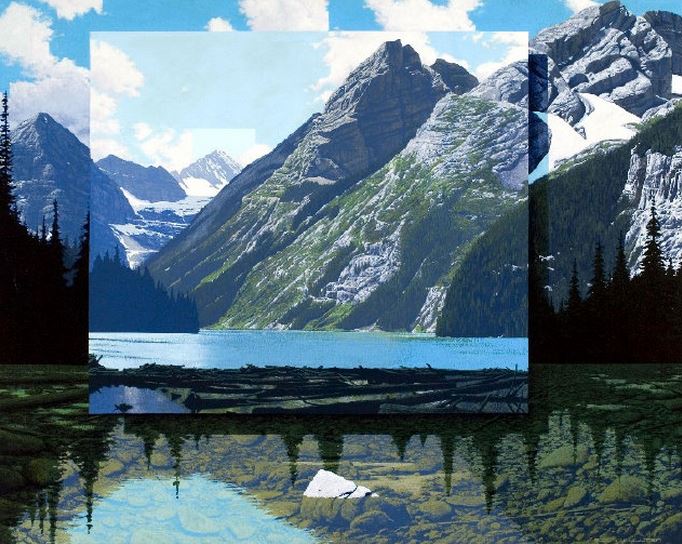
Scott Coulter -Upper Elk 48×60
While we paint with very different styles and processes, I found it very easy to become a big fan of Scott’s atmosphere filled landscapes as well as the way in which he painted them. Every painting is just him and his brushes with perhaps a photo or two to guide him. There are no projected images onto his canvasses, no airbrushes to create his beautifully graded colors, no digital assistance of any kind– just him and an unerring ability to build magnificent, and often very large, paintings with a palette that is instantly recognizable to anyone who knows his work. I remember seeing him paint years ago and being so impressed with how he made the very difficult seem so easy. He’s master of his art.
He was influential in my desire to paint very large. I remember one piece he was commissioned to paint that was huge, so much so that the patron provided him with a space, a small but tall inner courtyard they owned, in which he could paint because it was too tall for any space available to him. It was something like eleven foot tall and had an incredible visual impact. I am sure it still brings oohs and aahs in its current home. Rogue’s Gallery, shown below, is another large piece at 66″ square that I would love to see in person.
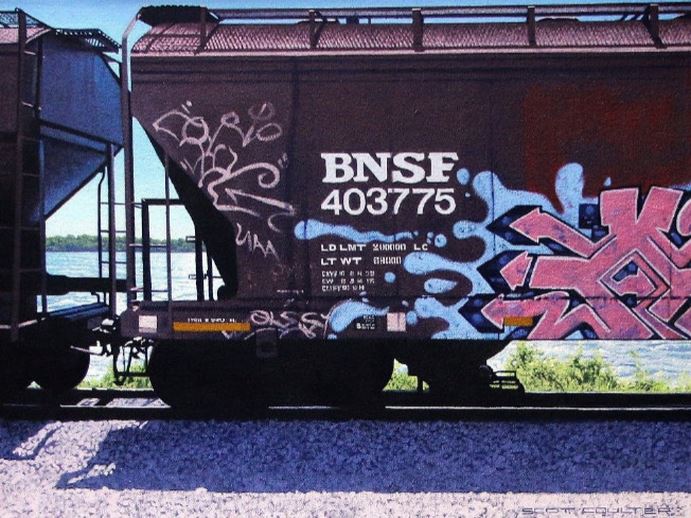
In recent years, he began painting railroad cars and physical features such as underpasses with graffiti covering them and it fits into his body of work so well that it seems like it has always there. Hard not to like this as well.
For more info on Scott’s work check out his website by clicking here and if you’re in the NYC area this weekend, check it out in person at the Gracie Square Art Fair.
No two ways about it– just good work. Great to see you, Scott. Look forward to seeing you again!
In my picture of the world there is a vast outer realm and an equally vast inner realm; between these two stands man, facing now one and now the other, and, according to temperament and disposition, taking the one for the absolute truth by denying or sacrificing the other.
~Carl Jung
*********************
I came across this passage from the writings of ground-breaking psychoanalyst Carl Jung recently and it very much summed up what I have been saying for several years about the manner in which I view my work. I often call them internal landscapes, which I see as my inner response or alternative to the outer world. Perhaps, as Jung says, I am accepting my internal view for absolute truth–as I see it– by sacrificing the reality of the outer realm.
I don’t know. To me, both worlds exist fully and have equal validity and I split my existence moving between the two. Actually, my time spent in that internal land make my time in the outer realm more tolerable. It’s when I struggle to find my way into that inner world that the outer world becomes more difficult to bear
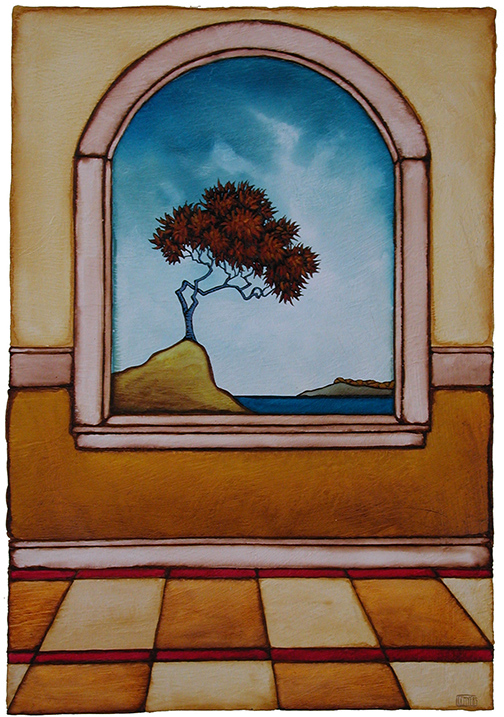
This idea of inward and outward perspective made me think of a series called In the Window that I had painted a decade ago of views of my landscapes as seen through windows. The piece at the top, In the Window: Dream Away, was the first from this series. It’s an inversion of Jung’s analogy with my internal Red Tree landscape existing here in the outer realm and the external reality occupying the inner space, the window serving as a real and symbolic portal between the two worlds, one through which I can move back and forth easily.
I had never really thought of this series in those terms. Initially, this series was meant as a way to present my landscapes in a different manner. Like a fine piece of jewelry, the landscapes would act as a precious stone and the window and internal space would act as a setting for that stone. But it really comes down to a perspective on reality and I think at that point I was just beginning to see that these landscape were as much internal as they seemed external while looking out that window.
Hmm, something to think about on a thankfully rainy day…
At the end of my workshop last week, one of the attendees presented me with a painting she had completed during the second day. She even titled it for me! Called Ecuador In My Heart it reflects many of the elements- the cities and villages, the sea, the mountains and the trees and flowers– of the native landscape of Ecuador-born artist Paulina Garces Reid. I love this little painting, the way in which the blocks come together to tell their story and the manner in which Paulina modulated her colors, which she pointed out are the colors of Ecuador, with dark glazes.
I was moved by her sharing this painting with me and amazed how far she, like all of the students, had progressed in such a short time. I explained that she was at a point with my technique that had taken me months and hundreds, maybe thousands, of hours to reach. Looking around the room, I could see on every table something that I know I could easily find in my bin of my own early experiments. I saw one specific experiment of mine (shown here) in Paulina’s piece, one that hadn’t reached as far as she had in just a handful of hours.
These students had shot past my own learning curve, had easily grasped concepts and processes that took me a long time to develop and master. Going into this, I didn’t know what to expect as to what I might see from these students or how I might feel at the end. I do know that after the first day I had absolutely no expectations and couldn’t see myself doing this again. But that second day changed everything. Like the students, I had my own learning curve to conquer and seeing the work from Paulina and the others made me feel that it was something I could quickly get past to make my teaching more effective if there is a future opportunity to do this.
And I guess that’s the thing I take from this. It established a starting point from where my learning curve began and I can see progress along that curve. And like the students, it’s exciting to see progress in any endeavor. So, I may teach again not just for the thrill of seeing others being excited by the work they produce as a result but for my own excitement in learning how to better deal with people, how to better communicate my own experience to them. Like y paintings, it all comes down to communication…
Thank you again, Paulina, for the beautiful gift. I will hang it with pride in my studio.
Back in June, I wrote about going to the Smithsonian’s American Art Museum to see the painting shown above, Achelous and Hercules, a wondrous mural from the great American painter Thomas Hart Benton. It was commissioned to hang in a now-defunct Kansas City department store in 1947 and after the store closed in 1984 this masterpiece was given to the Smithsonian. It is a 5′ high and 22′ wide wooden panel that Benton painted in egg tempera. It’s a piece I could stand in front of for hours, losing myself in the rhythms and colors.
That being said, I came across a video taken from an old film that shows the incredibly elaborate process that Benton used in the making of this mural, which took about eight months. It is fascinating and unusual to see a known masterpiece coming together in all its stages. It makes me appreciate this painting even more.
Here is that video. It’s about 11 minutes long and worth the time spent.
The artist is a man who finds that the form or shape of things externally corresponds, in some strange way, to the movements of his mental and emotional life.
—Graham Collier
****************
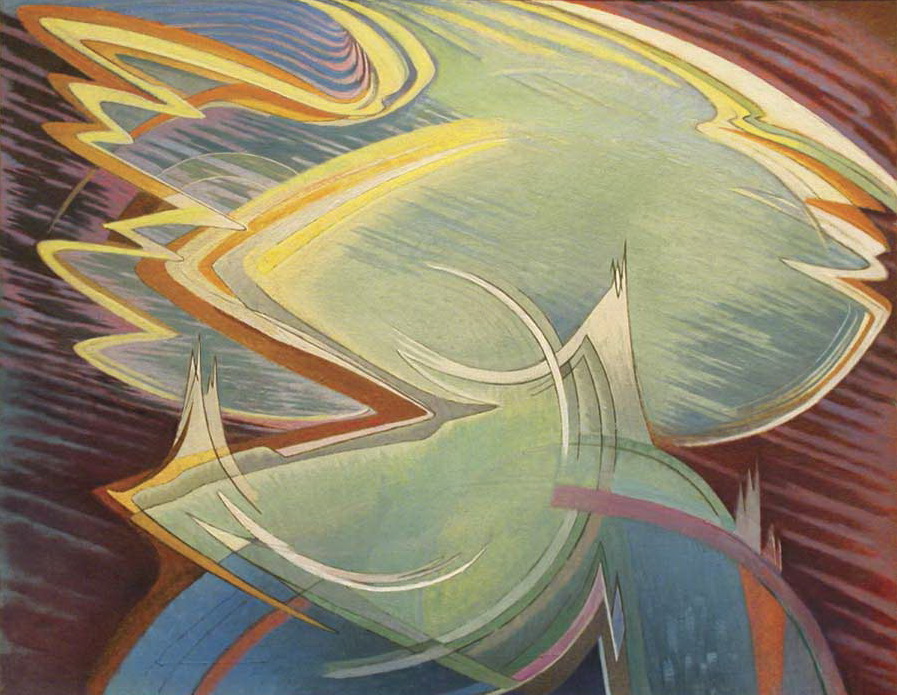
I have been working on dream inspired patterned forms, as I’ve noted here several times recently. I have been incorporating into the layers that make up my skies in simple landscapes where they serve to give added depth and texture. It works really well in that context and it would be easy to just use it in that way.
But there is something about some of them that make me just push them to the forefront alone without masking them with any representational forms over them. Something beyond narrative. Elemental. Like it is somehow tied to my own internal shapes and forms and patterns.
I was thinking this when I came across the quote at the top from the late jazz musician/composer Graham Collier. It made so much sense because I think that is, in general, the attraction of art for me– it’s an external harmony of internal elements.
I didn’t know much about Collier who died in 2011. He was a bassist/bandleader/composer who was the first British grad of the Berklee College of Music. He played around the world and also wrote extensively on jazz but he still wasn’t on my radar. While I like jazz my knowledge, as it is in many things, is pretty shallow. So I decided that i should listen to some of Collier’s music.
The first song I heard was titled Song One (Seven-Four) and it just clicked for me. It was so familiar and seemed to be right in line with the piece at the top, a 12″ by 12″ painting on masonite panel. It made me think about the connection with music, how sounds often take the form of shapes and colors in the minds of both musicians and listeners.
Again, very elemental.
So I began to think of these newer pieces as music. It creates a context that makes sense for my mind, one that gives me a way of looking at the work without seeking representational forms. It’s an exciting thing for me and I look forward to some newer explorations in this realm in the near future. For Graham Collier’s clarification, I am calling the piece at the top Jazz ( Song One). Here it is :
The power of beauty at work in man, as the artist has always known, is severe and exacting, and once evoked, will never leave him alone, until he brings his work and life into some semblance of harmony with its spirit.
—Lawren Harris
***************
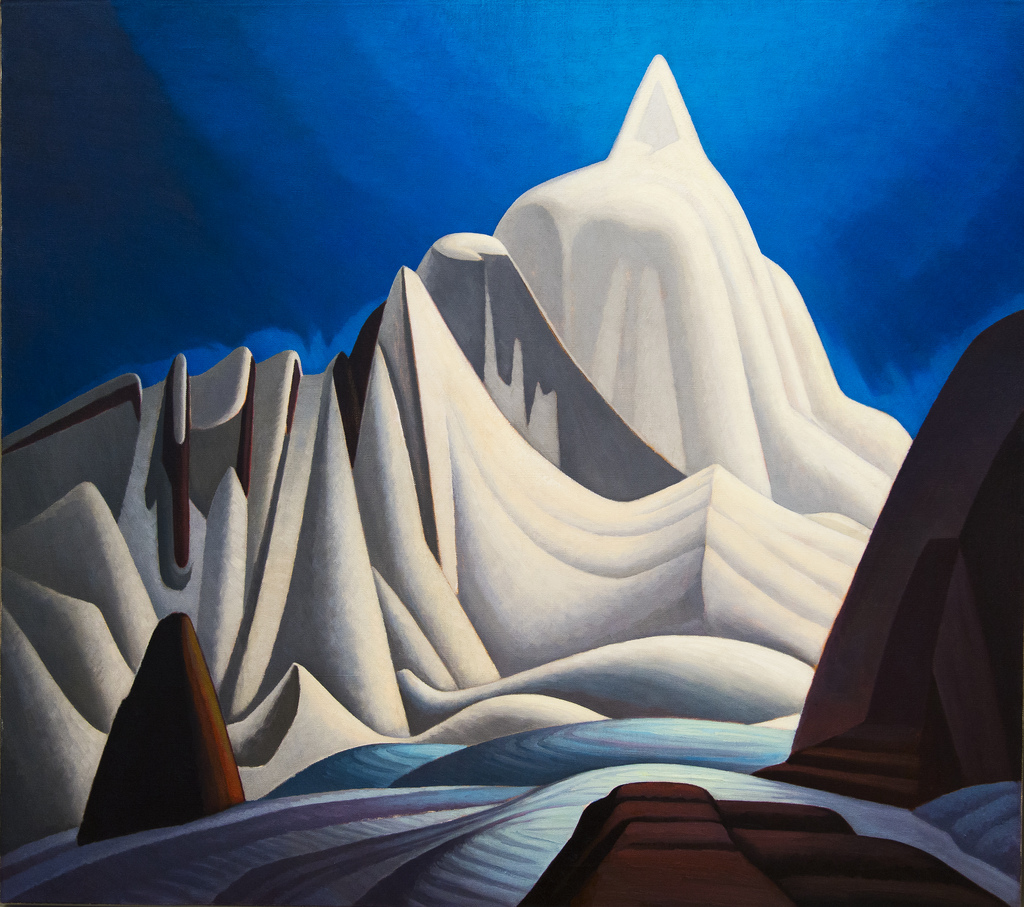
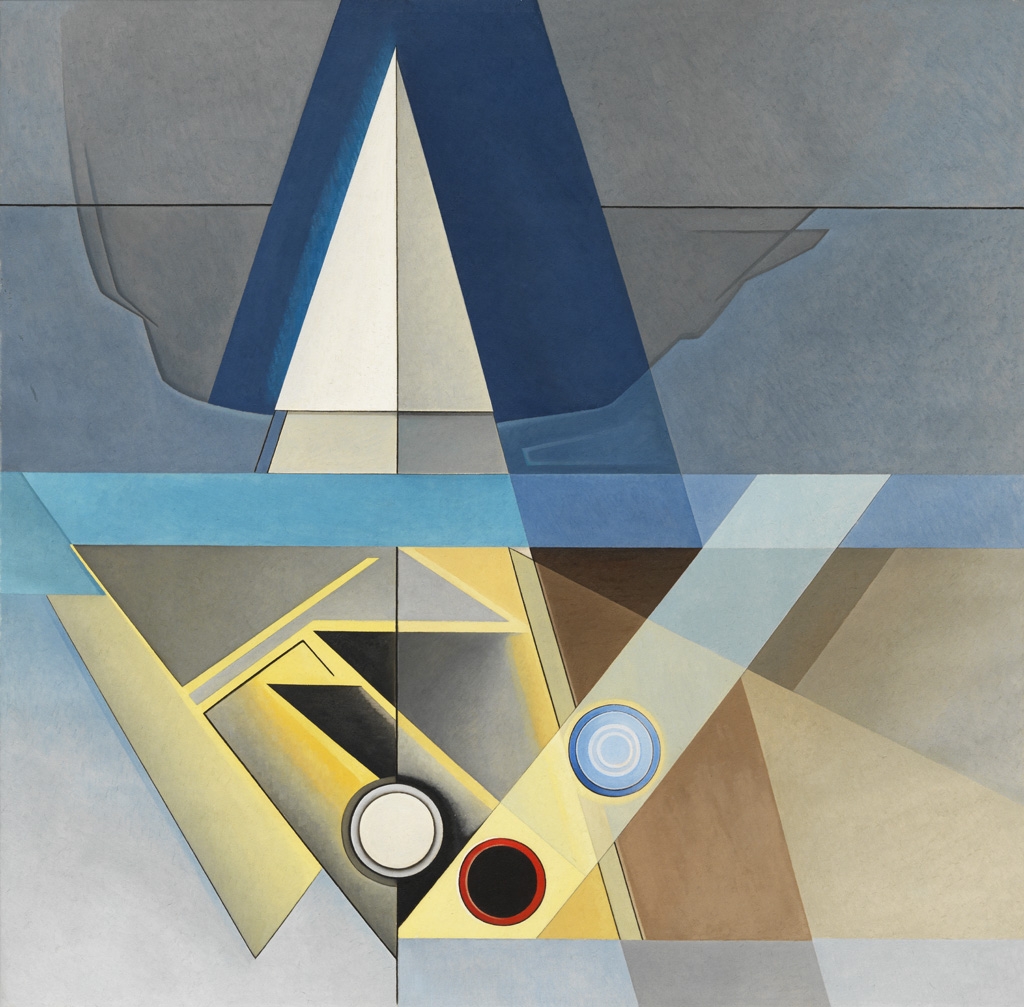
The more I look at the work and read the words of the great Canadian painter Lawren Harris (1885-1970), the more of a fan I become. His work was never about capturing the physical reality of place. No, it concerned itself with capturing the emotional response to the and harmony and spiritual nature of place, to evoke that power of beauty that has moved him. It reminds me in that sense of Edward Hopper’s work.
I am totally enamored with his paintings of the great white north in fantastic colors and forms but have been recently looking at his more abstract work and find then every bit as beautiful and engrossing. They possess that same degree of feeling of his more representational pieces yet move into an even more internal space. I find them intriguing and inspiring.
There is a book on the work of Lawren Harris coming out in a few weeks, co-authored by actor/comedian/art collector Steve Martin, The Idea of North: The Paintings of Lawren Harris, that will be attempting to take Harris from being portrayed as just a Canadian painter and place him highly in the larger context of all art. It’s a book to which I am looking forward.
Edward Calvert was a British artist born in 1799 . He was trained in the Royal Academy as a painter and had a distinguished career as traditional painter of his era. But in his early years, he also learned wood and copper engraving as a member of a group of artists who were followers of visionary artist and poet William Blake. They called themselves The Ancients.
It was during this time that Calvert created a series of prints from his engravings that are considered visionary masterpieces. I know that when I look at them they seem to be out of time and almost modern in feel, certainly not something you would expect to see from Britain in the 1820’s. His last engraving from this time was The Chamber Idyll, shown at the top, finished in 1831. It is considered his masterpiece and would be the last print he ever did, abandoning printmaking altogether to pursue his career as a painter.
He didn’t carry the visionary feel of his early print work into his paintings, choosing to work in the traditional style of the time. While he had a long career as a painter, his painted work is not considered in the nearly the same regard as his prints which are considered to be some of the most important British prints made. I think they are pretty wonderful and find myself just staring at them, taking in each composition’s design and use of space within the picture. Just beautiful…
The Sheep of his Pasture circa 1828 Edward Calvert
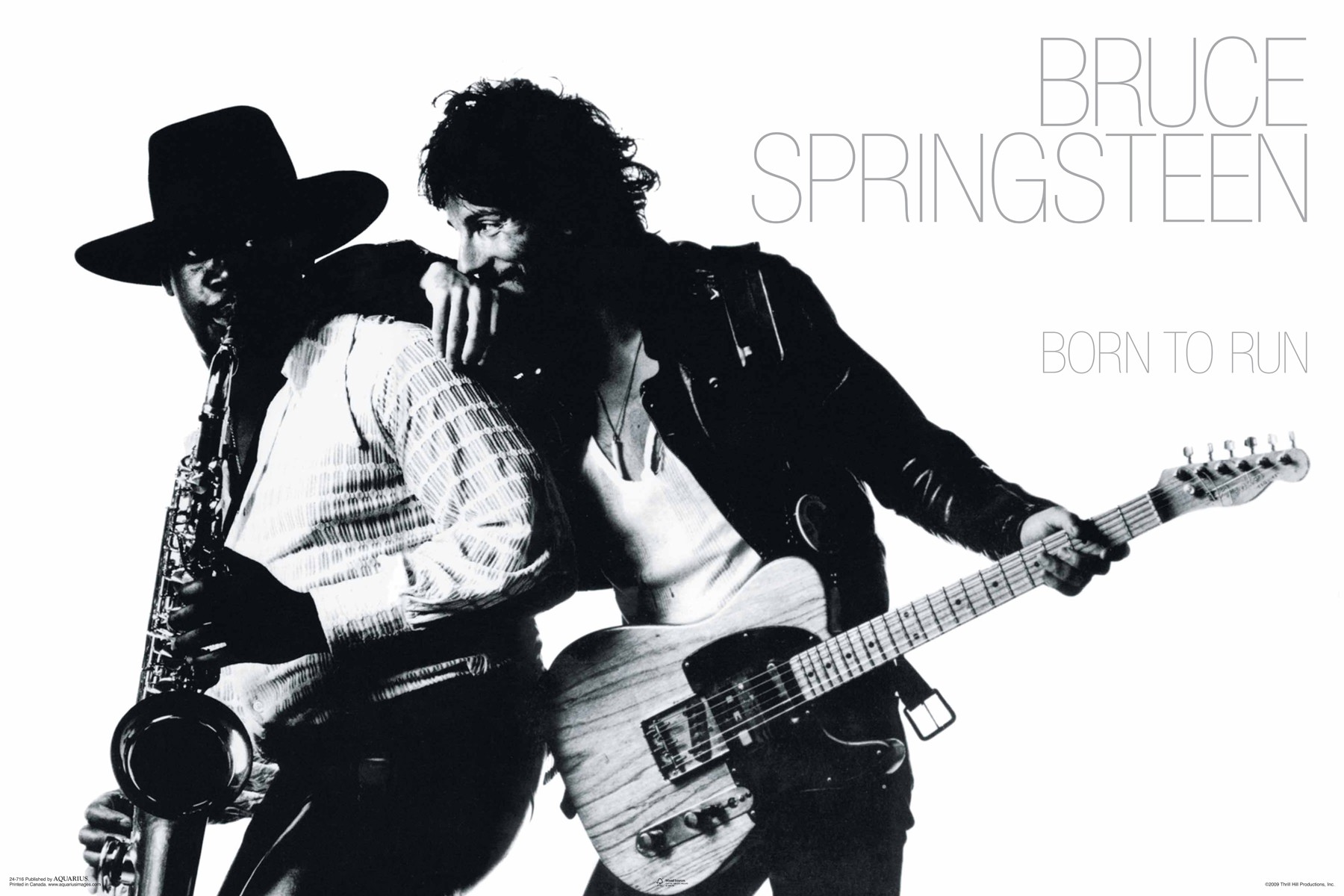
Born to Run turned 40 years old yesterday and I am somehow surprised, even though I am well aware of time passing. Maybe because it remains so in the present for me to this day. Actually, my first artistic foray involved selling Bruce t-shirts out of the want ads in the back of Circus magazine. They were a little crude, screen-printed with a logo for the E Street Band that I had designed on the front and a verse from Born to Run on the back. Sold a few, mainly to fans in Europe including one in Northern Ireland who remains a friend to this very day, but not enough to call it a success or even break even.
But Springsteen, and Born to Run in particular, had a huge influence on my life as well, well beyond that failed attempt at marketing. I was knocked out by his commitment to his passion, his need to keep true to his own vision for his work and his need to do all he could to get that vision across to his audience. It may not always be your style or taste, but his work is as true to his vision as any artist in any medium.
Here’s a blog entry from back in 2009 where I documented my first encounter with Bruce:
When I was seventeen years old I left high school early, in January. I guess I graduated. I had enough credits, had fulfilled all the requirements. Never went to a ceremony, never received a diploma. I had had enough school at that point. I was adrift in my life. No real goals to speak of. Oh, I had desires and dreams but no direction, no guidance.
At some point, I decided i would move to Syracuse and work for my brother, putting in above-ground swimming pools, but that wouldn’t start until April so I had several months to kill. Free time. I spent most of my time reading or watching TV or just driving around. One day in February, I stopped in at the local OTB (that’s off-track betting, by the way) and bet my last eight dollars on the ponies at Aqueduct.
Good fortune was with me that day and I won, hitting the daily double and walking away with a couple of hundred dollars. I called Cheri, my girlfriend (and now my wife) and asked if she would be interested in going out. There was a guy playing tonight at the Arena in Binghamton who I had heard a little about. I had his first two LPs and they were alright. Might be interesting and I had money burning a hole in my pocket. His name was Bruce Springstone, Springstein- something like that.
So we went to Binghamton. We got there about an hour before the show and it seemed so different than other shows we’d been to at that time, the mid-70’s. It was so quiet. People were lined up but it was almost silent, like there was this heavy air of anticipation stifling all sound. We still needed tickets so we headed to the box office. I asked the lady behind the glass for the best seats she had and after a moment she slid me two tickets. I looked at them then asked if she had anything better. She laughed and said no, these were pretty good.
They were in the third row, just left of centerstage.
I did say that I was seventeen, right?
Inside, there was a quiet stillness as we took out seats. There weren’t the screams of drunk kids nor the pungent clouds of pot smoke. No beach balls bouncing through crowd–just that heavy air of anticipation. As we waited, the people around us kept nervously looking at the stage, which was close enough to touch, as a well dressed older man tuned a grand piano. We had no idea what to expect but our interest was being piqued. Finally, the roadies cleared the stage and the arena went black. The first Bruuuces filled the air.
The lights came up and there they were, only feet away. Bruce was in a white collarless shirt buttoned at the neck and a vest with a woolen sport jacket. Miami Steve ( Silvio for those of you who know him from the Sopranos) was dressed in a hot pink suit with a white fedora. And directly in front of us, resplendent in a white suit that seemed to glow in the lights was the Big Man himself, Clarence Clemons, his sax glinting gold.
It was overwhelming for someone not knowing what to expect, like mistakenly walking into a revival meeting and coming out converted. It was unlike anything I had ever seen to that time. It was pure sonic nirvana with the thump of Mighty Max’s bass drum rattling my sternum and the Big Man’s sax flowing high over jangly guitar and tinkling piano lines.
But more than that was the sheer effort that was put out by Springsteen. It was the first time I had seen someone so committed to what they did. It seemed that all that mattered at that moment for him was to get across that space to the people in that arena. He dove across the stage. He clambered onto speakers. He gave everything. By the end of the show, some three and a half hours later, he appeared to have been dragged from a river. He was soaked from the top of his boots to the top of head and when he played his Telecaster, his hand on the neck of the guitar would fill with a pool of sweat.
His desire and commitment to please us was something I carried with me.
Several years later I ran into a person who had been at that show and when I told him my luck at getting such great seats he turned green with envy. His seats were much further back in the hockey arena. We then both agreed that our favorite moment was when they did a cover of It’s My Life from the Animals. We didn’t really know one another but we both gushed about how that song had moved us, had changed our lives in some small way. I still carry that image and when I hear that song I am suddenly 17 years old again. And ten feet tall with the world at my feet because it was my life and I’d do what I want…
That’s my first Bruce story.
Here’s She’s the One from the year before the show I was at. Enjoy.
 I am certain about what I will never do – but not about what my art will render.











 Redtree Times