Feeds:
Posts
Comments

Archive for the ‘Influences’ Category


I too am not a bit tamed,
I too am untranslatable,
I sound my barbaric yawp
over the roofs of the world.

Walt Whitman, Song of Myself


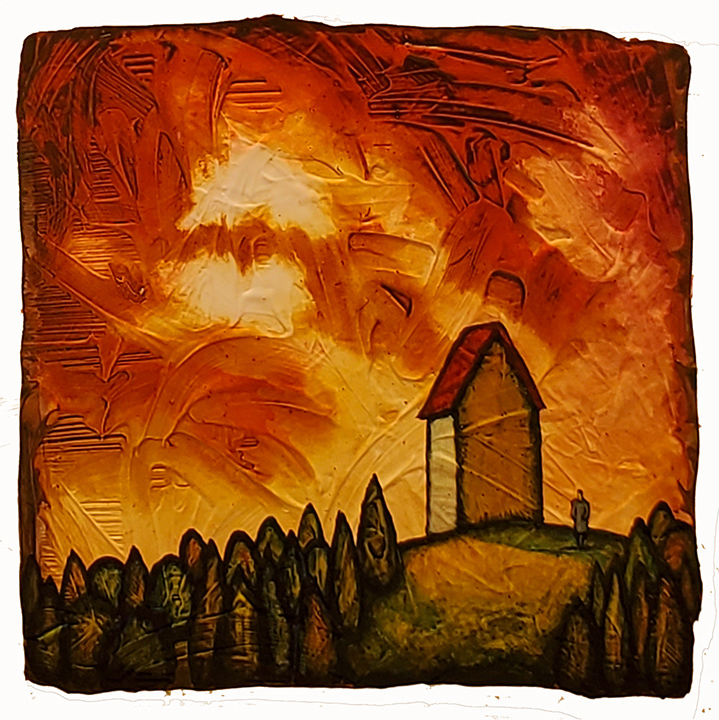
I finished this smaller piece the other day (it is headed to the West End Gallery today) and with the Red Tree appearing to hover above the Red Roofs both near and far, all I could think of were the lines above from Uncle Walt. That’s Walt Whitman, actually, but I always think of him in familial terms not that he was anything at all like my own uncles.

These lines from Song of Myself have rang in my ears for decades and are at the core of my desire to paint and in the formation of my voice as an artist.
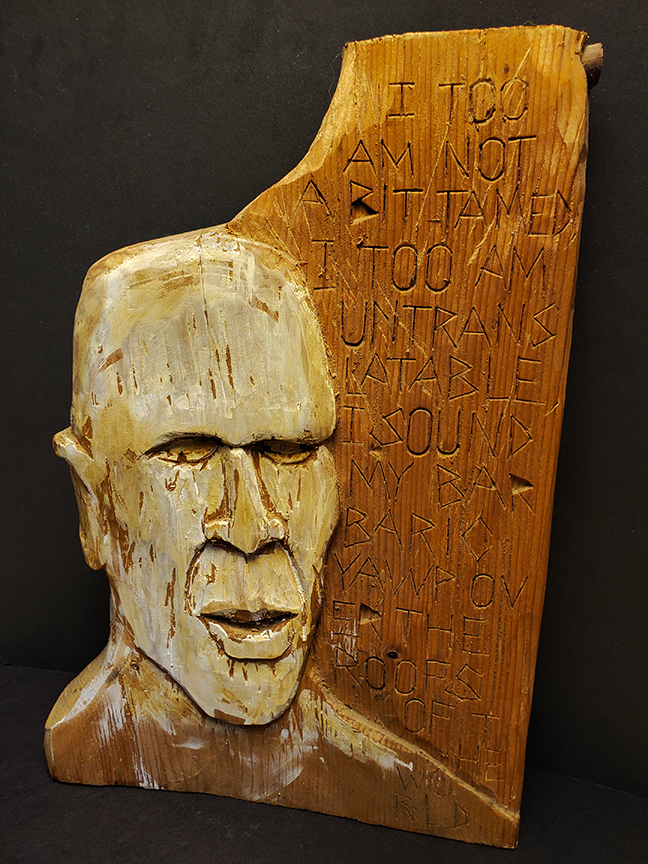
Before I even thought of beginning to paint, I tried my hand at wood carving. I did a number of bas-relief carvings that were fairly crude in a folksy kind of way. I was untrained and just went at it, much as I did later on with my painting. I believe that the painting worked out much better but the carving had a part to play for me at the time.

One of the first things I carved was a rough-hewn face with the four lines– poorly executed– from Whitman next to it. It was nothing to write home about, carved as it was from the end of an old 2×12 pine board. I am not particularly proud of it as a piece of art but it has great meaning to me and stays near me in the studio.

I have described what these words have meant to me in the past like this:

…the four lines above have been a guiding beacon for me throughout the past 25 years as I have tried to be an artist. These words instructed me to be only myself, to openly and boldly express my feelings without fear or shame. To not hide my scars, my fears or my weaknesses because they are part of my wholeness and keep me in balance. To not be underestimated or devalued by myself or anyone else. To claim a foothold in this world and bellow out the proof of my existence in my own voice:

Here I am.

There are paintings that I do that are meant to represent this thought, paintings that are meant to be plainly expressions of that Here I am. I consider them icons in my body of work, pieces that fully represent my work and what I want from it. This painting definitely falls in that category. It’s simply put but not a simple expression.

When I look at this painting I personally see myself and all my hopes and aspirations, all that I am or desire to be.

What I hope for this painting is that someone else sees that same here I am in it for themselves, that they see in it those things that make them a whole and perfectly imperfect person with a place in this world and a voice that demands to be heard.

Is that asking too much?

I immediately thought looking at this new painting that it fit into this category, that the Red Tree here represented my own need to let out my barbaric yawp, to announce my existence in this world. I am calling it I Sound My Barbaric Yawp.

It might not be quite as roughly finished as the carving but the yawp is the same.

Sound your own yawp in the world today. Have a good one.
Read Full Post »


I’m helplessly and permanently a Red Sox fan. It was like first love…You never forget. It’s special. It’s the first time I saw a ballpark. I’d thought nothing would ever replace cricket. Wow! Fenway Park at 7 o’clock in the evening. Oh, just, magic beyond magic: never got over that.

― Simon Schama


Maybe it takes the words of an esteemed British historian like Simon Schama to best describe the grand attraction of a ballpark when first seen in the waning light of the day, with the lights making the green grass and bright white chalk lines of the field pop into your eyes. I remember that feeling at Shea Stadium in the late 60’s, going up the darkened ramp from the concourse to the stands, emerging into a burst of deep colors and lights along with the buzz of the crowd increasing with each step forward.

It was magic beyond magic.

Baseball is back this week, with Spring Training beginning. For me, baseball is the canary in the coalmine. It felt odd and out of place last year with a raging pandemic and the country ripped apart by culture wars and the political apocalypse of an election that felt as existential as any we have had in recent times. Baseball was still there in a weird bubble that took away much of what made it important as a cultural touchstone.

It felt sporadic and detached.

Like most of us.

But it is coming back, as it always has each February, and with it comes the hope that we are nearing a point where we can sometime soon return to a form of normalcy. Where kids can experience that burst of color and light for themselves, can root loudly for slick fielding infielders and hard hitting sluggers. Where old farts like me can revel in the cyclical nature and routine of the game along with its esoteric details, its poetry, and its history. That

Author Michael Chabon, in his book Summerland, put words to my own feelings the game and how it echoes and rhymes with day to day life:

 The first and last duty of the lover of the game of baseball,” Peavine’s book began, “whether in the stands or on the field, is the same as that of the lover of life itself: to pay attention to it.

I have had trouble immersing myself in spectator sports this past year with all that is happening. But the start of Spring Training offers renewed hope. And that hope is a big part of the game. While personal glory and team victory are the goal, baseball is a game about how one copes with failure. It is a game of humility. The greatest players of all time failed more than they succeeded and most players go through their careers without winning the World Series. 

The hope is that if you give it your best effort, this pitch might be the big pitch or this catch will be the big catch. This hit might be the big hit.

This year might be the year.

It is a grand metaphor for the hardship and grace of life that repeats itself 162 times a year. Like life, it offers us everything if only we pay attention.

Pay attention and have a good day.

Here’s a favorite baseball tune from Mabel Scott to kick off the season:


Read Full Post »


So don’t be frightened, dear friend, if a sadness confronts you larger than any you have ever known, casting its shadow over all you do. You must think that something is happening within you, and remember that life has not forgotten you; it holds you in its hand and will not let you fall. Why would you want to exclude from your life any uneasiness, any pain, any depression, since you don’t know what work they are accomplishing within you?

― Rainer Maria Rilke, Letters to a Young Poet


Funny how often the words of the poet Rilke mesh with the message I am seeing or hoping to see in a painting of mine. It’s certainly the case in this new smaller piece, Standing in Shadow, that is part of the Little Gems show at the West End Gallery that opens this Friday.

For me, the message I wanted to distill here was that we all live in the shadows of places, people, and events. Even the past and the future cast a shadow on our lives in the forms of regret and fear, among many others. 

In a way, we are shaped by shadows, depending on how we react to them. In the best case, we seek to step beyond them, to find a place in the light where the only shadows present are those we cast in our wake.

That is where the words of Rilke come into play. It is while we are in the shadows, that we must use those feelings that thrive within us there, the anxiety and pain and other deep emotions, to find a way forward.

To use the shadows as building blocks toward the light. 

I’ve discussed this here before, this idea that it is most often that our hardships form our character and that our creations ultimately– and hopefully– reflect that character. I’ve always thought that the appeal of my work was in the shadows that came through in my work. I am not talking about physical shadows though they sometimes are manifested as such in the work. It’s more in the underlying darkness, the acknowledgement that there is dark behind the light. That even the optimism and hope carried in the work is tempered with a wary eye cast toward the shadows.

Our hardships do, as Rilke points out, accomplish work within us. That’s not easy to see when you’re deep in the shadows. But once one recognizes that the shadows are the place where the deepest emotions are spawned, that one can use these feelings as a way to the light, that it is the place where creation is born, it becomes a less scary place. 

At least that’s how I am reading this, in both Rilke’s words and in this painting.

I could be wrong. Wouldn’t be the first time and it certainly won’t be the last.

Maybe you will see it differently with the benefit of your own shadows. That’s how it should be.

Have a good day.

Read Full Post »

kandinsky


Lend your ears to music, open your eyes to painting, and… stop thinking! Just ask yourself whether the work has enabled you to ‘walk about’ into a hitherto unknown world. If the answer is yes, what more do you want?

Wassily Kandinsky


Still working on getting my creative engines revved up and ready to go. Normal for me at this point n the year. One thing that usually helps me in these times is turning to the words and works of Wassily Kandinsky.

Several years ago in a short post here, I shared the quote above and a great little film from Alfred Imageworks that features an animation of the elements from some of Kandinsky’s great paintings as well a film from 1926 of Kandinsky creating a drawing with these same elements.

These always seem to help me in some way that I can’t quantify. Maybe I should take Kandinsky’s advice and stop thinking on this.

Anyway, thought they’d be worth revisiting today before I get down to real work.

Take a look if you are so inclined and then have yourself a good day, again, if you are so inclined.

STEREOSCOPIC FOR EXHIBITION – KANDINSKY from Alfred Imageworks on Vimeo.


Read Full Post »

Franz Marc- The Yellow Cow 1911


Traditions are lovely things- to create traditions, that is, not to live off of them… the great shapers do not search for their form in the fogs of the past.

–Franz Marc


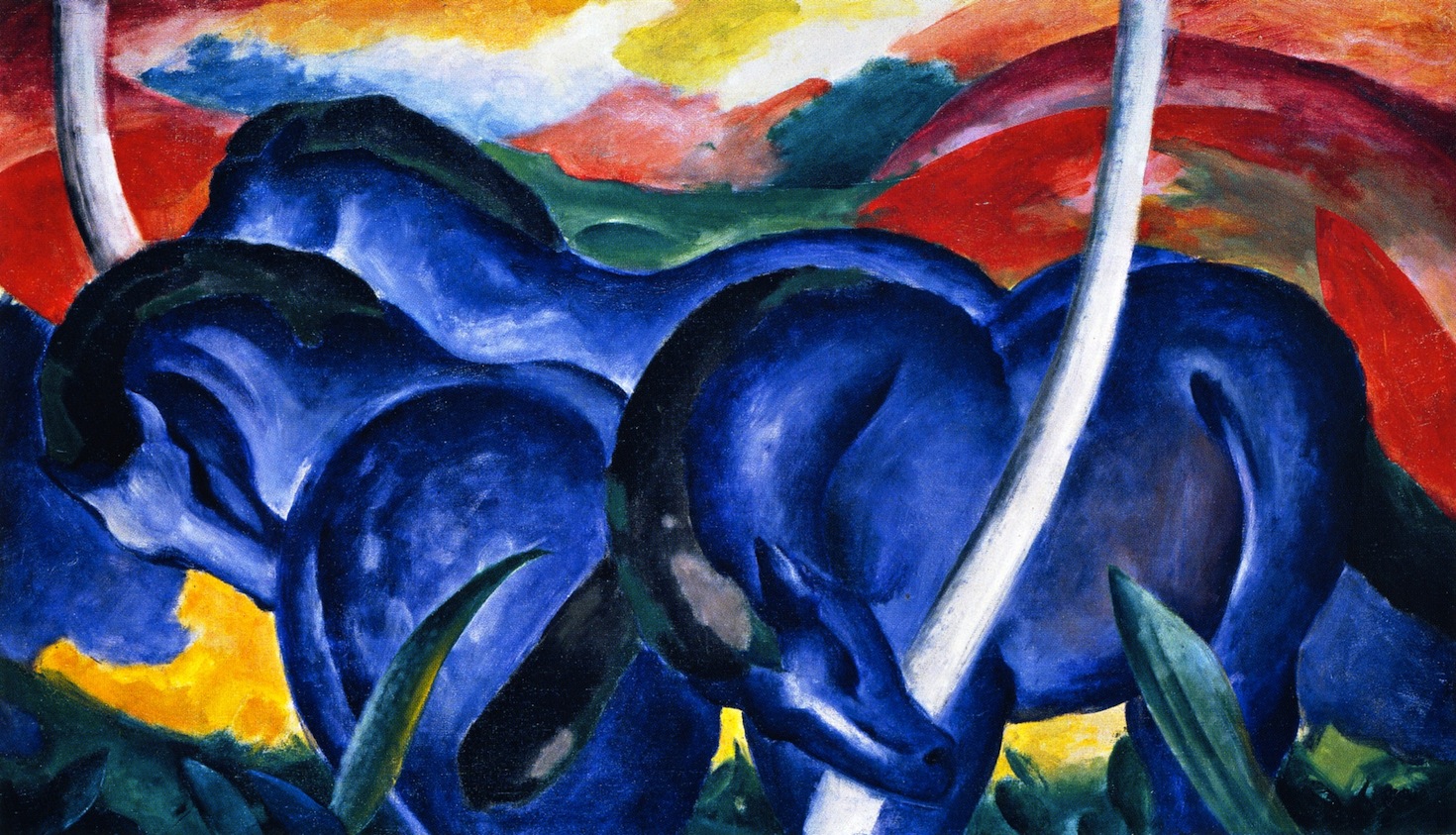
I chose today’s quote from German painter Franz Marc (1880-1916) because he was an influence for me early in my career. Not so much in the style or subject matter that he employed but more in attitude. I admired the fact that he created work that stood out and was identifiable as his from across a gallery space.

His work, vision, and voice were his alone, never aspiring to follow the style or schools of others. This is basically what he is pointing towards in the aphorism above– to not toil in the fields planted by earlier artists but to carve out your own space and work it in the way that suits and  best expresses you.

Franz Marc- Large Blue Horses

Franz Marc- Large Blue Horses

He is not downplaying the influences of the past. Early in his career Marc copied the works of other artists from before and contemporary to him. Doing so allowed him to pick and choose the elements in the works of others that meshed with his vision, allowing him to use these found elements to create his own avenue of expression.

He did not want to remain a replicator but wanted instead to be a creator. He wanted to work in a field that he had planted and nurtured. One that was his own.

And that was the attraction for me.

Of course, there was safety and security in remaining in the larger symbolic field with others but it would often be as an anonymous member of a larger group, your furrow always directly compared to the furrow of those alongside you, your harvest always compared to those of others.

Breaking away and heading out was risky. You had to believe that in taking this leap of faith that you would be able to work your little spot in your own way away from others and produce a harvest that is uniquely appetizing to others in some manner. But you might end up toiling in barren soil, creating crops that appealed to no one but yourself. It was scary to think that your field might never expand but you were at least nourishing yourself.

This was the type of thinking that drove my work early on, fueled by looking at the work of Marc and others who veered from the traditions of the past in their times.

Unfortunately, Franz Marc only worked his fields for a relatively short time, dying in WW I at the Battle of Verdun. He was a mere 36 years old. But his crop still lives on, surviving being labeled as degenerate art in the 1930’s by Hitler and the Nazi regime.

It is unique and in his own tradition.

I believe that the lives and careers of artists  like Franz Marc provide valuable lessons for any aspiring artist, even in this world and creative environment that is vastly different than the one that Marc inhabited.

I know it helped me. 


Back trying to take a hiatus. This post ran six years ago but it’s one that I felt deserved another run. Unlike the traditions that sustain and give meaning to our everyday lives, art often occurs when the traditions of art are set aside. I think that is what Marc was talking about here and I believe it is an important thought to keep in mind for those who have their own voice heard.

Back to plowing. Again. Have a good day.


Franz Marc- The Waterfall 1912

Franz Marc- The Waterfall 1912


Franz Marc- Horse and Eagle 1912

Read Full Post »


Simplicity is the ultimate sophistication.

― Clare Boothe Luce


This post ran a few years back on this same date, December 7. Every time I come across this entry while scrolling through older posts it stops me cold. The purity of the color, the clarity, the compositions and the absolute simplicity, along with the sophistication mentioned by Claire Boothe Luce above, of it all just capture me wholly. It just makes me feel content and satisfied as a human.

But at the same time, as an artist, it also makes me feel discontented and a bit unsatisfied because it stirs my creative juices, reminds me that I haven’t yet reached that same feeling of contentment and happiness that I know is potentially there within my own work. 

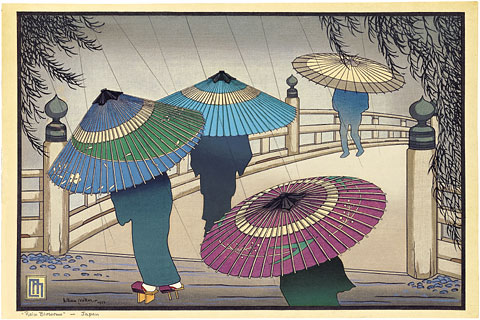
That’s the yardstick I use when looking at the work of other artists– how much it makes me want to work even harder. And the work of Lillian May Miller does just that. Take a look.


I came across the work of Lilian May Miller only recently and was instantly infatuated with her beautiful woodblock prints. The colors and compositions just ring true for me and they seem to create a bridge between the traditional and the modern forms of the woodblock art form. I am showing quite a few of her pieces here but I could easily show many dozens more.

Miller was an interesting person as well. She was born in Tokyo in 1895 to American parents, her father a diplomat. She was enrolled in the atelier of a famed Japanese printmaker at the age of 9 and had her first exhibit at the age of 14. She shuttled back and forth between Japan and  and the United States  (where she graduated from Vassar) throughout her life, including considerable time spent in Korea when her father was stationed there for the State Department.

She saw herself as an envoy or messenger between the cultures of the East and the West. When in Japan, she dressed in a uniquely Western fashion, wearing ties and sport jackets and sporting a cropped haircut. When she made presentation back in the States, she often did so wearing traditional Japanese kimonos.

Miller achieved a degree of recognition for her work in the years leading up to World War II. However, she was devastated by the Japanese attack –which, by the way, occurred on this date in 1941– feeling that it was a personal betrayal of her love for that country. She worked for a counter propaganda unit of the Navy in 1942 until a large malignant tumor resulting from abdominal cancer was found.

She died in January of 1943 at the age of 47.

Her work and her story has slid somewhat into the ashes of art history. But much of her work remains and it doesn’t take much to see the brilliance of it at its best. It will pull its way back to light sometime soon.

This is a very quick and incomplete synopsis of her life. There was recently a more complete article on Miller on the Atlas Obscura site recently that you can read by clicking here. There is also a book, Between Two Worlds, that details her life and work.

For now, enjoy these images.


Read Full Post »

“Light and Wisdom”- Currently at the West End Gallery

“If outer events bring him to a position where he can bear them no longer and force him to cry out to the higher power in helplessness for relief, or if inner feelings bring humiliation and recognition of his dependence on that power, this crushing of the ego may open the door to grace.”

***

“Every test successfully met is rewarded by some growth in intuitive knowledge, strengthening of character, or initiation into a higher consciousness.”

***

“The source of wisdom and power, of love and beauty, is within ourselves, but not within our egos. It is within our consciousness. Indeed, its presence provides us with a conscious contrast which enables us to speak of the ego as if it were something different and apart: it is the true Self whereas the ego is only an illusion of the mind.”

― Paul Brunton, The Notebooks of Paul Brunton


I was surprised to find I have never mentioned Paul Brunton here. I came across his work many years ago in a moment of serendipity at perhaps the lowest point in my life. I don’t think I am exaggerating in saying that without that encounter with his books, I most likely would not be sitting here this morning, writing this blog. Might not be an artist.

Might not even be. Period.

Paul Brunton (1898-1981) was a British writer who traveled to India in the aftermath of his service in World War I and encountered Hindu/Buddhist mysticism for the first time. He wrote several best selling books on his experiences that more or less brought Hindu/Buddhist to the west for the first time.

His magnus opus was published series of 16 of his notebooks, The Notebooks of Paul Brunton, containing observations and experiences. These were the books of Brunton’s that I first came across. As I said, I was at my bottom at that point and my mind was spiraling. I opened one of his notebooks and immediately found something, a short paragraph with his observation on the ego, that seemed to describe where I was at that point, something that I could latch onto.

That simple moment was a huge spark of hope. A beam of light.

I looked at the title page and saw that it was published by a organization located not too far from where I live now, my home area. I was across the country at that time and it was as though these words and that address near my home were telling me that what I needed, what I sought, was at hand, was inside me all the time.

That’s the short version of the story and it will have to suffice for today. I just thought Paul Brunton deserved a mention. He’s part of my path, my story, and when I look at pieces like the one at the top, Light and Wisdom, his words often jump to mind for me. I know that when I get spinning out of control, his words are gentle reminder of where I am now, where I have been in the past and what I was, what I am and what I want to be. 

Was, Am, Will Be.

Just keep trying and have a good day.

Read Full Post »

I came across the post below earlier this morning. It was posted several years back, just a couple of weeks after my father was admitted to to a local nursing facility, suffering from Alzheimer’s dementia. Four years have passed now and his condition has, unsurprisingly, deteriorated. He is now among the folks I describe in the the last paragraphs below. I visited this past week and basically just sat across from him, an enforced six feet away for safety’s sake, and looked at him as he lulled in his padded reclining wheelchair.

I called across to him several times throughout the visit, Basically, a hello in there kind of thing. But there was no response, not even a flutter of his closed eyes. He was there but he certainly was not there, as well. I wonder what part of his memories his mind was moving through at that time, what form of reality it was taking.

Anyway, here’s that post from several years back, including another great song from the late John Prine:

**************

GC Myers Early Work 1994I have a square cardboard box in one of the rooms of my studio. It’s not much to look at it and it certainly doesn’t have any significance attached to its exterior appearance.  But for me it’s a treasure chest, my secret bounty. You see, this rather plain box holds hundreds of small pieces from my earliest forays in paint from twenty some years ago.

They are not significant to anyone other than me. If you were to look in it you might not feel anything more than you would from looking at the old buttons, matchbooks and other tiny souvenirs of times past in someone else’s dresser drawers.

Many are clumsy attempts and most are deeply flawed in some way. But for me, they hold so much more deep meaning than is apparent from a first look. They are my artifacts, my history, my ponderings, my inner thoughts and my memory.

They are me.

There’s always a special feeling when I delve into them, like that feeling of looking at old family photos and vividly remembering moments that seem to have happened eons ago. I sometimes marvel at the brightness of my youth at that point and sometimes frown at the foolishness of it. I see where I thought I was going and can compare it to where I finally landed. There are ideas there that are dismal failures that make me smile now and make me wonder if I should have pursued them further.

And there are some that make me happier now than when they were done. Time has added a completeness to them that was lacking then.

And there are pieces like the untitled one above from back in 1994 that make me just stop and wonder where they came from. They seem like lost memories. I know I made this piece up in my mind but can’t remember why. I have skimmed over it a hundred times and never given it more than a shrug. But today I find myself looking intently at it as though it holds something for me that I can’t just pull out of it.

There’s a frustration in that but since I know that it is mine, I don’t really mind. I will have it for years to come and can question it again and again. Maybe my mind will release the secret or at least form a substitute reality at some point, one that brings me closure of some kind.

Who knows?

Today’s Sunday Morning music deals a bit with some of the same feelings. Well, I think it does.  It’s Hello In There from John Prine. Visiting my father in the nursing home has been hard, not just for the visits with him which still leave me shaken a little after each visit, but for the sight of the other older folks in even deeper states of dementia as they sit in their chairs in the hallways and dining rooms. There is a lonely blankness in their eyes that is heart-breaking.  You wish you could reach into them and pull their old self out in the open if only for a moment. But all you can do is say hello and hope they hear the words and the feeling in it.

Anyway, this is a great old song from John Prine. I hope you’ll give it a listen and have a great day.
***************

Read Full Post »

“Bold Run”- Now at the West End Gallery

*******************************

“Most people are convinced that as long as they are not overtly forced to do something by an outside power, their decisions are theirs, and that if they want something, it is they who want it. But this is one of the great illusions we have about ourselves. A great number of our decisions are not really our own but are suggested to us from the outside; we have succeeded in persuading ourselves that it is we who have made the decision, whereas we have actually conformed with expectations of others, driven by the fear of isolation and by more direct threats to our life, freedom, and comfort.”

― Erich Fromm, Escape from Freedom

********************************

Freedom’s just another word for nothin’ left to lose
Nothin’, don’t mean nothin’ hon’ if it ain’t free, no no

Kris Kristofferson, Me and Bobby McGee:

*********************************************

What is real freedom?

I can’t say for sure. Wish I could.

Lately, I have been thinking about the 1941 book from Erich Fromm, Escape From Freedom. In it, Fromm writes about that we actually have a fear of freedom.  Real freedom requires personal responsibility for our decisions and actions and creates an almost unbearable anxiety in man. Real freedom means living without a safety net, where we decide who and what we are, what we want from life, where we are held accountable for each decision we make.

Put that way, freedom sounds much more perilous.

As a result, we have fostered a desire to be told what we should be and what we should do. Fromm makes the point that we want someone to make the decisions that guide our lives while maintaining the illusion that we have freely made them.

“Modern man lives under the illusion that he knows ‘what he wants,’ while he actually wants what he is supposed to want. In order to accept this it is necessary to realize that to know what one really wants is not comparatively easy, as most people think, but one of the most difficult problems any human being has to solve. It is a task we frantically try to avoid by accepting ready-made goals as though they were our own.”

A life of real freedom is scary and difficult so it is always tempting to just fit in, to accept a bit of comfort and security in exchange for losing a large degree of that freedom. Doing this make us susceptible to falling prey to those with less than honorable intentions.

“Escape from Freedom attempts to show, modern man still is anxious and tempted to surrender his freedom to dictators of all kinds, or to lose it by transforming himself into a small cog in the machine, well fed, and well clothed, yet not a free man but an automaton.”

The concept of this book seems to be playing out in real time lately.

I don’t know that we, myself included, understand the concept of real freedom. I have tried to shape and live a free life but have I succeeded?

I don’t know.

I will continue to look for an answer but in the meantime, here’s this week’s Sunday Morning Music. It’s I Want to Be Free, an old Leiber and Stoller hit first sung by Elvis Presley in the 1957 film Jailhouse Rock. While Elvis does a fine job with the song, I much prefer this version from Robert Gordon who had a nice run as a rockabilly artist with several memorable albums in the 1980s. Here, I think he fills in the blanks that Elvis left in his version.

Give a listen and have a good day. And take a minute to think about what you think real freedom is.


Read Full Post »

********************************

“The ache for home lives in all of us. The safe place where we can go as we are and not be questioned.”

Maya Angelou, All God’s Children Need Traveling Shoes

********************************

This painting, Nestledown, 18″ by 26″ on paper, is part pf my current show at the West End Gallery, It has the feel of some of my older work with its simple design and spew lines at the edges where the paint has broke free of the picture plane. This gives it a feeling of finding a place of comfort in my eyes, one of security where you can let down your guard a bit.

This feeling is enhanced for me by the multicolored patches of color in the foreground. While they remind me of a patchwork quilt there is something else in the quality of the color that heightens the feeling, something I couldn’t put my finger on for quite some time after I painted this piece. It came to me the other day when I was looking at a book of work by the painter Egon Schiele.

This piece reminded me of one of his paintings, Agony, from 1912, shown here on the right. It shows a person wrapped in a patchwork quilt with a monk laying next to them, his own robe serving as blanket of comfort. As soon as I saw this piece I saw how the oranges, yellows, and reds of its quilt related to the colors in my painting. They provided much the same service in both paintings, creating warmth and security.

I wasn’t surprised by seeing this link. I have long admired the work of Schiele, especially the way he treated his colors, imbuing even the brightest colors with dark undertones. This creates a depth and gravity of feeling that transcends the color itself. This is something I attempted to adapt for my own process many years ago, something that I consider a major turning point in the evolution of my work.

This painting wasn’t consciously in mind when I painted Nestledown but it certainly echoed somehow in memory. And finding comfort in times of trial and agony is a thread that runs through this show. It’s something that hits close to home  both as a nation, as we suffer through the multitude of ills that plague us at present, and as an individual as my family deals with the last days of my father’s life.

We all just want to find a bit of comfort, a place where we can nestle down.

Read Full Post »

« Newer Posts - Older Posts »