 I find it hard to believe that I haven’t mentioned the work of Charles Sheeler here, outside of a mention of his collaboration with Paul Strand on the film Manhatta, a landmark American art film from 1921. Sheeler (1883-1965) is one of my favorite artists who as a pioneer in photography and painting in the early decades of the 20th century is often called the father of Modernism. Oddly enough, I am particularly drawn to his industrial imagery which replaces almost all evidence of things natural in completely man-made factoryscapes. This might seem to be the antithesis of my own work, which often omits all evidence of human intervention in my landscapes.
 Some of his most potent work came from an assignment where Henry Ford hired Sheeler to photograph his factories, wanting him to glorify them in an almost religious manner, as though they were cathedrals for the new age. As Ford had said at the time, “The man who builds a factory builds a temple. The man who works there, worships there.” Sheeler was impressed with the factory complexes and felt that, indeed, they represented a modern form of religious expression. His painted work from this time glorified the machine of industry in glowing forms and color.
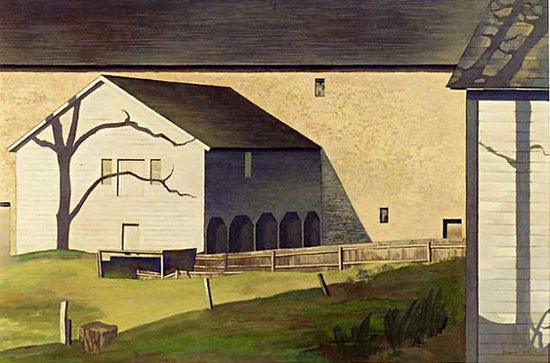 He saw the factory as a continuation of the American idea of work as religion, one that was rooted in the sense of reverence and importance of the barns and structures of the farms of the earlier pre-industrial age. He painted many scenes of farms and barns, abstracting the forms as he had with the factory scenes.
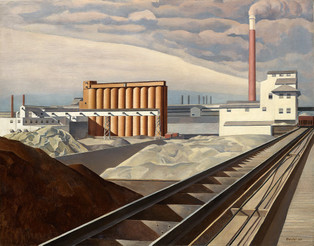 I don’t know that I completely agree with Sheeler on his idea of the factory as cathedral but I do have to admit to being awestruck in the presence of large factory structures. I remember working in the old A&P factory, a huge building that was said to have the capability to produce enough product each day to feed everyone east of the Mississippi. It no longer exists. Some of the huge rooms in the building were amazing to stand in, as the machines hummed and throbbed while workers hustled about servicing their needs. I particularly remember the tea room which was a huge ca cavernous space with row after row of steampunk looking machines that bagged the tea then sewed it shut. I cleaned these machines for several weeks and, standing in the grand space in silence after most of the workers had gone and the machines turned off, felt that feeling of awe. I would sometime walk around from area to area, just taking it in. I didn’t necessarily adore it in the manner of a religious zealot but there was no denying the power in its magnitude and the power of the machine.
Maybe that’s why I’m drawn to Sheeler. Maybe its his use of form and color. I don’t know. I guess it doesn’t really matter. I just like his work. Period.




 I’ve been going through some books on my shelves that I haven’t looked at for some time and came across a smallish book on the work of Richard Lindner, who was a German born (1901) painter who moved to New York during World War II. He taught at the Pratt Institute then later at Yale before his death in 1978.
 guided the hand of the film’s artist who most people think was Peter Max. However, the artist was Heinz Edelman . This misconception probably shows Lindner’s influence on Max as well. I also can see Lindner in some of Terry Gilliam‘s animations for Monty Python. The Beatles paid tribute to Lindner by inserting his image in the group of figures on the cover of their classic Sgt. Pepper’s Lonely Hearts Club Band album. He’s between Laurel and Hardy in the second row.
 One of my favorites is shown to the left here, FBI On East 69th Street. I have no idea whether he was influenced by Lindner’s work (although I wouldn’t be surprised), but when I look at this painting I can only think of David Bowie, especially in the early 70’s in the Glam era. Again, the strength of the color and shape,s as well as how his figures fill the picture frame, excite me. How I might take this excitement and make it work within my own work is something that remains to be seen. It may not be discernible but seeing work that makes your own internal wheels spin will show up in some manner. We’ll have to see if this comes through in the near future.


 Today I want to just show the influence of Maxfield Parrish on my work. He is certainly well known for his fairy tale-like scenes of scantily-clad young women or children in fantastical settings but I have always loved his other, lesser known work, particularly his landscapes and homescapes.
  I am also visually excited by the way Parrish used gradience in the colors of his skies, taking a deep rich color at top and drawing it down in lighter fragments of the colors that make up the original color. It creates a brilliant effect.


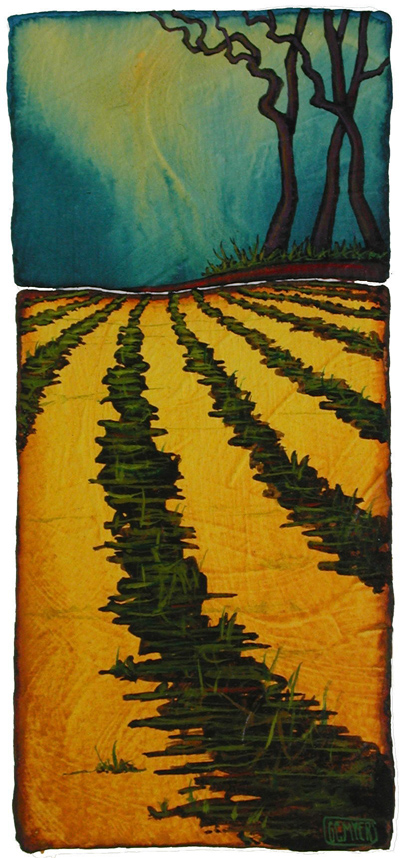
 I just wanted to share a few more tidbits from the recent foray out west. The image shown here is from the late artist Eyvind Earle, who I have mentioned here a couple of times before. I have quite an attraction to his graphic style and as we finally emerged on our drive westward from the wide agricultural central valley I began to see how the landscape of the coastal hills of California inspired his work. Golden hills with perfectly crowned oaks placed sporadically upon them were in abundance. It was hard not to see paintings coming to life as I drove through the hills.
 Redtree Times