Feeds:
Posts
Comments

Archive for the ‘Influences’ Category

We who lived in concentration camps can remember the men who walked throughout the huts comforting others, giving away their last piece of bread. They may have been few in number, but they offer sufficient proof that everything can be taken away from a man but one thing: the last of the human freedoms — to choose one’s attitude in any given set of circumstances, to choose one’s own way.

–Viktor Frankl

***********************

I ran this quote from Viktor Frankl a couple of years back in a post about how a painting reminded me of Frankl’s work, as outlined in his classic book Man’s Search for Meaning.  In it, he wrote of his survival in  a Nazi concentration camp during World War II and how he noted that those who endured were those who found a purpose to live outside of themselves.  It could be as simple as needing to live to see their spouse once more.  It was a goal, a purpose that they could see in the future beyond the horror that engulfed them in the present.

Those who saw no purpose, no future, seldom survived.

That is as condensed a version of what I gleaned from Frankl’s work as I can give.  I know that it transformed my own view of life at a time in my own life when I seemed to exist without purpose, a time that now seems eons ago, thankfully.  Frankl’s work has continued to spring up in my thoughts over the decades, always inspiring me to look for purpose in my existence.

So when I recently  finished this 24″ by 30″ painting on canvas, I wasn’t surprised that his work again came to mind.  There is a sense of direction and purpose in this piece that fits with how I think of his work.  The Red Tree has a certain dignity and spirit, like an unquenchable fire, and the winding path goes past it into an unseen future.  The path is the purpose on which we move forward.  Yes, there are hardships and uncertainties that must be endured but there is a future if we follow this purpose.

I have titled this painting Viktor.  It both represents Frankl and his work as well as well as the work victor.  It is part of my upcoming show at the West End Gallery, In Rhythm, which opens July 20.

Read Full Post »

John Ruskin- Ferns on a Rock 1875

The greatest thing a human soul ever does in this world is to see something and tell what it saw in a plain way. Hundreds of people can talk for one who can think, but thousands can think for one who can see. To see clearly is poetry, prophecy and religion, all in one.

–John Ruskin

**************************

I have been very interested lately  in the work and life of John  Ruskin,  who lived from 1819-1900.  He was one of those Victorian British sorts who displayed a wide range of talents throughout the era.  He was one of the greatest of  British watercolorists, perhaps second only to the great JMW Turner, whose work he defended in a book, Modern Painters, that sought to prove the superiority of the landscape painting of the time  over that of the early Masters.

John Ruskin- Amalfi

Although his painting is wonderful, he is probably best known for his criticism and his writing.  He had a real dogmatic sense of certainty in everything he took on, a quality that was very appealing if you agreed with his views but one that didn’t always sit well with those who did not.  I am not going to go into a biography of his life here but I wouldn’t deter anyone from looking further on their own by clicking on his name above or going to his bio page at the Victorian Web.  It is a most interesting life filled with famous names, controversy ( a famous court case with Ruskin being sued by James MacNeil Whistler for libel) , madness and tragedy.  All the elements of a great story.

The thing that first caught my eye was not his painting, though I do really like and appreciate it, but a rather a passage from a lecture he gave that I thought could have been written for our time as well as we seem to be ever more embracing of a culture that is anti-intellectual, anti-environmental and anti-science.  He wrote:

No nation can last, which has made a mob of itself, however generous at heart. It must discipline its passions, and direct them or they will discipline it, one day, with scorpion-whips. Above all, a nation cannot last in a money-making job; it cannot with impunity,–it cannot with existence–go on despising literature, despising science, despising nature, despising compassion, and concentrating its soul on Pence.

There are days when I fear that we must prepare ourselves for those scorpion-whips that Ruskin foresaw.

Read Full Post »

I was out in the driveway with some old pieces of stone when I heard a voice telling me to pick up my tools and start to work on a tombstone. I looked up in the sky and right there in the noon daylight He hung a tombstone out for me to make.

—–William Edmondson, on his inspiration to begin sculpting

****************

My last post was about the grand paintings of the Renaissance era, beautifully crafted pieces from painters who were extensively trained under master artisans so that they could capture the religious spirit that was the subject and inspiration for most of the work of that time.  But that post made me think about how others, less schooled and less well equipped, translate this same inspiration into forms.

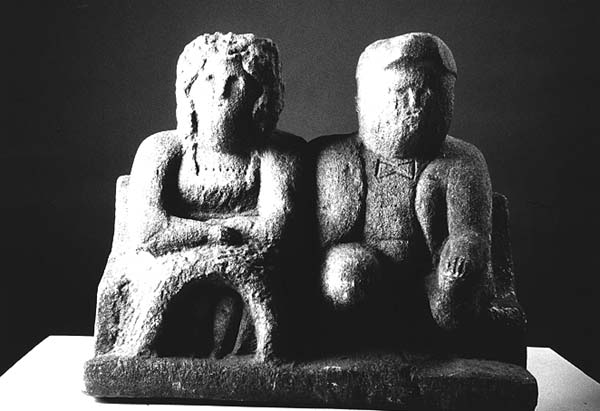
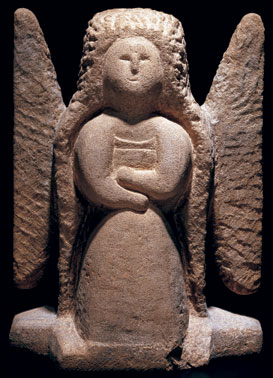
That  thought brought me quickly to William Edmondson,  a man born in 1874 in Tennessee to former slaves.  Edmondson worked in a number of jobs throughout his life, losing his job as a hospital orderly in the late 1920’s when he was in his mid-50’s.  It was at this point that he had the vision he describes above which led to him to begin sculpting for two African-American cemeteries in the Nashville area.

 Using handmade tools such as a chisel made from a railroad spike and working on discarded chunks of stone from building sites, it soon became clear that Edmondson had a true affinity for capturing the essence of figures in stone with forms that were spare but elegant with subtle shaping.  I see a simplified elegance in much of his work that cannot be taught, that is simply an expression of the artist’s self and spirit.

Edmondson sculpted for the next couple of decades until his death in 1951, gaining acclaim as perhaps the finest American folk sculptor of the century.  He was the first African-American artist to be featured  in New York’s Museum of Modern Art in 1937 and his work is still celebrated today for its extraordinary qualities.

Edmondson’s called each of his sculptures “miracles,”  something that strikes very close to home for me.  I think it’s that feeling of having something emerge from your hand that seems to transcend what you are as a human, something that is more than the sum of your own parts.  I have sometimes been fortunate enough to have experienced this and have felt that same sense of wonder at this miracle of creation.  It’s a wonderful moment that serves as  inspiration to continue to push forward with the work, to continue the inward journey.  It’s a true  pleasure to see Edmondson’s inspirations come to life.

Read Full Post »

Whenever we get to DC for any appreciable time, we try to get to the National Gallery.  We can spend hour after meandering through the maze of viewing rooms, taking a vurtual tour through the timeline of art history.  There’s so much to see that we never see it in its entirety, often leaving out entire eras and movements.  But one section that we never miss is that area that features the Byzantine and early Italian Renaissance art.  Maybe it’s the beauty of the gold-leafed backgrounds that give the religious scenes an iconlike feeling or maybe it’s the thought of all the history that many of these pieces had witnessed and how amazing it is that they have weathered the vagaries of many wars to survive in such beautiful condition.

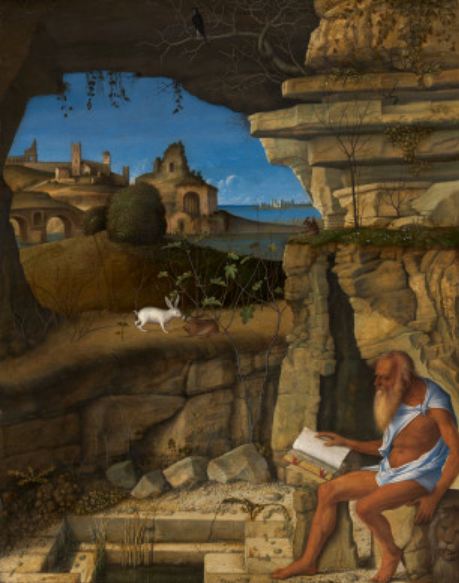
Take for example, the painting above, St.. Jerome Reading from one of my favorite artists of this era, Giovanni Bellini.  The surface and colors of this piece are stunningly pristine looking even though it was painted in the 1480’s.  It looks as fresh as a newly painted work.  I don’t know how much conservation this painting has underwent but one of Bellini’s masterpieces and another of my favorites, St. Francis in the Desert, which is in the Frick Collection in NYC, underwent conservation last year and they said it basically just needed a good dusting off.  Even if it has underwent a little plastic surgery, which I doubt, it is incredible to see it’s surface.

Another favorite is a piece from Andrea del Castagno made from leather stretched over a wooden  frame called The Youthful David that features the image of the biblical David with his sling in hand and the head of Goliath at his feet.  The piece was painted as a shield for probably some wealthy Florentine family to brandish during  the festivals and parades of the time.  I love the color and action of this piece as well as the thought of how many events it has been witness to over the ages, how many parades in which it was carried since it was painted in the 1450’s.

I could go on and on about some of the work there, so many pieces that stop me in my tracks in awe.  I thought I would just mention these two because they hit me most the other day and continually inspire in ways that are not always evident.

Just plain good stuff…

Read Full Post »

A new painting  that is headed for my upcoming show , A Place to Stand, at the Principle Gallery , opening June 8.  This is a 12″ by 36″ canvas that carries the title Almost Blue, a title taken from the great Elvis Costello song.

I often talk about  the color blue as being addictive, about how difficult it is at times to pull myself away the color when I am working with it.  It is the yin to the yang of the reds and yellows I often work with in my paintings.  The reds and yellows are often bold in statement, claiming a small piece of the world as their own and making the case that they have meaning in this world.  The blues, however, don’t make such brash statements.  They create a different atmosphere, one that is quietly questioning why they are here in this world. Blue is a calm sense of wonder and reflection, almost melancholy at times. 

The Red Tree is here but its normally bold statement of self is enveloped in the blueness of the sky and landscape surrounding it, making it feel less like a statement than a question.  There is an uncertainty as to the whys and whats of its existence and the red of the tree seem almost ready to turn to blue.  It is almost blue.

I was going to have a video of either Elvis Costello or his wife, Diana Krall, doing the song here.  Both are fabulous.  But I came across this video of the late jazz great  Chet Baker doing the song in a performance taken from the film Let’s Get Lost, a documentary about his life made in 1988 not long before his death.  If you don’t know much about Chet Baker, you should really check out his bio.  It is the stuff of classic tragedies and will surely someday be the subject of a great film.  This version of the song  is a great expression of his existence and in the photos shown throughout the video you can see the toll that life, violence and drug abuse took on Baker over the years.

Almost Blue…


Read Full Post »

The man who insists upon seeing with perfect clearness before he decides, never decides. Accept life, and you must accept regret.

****************

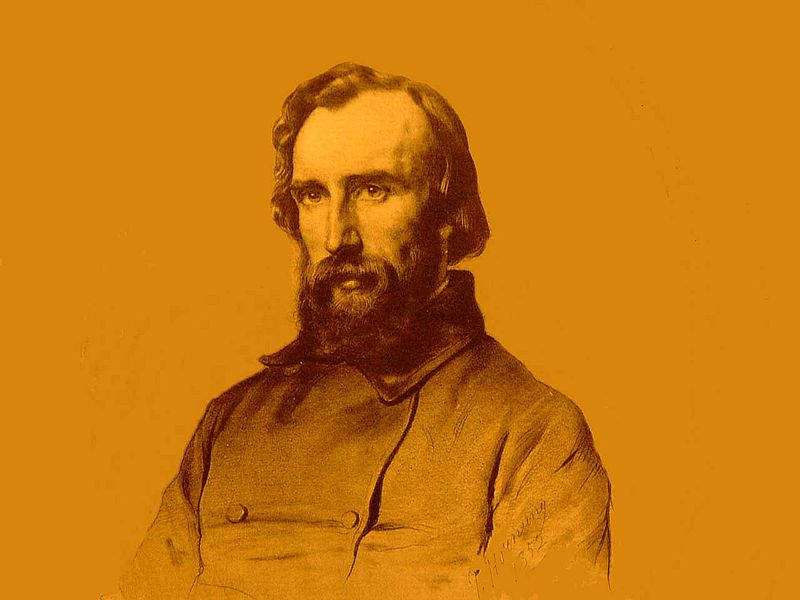
One of the great things about the cyberworld is the ability to find the work, either in image or words, of those people that might easily go unnoticed in the past.  You can now come across a few words or images that intrigue  you and within moments have access to a world of information about the writer or artist.  Such was the case recently when I stumbled upon a few quotes from the writer of the words above and  shown in the portrait above, Henri-Frederic Amiel

Born in 1821, Amiel was a Swiss professor, poet and writer who died in 1881, leaving no major marks on the world before his death.  Although esteemed, his poetry was not celebrated and he made no major breakthroughs as a professor of moral philosophy in his time.  It was after his death that Amiel began to live on in the form of a personal journal that he kept from the 1840’s until the time of his death.  Called the Journal Intime, it is a wondeful inner exploration of the man, exposing a depth of thought apllied to universal truths.  His words, written over 150 years ago in many cases, seem as fresh and as true today as then, a fact that made the Journal Intime a timeless classic  in much the same manner as the essays of Ralph Waldo Emerson

However, despite its acclaim after it posthumous publishing, the book has faded from the modern consciousness  and may not grace the shelves of many libraries.  But thanks to the online world, it is a book that is now readily available to those wishing to read these thoughtful words.  It is available on most book sites and is available free at a number of sites including Project Gutenberg.

So many of the quotes that have been pulled from the Journal Intime ring true for today, including those that could be applied to subjects that are hotly debated in this country such as healthcare and taxation of the richest of us:

In health there is freedom. Health is the first of all liberties.
Sacrifice still exists everywhere, and everywhere the elect of each generation suffers for the salvation of the rest.

I was probably drawn to his words by two that said what I have said for some time.

The great artist is the simplifier.

Learn to… be what you are, and learn to resign with a good grace all that you are not.

The Journal itself is not an easy read.  It is a winding road through the life of one man and doesn’t always reveal its truths quickly.  So if you wish to quickly absorb some of Amiel’s aphorisms, I suggest checking out his pages at BrainyQuote or ThinkExist.

Good stuff…


Read Full Post »

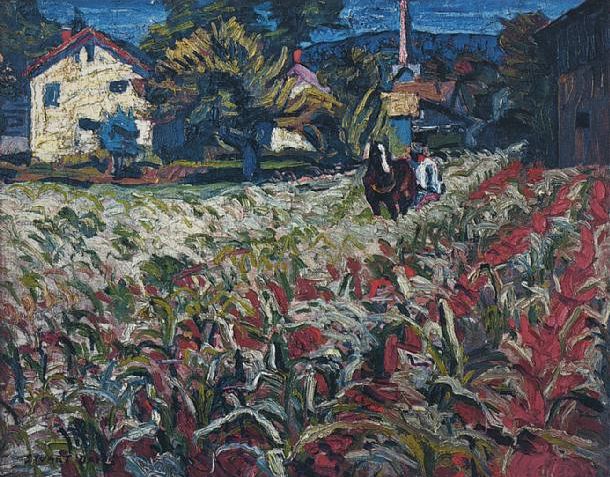
Many of us are familiar with the work of Stuart Davis (1892- 1964), the American Modernist whose paintings presaged the Pop Art of the 60’s.  They were bold and colorful abstracted collages that use imagery from the landscape of the popular culture at the time they were created, creating works that immediately evoke a time.  When I see them I a transported to the New York or Paris of the 40’s and 50’s, with Jazz and poetry blossoming in the aftermath of a devastating war that really changed our perceptions of the world.

But it is Davis’ early work that always intrigues, particularly a small group that was painted not to far from where I live.  There are three landscapes painted just over the state line  in rural Tioga, Pennsylvania in 1919 that are very different from the work for which Davis is best known.  They show a young artist still working in the style of those artists who inspired him, trying on their style and brushstrokes in an effort to find his own voice. 

You can see how  he had been affected by seeing the work of Van Gogh and Picasso for the first time at the legendary Armory Show in 1913, where his own work hung among the emerging giants of modern painting.  Davis was then a student of Robert Henri and painted in a style associated with the  NYC Ashcan school of painters , of which Henri was a leader.  These three pieces have thick. expressive stokes of paint and scream of Van Gogh and have few hints at where Davis’ road would eventually lead him.

The pieces are very accomplished and have a certain charm but it is obvious that they are still derivative and that Davis is still in the midst of his evolution from talented mimic to an original voice.  To me, they are an interesting insight to how we synthesize our broad spectrum of  influences into something truly original.  I would be hard-pressed to say that the man who painted these pieces would eventually become a leading light of abstract modernism but they somehow moved him along in his search for his own distinct voice.  It only goes to show that we should take in everything that excites us even if it seems out of our normal area of comfort.  It may open new and exciting worlds to us that we could never foresee.

Stuart Davis--Self Portrait 1919


Read Full Post »

I’d Find a Way

“Patience and perseverance have a magical effect before which difficulties disappear and obstacles vanish.”

-John Quincy Adams

^^^^^^^^^^^^^^^


I don’t what made this pop into my head but I was thinking about a conversation from a few years back that I had with a friend who is also a painter. He has been an artist for almost his entire adult life, pretty successful for much of that time. We both agree that we are extremely fortunate to have found the careers that we have, one that feels like a destination rather than a passageway to some other calling.

For me, I knew this was the career for me when I realized I no longer looked at the job listings in the classified section of the paper. For most of my life, I felt there was something else out there that would satisfy me but I didn’t know what it was or how to find it. Maybe it was as simple as finding the right job. Or so I thought. When you don’t know where you’re going, any direction might be the right direction.

But during this particular conversation this friend asked, “What would you do if you suddenly couldn’t paint? What if you were suddenly blind?”

For him, it was unthinkable. His life of creation was totally visual, based on expressing every emotion in paint.

I thought about it for a second and said simply, “I’d do something else. I’d find a way.”

In that split-second I realized that while I loved painting and relished the idea that I could communicate completely in paint, painting was a mere device for self-expression. But it was not the only way to go. I knew then as I know now that the deprivation of something that has come to mean so much to me would, in itself, create a new need for expression that would somehow be satisfied. I have always marveled at the people who, when paralyzed or have lost use of their arms, paint with their toes or their mouth . Their drive to communicate overcame their obstacles. Mine would as well.

If blinded, I could or do something with words, using them to create color and texture. Perhaps not at the same level as my painting but it might grow into something different given the circumstance. The need to communicate whatever I needed to communicate would create a pathway.

It was an epiphany in that moment. Just knowing that I had found painting gave me the belief that I could and would find a new form of expression if needed. And i found that greatly comforting.

Yes, I’d find a way…

Note:  The above was originally ran here in April of 2009


Read Full Post »

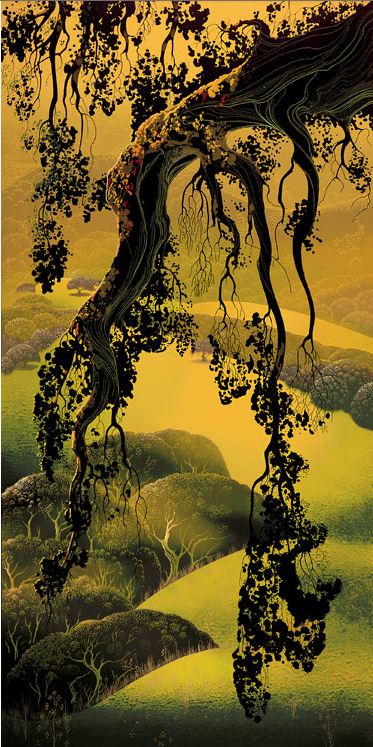
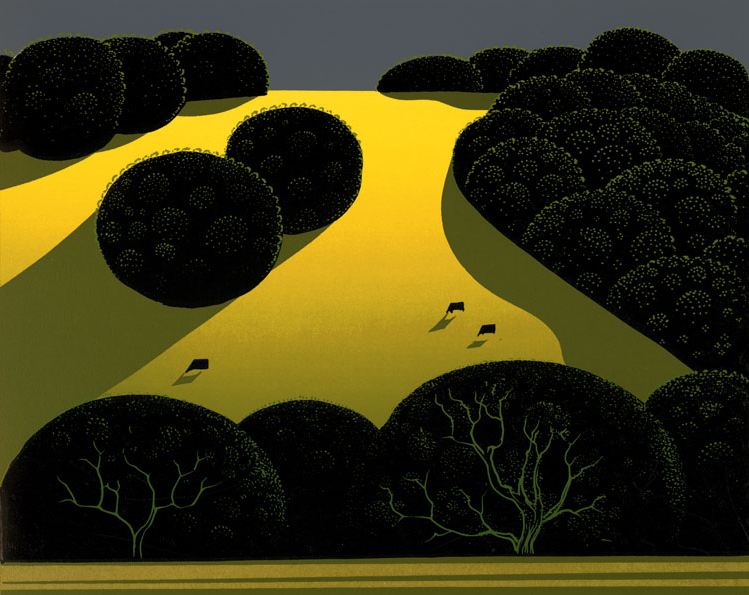
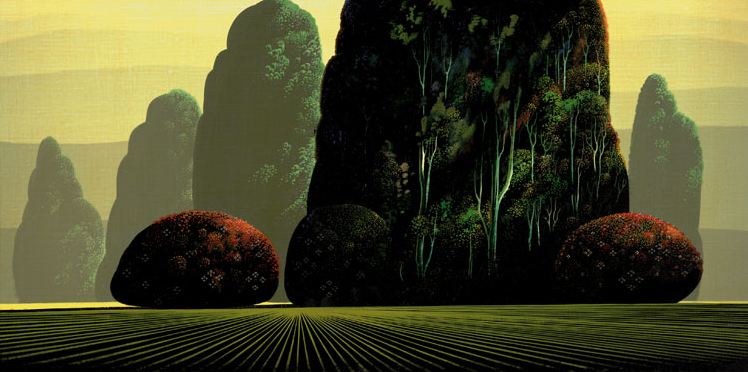
I recently picked up  the second volume of The Complete Graphics of Eyvind Earle, a 9-pound behemoth of a book featuring the work of the artist who I have written about here once before.  It’s an incredible book, full of spectacular imagery and pure color that I find both inspring and humbling.  He had a tremendously long career, about 70 years, that began with a one-man show at the age of 14 and continued through stints as a fabled Disney artist and graphic artist known for his  highly stylized greeting card design.  Through it all, there was an amazing consistency and brilliance to the many pieces produced by a prolific artist in such a long career.  I find myself overwhelmed by the variety and quality of his work as I go through the book which only covers a small part of work.

Just incredible.

There’s great clarity in the work of Eyvind Earle.  The compositions are often both complex in design but come across as simple, a duality that I really find appealing.  The color is bold and could be a little sharp in tone if it weren’t harmonized so masterfully within the picture plane.  He is a pure genius at handling harmony and contrast– another duality that strikes me. 

I also like the fact that Earle was an unabashed landscape artist, feeling no desire to express himself  through figurative work.  He found total expression in his handling of the landscape around him, often depicting the open spaces and coastlines of California. They are not mere scenes but have emotion and a depth that goes well beyond the surface, another aspect that appeals greatly to my  desires for my own work.  In short, it’s just beautiful work and an inspiration with every look.

Read Full Post »

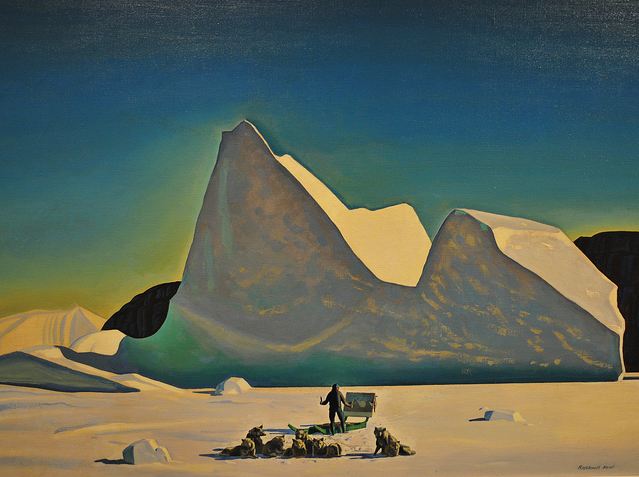
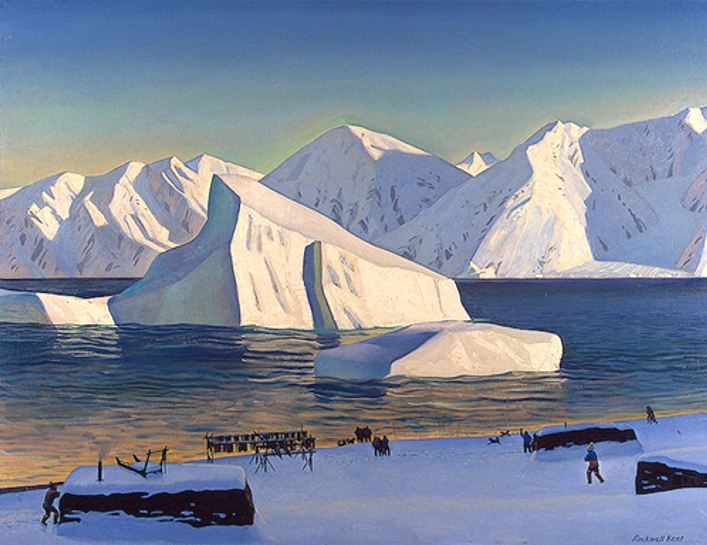
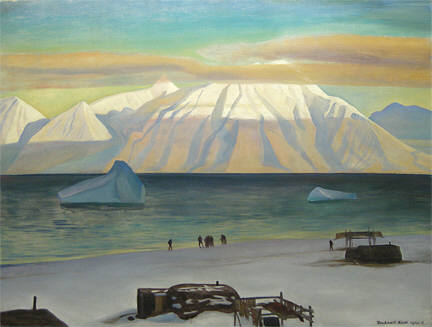
He draws earth as another might draw the exciting and desirable strong body of a man or woman.  His earth is essentially a naked savage earth living out of doors, not so much a cruel and terrifying savage as a wild and free one.

–Grant H. Code on the work of Rockwell Kent

**************************************************

I’ve written about my admiration for the work of Rockwell Kent here in the past, about how his landscapes have a mystic feel, seeming more than mere depictions of this world.  There is an existential aura about them so that when I look at them there seems to be  an added layer of mood and emotion.  It reminds me of the paintings of Edward Hopper that have that peculiar feeling that hints at more than the scene depicts. 

Some of my favorite pieces from Kent are his Greenland paintings, done during the several extended periods that he spent there during the late 1920’s and 30″s.  The colors are beautiful and clear with subtle gradation in the sky that gives it a light and free feel with massive icebergs and mountain faces providing a wonderful counterweight.  As the writer Grant Code wrote above in 1937, Kent  depicts a landscape that is wild and free, not a cruel and terrifying savage.  It’s just spectacular work that has an ethereal air that I can only hope for in my own work. 


Read Full Post »

« Newer Posts - Older Posts »