Bring tea for the Tillerman Steak for the sun Wine for the woman who made the rain come Seagulls sing your hearts away ‘Cause while the sinners sin, the children play Oh Lord, how they play and play For that happy day, for that happy day
–Tea For the Tillerman, Cat Stevens
This was one of those days when I had to go against my instincts in choosing a song for my Sunday Morning Music selection. I came into the studio early this morning and I wanted to hear something louder and more raucous. Not necessarily angry though that wasn’t out of the question.
I first thought of an old Del Fuegos song from the mid-80’s, Nervous and Shaky. It’s a song from a Boston based garage-rock band that had a brief burst of notoriety, looking for a bit like they could be a next big thing. I liked their stuff a lot and this song still pops in my head every so often. I tried finding a YouTube video that captured the sonic boom of the vinyl version but it just doesn’t come through well enough so I moved on.
Then it was Jack White (not quite right today) then late bluesman John Campbell who I featured here ten years ago, writing about being wowed by him in a tiny club opening for the legendary Buddy Guy. Then it the Clash and Little Willie John and on and on.
Nothing felt right to share.
Then I came across a version of Wild World, the old Cat Stevens song– it’s fifty years old!— performed as a duet by him with the late Chris Cornell.
It instantly felt right. It felt nostalgic since the Cat Stevens albums of that time were among the first I bought for myself as a pre-teen and remained on my playlist for quite a few years after. Plus, being aware that it is indeed a wild world out there is a good bit of advice for anyone. So here is that performance with Chris Cornell plus I threw in the very short title track from the album that it was on, Tea For the Tillerman. It’s a song that always strikes a vibrant chord within me.
By the way, the image at the top is the album cover art for that album, created by Cat Stevens. Most folks who grew up in that time will recognize it immediately.
So, give a listen and have a good day. But remember, it’s a wild world out there.
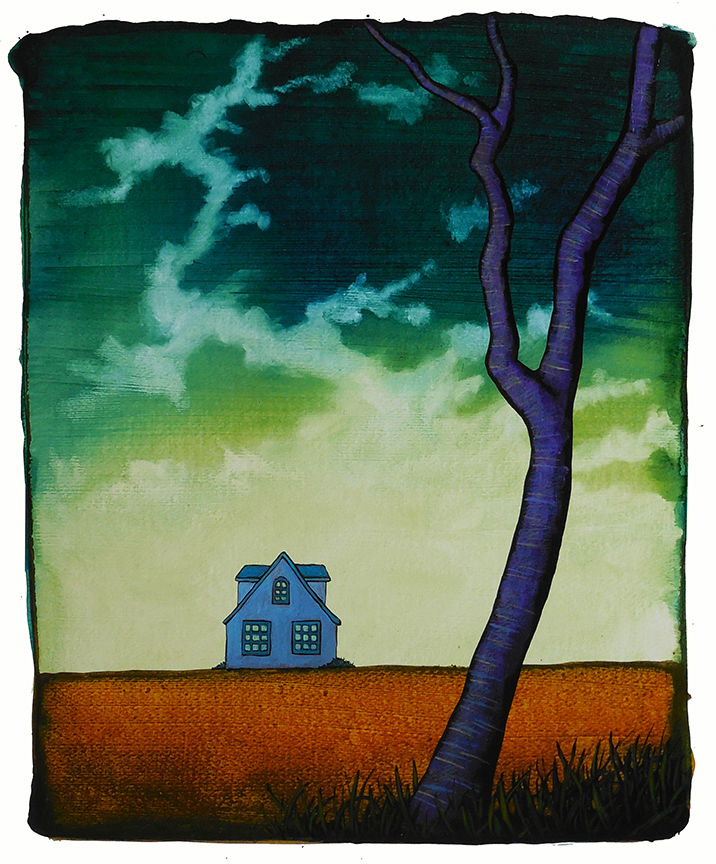
“The Quarantine House” – Now at the Principle Gallery
“But I must go back here to the particular incidents which occur to my thoughts of the time of the visitation, and particularly to the time of their shutting up the houses in the first part of their sickness; for before the sickness was come to its height people had more room to make their observations than they had afterward; but when it was in the extremity there was no such thing as communication with one another, as before.”
― Daniel Defoe, A Journal of the Plague Year, 1722
I see that we, as a nation, had over 70,000 new cases of covid-19 on Friday. It made me think about how this time has changed so many things in daily lives.
So much isolation, which I know is so difficult for so many of us. Economic pain from job losses and businesses closing. And those that do have jobs continue along with the nagging fear that they are putting themselves at risk every day.
And that is without even mentioning the actual virus and its effects on the afflicted and their families.
It made me wonder how this compared to other times and other pandemics. I did a little skimming of A Journal of the Plague Year, written in 1722 by the author of the better known Robinson Crusoe, Daniel Defoe. It tells in journal form the story of a man’s life in 1665 in London when the bubonic plague, the Black Death, ferociously struck that city. That particular episode of the Black Death killed over 100,000 Londoners which was abut a quarter of the population at the time. And that was not even close to being the worst case of the Plague. It literally killed hundreds of millions of people throughout Europe and Asia in the centuries when it was at its peak and it still persists in places where conditions allow it to continue. No herd immunity here, folks.
But looking through Defoe’s book and reading sections made me think how horrible it must have been at that time. To be afflicted often meant being boarded in your home. There would be no contact with the outside world. No internet, no cellphones, no Netflix or Instacart or Door Dash deliveries. You would be completely cut off and alone with your painful imminent death as your companion.
It’s a terrifying prospect. I don’t mean to bring you down with this but I just found it interesting. It made me realize how fortunate we are to have the technological connections that we have. I don’t say that easily because I often find myself damning the persistent and invasive nature of the technology even as I use it.
At least now we can get information, as poor and misinformed as it sometimes is. But imagine being ill, sitting in a dark, boarded up home without any idea what might be taking place outside those walls. No news of possible cures or therapies. No idea of whether this would ever end, that relief might come before death.
I have a hard time imagining the horror of that situation. Nothing in my life, nor in probably most of yours out there, has prepared me for that.
There was another paragraph that sounded familiar:
“But it was impossible to beat anything into the heads of the poor. They went on with the usual impetuosity of their tempers, full of outcries and lamentations when taken, but madly careless of themselves, foolhardy and obstinate, while they were well. Where they could get employment they pushed into any kind of business, the most dangerous and the most liable to infection; and if they were spoken to, their answer would be, ‘I must trust to God for that; if I am taken, then I am provided for, and there is an end of me’, and the like. Or thus, ‘Why, what must I do? I can’t starve. I had as good have the plague as perish for want. I have no work; what could I do? I must do this or beg.”
It made me think again about those folks who have no choice but face the possibility of infection, about those business owners who are at risk at losing everything they have worked much of their lives for. It also reminded me of the foolhardy people who think they are somehow beyond the reach of the virus, that they do not have to concern themselves with the welfare of others.
I am sure there were those same fools during the Black Death.
I don’t know that there’s a point here except to say that I am grateful for being able to ride this out in this era with our technologies, connections and conveniences rather than any of the pandemics from the past. All things considered, we are fortunate. Maybe not too smart but fortunate.
Perhaps two hundred years in the future some person going through a new pandemic of that time will look back on this in some digital archive and say, “Man, I am so glad I didn’t have to live back then!”
And hopefully, they will also be grateful for their own situation.
Be grateful for what you have and have a good day, folks. To that end, here’s a little William DeVaughn with one of my faves.
“But what they find most amazing and despicable is the insanity of those who all but worship the rich, to whom they owe nothing and who can do them no harm; they do so for no other reason except that they are rich, knowing full well that they are so mean and tightfisted that they will certainly never give them one red cent during their whole lives.”
― Thomas More, Utopia, 1516
It might have been written in 1516, but Sir Thomas More sure understood human nature and our ever mystifying adulation for the rich and powerful.
Some things never change.
I am going to leave it at that but do want to add one more thing on the subject of Utopias.
This Saturday evening on HBO premieres the Spike Lee film America Utopia, which is a performance of the recent Tony-winning Broadway show of the same name from David Byrne. It was one of the shows that I would love to have seen. Of course, the pandemic has brought live performance to pretty much a halt. But at least there’s a film to celebrate this show. The trailer looks great.
Here’s that HBO trailer for America Utopia followed by a performance from the Colbertshow from Byrne and the rest of his talented crew. Enjoy and try to have a good day.
“I have learned that if you must leave a place that you have lived in and loved and where all your yesteryears are buried deep, leave it any way except a slow way, leave it the fastest way you can. Never turn back and never believe that an hour you remember is a better hour because it is dead. Passed years seem safe ones, vanquished ones, while the future lives in a cloud, formidable from a distance.”
― Beryl Markham, West with the Night
Spent some time listening to music from the late Chet Baker this morning. There’s always an abundance of raw emotion in his playing and one selection felt right this morning as I watch the leaves falling outside my studio window. Something quite sad and wistful in seeing the leaves drop on this gray morning, much like the feel of much of Baker’s music.
The song is Leaving from a relatively little known album with the same title from 1980. The photo of Baker that accompanies the track below shows him at a late stage of his life when he was showing the ravages of his drug addiction and a few violent episodes. It’s quite a face.
So, settle back in, sip your coffee, let your mind go and give a listen. Then have a good Sunday.
Sounded like the truth Seemed the better way Sounded like the truth But it’s not the truth today
–Leonard Cohen, It Seemed the Better Way
Come on in. It’s safe here today. No commentary, even though the lyrics of the song I am featuring have something to say on their own. But even that is subject to your own interpretation.
I will spare you mine.
The song I am featuring today really struck a chord with me this morning. It is from the 2016Leonard Cohen album, You Want It Darker, which was the last before his death in November of that same year.
A lot of things died that November.
I am sorry. That was commentary.
This song is called It Seemed the Better Way and it features the cantor and male chorus from the Montreal synagogue that Cohen attended as a child. At the time of the song’s release, he described the lyrics of this song as “The feeling of a prayer that’s been there forever, but the spiritual comforts of the past no longer available.“
It raises a lot of philosophic questions. But I’ll let you work on those without my input today.
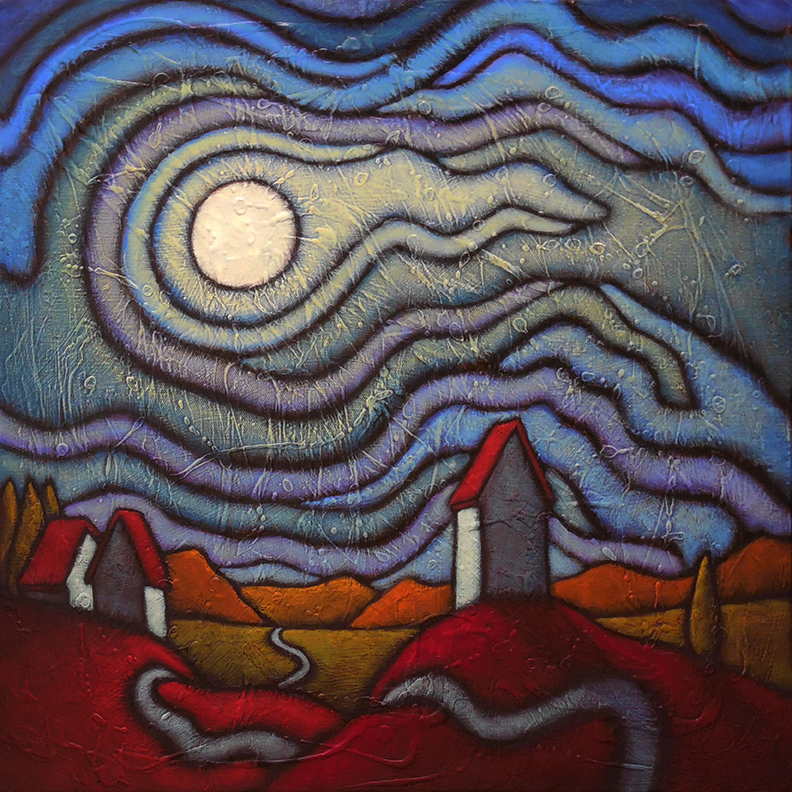
I thought I would accompany this song with a painting at the top that borrows the title and tone of another Leonard Cohen song. It’s Night Comes On and is currently at the West End Gallery. This is one of those personal pieces, those paintings that keep me coming back to look again and again. There seems to be something in these sort of paintings for me that is beyond its shape and form and color and line. It holds something just beyond my comprehension but I somehow understand that it is there even though I don’t yet understand it.
And I may never understand it. Maybe that’s the point.
If you know what it is, let me know. And if not, I certainly understand that, as well.
“Song of Silence”- at Principle Gallery, Alexandria
All your silver, all your gold Won’t shine brighter than your soul
—Rhiannon Giddens, He Will See You Through
Just want to play some music this Sunday morning and not make commentary on anything. Just let it be for the moment.
These are two songs from one of my favorites, Rhiannon Giddens, who never fails to deliver incredible performances.
The first is a new version of her powerful song Cry No More, which was written in response to the massacre at the Emanuel AME Church in Charleston, SC in 2015. This new version and video reflects the distancing of current days and is as emotionally charged in its messaging as the first.
The second song is He Will See You Through from a collaboration last year with multi-instrumentalist Francesco Turrisi. that resulted in a wonderful album, There Is No Other. I love the spare beauty of this song. If you get a chance, give a listen to the rest of the album. Great stuff.
“Mental pain is less dramatic than physical pain, but it is more common and also more hard to bear. The frequent attempt to conceal mental pain increases the burden: it is easier to say “My tooth is aching” than to say “My heart is broken.”
― C.S. Lewis, The Problem of Pain
This certainly is a time of mental pain. It’s time with a lot of moving parts, so many things with so many repercussions all going on at one time. Everything, every emotion and passion, feels heightened.
And that can be overwhelming. After all, most of us devote our lives to avoiding pain and difficult emotions.
Unfortunately, there are times when it can’t be avoided.
This is such a time.
We will all have to dig deep into our inner reserves and call on whatever courage and strength we have accumulated there. And if our reserves feel lacking, don’t despair alone. As C.S. Lewis points out above, mental pain is hard to bear and trying to go it alone makes it even more difficult. Everyone–and I mean everyone–needs help now and then so in these times of super stress, reach out and let someone know.
The exposure is often purifying.
On that note, here’s song from someone who, several years ago, I never thought I’d be playing here. It’s Sign of the Times from Harry Styles, who came to fame as part of the manufactured British boy band phenoms, One Direction. But going out on his own, he has proved himself quite a talent and this song has stuck with me from the first time I heard it a few years back.
Give a listen, reach out to friends and family and have a decent day.
One of the very few surviving drawings from the Warsaw Ghetto
“Zog Nit Keynmol (Song of the Warsaw Ghetto)”
Never say that you have reached the very end, When leaden skies a bitter future may portend; For sure the hour for which we yearn will yet arrive, And our marching step will thunder: we survive!
From green palm trees to the land of distant snow, We are here with our sorrow, our woe, And wherever our blood was shed in pain, Our fighting spirits now will resurrect again.
The golden rays of morning sun will dry our tears, Dispelling bitter agony of yesteryears, But if the sun and dawn with us will be delayed, Then let this song ring out to you the call, instead.
Not lead, but blood inscribed this bitter song we sing, It’s not a caroling of birds upon the wing, But ’twas a people midst the crashing fires of hell That sang this song and fought courageous till it fell.
So never say that you have reached the very end Though leaden skies a bitter future may portend Because the hour which we yearn for will arrive And our marching step will thunder: We survive!
I like history and am a fan of World War II movies. Now when I say that, I don’t mean the combat films, though there are many fine examples. My favorites are those that focus on the people who fought as Partisans against the fascist forces of that time. Movies like Hangmen Also Die!, The Seventh Cross and Watch on the Rhine are such examples and favorites of mine. Casablanca, at its core, is also such a film.
There is something in these films that goes beyond the horror and stupidity of war and brings a very human element into the conversation. For me, it is the portrayal of common people fighting for their freedom and dignity in any way they can against brutal and overwhelmingly oppressive forces that I find so appealing. They often band together in covert underground organizations to form a network that attempts to stymie their oppressors expansive desires.
Many of these groups of partisans had rallying songs that they used to unite themselves and to shore up their strength and courage. In Watch on the Rhine, one of my favorite characters in all filmdom, a Resistance leader played to perfection by Paul Lukas, sings a song that he sang as a German soldier returning from WW I that had been adapted as a song of resistance to the Nazis. Very powerful stuff.
The song below (with lyrics above) is such a song. It is Zog Nit Keynmol which is sometimes called The Song of the Partisans or The Song of the Warsaw Ghetto. It was sung during the siege of the Warsaw Ghetto and is still sung today as an anthem of defiance and perseverance.
And survival.
Most versions of this song are in Yiddish or Hebrew but I am sharing the version of this song from the great Paul Robeson that integrates both an English translation along with the original Yiddish lyrics.
If you need to shore up your own courage and strength in the iffy days ahead, give a listen. Powerful stuff, indeed. Have a good day and stay aware.
The pessimist resembles a man who observes with fear and sadness that his wall calendar, from which he daily tears a sheet, grows thinner with each passing day. On the other hand, the person who attacks the problems of life actively is like a man who removes each successive leaf from his calendar and files it neatly and carefully away with its predecessors, after first having jotted down a few diary notes on the back. He can reflect with pride and joy on all the richness set down in these notes, on all the life he has already lived to the fullest. What will it matter to him if he notices that he is growing old? Has he any reason to envy the young people whom he sees, or wax nostalgic over his own lost youth? What reasons has he to envy a young person? For the possibilities that a young person has, the future which is in store for him?
‘No, thank you,’ he will think. ‘Instead of possibilities, I have realities in my past, not only the reality of work done and of love loved, but of sufferings bravely suffered. These sufferings are even the things of which I am most proud, although these are things which cannot inspire envy.’
― Viktor E. Frankl, Man’s Search for Meaning
Thought I’d kick off the first day of autumn by sharing a painting, And the Glimmer Comes, which I look at from my chair now, a few words from the always inspiring Viktor Frankl on finding meaning in one’s life and a piece of music that brings it all together for me, as someone just in the autumn of his life. Well, I say just but I guess that would be based on a lifespan of 120 years.
High hopes, I suppose.
The music is an atmospheric piece, Good Night, Day, from the late Icelandic composer Jóhann Jóhannsson (1969-2018) who was best known for his scores for films such as Arrival, Blade Runner 2049 and The Theory of Everything.
I am going to leave it at that. Have a good first day of fall.
Things come apart so easily when they have been held together with lies.
—Dorothy Allison, Bastard Out of Carolina
How long can you stand on a tower of lies?
How long can you endure on a tower built with lies for posts and boasts for beams ?
How long before you see the folly in reinforcing one lie with another?
How long before the foundations come apart and fail?
How long before truth comes as gravity to pull this tower down?
How long can we tolerate you standing brazenly atop your tower of lies?
How long until the inevitable collapse comes?
How long until we begin to tally the casualties from the fall?
How long before we begin to build a straighter and stronger tower?
How long can you stand on this tower of lies?
The post above ran back in February of 2017. That seems like an eternity ago now. It asks how long you can stand on a tower of lies.
We may be coming to an answer, at last. The past 3 1/2 years has seen the most remarkable amount of lying and deceit ever to spew from an administration. It is without equal in our history.
Not even close.
The whole administration is a tower built from lies, deflections, spittle, tape and hairspray. It is as weak as the fool atop it.
And now the “Good Germans” who continue to shore up the foundations of this rickety horror show now make no pretense of honesty, openly and shamelessly lying for all the world to see. Their words, their ethics, their moral compasses are worthless trinkets now.
It is obvious they will and plan to do absolutely anything needed to maintain power. There are a number of scenarios floating out there that outline sheer power plays right out of the fascist/authoritarian playbook that might be in play soon. As hard as it is to imagine these things ever coming to be in this land, we have to at least look at them, be aware of them.
I know that four years ago, in September of 2016, I worried that the scenario we’re experiencing might be a possibility with the election of the orange creature. But I felt that my imagination was just running wild and that the institutions, our Constitution, the balance of power would surely be strong enough to hold back the onslaught.
So now, I hope for the best outcome but pledge to be prepared for the worst.
Be aware and prepare.
Here’s another song from people who were in such a situation. It’s Bella Ciao, a resistance song from the Italian partisans, the anti-fascists who fought the underground battle against Mussolini and Hitler during World War II.
Bella Ciao was originally a rallying song for the women who labored in the rice paddies of northern Italy in the 19th century. Their jobs were backbreaking and they were treated poorly which resulted in strikes and riots and the violence that accompanies such things. This was their rallying song. Bellla Ciao translates as Goodbye Beautiful.
This version is from Marc Ribot‘s 2018 album Songs of Resistance 1942-2018 and features the unmistakable vocals of the great Tom Waits. It is a powerful version of a powerful song that still stands as symbol of resistance to authoritarianism to this day.
Let’s hope we don’t have to adopt this song as our own. Be aware and prepare.





 Redtree Times