I just received a copy of a Dutch magazine, Geloven Onderweg, which loosely translates into English as Go Believe. I mention this because it contains an image of one of my paintings, Archaeology: Rainbow’s End, as the illustration for one of its articles. I was approached a few months back about the possibility of using the image in this magazine which is published by the Dominican order in the Netherlands.
The article is written by Jakob Van Wielink and is titled Archeoloog wit een mild hart which translates as Archaeologist With a Mild Heart. Beyond that, there is little I can tell you about the article or any of the other writing in this issue. However, I can tell you that the theme of this issue is outlined on the cover with Trust and the Future in Dutch under the image of a small boy confronting a Mark Rothko painting. Interesting image…
They used my painting in a lovely manner with the image in the upper right hand corner of a two page spread with the image also used as a half-tone underlay. It looks good and I am pleased to be able to have my work exposed in some small way in the Netherlands.
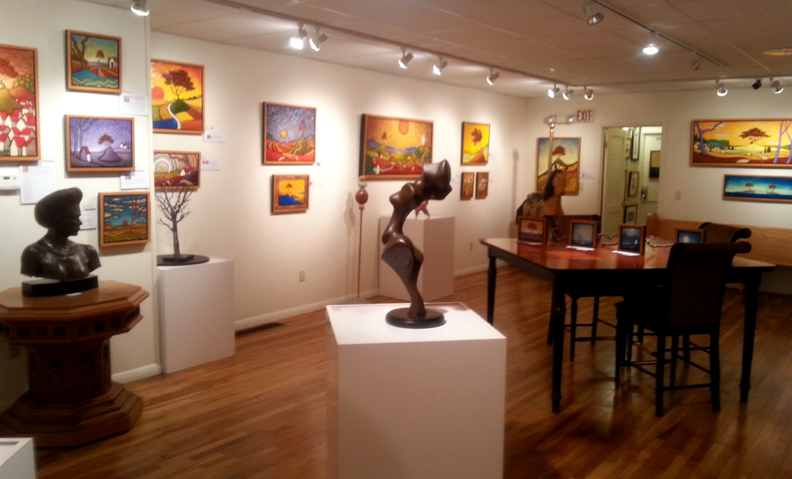
In today’s edition of the Erie Times-News, there is a review of Into the Common Ground, my show currently on view at the Kada Gallery. Written by Karen Rene Merkle, it gives an insightful and positive overview of the show.
It’s always a treat to see how others view your work, especially when they make the effort and spend the time getting to know the work. It is my understanding that Ms. Merkle does just this, giving each piece her undivided attention as she takes in the show at the gallery. This makes it easy for me to fully appreciate her observations and insights about the work.
In the review, she mentioned that over the course of my time with the Kada, going on 19 years now, that the Erie community had adopted me as one of their own. That really struck a chord with me, being a person who has often felt out of place.
I have come to really appreciate the vibrancy of the Erie community, how it has maintained its dignity and identity through its transformation into the 21st century. There is a lack of an inferiority complex and a real strength in their self-belief which dispels any traces of deference to larger cities. As Joe DeAngelo at the Kada Gallery would say: It is what it is.
Most other industrial-based Rust Belt cities have not been able to move forward with the spirit and pride that I have experienced in this city.
So to be adopted by a community that is proud of its people and history and looks forward with optimism makes me happy to call Erie a second home.
I cam across this wonderful graphic from San Francisco based artist/illustratorRoberto Ziche that does a wonderful job of contrasting the sizes of the planets in our solar system with our sun. We earthlings are represented at the bottom by that tiny third marble from the left. If you are tired of all of the dogma, ego and hubris you’re bombarded with on a daily basis, just take a glimpse at this and you’ll be reminded of how insignificant we are in the grand scheme of all things.
To give this even more impact, the graphic above doesn’t even deal with the vastness of the emptiness between the planets and the sun. However, the graphic at the bottom gives us a little more perspective on this front. You could take all of the other planets in our universe and they would fit in the space between our Earth and Moon. With almost 5000 miles of room to spare. We are tiny and far from most anything.
For some, the realization brought on from seeing this might be one of terror, of feeling powerless and miniscule. That’s understandable but I don’t necessarily see it that way.
We are what we are and we exert influence in our own personal universe. We may be but a single letter in a word in a sentence in a book in a library in one city in one country in this entire universe but on that page in that book, our presence can be be vital, affecting everything surrounding us.
Regardless of the scale, we can be vehicles for positive action in our own small universes.
But if we begin to think that we are of more significance than any other letter or word on that page in that book in that library, we need only look at this image for a reminder of where we truly fit in.
You can get a high resolution 27.1 PNG version of the poster above at this site.
Photo by Joe Capra- Scientifantastic Greenland Ice
I was browsing through a few websites that I haven’t been able to keep up with lately and came across this video shot in Iceland and Greenland by photographer Joe Capra aka Scientifantastic. Capra specializes in ultra high definition time-lapse photography, cinematography and still photography and has traveled the world for his assignments for clients such as the National Geographic, the Discovery Channel and Animal Planet. It’s beautifully shot and lushly colored work that has earned Capra a reputation as one of the finest in his field.
This particular film was shot in Iceland and Greenland over the course of ten days as Capra sought to film the Aurora Borealis. I found it very striking and found much in it that reminded me of some of my own work, particularly the shots that highlighted the starkness of the landscape and those where the color of the scene was transformed by the Northern Lights into odd shades and combinations. Just a lovely short film with beautiful imagery, one in which I can find lots of inspiration.
For more info on Joe Capra and his work,click here.
It’s funny sometimes on Sunday mornings, when I am looking for a piece of music to feature here, how I start with an idea of what I would like to use and find myself so far afield from that original thought when I actually begin to write. I will look up a song on YouTube and something on the list on the right will catch my eye and I will click on that and the same thing happens on the next page until after several songs I discover am nowhere near where I began this little exploration. Sometimes it’s good and sometimes not so much. Today I think it was good as it took me to a place and music and an artist with which I wasn’t familiar.
The artist is Tara Kamangar, a talented young American pianist who released an album this year called East of Melancholy which examines the links between the east and west in music particularly between the works of Russian and Persian composers. I listened to several selections from the album and, though I am not a classical musical buff, found them quite engrossing, particularly the piece I have selected for today, Homage to Omar Khayyam composed by Iranian Aminollah (Andre) Hossein (1905-1983).
Omar Khayyam , who lived from 1048-1131, is best known to us today for his poetry which were composed in four line verses called ruba’i. The image above is one of these verses in Persian, each leg representing a line of verse. The collection of these ruba’i is a rubaiyat from which we get the title of the work which we know best as TheRubaiyat of Omar Khayyam. It has survived the last almost thousand years aided by Edward FitzGerald‘s famed translation which brought it to the attention of the west as well as reintroducing him to Iranians who had lost touch with the work.
However, the rubaiyat overshadows Khayyam’s vast influence on the world. He was a true renaissance man, several hundred years before the idea of such a thing even existed. He was a mathematician, an astronomer, philosopher and poet. He wrote treatises on many subjects that shaped the modern world. Truly, a giant of the mind yet we know him mainly as writer of short verses.
This piece begins with one of these verses:
The Moving Finger writes; and, having writ, Moves on: nor all thy Piety nor Wit, Shall lure it back to cancel half a Line, Nor all thy Tears wash out a Word of it.
Something to think about on a Sunday morning. Hope you have a great day.
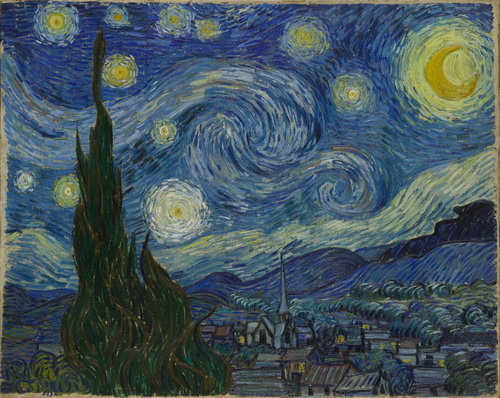
The Starry Night by Vincent Van Gogh is one of the most beloved paintings of all time, stirring all sorts of emotions from a wide spectrum of the population as it presents a paradox of serenity and turbulence in the night sky of Provence. It has been analyzed to death by art critics, psychologists, theologians and every art history student since it was painted in 1889, each striving to explain the meaning that they pull from it.
And maybe they’re all right.
But recently there has been a different analysis of this work. It has to do with fluid dynamics and the problem of finding a mathematical equation for turbulence– the sort of turbulence you might see in an eddy in a stream or that which is depicted in the swirling light and color of Van Gogh’s painting. Russian mathematician Andrei Kolmogorov (1903-1987) came closest to solving this problem in the early 1950’s yet it remains one of the great unsolved problems of physics.
Back in 2004, the Hubble telescope picked up images of eddies of gas and dust around a distant star and scientists were reminded of Van Gogh’s painting. Scientists from a number of countries collaborated on an analysis of the luminance in his painting and discovered that the structure of his painting was very much patterned like Kolmogorov’s equations for turbulence.
I am not going to say much more. There is a wonderful short film below from TED-Ed and Natalya St. Clair that much better explains this. But before you watch, I wanted to add one more thing which is the supposed inspiration for Van Gogh’s sky.
There was a drawing that was well known in Europe in the latter part of the 19th century that was done by William Parsons, also known as Lord Rosse, who had built a large telescope on his Irish castle in the 1840’s. Called Leviathan, it was the largest telescope in the world until 1918. With it, Lord Rosse was able to observe the great swirls of the near universe, turning them into drawings which circulated throughout Europe. This one shown on the left is of the Whirlpool Galaxy, M51, and is believed to have been the spark for Van Gogh’s sky.
Anyway, watch this great short on the analysis of Van Gogh’s great painting. Or perhaps you would rather just be content with our own interpretation of the work and what it does for you personally. Either way is good.
Last week I showed the Merry Cemetery in Romania with its colorful wooden tombstones. After that, a friend sent me a link to another blog that showed an image of a nearby monastery, Peri Monastery, in the same town, Sapanta. It was a magnificent structure, supposedly the tallest wooden structure in Europe, that looked like something pulled from a fairy tale. Despite its appearance, it is a new structure but one that is in the tradition of the wooden churches of that region, with wooden shingles on the roof and wooden pegs used throughout instead of nails.
Nearby is the bell tower for the monastery. It is an equally striking building as is the carved gate to the grounds.
Bell Tower, Peri Monastery, Sapanta, Romania
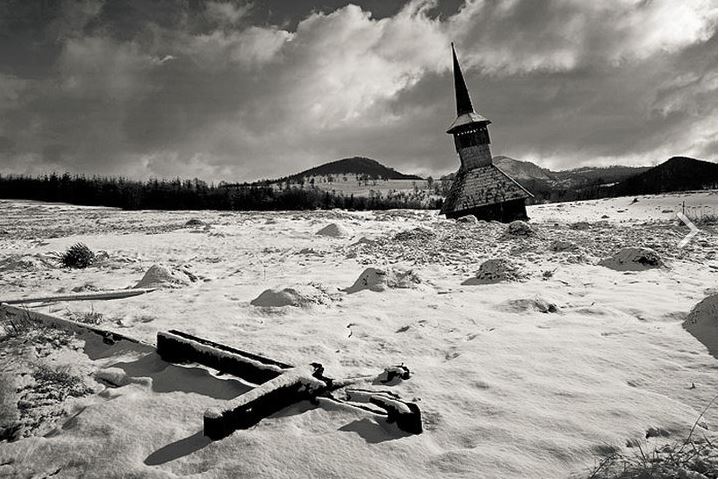
While looking at some other images of this monastery, I came across these images below that captured my imagination. One is a winter scene of a destroyed church. I don’t have any info on the story behind this but it is an intriguing photo. The other is of haystacks in the field. They stack the hay on poles which creates these slender, almost human-like shapes, that seem to be marching across the fields. Fittingly, the Romanians call them Germans. I kind of think they look like the Shmoos from the old Li’l Abner comics.
It’s a few days before Halloween which conjure up all sorts of macabre images, especially those of creepy cemeteries. I am not one of those people who are repelled by the thought of cemeteries and I am sure I have mentioned my fondness for cemeteries on this blog.
I’ve always been attracted to the peacefulness of them, the shape of the stones and the names inscribed on them. I try to imagine the lives behind those stones and names, trying to somehow connect with their essence. I even speak to them sometimes, especially those that I know or those who have become my favorites in the cemeteries where we regularly walk. For instance, I always say hello to one couple with what I consider wonderful names– Arthur and Flora Greengrow.
Grim Reaper Figure at Base of Tombstone
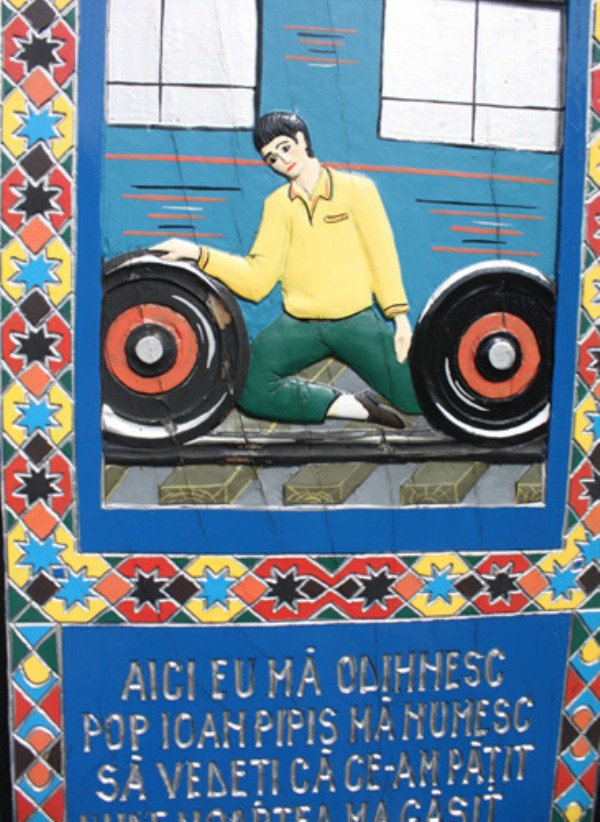
While many of us here are scared a bit by cemeteries, there are place where that is not the case. There is, for example, Merry Cemetery in Sapanta, Romania. It is filled with brightly colored wooden tombstones that are carved with a sometimes humorous limerick and naively painted images depicting the deceased at work or play . Sometimes, however, the stones show how the person died. These images can be a bit gruesome but even then there is a lightness about the tombstone. You see, they are aligned with the Dacian culture which is associated with the Zalmoxian religion which has a differing view on death compared to most, seeing it as a moment of great joy filled with the anticipation of the better life that is waiting.
With the bright blue tombstones and descriptive and often humorous limericks ( there is a very funny one about a woman where the voice of the limerick is her son-in-law who hopes she is happy now because he doesn’t want her back), Merry Cemetery has become a worldwide tourist attraction with crowds traveling to see the 800-some tombstones. I guess it’s always a Happy Halloween in Sapanta.
Here a few views of some of the tombstones:
Merry Cemetery Tombstones Romania
Tombstones with a boy drowning and a girl being hit by car
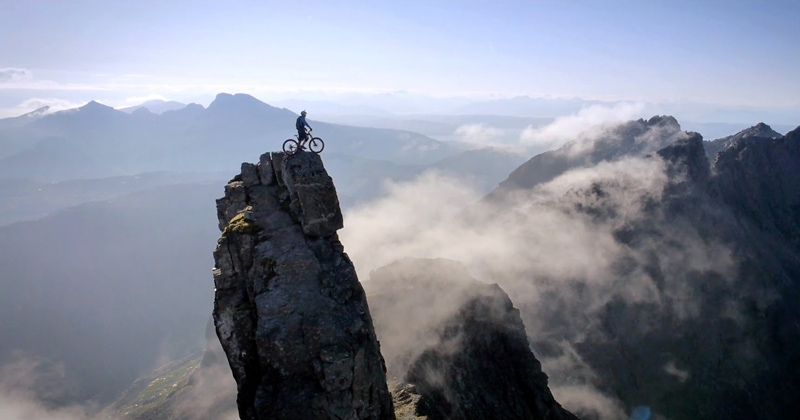
Danny MacAskill is a Scottish bicycle trials rider, which means he has amazing bicycle-handling skills. Trials riding involves going through extremely difficult obstacle courses without setting a foot to the ground at any point. MacAskill has taken this ability to new levels over the years, traveling the world to find ever more arduous challenges for him and his bike, releasing a number of videos documenting his feats. You can go to his websitefor more information on his past exploits.
But perhaps his greatest feat to date took place in the very place from which he came, the Isle of Skye in Scotland. He recently took on the fabled peaks of the Cuillin Mountains, a rugged and jagged ridgeline that seems almost impassable for anyone on two wheels let alone two legs. The resulting film is a beautifully shot and pretty amazing. There is breath-taking scenery and riding that will make you hold your breath. If you have a few minutes, take a look. You will be thrilled in some form.
Today, October 1, is the 99th birthday of groundbreaking psychologist Jerome Bruner, who, by the way, still teaches at NYU. To be honest, I don’t know a lot about Bruner or his work. But on theBrainPickings site today, Maria Popova wrote a wonderful essay about one of Bruner’s articles, Art As a Mode of Knowing, from his 1962 book, On Knowing: Essays For the Left Hand. In it she describes how : Bruner considers the unique language of art and how it complements that of science. He outlines the four psychological aspects of the art experience — connectedness, which deals with the reward of grasping the essential ideas a work of art communicates; effort, which we exert to draw meaning from the ambiguity of art; conversion of impulse, which makes an object of beauty move us; and generality, which deals with the universal aspects of what we find beautiful and moving.
It’s a great article, one that I highly recommend for anyone who has wondered about what defines the difference between art and decoration and why we are moved by some works and left emotionally unsatisfied before others. I know that I am often perplexed by work that I see that is incredibly crafted and beautiful to look at yet doesn’t raise any response from within me. What is it that makes this beautiful thing so cool and vacant? Is it art or is it just a wonderful decorative piece? Popova’s article sheds some light on Bruner’s insights into this matter and it rings true for me.
Happy birthday, Professor Bruner, and thank you for these wonderful observations.
 I just received a copy of a Dutch magazine, Geloven Onderweg, which loosely translates into English as Go Believe. I mention this because it contains an image of one of my paintings, Archaeology: Rainbow’s End, as the illustration for one of its articles. I was approached a few months back about the possibility of using the image in this magazine which is published by the Dominican order in the Netherlands.











 Redtree Times