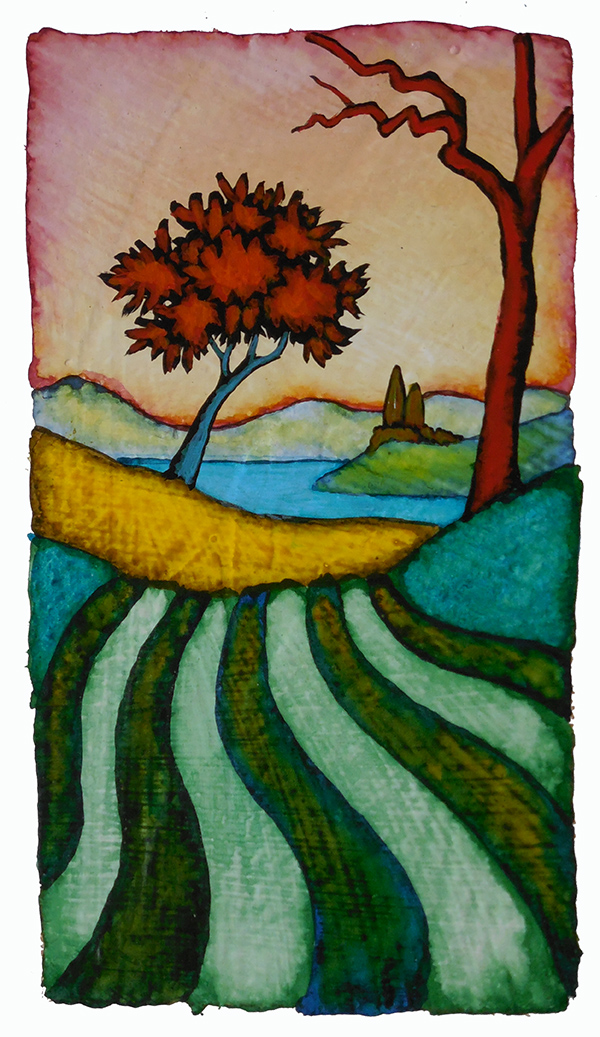
When I finished this small painting, the term Seventh Heaven quickly came to mind and bound itself to it as its title. There was a quality attached to it that evoked that phrase that I’ve heard thousands of times, mostly describing a time and place of immense satisfaction.
Bliss.
But in all those times I never thought about what Seventh Heaven really meant or where it came from. It was just a phrase that was thrown around easily without thought.
Turns out it has beginnings and attachments to the ancient Greeks, the Kabbalah of Jewish mysticism and in Hindic and Islamic belief.
The Greeks’ believed there to be seven classical planets beyond our earth —Mercury, Venus, the Moon, the Sun, Mars, Jupiter, and Saturn— each having its own heaven.
In the Jewish Kabbalah, there are seven levels of heaven, each ruled by an angel. For example, Shamayim is the first heaven, governed by Archangel Gabriel. It is the closest of heavenly realms to the Earth; it is also considered the abode of Adam and Eve. The seventh heaven here is called Araboth. Under the leadership of the angel of Saturn, Cassiel, it is the holiest of the seven heavens, housing the Throne of Glory attended by the Seven Archangels and serves as the realm in which God dwells. Beneath the throne itself lies the abode of all unborn human souls. It is also considered the home of the Seraphim, the Cherubim, and the Hayyoth.
The Islamic seventh heaven is similar in many ways to that of the Kabbalah, comprised of a divine light that is incomprehensible to mortal man.
Hinduism divides the material universe into fourteen worlds, seven of them being upper and seven being lower. Brahmaloka is the highest of the seven upper worlds, the highest of the joyful worlds a person might attain. It is the home of Lord Brahma.
There’s more but we’re going to keep this shallow today. It comes down to all of the different forms of Seventh Heaven denoting a place of ultimate joy.
That description fits this little piece, with its seven rows in the field of the foreground, for me.
It is a seventh heaven by itself. Even if it brings me only a moment of bliss, that’s I all I can ask for here on this earth, I suppose.
******************
This piece, Seventh Heaven, is part of the Little Gems exhibit at the West End Gallery which opens Friday, February 7 with an opening reception that runs 5-7:30 PM.
The annual Little Gems exhibit opens this coming Friday, February 7, at the West End Gallery in Corning. This is the 26th year that the West End has hosted this show and I am fortunate to have been along for the ride, going back to that first one in 1995 at their second story old gallery space.
That was my first experience showing my work publicly. I had no idea what to expect when I stood there, anxiously trying to blend into the background as people milled around the gallery, on that night of the first opening. But based on the past 25 years, things seem to have worked out okay.
For me and for the Little Gems show which has turned out to be a perennial favorite for fans of the West End Gallery. It is the most popular show there, year in and year out. It’s fun for most of the artists to make small work and perhaps try out new things. There are plenty of small but mighty paintings created for this show which allows attendees, be they avid or first-time collectors, to attain original and high quality pieces of art at obtainable prices.
This painting above is called Riding High. I haven’t looked back but I think a boat painting is part of my contribution for this show most years. It’s a theme and an image that translates well to a smaller scale, maintaining its full impact. By that, I mean that it seems bigger on the wall than it actually is.
A lot of the work throughout this show have that quality.
So, hope you can make it to the show this Friday, February 7. The opening reception begins at 5 PM and goes to 7:30. The show is hanging if you want to stop in for a preview and to claim a little gem for yourself.
Here’s a song from the late June Carter Cash‘s final album that I think lines up well with this painting. It’s a lovely old Carter Family song called Sinking in the Lonesome Sea.
“I’m not sure this will make sense to you but I felt as though I’d turned around to look in a different direction so that I no longer faced backward toward the past but forward toward the future. And now the question confronting me was this: What would the future be”
― Arthur Golden, Memoirs of a Geisha
**********************
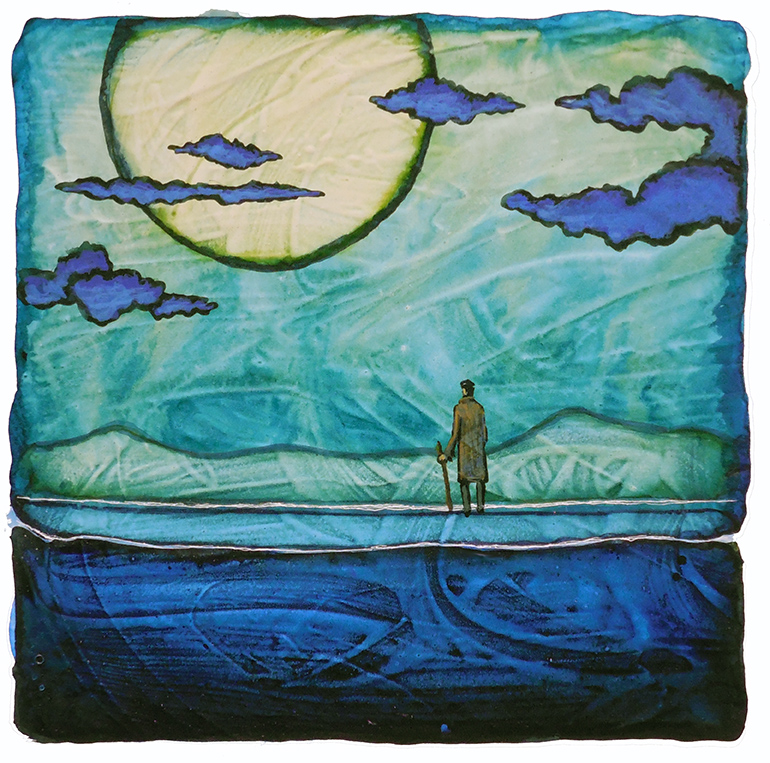
This small painting that is hanging as part of the Little Gems exhibit at the West End Gallery (opening Friday, February 7) is titled Memoir.
The thought behind that title was that that while the future seems uncertain as we look forward, our pasts as we recall them are often just as uncertain.
Our personal histories are a patchwork, like the sky in this painting, of half memories and dimly lit stories. Faces and names fade. Words once spoken are lost in the void. We have grainy snips and snaps of what we recall as significant moments and some surprisingly sharp images of insignificant moments that puzzle us, leaving us to wonder why they remain so clear.
Do they mean something more and we just don’t see their true meaning?
I looked at this small piece and wondered what I would include in my memoir. What would I pull from that haphazard patchwork that I would want to share now and into the future?
After sifting through the shards of broken memories, I come to the conclusion that I don’t want to write a memoir. Let my memoir show itself in my work, let my story be told in paint and line and shapes, a crude group of hieroglyphs that will no doubt go untranslated in generations to come.
Let the future, if it is so inclined, write my past. That shall be memoir enough for me.
For this Sunday morning music, here’s a song to go along with this painting. It’s the Nick Lowe pop classic, When I Write the Book.
The world was on fire and no one could save me but you It’s strange what desire will make foolish people do
—Chris Isaak, Wicked Game
************************
Another piece headed to the West End Gallery for their annual Little Gems exhibit, opening next Friday, February 7. It’s called Wicked Gameafter the title of the Chris Isaak song from 1989. Wow, hard to believe it’s been that long. But that opening line– The world was on fire…— was the first thing that came to mind when I finished this little piece.
It fit the painting.
As does the second line– It’s strange what desire will make foolish people do…– which fits the time, this particular moment in history as we watch a Republican party so fixated on their desire to maintain power that they will turn a blind eye to the corruption of our system that has taken place in the open for us all to see. The question of whether they will ever stand up for truth and justice, against those wrongs we know have been done and those we expect will be done in the future, seems to leaning toward a big and emphatic NO.
Doing that which is right even when it doesn’t personally benefit you or goes against your personal interests is a noble and honorable thing.
Don’t expect to see such a thing anytime soon.
Like the song says: It’s strange what desire will make foolish people do. Put on your seatbelts, folks. It’s going to be a bumpy ride.
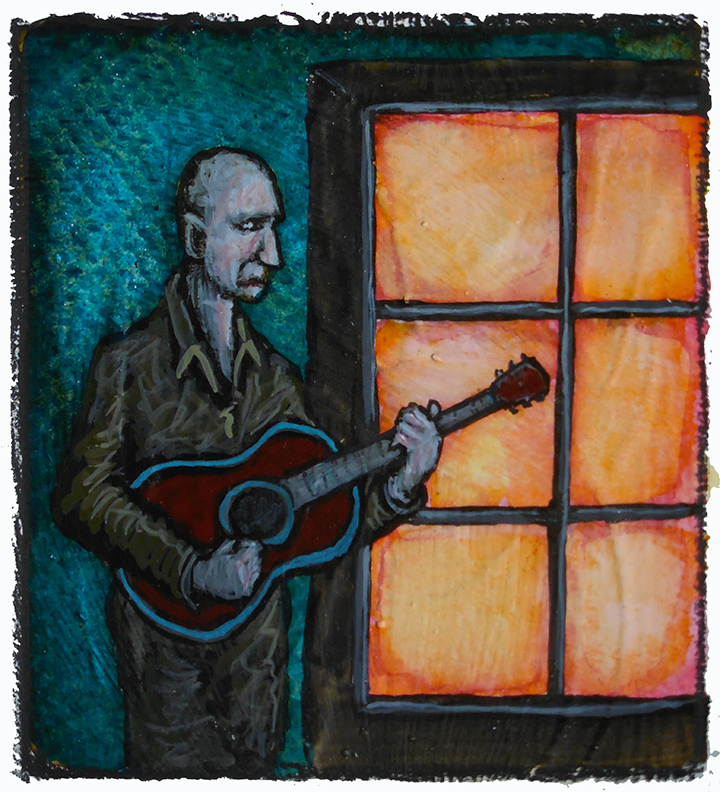
This is a new piece, Walking Blues, that is headed to the West End Gallery for the annual Little Gems exhibit, which opens on Friday, February 7. As I have mentioned here before, the Little Gems show occupies a special place in my heart. The 1995 show was the first time my work was ever shown to anyone outside of my family and a very few friends.
It was a life changer for me, the first real big step in moving from what felt like an old life into a new and altogether different life.
And it felt like that at the time. It was abundantly evident for me. It wasn’t one of those things that happens without you really feeling the gravity of what is taking place. I didn’t know where this path would lead me or if I could even stay on it for long. But I knew it was a new path that had, if I was willing to really commit and work for it, the potential to change my life in some way.
And it has.
While this coming show is actually my 26th Little Gems show, it marks 25 full years of doing this, of transforming my feelings into paint, embedding thought into material. Standing at that first one back in 1995, anxiously watching to see if anyone even looked at my work let alone showed interest, there was no idea that it would lead here.
Like so many things, I just didn’t know.
But I am glad for it. And thankful.
Hopefully, I will be reminiscing about that first show on the occasion of my 50th Little Gems exhibit, 25 years (well, actually 24 years) from now.
I don’t know but we’ll see.
Here’s a version of the great blues classic, Walkin’ Blues, whose title I pinched for this painting. It originally recorded by the legendary Robert Johnson but I thought this very unique performance by contemporary bluesman Guy Davis amidst the stark beauty of the snow and ice of Uummannaq, Greenland, 369 miles north of the Arctic Circle fit this little gem of a painting pretty well.
I have posted This description of one of the process for one of my paintings, followed by a short video showing its evolution from start to finish, a couple of times over the past nines years. I thought it might be a good time to revisit it as there are many new readers who may not be familiar with how my work comes together. I paint in two distinctly different processes, one being a reductive process where I put paint on the surface then remove much of it and this process that is additive, with layer after layer of paint building up. Here’s what I wrote in January of 2011:
I worked on a new piece the last couple of days, a large canvas that is 24″ by 48″. I had already gessoed the canvas with a distinct texture and applied a layer of black paint. I had vague ideas of where I thought the painting might go from a composition standpoint but knew that this was only a starting point in my mind. Like most of my paintings, the finished product is often drastically different than what I imagined at the beginning. As I paint, each bit of paint dictates the next move and if I don’t try to force in something that goes against these subtle directions given to me by the paint the piece usually has an organic feel, a natural rhythm in the way the different elements go together. A cohesion of sorts.
Knowing I wanted to use a cityscape in this piece, I started in the bottom left, slowly building the city with geometric forms and rooflines in a red oxide paint that I use to block in my composition. I prefer using the red oxide because it gives a warmth under the layers paint to come that shows through in small bits that are almost undetectable at a quick glance.
At this point I still am unsure where the painting is going. I have thoughts of filling the canvas completely with the cityscape with the smallest view of the sky through the buildings but am not married to this idea. The paint isn’t telling me enough yet to know. But it has told me that I want a path of some sort- a street or canal- through the composition. I make room for one near the center before starting on the right side with the buildings there. I go back and forth between the right and left sides as I build the city, constantly stepping back to give it a good look from a distance to assess its progress and direction.
At a point where the city is nearing the halfway point on filling the canvas, I decide I want this piece to be less about the cityscape and more about how it opens to the open sky beyond it. I extend the road that started at the bottom and twist it upward, terminating it at a bend in what will be now a field beyond the city edge. The sky, though still empty, is pushing me ahead, out of the city. The piece has become about a sense of escape, taking the street from the cityscape and heading upward on it towards the open fields and sky. Painting faster now, another field with a bit of the road appearing is finished beyond the first lower field. I have created a cradle in the landscape for the sky to which I now turn my brush.
There’s a certain symmetry at work here and I decide I want the central focus of a sun in this composition. I roughly block in a round form, letting it break beyond the upper edge of the canvas. I pay little attention to the size of this sun except in its relationship to the composition below it. My suns and moons are often out of proportion to reality but it doesn’t matter to me so long as it translates properly in the context of the painting. If it works well, it isn’t even noticed.
I finish blocking in the sky with the red oxide, radiating the strokes away from the sun, and step back. [The video below basically begins at this point in the process] The piece has began to come alive for me and I can start to see where it is going. The color is starting to fill in in my mind and I can see a final version there. This is usually a very exciting time in the process for me, especially if a piece has a certain vitality. I sense it here and am propelled forward now, quickly attacking the sky with many, many brushstrokes of multiple colors. working from dark to light.
There are layers of a violet color in different shades that are almost completely obscured by subsequent layers. I could probably leave out these violet layers but the tiny shards that do barely show add a great depth to the flavor of the painting for me and to leave them out would weaken the piece in a way.
I have painted several hours on the sky now and still have a ways to go before it reaches where I see it in my mind. There are no shortcuts now. Just the process of getting to that final visualized point. But it’s dinnertime and my day is now done. I pick up and step back to give it one final look before I head out into the darkness. This is where the painting is at this point, where I will start soon after I post this:
In the blog post with the final version I then wrote:
Above is the tentatively finished version of the painting I started earlier this week, a 24″ by 48″ canvas that I am considering calling Escape Route. I showed the first few steps of the painting process on this blog two days ago, ending with the sky being near finished and the composition blocked in. I’m not going to go into all the steps and decisions that went into completing this piece. Instead, I put together a short film that shows the painting evolving to the finished product.
I will say that the final version is much different in many ways than I first envisioned with the first strokes of red oxide that went on the canvas. Each subsequent bit of color, each line that appeared, altered the vision in my head just a bit, evolving the piece constantly until the very end of the process. Even the last part, where I inserted the treeline that appears on the farthest ridge, was not seen in my mind until just before the decision to proceed with them was made. I decided to go with this treeline to create a final barrier for the road to break past on its way upward toward the sky. A final moment of escape.
This painting has given me a great sense of satisfaction after finishing it. I spent much of the late afternoon yesterday just looking at it and taking it in. I don’t know if it will translate as well on the computer screen but this piece has substantial size at 24″ by 48″ which gives great weight to the blocks of color from the buildings and the light from the sky. There is a sense of completeness here that I could only struggle to explain, but as I said, brings me great satisfaction. I feel as though the evolved painting has exceeded what I imagined when I first started this piece. While I can’t fully explain that, it is all I can hope for from my work.
I will spend some more time over the next several weeks looking at this painting, determining if anything should be tweaked or altered. A highlight added here, a line made crisper there. But as it stands, it feels as thought it has taken on its own life and I will probably leave it alone as it is.
And here’s the video, only about a minute long, that shows how the piece came about.
I found that if I planned a picture beforehand, it never surprised me, and surprises are my pleasure in painting.
–Yves Tanguy
*******************
Thought we’d start the new year with a quick look at the Surrealist painter, Yves Tanguy. I can’t say I know a lot about Tanguy, who was born in Paris in 1900, raised in Brittany and died in Connecticut in 1955. He first was attracted to painting in 1922 after seeing a Giorgio De Chirico painting in the window of a Paris art dealer as he was riding a passing bus. He jumped off the bus and went back to study the painting. That was the experience that set off his career.
But with the little info I could quickly glean, I found that we shared a few similarities. One was coming to painting with little training. I consider myself basically self taught and, while he had did some sketching before his brush with De Chirico’s work, Tanguy basically set out on his career as a painter with no formal training. His self taught style developed quickly and was recognizable and celebrated within several years.
He also practiced automatism in his work, which is just a more formal word for having no real plan as you start a painting. I actually didn’t know there was a word for this though I’ve been practicing it for decades now. Much like he said in the quote at the top, I also take great pleasure in the surprises that come from working this way. There’s a form of revelation in working this way that I can’t get when beginning a piece with a predetermined outcome.
Tanguy also described the effects of his automatism this way: The painting develops before my eyes, unfolding its surprises as it progresses. It is this which gives me the sense of complete liberty, and for this reason I am incapable of forming a plan or making a sketch beforehand.
I understand this completely.
He also said: I believe there is little to gain by exchanging opinions with other artists concerning either the ideology of art or technical methods.
I hate to admit it but I kind of agree with this. Don’t get me wrong, I very much enjoy talking with other artists, hearing about their experiences and their breakthroughs. But I don’t really like to talk about my own process or my ideology with other artists. Oddly enough, I am more likely to do this with a group such as at a gallery talk. There, I feel like I am simply describing what I do and not giving advice or direction, which I dislike giving to other artists.
I think art comes from having an idea of what one wants and needs to get from their art as well as their individual knowledge of their strengths and weaknesses as applied to technique and materials. I can’t tell someone what they need from their own art or how it should make them feel. Nor can I tell them how they will better understand what they know about the paints or tools they use. I can give little ideas but they must gain their own insights through their own experiences.
I’ve often said there is no right or wrong in art and this hesitancy to exchange opinions is just an extension of that. What might be right for me or Yves Tanguy might not be right for another artist.
Okay, I know there is a that can be debated here but I am tired of even talking about this right now. Let’s just look at few Yves Tanguy paintings, okay?
Yves Tanguy- The Sun In Its Jewel Case – 1937
Yves Tanguy- There, Motion Has Not Yet Ceased – 1945
Every saint has a past, and every sinner has a future.
–Oscar Wilde
***********************
Yesterday, I wrote about trying to go back through my work from the past decade and choose pieces that best summed up each year. It’s a difficult, if not impossible, task. There are often many different directions that the work moves in over a given period of time or sometimes pieces that strike a chord most for me may not represent the larger body of my work for that time period.
This past year, for instant, had many tentacles. The landscapes began appearing with multiple beds of flowers. The sailboats took on larger and more expressive waves. A new female figure emerged to paddle across flat waters. And, of course, the faces from my Multitudes series began to appear.
All of these elements will no doubt remain in play for the near future and maybe well beyond that. Who knows? And who knows what new things will emerge to grab my focus?
I sure don’t.
The piece shown here, Saints and Sinners, is from this year’s Multitudes series. It’s a favorite of mine, one that I might consider as a piece to represent this past year, at least for its particular tentacle. It’s a painting that I think works well for ending this year and welcoming the next. It has a feeling of looking backward and forward. Of examining what we have been, what we are and what we might someday be.
As I like to say: What I was then is not what I am now and what I am now may not be what I will be in the future.
None of us are fully saints or sinners. There may be a few who are fully sinners well beyond redemption ( ** comes to mind) but most of us are in that boat that drifts between the two opposite shores.
I am hoping that we drift closer to the saintly shoreline in 2020.
In my picture of the world there is a vast outer realm and an equally vast inner realm; between these two stands man, facing now one and now the other, and, according to temperament and disposition, taking the one for the absolute truth by denying or sacrificing the other.
—Carl Jung
*********************
Time flies.
We’re looking at another decade slipping away. I originally didn’t give much thought to any way of marking this but in recent days began looking back at work from the past ten years, trying to to see if there was a single piece that summed it up for me.
That is really difficult. Even trying to choose a single painting that sums up a single show or year is often near impossible. There are favorites, pieces that speak to me more personally than others, but they often don’t reflect the body of work as a whole. But choosing one that stands as a symbol for ten years of hard work seems out of the question.
But I tried and came up with a few that stood out as possibilities. The painting at the top, for example. It’s The Internal Landscape from 2012. It’s a large piece, 4 1/2′ by 7′, and was the titular centerpiece of my show that year at the Fenimore Art Museum in Cooperstown, NY.
It’s a painting that has meant a lot to me, as far as building a confidence in myself that my work had lasting value that might carry it into the future somehow. I had been a full-time artist for about 14 years at the point that this was painted yet I still wasn’t confident my own evaluation of my work. I felt that it was a real expression, not mere decoration. It was my inner reality and like, Jung’s words above, I often found myself torn between this inner realm and the outer realm of the world. I knew this as a real world but I didn’t feel that I was qualified to say if this reality was enough, that it transcended what it meant for myself.
But this painting and its acceptance by the viewers of that show made me realize that my work’s effect could move beyond me.
And that was vastly important to me in doing this thing that occupies my days and nights.
Now, I can’t say this painting fully sums up the decade for me but it may come as close any other piece I might choose. It occupies a wall in my studio now and I take moments now and then to take it in. Its size makes it an embracing piece, one that makes me feel as though I am stepping into it with the warmth of the colors and shapes wrapping around me. It’s easy to spend time in front of it and let my mind wander among the fields and hills.
I don’t know that it will ever find a home outside the studio and that is fine with me. It feels like family, like a part of me now.
We’re moving into a new decade in a few days and I though I would play some music this Sunday morning that reflected that fact. My personal opinion is that this could be a momentous year with ramifications that could echo down through whatever history we have left here. You can interpret that however you wish, be it with cheery optimism or dark pessimism. It could go either way at this point.
You might get a hint of my own view from the song selection: the Johnny Cash classic, Ring of Fire, written by June Carter. However, this is a different take on the song. Where the original is uptempo with a mariachi guitar band feel, this version from former Animals lead singer Eric Burdon in 1974 has a driving military march feel.
I first came across this version many, many years ago when I found the Eric Burdon album it was from, Sun Secrets, in a bargain bin of 8-track tapes at the old J.J. Newberry five and dime store in Elmira, which, if I am not mistaken, has been closed for decades now. I think I paid a quarter for the tape, which appealed to me had versions of many of Burdon’s earlier Animals’ hits such as It’s My Life and When I Was Young.
Hey, it was a quarter and our car at the time still rocked a player for the massive 8-track cartridges. I was always afraid that if I slammed on the brakes too hard that one of them might fly up and crush my skull.
It turned that some of that album was meh but some of the songs, especially the reworked versions of older songs, really worked. I especially liked this version of Ring of Fire even though the Cash version is perfect as it is. I just like to hear new interpretations, I guess. Give a listen and see for yourself.
The painting above is titled, of course, Ring of Fire. It’s from artist Gina Pfleegor, who also exhibits her work at the West End Gallery. I am proud to have this piece hanging in my studio.
Gina has been a tremendously talented painter of realism for a number of years but has really blossomed in recent years, moving to new levels with a series of metaphorical paintings with female figures as their central focus, many using her daughter as the model. These pieces have a unique quality that make them really sparkle on the wall and engage the imagination of viewers, myself included.
Just plain good stuff. So, take a look her Ring of Fire, give a listen to Eric Burdon’s version of Ring of Fire then brace yourself for whatever 2020 might bring.
 When I finished this small painting, the term Seventh Heaven quickly came to mind and bound itself to it as its title. There was a quality attached to it that evoked that phrase that I’ve heard thousands of times, mostly describing a time and place of immense satisfaction.



 Redtree Times