Feeds:
Posts
Comments

Archive for the ‘Painting’ Category

"Mr Wyndham Lewis as a Tyro"- Wyndham Lewis

“Mr Wyndham Lewis as a Tyro”- Wyndham Lewis

For many years now, one of my favorite books to just sit and flip through is my now very worn copy of  A Dictionary of Art Quotes by Ian Crofton.  It has great quotes by artists and critics about artists, schools of art and assorted other things that have to do with art.  The thing that I like most is that Crofton keeps it subjective, often having opposing points of view under each heading.  You might read one quote praising an artist while the very next might be one that portrays him as a hack. It’s interesting to see this contrast of perceptions, often by the artist’s contemporaries.

Some artists receive no negative words against their work or personality– Henri Rousseau, for instance, who was much beloved and respected by his contemporaries.  Most have positive quotes with an occasional barb thrown in their direction.  But the section concerning one artist, Percy Wyndham Lewis, really stuck out when I read it.  There is not anything that could be perceived as positive–Ernest Hemingway even said he had the “eyes of a rapist.”  Not knowing much about this artist, it prompted to find out a little more about Wyndham Lewis, as he preferred to be called.

It didn’t take much research to discover reasons behind the vitriol directed at him.

First, a little background.  Lewis was born in Nova Scotia in 1882, educated in England, lost his eyesight in the late 1940’s and died in 1957.  He was an extraordinarily talented painter and writer and the founder of the Vorticists, an art and literary movement derived from Cubism that flourished in the years before World War I but died out in the aftermath.   He painted and drew , wrote well received novels and published a ground-breaking art magazine, Blast.  No lack of talent, that is for sure

"T.S. Eliot"- Wyndham Lewis

“T.S. Eliot”- Wyndham Lewis

But from what I can deduct, he was a very contentious and very opinionated, always seeking an argument or looking to tweak those he viewed as his intellectual inferiors.  He ruffled more than his share of feathers.  As he said, “It is more comfortable for me, in the long run, to be rude than polite.”   But his biggest offense came in the early 1930’s when he wrote in favor of Hitler and the Fascists, believing them to be the keys to maintaining peace in Europe.  That was, to be sure, not well received and was for many unpardonable even though Lewis did reverse his views later after a 1937 trip to Berlin when it became obvious to him that he had gravely misjudged the intent of Hitler.  He wrote a number of items against Hitler and Fascism and in defense of the Jews of Europe but the damage was done: he was a persona non grata.
He basically disappeared from the art scene although he continued to write prolifically, even after the loss of his sight. There was a re-interest in his painting  and Vorticism in the mid-50’s , just a year or two before his death and in subsequent years his profile as an artist has regained some of its lost stature. He is consdiered among the finest of British portrait painters.  His painting of poet T.S.. Eliot, shown here, is considered one of his finest and one of the great examples of British portrait painting.

I picked up a book on his portraiture and find it very compelling.  The self portrait at the top of the page, Mr Wyndham Lewis as Tyro, really stood out for me as did the ominous Praxitella, below.  An interesting character.  I was glad to come across his work and will continue to explore it.

Wyndham Lewis -Praxitella

Praxitella– Wyndham Lewis

A Battery Shelled- Wyndham Lewis

A Battery Shelled- Wyndham Lewis

Wyndham Lewis- Seated Figure

Seated Figure- Wyndham Lewis


Read Full Post »

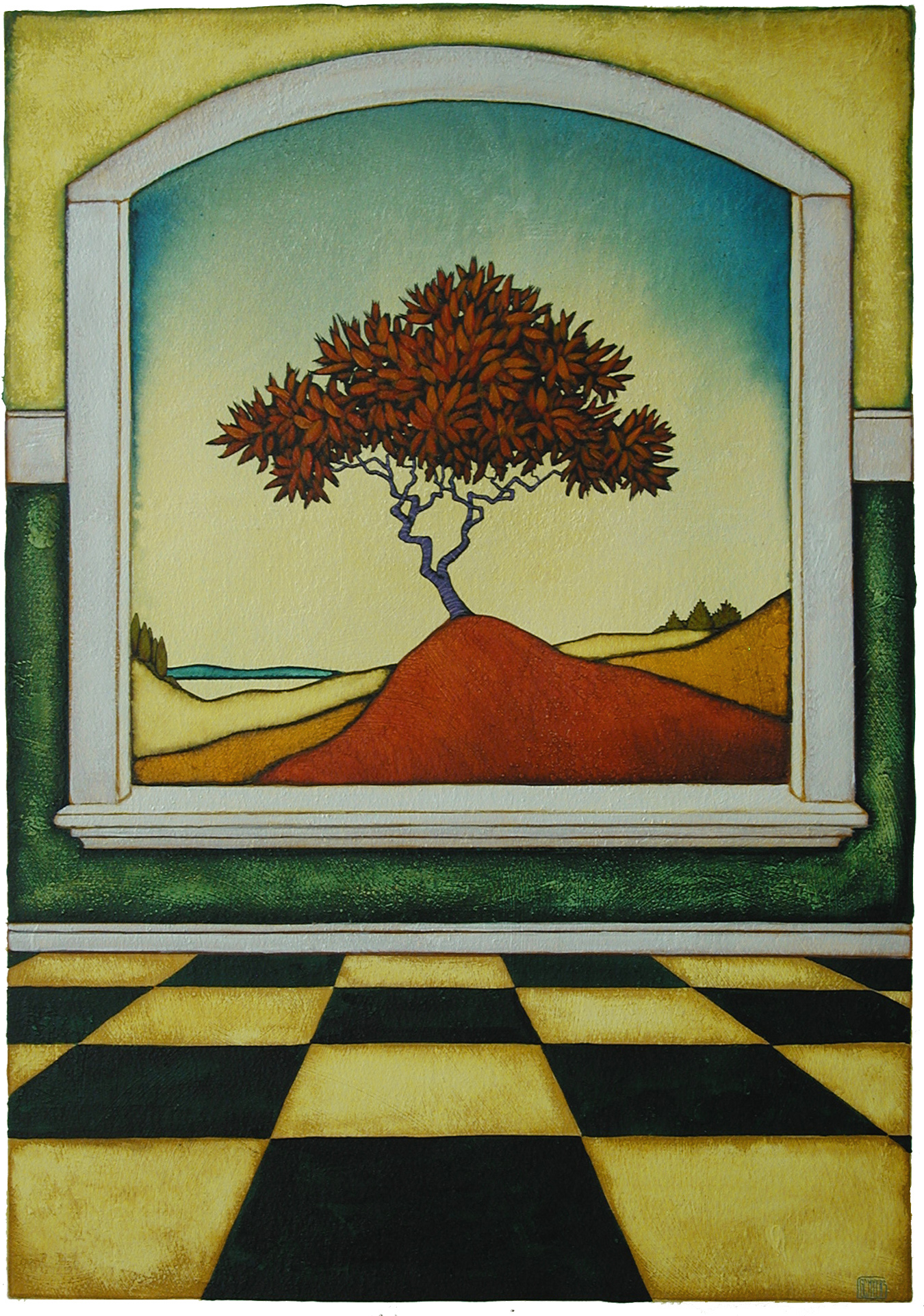
GC Myers-In the Window- Flower of DoreenI wasn’t going to do a re-post on the blog today but when I was going through some images I came across an image from a series that I did in 2005 called In the Window which had my typical landscapes with the Red Tree as seen through a window in various interiors.  This series was pretty well received but never found its way into my regular rotation of work.  It remains an isolated series from that time but is one that is very close to me personally.  I guess an example of this fondness might be that there is one piece in the series, the one above bears my late mother’s name.  Its title is In the Window: Flower of Doreen.

Seeing that her birthday is next week I felt like I should pay her a little tribute here.  She never witnessed my work in a gallery, never knew that I would find a career doing this.  But I think she would be pleased  by the fact that her name lives on in a painting and that the flowers she planted many years ago are doing well.

Here’s what I wrote several years back along with a few more examples from this series at the bottom:

GC Myers-  In the Window- EverpresentA question asked of me this weekend inspired me to go back into my archives and pull out the images of a few pieces done several years back.  I was asked if I used this time of the year as a starting point for new work and I said that I often did,  using it as a time to begin new ideas that I want to try.  I explained that it was important for me to continue trying new things as it excited me in the studio and that this excitement was important to all of my work.  This new work provides a vibrancy that permeates all my work and helps me find the new in compositions that I have painted in the past.

I explained that I liked to try new concepts in series in most years and that some are more embraced than others and become part of my regular painting vocabulary for years.  The Red Roof series is such a series.  I have painted examples in this series for several years and it has become ingrained.  The Archaeology series is another. 

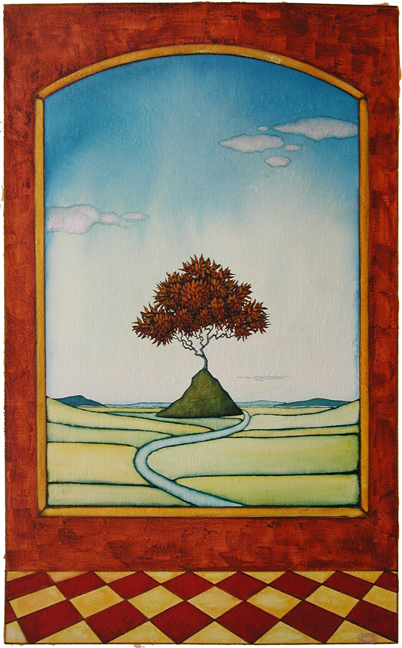
Other series last but a season.  While they may be popular from a sales standpoint,  they soon exit my routine.  The In the Window series is an example of such a series.  Done in 2005, they were a series of paintings that featured simple interior scenes with large windows that were highlighted by examples of my typical landscapes.  The idea was that the interior scene acted as a setting to show the landscapes in a different manner, much like the setting for a piece of  jewelry dictates how a gem is seen.  The gem here was  my landscape.

GC Myers- In the Window: Dream AwayThis painting shown on the left, In the Window: Dream Away, was the first piece.  It seemed to jump off the paper on which it was painted.  Very vibrant.  The setting of the window pushed the scene of the tree atop the mound overlooking the water out of the frame and seemed to intensify it.  I was immediately taken with the concept and a number of others soon followed, including the one at the top.  These pieces sold pretty well but they eventually lost steam for me from a creative standpoint.  While I still felt that they were vibrant , I sensed that I had done as much as I could with the concept and didn’t want it to become labored and tired.  My excitement was passing and I wanted to stop near a peak rather than at a low when the work was completely played out when I was viewing it as a toil rather than a joyous activity.

I still feel excitement personally when I see these pieces from this time and I know they are of a certain time for me.  I want them to stand as they are in my body of work.   As I described this this past weekend, I explained that the interesting thing about stopping a series is that it creates a finite number of pieces within it.  They become more distinctive over time, more representative of a certain time in my own artistic continuum.  So while these series, such as the In the Window series, are short-lived they have a longer viewpoint.

GC Myers-  In the Window- Full PotentialGC Myers- In The Window: Worlds Beckon GC Myers-  Inthe Window: The Searcher GC Myers-  In the Window:The Vigil GC Myers-  In the Window:Home Land

Read Full Post »

GC Myers- Secret of All TriumphsPerseverance, secret of all triumphs.

–Victor Hugo

**************

Sometimes sticking with a piece that is in trouble pays off.  The painting shown at the top, a 20″ by 20″ canvas that is yet to be titled, was started several weeks ago.  All of the major forms, including the deep blue sky, were blocked in the transparent colors that I use in my wet or reductive work–that is where the paint is put on thickly then absorbed off of the surface until it reaches a tone that fits my eye.  But it just didn’t ring out, had an awful flatness that just made the whole thing dull.  The colors in the foreground were muddied and blah.

I looked at it for weeks.  Actually, I didn’t look at it that often because it just didn’t have anything to pull me to it.  I got to the point that I avoided looking at it at all.  Finally, I decided to scrap the whole thing.  Paint it over in black and start with an empty slate.

Tabula Rasa.

So I took it down into the basement of my studio where I do apply my gesso and do other sloppy work.  I pulled out a thick brush of black paint and slapped it across the sky and worked it back a few times.  The strokes didn’t go into the lower sections of the painting, remaining only in the sky.  I stopped and took in it for a second, the black brush poised to swat across the center now.  The contrast of the black against the colors made the fields pop a bit, gave them a little life.

Just a little.  Maybe there was something there, a flower that could blossom if I just stuck with it a little longer.

So finished the sky in black and in a few days brought it back to the easel.  Each stroke of color that went against the black surface of the sky brought it more and more to life.  When the sky was close to being finished, I went back into the lower fields, glazing them with new layers of color that took away some of the dullness that had plagued them.  The sky had a pop now and the lower fields were catching up to it.  But the central field between the curved horizon and the large mound on which the Red Tree would stand was still an awfully dull green that sucked the life from both the top and bottom.  A sucking vortex.

Maybe this wasn’t going to work after all.  One element so out of kilter could kill the entire thing, break its fragile life force.

After a while I thought that the black had worked so well in the sky, why not break it out in that central field.  Go completely in a different direction with it– make it a red field that would pop in the center of the piece and give contrast to both top and bottom.  Instead of sucking life from it, it would now give it life. And sure enough, it brought everything together.  Even before the trees made an appearance, it was ebbing with life. And when they did appear, it felt complete and alive.  All that I can ask of it.

Now I can’t stop looking at this piece that once made me grimace.  Perseverance pays off in the end, as it usually does.

PS:  Now that I look at this piece after writing this, I believe I will title this painting Secret of All Triumphs. Thanks for the inspiration, Mr. Hugo.

Read Full Post »

2015 GC Myers WIPWhen I finished up in the studio yesterday, I was at this point in progress on a new painting.  It is a 20″ by 60″ canvas that was started with only the thought that it would be curtained in by two layers of tree trunks on each side.  The basic composition of the entire piece is laid in in an underpainting of red oxide and there are a numbers of layers of color in the sky, beginning to give shape to the tone of the painting.

It has definition and purpose now.  A forseeable destiny.

This is one of my favorite stages of my process.  The bones and form of the painting have been created, the decisions concerning composition made, and the painting begins to stir to life.  There is a keen sense of sharpness to it at this point, as though the essence of its being has been boiled down and captured in this layer of red oxide paint.

Like a revealing of its soul.

The layers that will follow will give detail and nuance to round out its wholeness.  It’s interesting  to watch it go from this sharply defined revelation of self through the series of transformations brought on by each subsequent layer of color.  There will be points when this sharpness will fade completely away, leaving the piece dull and flat–barely alive.

Sallow. Like a patient on a respirator.

At that point,  I sometimes finding myself questioning my prior decisions and asking if the piece will ever come back to life.  This comes near the end and, disheartening as it sometimes is,  would be my least favorite part of the process if not the fact that I have the knowledge of and confidence in what will soon take place on the canvas.

The layers of color come quicker and consist of fewer strokes but each small move now seems to bring more and more of a change to the piece.  The soul of the painting that once filled the canvas in the completed underpainting above now begins to reveal itself again in its fullest form.

Now, that being said, it what I hope happens.  Sometimes it just doesn’t.  But sometimes the soul of the piece is revealed so strongly at this point that it will not be denied.

And that’s what I believe will be the case with this piece.  At least, that is the hope.  We shall see…

Read Full Post »

GC Myers 992-141-small1It’s another cold day here in the northeast,  -5° this morning when I walked out the door.  By the time I got over here to the studio after my short commute ( a stroll through the woods) I was ready for a little heat.  Turned on the computer to look up an old piece and immediately came across this small triptych from 2002 which was always a favorite of mine. It’s a little anomaly comprised of three small squares, each about 4″ by 4″.  I always liked the surface of these pieces — they had a smooth, almost burnished look that I haven’t used in many years.

Seeing this piece made me want to revisit that surface treatment once more, thirteen years later.  It also made me want to feel that heat in the form of a very distinct song.  Fire from Jimi Hendrix.  Talk about going back in time.  Are You Experienced? in 1967.  This song will be fifty years old in a couple more years which seems crazy– it’s timeless heat.

So, Jimi, on this frigid morning, let me stand next to your fire.


Read Full Post »

GC Myers Kabuki TV 1994Whenever I come across this little experiment from back in 1994, I linger over it for a few minutes and smile a little.  There’s a lot going on with plenty of bright colors and sharp angles but with a narrative element within it where I saw a person watching a Kabuki performance on their television.  But more than that I am reminded of the decision to move away from this experiment and continue in the direction that eventually led me here.

You see, I enjoyed doing this work, enjoyed the process and the final product.  I could have easily followed this path and been fairly happy.  But it lacked something that while I can’t really put a finger on it was found later in the work that I eventually produced in later years.

Heart?  Soul?  I can’t say.  But it was fun at the time and makes me smile now.  Plus the lesson in learning what you can and can’t be is beyond value.

I wrote a bit more on this subject, also set off from this little painting, back in 2010:

Just looking through some old things, mostly little pieces that are from the time when I first started painting, and I came across this.  At the time  I was playing around with color and masking, where you put something such as tape on the painting surface and paint over it then peel it away to reveal the unpainted surface underneath.  It can be a big part of traditional watercolor painting and I wanted to see if it fit with the way I thought and wanted to paint.  It didn’t.  But I did come up with this little abstraction that always catches my eye and makes my mind’s gears turn.

It’s always interesting to see these little pieces because it inevitably triggers memories of that time when every day was bringing new discoveries as I tried to learn more and more about color and different mediums.  Sometimes things clicked and it was revelatory to discover my strengths.  Other times, it was a struggle and the end product was muddled, labored.  But there was still something to be learned there.  Like identifying my weaknesses and learning how to strengthen these areas or, at least, downplay them.

I guess that this is the process for development in any area of your life,  playing up your strong suits and trying to cover your weaknesses.  Perhaps that is why I like to see these old experiments, to be reminded of my growth, artistically and personally, through the years. 

At least, what I perceive as growth.

Read Full Post »

GC Myers-Hasten Down the Wind smThis is a painting  that I finished over the weekend.  It’s 10″ by 30″ on canvas and is titled Hasten Down the Wind.  If that sounds familiar you probably remember the old Warren Zevon song from the the 70’s most famously covered by Linda Ronstadt on her album with the same title.  It was a pretty big album at the time.  I just always loved the imagery in that phrase– hasten down the wind– and thought it fit well with this piece.

The song is about the end of a relationship, where the girl recognizes that nothing is working for them any more and the guy finally grudgingly admits it as well, telling her to leave , to go hasten down the wind.

I see this in this painting with the Red Tree reluctantly holding onto those leaves as they struggle to depart on the wind even though it knows that it has to be this way, that they must leave.  There is something bittersweet yet liberating in this idea that sometimes things are just not meant to be.  We often hold onto things–people, ideas and hopes and dreams– that don’t truly fit with who we are with the thin hope that things will somehow change to match our perceptions.  But recognizing that this is not meant to be and letting these things go allows us to perhaps find our truer selves.

In short, we sometimes have to lose things to reveal who we really are.

Read Full Post »

GC Myers-Unpuzzled 2015January is always a month of feeling out in the studio, trying to find a rhythm, a strand that I can grab onto and follow into the rest of the year.   Getting  a group of small pieces ready for the Little Gems show at the West End Gallery (which opened last night) is part of this feeling out process, sometimes acting as a preview as to where the work may ultimately lead me.

This year found that group with clear and glowing transparent color that was very gem-like.  The pieces felt like pieces of jewelry as much as paintings to me which is something I might be able to carry forward.

But now it is February and I am beginning to just let things flow as they come out, emotionally based and free of too much forethought.  Just let it happen and not try to direct it too much.  The first piece after the Little Gems  and in this February frame of mind was the piece shown here at the top, an 18″ by 18″ canvas that is called  Unpuzzled.  This is as much a piece for myself  alone as anything I might do, meant to only satisfy my own need to see it.

I wanted to see a harmony of patterns, rhythms and color that was as much non-objective as objective, which is how I could describe just about any of those pieces which most deeply satisfy me personally.  As this piece does.  It’s one of those pieces about which I don’t care what others might think– it works for me.  And maybe just for me but it doesn’t matter.  It just clicks an internal switch for me.

Sitting here at the moment, looking at this painting, makes me want to translate something like it to a much larger format, maybe 4′ by 4′, where the impact of the forms and colors would resonate with the grander scale.

Maybe…

Read Full Post »

GC Myers- Storms Are on the OceanI’ve been working recently on some very small pieces for the upcoming Little Gems show at the West End Gallery in Corning.  I’ve mentioned here before that this particular show is always  a sentimental favorite of mine as it was in this show that I first publicly showed my work twenty years ago.  It represents the first step on to the path that I now follow and that makes it special for me.  Plus I enjoy working in the smaller scale for a bit.  It allows for easily easing back into older themes and forward into newer ones.

One of these pieces that just finished yesterday is shown here at the top.  It’s a 4″ by 6″ painting that I call Storms Are on the Ocean.  I haven’t done a boat painting in some time and thought the smaller format would be the perfect opportunity to re-visit the theme.  I am always drawn to the motion in these pieces and the billow of the sail.  It reminds me of a fable or a dream in some way that I find appealing.

I thought this would be the perfect match for this week’s Sunday morning music which is the song after which this painting is titled.  It’s The Storms Are on the Ocean, a song first done by the legendary Carter Family back in the late 20’s.  This version is from June Carter Cash‘s last album, Wildwood Flower, which was released in the year, 2003, after her death.  Like the final recordings of her husband, the great Johnny Cash, this album shows her in a fragile state of health which adds greatly to the emotional impact of the songs.

It definitely comes through on this lovely song with its haunting chorus:
The storms are on the ocean
The heavens may cease to be
This world may lose its motion, love
If I prove false to thee

Enjoy and have a great Sunday.

Read Full Post »

GC Myers In the Time of DreamingI’ve been looking for a while at this new painting, a 24″ by 30″ canvas.  It has a calming effect for myself.  Maybe it’s the placid blues and violets or the softness of the moon’s light–I don’t know yet.  I just find myself letting go and being pulled into the central geometry of this piece, that triangle formed by the moon, the Red Tree and the group of Red Roofed houses atop the rise.  There’s a sense of mystery in it from which I can’t look away.

I call this piece In the Time of Dreaming.  Maybe it’s the mystery aspect that brings the title to mind, in way we sometimes find our own dreams– puzzling but somehow pointing to something that we just can’t quite put a finger on.

I also thought of the Australian Aborigines’ Dreamtime when the title came to mind.  Their Dreamtime is the basis for their entire belief system, the eternal time in which creation occurred and where the individual exists before and after their worldly life.  It is the time where their ancestry exists as one resulting in their belief that they accumulate worldly knowledge through the wisdom gained by their ancestors.

This results in a knowledge of the world that is passed down through word and song.  They can travel great distances through their lands guided by the Songlines,  paths that are traveled while singing specific songs that point out direction and landmarks.  It’s a beautiful system that very much ties the Aborigines to their ancestry and the land in which they live.  The late Bruce Chatwin wrote an interesting book, The Songlines, in the 80’s that gave a great account of this culture and belief system.

But whatever the reasoning, conscious and unconscious, behind it, I find myself continuing to look at this piece.  And dreaming.

Read Full Post »

« Newer Posts - Older Posts »