Feeds:
Posts
Comments

Archive for the ‘Painting’ Category

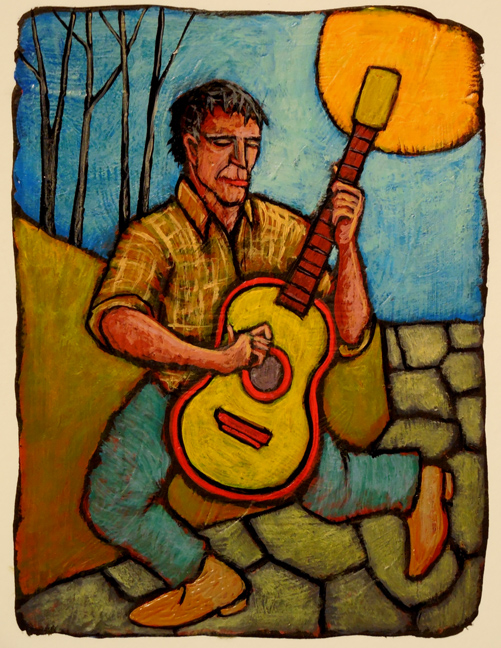
GC Myers - Train Kept A Rollin smEvery so often I try to break things up with my work, go a bit away from my typical subject matter.  Usually these are pieces that are mainly for myself, pieces that give me a different sort of satisfaction.  They’re not always my best work but just the process of painting them and the pleasure they give personally give me makes them some of my favorite pieces.  Such is the case with the painting shown here, a smallish 4 1/2″  by 6″ work on paper that I finished yesterday in the studio.

I have done a number of guitar pieces through the years.  While I think it has to do with my love for guitar music, I think it has as much to do with the shape of the instrument and the manner in which it is held, almost in a loving embrace.  As I have noted here in the past, the guitar has been a frequent subject of artists through the ages for just this reason.  So yesterday, while trying to clear my artistic palette a bit, started my day set on painting a small guitar painting,  I had no idea how it would proceed or even the feel that it would hold.  I just started with the idea of a guitar.
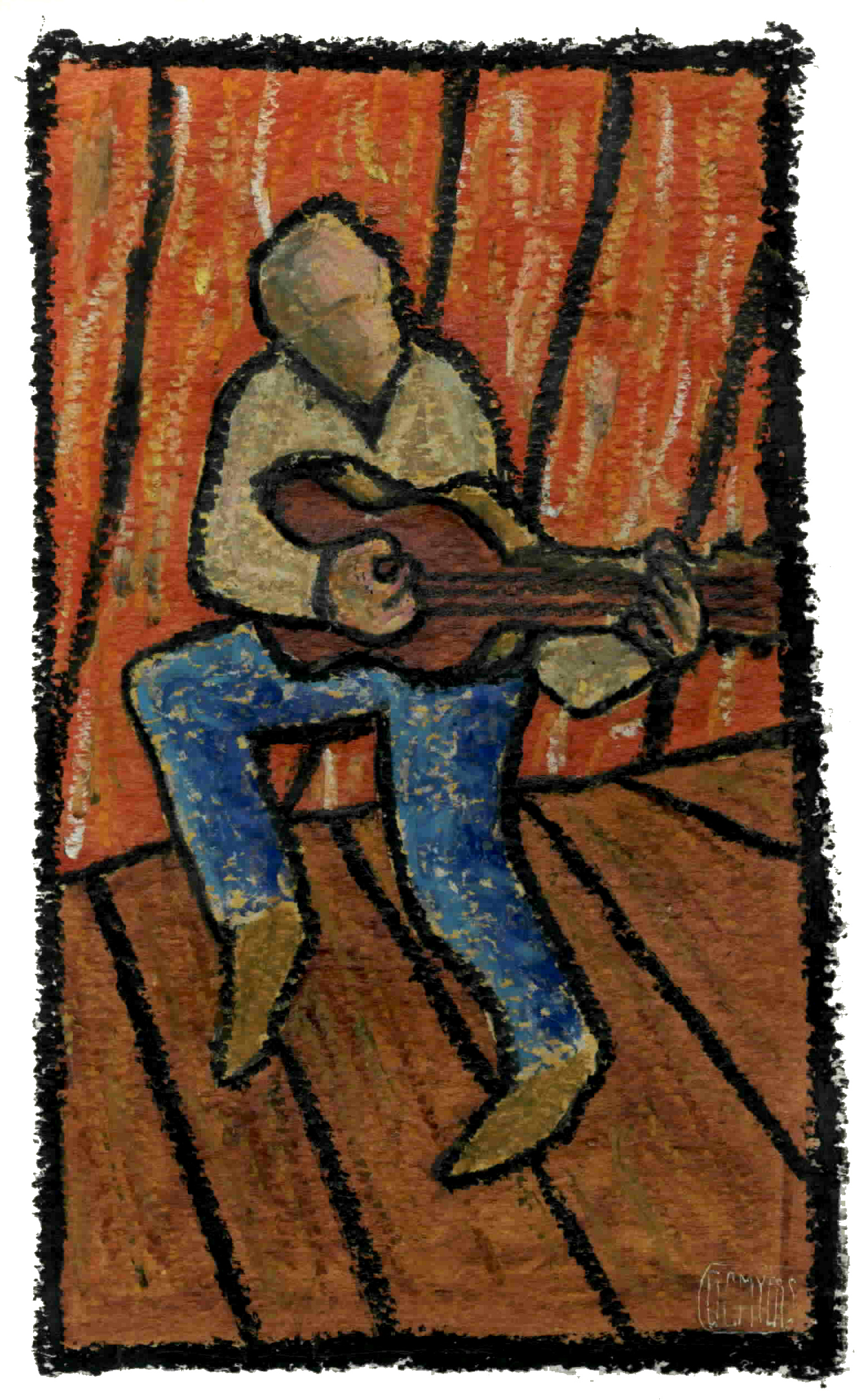
rockin-billyIt wasn’t until  late in the game that it broke free and became a dancing piece, mainly because I came to a point where I wanted to have the entire figure, feet included, in the frame.  Without this , it would be too stiff, too formal, and the manner in which the guitar was painted was anything but that.  It’s cartoonish, more like a cardboard prop, especially in the way it was being held.  But in order to get the feet in frame I would have to have them askew, in motion.

He suddenly became another Rockin’ Billy, like the oil crayon piece here on the left that I did  for myself many years ago. and featured here several years back. At this point, my memory of this piece kicked in and I even modeled the feet in the same fashion.  I also kicked up the colors a little more to create a little higher contrast, making it more stylized.  It reminds me of  a cartoon or a stained glass window.

As I said, it’s not my typical work and probably won’t leave the studio.  But I find great enjoyment in this type of work, finding purpose and direction in them that propels me ahead in my other work.  I think that makes these pieces memorable for me, makes them stick with me.  Plus, it gives me a chance to play a song from Johnny Burnette, one of the early Rockabilly kings, probably a little less remembered than some  others.  Here’s a song and frantic video that would make my Rockin’ Billy dance, called Train Kept A Rollin’.

Read Full Post »

GC Myers Shambhala smAccording to Buddhist tradition, Shambhala is name given to what they consider the Pure Land, a utopia of sorts whose reality is as much spiritual as it is physical.  A place where everyone achieves a state of enlightenment and peace and tranquility.  Author James Hilton morphed the name into Shangri-La for his novel Lost Horizon which describes a group of Westerners who find themselves the guests in a small idyllic nation of this name tucked away in a protected Himalayan valley.

Whatever you call it, the idea of a place of enlightenment and peace seems pretty attractive to me these days, given the many events going on in the world being driven forward by such negative factors as greed, hate and fear.  That tranquil inner place is what I see in this new painting, an 18″ by 36″ canvas that carries this name, Shambhala.  The road , for me, represents the search that leads to this elusive state and the sun  a blissful guide with a warm lure that radiates throughout the sky.  The Red Tree is on a small peninsula set into a calm body of water, still attached to the world  but in an ethereal space.  It is in a state of being where it is firmly in the moment, having set aside the past and disregarding the future.  Just absorbing the now.

That’s what I see and that is what I imagine how that moment might feel but I am still on that path, looking ahead for a sight of that hopeful destination.

Read Full Post »

Beltracchi Working on a Fake Max Ernst (Vanity Fair)

Beltracchi Working on a Fake Max Ernst (Vanity Fair)

This past Sunday, 60 Minutes did a segment on a German artist named Wolfgang Beltracchi.  I would be surprised if you had heard of him unless you know this story.  But you probably have seen his paintings if you have been in many of the great museums of the world.  You see, Beltracchi is an art forger who has dozens of fakes still hanging in many venues around the world.

There was a brilliant twist in his scheme to bring fake paintings to the public and especially to the big money collectors.  Rather than merely copy existing paintings from the masters, Beltracchi would more or less channel the artists, making paintings that he felt that they themselves might have painted if they had had the time to move in a given direction.  They are labeled as  lost masterworks. He would do great amounts of research into the artist’s body of work and biography as well as studying the materials and tools of the time periods so that everything gave it a genuine appearance.  His research was so meticulous that his paints often matched the chemical profile of the originals, making the fake almost impossible to detect with even the most sophisticated of scientific tools.

Helene Beltracchi posing as her grandmother in front of fakes

Helene Beltracchi posing as her grandmother in front of fakes

This genuine appearance made validating the work as original much easier.  But Beltracchi and his wife, Helene, completed the deal with a detailed backstory that made complete sense and was seldom challenged.  They claimed that the paintings were owned by Helene’s grandparents there in Germany and were hidden from the Nazis before World War II .  To make the illusion complete, they would make up Helene as her grandmother and take photos on old period photo paper in front of the paintings.

It was deviously clever deception that stumped the art world for many years.  Museums and high profile collectors (Steve Martin was duped by one of Beltracchi’s fakes to the tune of around $850,000) ate up his works, some being included in books of the best paintings of the last century as well on the cover of a high profile Christie’s Auctions catalog.

The deception was perfect.

Except for one tiny mistake.

On one of his paintings Beltracchi used a tube of white paint that did  not disclose that it included a bit of titanium.  Titanium white was not available as a pigment until 1921 and his use of it made the work instantly detectable.  The house of cards crumbled and both he and his wife were arrested.  They lost everything– the cars, the yachts, the plush homes and the huge stacks of  cash that their con had provided.  They are both serving terms in an German open prison, meaning that they go out each day to work and return at night.

Most of the works , which Beltracchi claims to be well over 1000 and maybe as many as 2000 by over 50 different artists, still hang in many museums around the globe.  It will probably take some time and effort to detect these fakes, if they do it all.  Nobody wants to admit they’ve been conned.

Bellini's "Saint Jerome Reading" at the National Gallery, DC

Bellini’s “Saint Jerome Reading” at the National Gallery, DC

It’s an interesting story.  I was immediately intrigued by Beltracchi’s claim that he could paint in the style of anyone except for perhaps Bellini.  I love Bellini’s work and was glad when this master forger thought it was beyond counterfeiting.  But I wondered how an artist who had this kind of ability, this technical prowess, could have no voice of his own.  The money and the thrill of the ruse were surely big factors in discarding his personal aspirations. For me, painting and art is all about personal expression and emotion.  To see someone with so much obvious talent to be without any personal expression that he would call his own is somewhat sad.

Perhaps he views this whole thing as some sort of performance piece in itself, in which case he may be the greatest artist of our time.  But I doubt it.

Read Full Post »

GC Myers- Happy Trails smI finished this painting, a 10″ by 20″ canvas,  over the weekend.  Every piece has a different feel in process.  Some are struggles, not wanting to show me a way through to the finish.  Every decision and move must be really scrutinized.  Some show me a way but leave me uneasy about my choices until near the end.  And some, like this painting, open wide and invite me in, the process feeling almost effortless.

This painting felt right from the moment it went on the easel.  The composition fell together easily and the colors meshed immediately which left me feeling as though I was simply along for the ride.  Not painting but rather just observing it coming together.  It’s an interesting feeling and one that is highly desirable, at least for me, as the resulting work usually feels naturally free and easy.

And for me this piece has this feel.  It flows easily and the warmth of its colors and the rising elevation of it gives me a sense of joy, as though it represents a desired destination, an endpoint to a long journey.  You always hope that your journey will end well and this piece is symbolic of that hope.  I call it Happy Trails.

Some of you of a certain age will probably immediately associate this with the theme song  of  film and television cowboy Roy Rogers , written by his wife, cowgirl Dale Evans.  Those of you of a slightly younger age will probably think of the song that Van Halen with David Lee Roth used to end its shows.  And those of an even younger age will probably just think that its a catchy title.  I fall into the first group, having watched reruns of the Roy Rogers Show on Saturday mornings as a kid, mainly because we only had a couple of channels.  Plus, I did like Trigger and Roy’s sidekick, Gabby Hayes.  And the theme song which ended every show.

It’s a catchy and pleasantly warm song.  Its feel and title fit this painting well.  Here’s a lovely version that I found online from a gentleman on a ukulele named Patrick Hildebrand Sr. from the Amazing Music Store in Pacific Palisades, California.  The uke’s warm tones and his pleasant voice fit this song well.

Read Full Post »

Buddha Candle

GC Myers Pure Joy smI used the term joyous melancholy in yesterday’s blog to describe the feeling of a painting and a moment, the paradox of finding some sort of small pleasure in a gloomy moment.  It’s a delicate but satisfying feeling, one that solemnly affirms one’s humanity.  The new painting above, an 8″ by 24″ canvas,  is the opposite of that.  It is not paradoxical in any way nor is its message delicately or solemnly expressed.  It is pure color and joy that proudly displays what it is with gusto.

It’s a very strong, almost muscular piece in its expression.  Bold and unapologetic.  Willing to share its glee with anyone who is drawn to look at it.  It brings to mind a quote from Buddha: Thousands of candles can be lighted from a single candle, and the life of the candle will not be shortened. Happiness never decreases by being shared. 

A reminder that our joy is not a finite product, that it should be a shared experience.  I think I will call this painting  Buddha Candle.

On yet another below zero morning, I am enjoying the warmth and joy in this piece.


Read Full Post »

GC Myers-Serenata Blue This is another of the pieces that are in the upcoming Little Gems exhibit at the West End Gallery in Corning.  This little guy is titled Serenata Blue and is a just a bit larger that 2″ by 4″ on paper.  It’s a continuation of the recent snow paintings as well as another of my solitary guitarist pieces, of which I do a handful each year.

There’s something very appealing to me in the solitary guitarist standing amidst open space as he cradles his guitar.  It usually brings me a wistful, somewhat sad feeling.  Not in a bad way sad.  Just a slight existential melancholy.  You know, the good kind.

I thought that there should be some appropriate musical accompaniment to this painting so I came up with a sad song.  And I mean sad.  This Nancy Griffith’s version of Tecumseh Valley.  It’s an achingly  beautiful and sad  lament that tells the story of a poor mountain girl.  To make this version even sadder, this is from a tribute show from the friends of the song’s writer, the great Townes Van Vandt, right after he passed away in 1997.  But it is a haunting and lovely song so don’t be afraid to listen.

Read Full Post »

“Meaning in a painting is derived from quality. It is reciprocal and will return what has been given to it both to its creator and to the beholder, by a multiple combination in visual concept of pattern, color, form, and that undefined intangible which transcends all classifications. My paintings subscribe o no period or school. If they possess that sustaining power of meaning and authenticity which constitute the basic attributes of a work of art, as well as an awareness of the contemporary scene, they will be illustrative of the progressive trends of their time. Their visible concept may ostensibly reveal characteristics of Time and Place, but the roots reach deep into ethnic strains of ancient culture through which the archetype emerges as indicator of the universal and eternal urge toward creation.”

–Peter Krasnow, 1975

*******************

Peter Krasnow - Edward Henry Weston (24 Mar 1886- 1 June 1958)  1925While looking up some info on photographer Edward Weston, I came upon this portrait of him, shown here on the left, that really caught my eye.  I loved the colors and stylization. The artist listed as the painter was a name that I was not familiar with, Peter Krasnow.  Doing a bit of research, I stumbled upon another interesting life and body of work, one that evolved greatly over time.

Born in in the Ukraine in 1886, Krasnow learned the art of color mixing from his father who was a decorator.  Krasnow was Jewish and came to the US in 1907, fleeing the pogroms that had been taking place in his native land as well as seeking training as an artist.  He lived first in Boston then moved to Chicago to study at the Art Institute.  After graduating in 1916, he and his wife, who he had met in Chicago, moved to New York.

St. Andrew's One Cent Coffee StandHis work at that time was darker in tone, echoing the neighborhoods around their tenement home as well as recalling memories of his native Ukraine.  But Krasnow felt hemmed in by the dark urban landscape and upon the casual recommendation of an art critic, headed west to California in 1922.  He stayed there, except for a short residency in France, for the rest of his life.

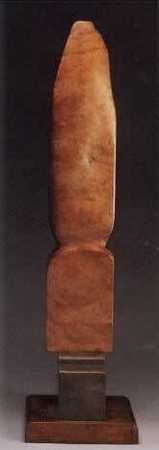
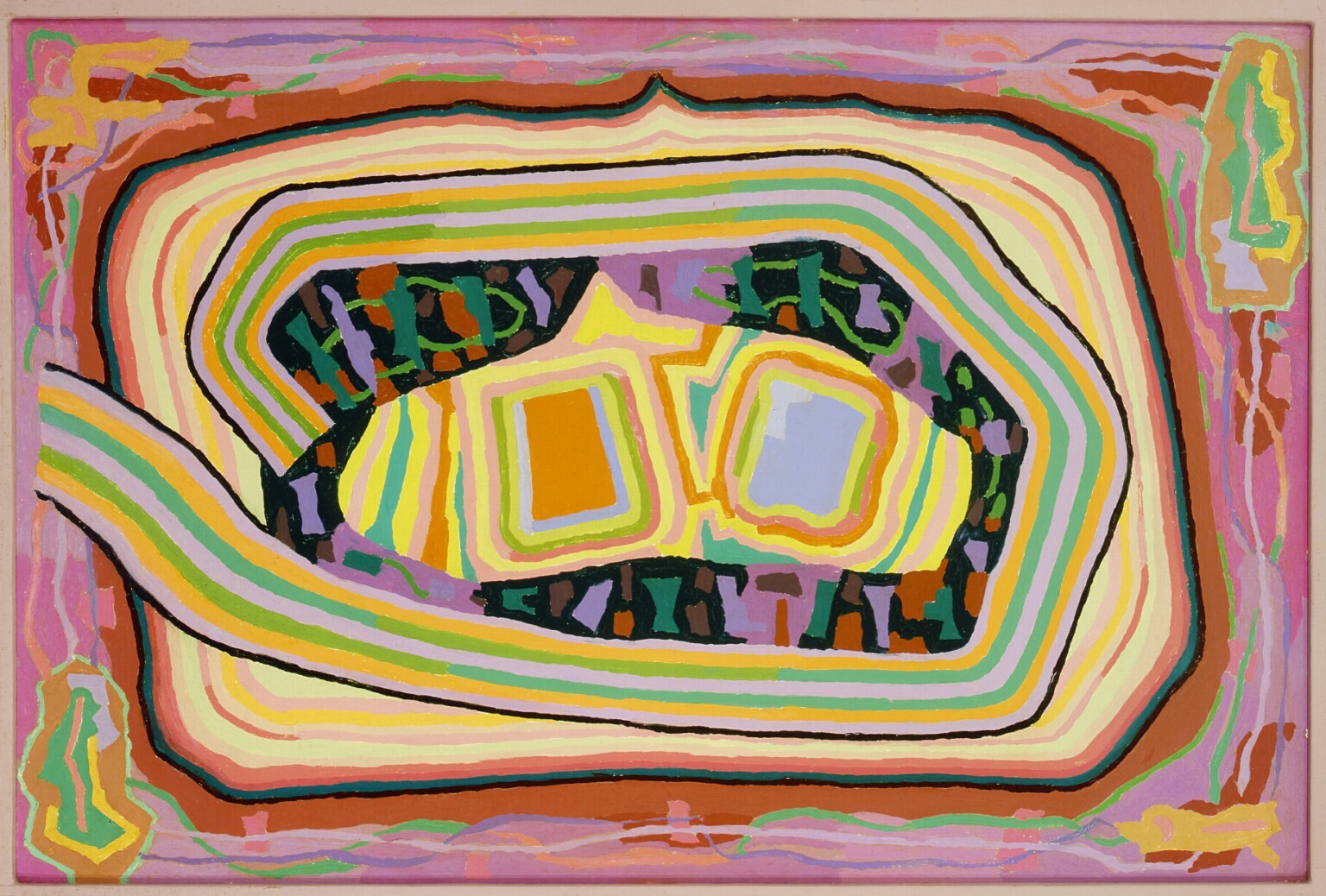
In 1923, Krasnow purchased a parcel of land from photographer Edward Weston and built his studio.  Weston became a lifelong friend and Krasnow s0on found himself in a loose knit  group of  avant garde artists.  His palette changed to  lighter and airier colors that infused his landscapes.  After moving to France then returning he began experimenting with abstraction, both in paint and in sculpture, carving wooden totem-like pieces.  It was this work, along with his work as a printmaker, that occupied his career until his death in 1979 in California.

While he is not tremendously well known nor has his work achieved astronomical prices at auction, his impressive body of work work is vibrant and deserving of greater attention.  I really enjoy seeing the course of his work throughout his career, seeing the connection in seemingly disparate styles.  I know that I am glad to have come upon his work and will keep doing some research.

Krasnow  Self Portrait 1925

Peter Krasnow- Self Portrait 1925

Enigma (K-2) Krasnow  Totem Sculpture Krasnow  The River 1959

Read Full Post »

GC Myers- Steps to Solitude smMaybe I decided to use this image  because it was -8° when I headed out for my stroll through the woods to the studio.  Well, not really a stroll.  More like a hard determined march, trying to cut through the sharp cold as quickly as possible.  But as I glimpsed at the still dark sky,  Venus  was shining brightly just above the treeline, so much so that it caused me stop and just wonder at its brilliance.  To my eye it had a reddish glint that made it seem  like some exotic little gem in the sky.  Beautiful enough to stop me in my frozen tracks.

This brought to mind the upcoming  Little Gems show at the West End Gallery in Corning that opens next Friday,  February 7th.   I am currently prepping a group of paintings for this exhibit of small work which is always one of my favorite shows of my painting year and one that always brings back good memories.  As I have noted here in the past, the Little Gems show in 1995 was the first opportunity I had to show my work in public.

A first step on a then unknown path.

This will be my twentieth Little Gems show, something which would have seemed unfathomable back at that first show.  I don’t paint as many small pieces in recent years, spending more time on larger work, so this is always a great time to revisit the small form.  There is something  wonderful in seeing the colors and forms compressed into a smaller space, something that brings out the gem-like quality in each.  Each element, each mark takes on greater weight in the smaller form.  There’s a different type of concentration, one that is  quicker in its self-editing and one that is definitely more intuitive.  The sizes are such that everything just happens quicker and there is less time to ponder.

And that is often a good thing.   I’ve often said that I’m not smart enough to paint when I have to think about it.   Maybe these small pieces are  proof  of this.

**********************

This piece is called Steps to Solitude and is a compact 3″ by 6″ painting on paper.  It will be at the West End by the end of this week along with several other small pieces.

Read Full Post »

GC Myers- California Dreaming 2014It’s another clear and cold winter day, about 4 degrees outside .  It’s visibly beautiful with the crisp and sparkling snow clinging to the pine boughs.   The contrast between what I see out the window of the studio and what I am seeing in my mind is often hugely different.  This new painting is such an example.

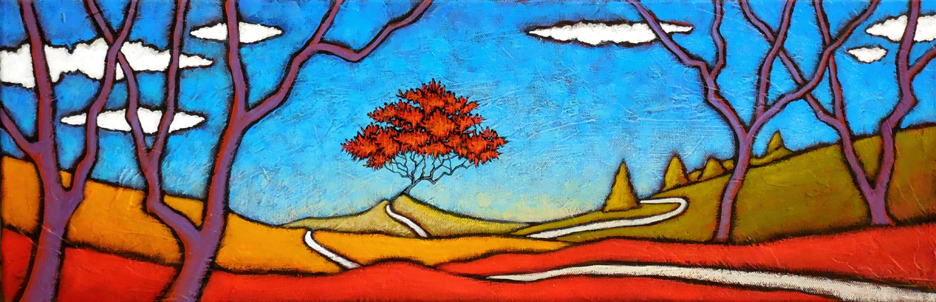
It’s a 36″ by 36″ canvas that I am calling California Dreaming.  It was not done with intention but as I was finishing it I couldn’t shake the feeling that this large piece reminded me of California, at least in some microcosmic way.  The mountains in the rear remind me of the Sierras rising from the Central Valley and even the two smaller hillocks in the foreground felt a small bit like the coastal hills.  When you added in the warmth of the colors, it just felt very California to me.

Having this on the easel then turning my head 90 ° to look out the window is quite the contrast.  Both make me happy but they are worlds apart.  At least, a continent and several temperate zones apart.

The title is, of course, a reference to the famous The Mamas & The Papas song, although my favorite version, out of  the many done of this song, is from Jose Feliciano.  Here’s a really nice instrumental version done by an exceptional guitarist, Michael Chapdelaine.  Enjoy and have a great day, whether you’re warm or just dreaming.

Read Full Post »

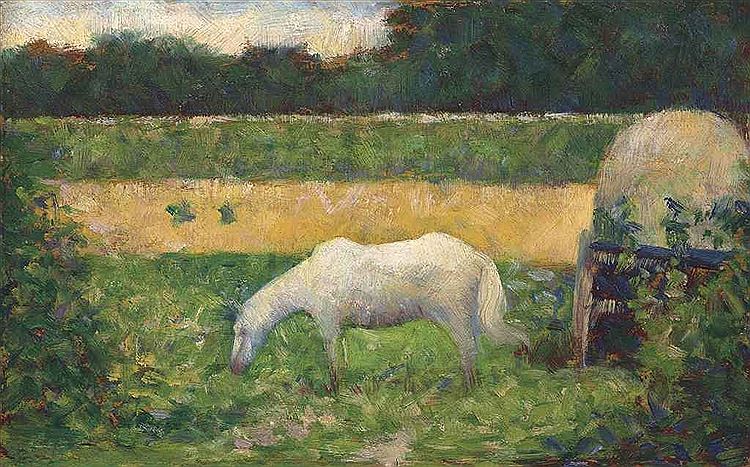
George Seurat -Paysage Avec ChevalI subscribe to a service that provides information such as auction results for artists, both living and dead.  It is always interesting to scan the auction results for my favorite artists, to see how they are currently viewed by buyers.  For example, anything by Vincent Van Gogh still draws huge money, even the work that doesn’t possess the signature brushwork and color of his better known works.  Those pieces that do, go for astronomical sums.  His popularity with the public is as strong as ever.  I guess that is no surprise.

A_Sunday_on_La_Grande_Jatte,_Georges_Seurat,_1884.It’s also interesting to scan the results to see other work from artists than that which we know them by that hangs in museums.  We tend to think of artists by their best work and seldom see the complete chain of work that runs through their career, never really seeing their weak links or developmental work.  The image at the top, Paysage Avec Cheval,  a painting that goes up for auction at Christie’s London, is a good example of this.  It’s a lovely piece but you might not guess the artist.  This is from George Seurat whose work, such as his most famous work shown here on the left,  is forever tied to pointillism.  But scanning through his records, you can get a better sense of the evolution of his work.

I am also looking for consistency in the artists whose work I am scanning through.  Again, we always think of the artists in terms of their best known works and are often unaware of the totality of their body of work.  Some artists are incredibly consistent, even in their early formative years.  Others have high peaks and deep valleys, with a huge disparity between their best and not-so-best work.  I am always encouraged by both types of artists.

I strive for consistency in my own work but have had dips and valleys in my work, particularly in the formative days early on.  In those days, I thought of the great artists only in terms of their best  works that hung in the great museums of the world, thinking that they simply got up each day and turned out incredible work.  I could not fathom the possibility that they had swings and misses.  It’s encouraging to see that those icons whose work I revere often struggled in the same way as me and that the great works we know them for were not created in a vacuum.  They came with great effort and day after day of moving ahead in often small increments.

I think any aspiring artist should take a few minutes to look through the whole of the works of their heroes.  They might be encouraged, as I often have been, to know that the path they are on is not so much different.

Read Full Post »

« Newer Posts - Older Posts »