Feeds:
Posts
Comments

Archive for the ‘Quote’ Category

More tears are shed over answered prayers than unanswered ones

— Mother Theresa

******************

This is a little piece that I did many years ago, one that never made it out of the studio.  A piece that is really for me.  It’s not a great piece of work, maybe not even good.  But it’s one of my personal favorites.  It’s informally called Be Careful What You Wish after the old adage: Be careful what you wish because you may just get it.  I always bear this saying in mind to remind myself that with everything there is a responsibility, a cost that may not be evident on its surface. 

Something we often fail to ponder when making wishes and decisions.  Unconsidered consequences.

Kind of like the story of the Monkey’s Paw, the old tale where a family receives a monkey’s paw from a friend who has just died.  The paw is a talisman with the supposedly mystical power to grant the holder three wishes.  The family wishes for money and their son is killed in a horrific accident and they  receive a large amount of money from his insurance policy.  After the funeral, they are stricken with grief and they wish for their son to be alive again.  Soon, there is a knock at their door.  It is their son–alive.  But still horribly mutilated and in extreme agony.  They use the third wish to wish him dead again.

Actually, this reminds me more of  Pandora’s Box, where Pandora is given a box (or jar, depending on how the story is told) by the god Zeus with the instructions to not open it under any circumstance.  Of course, she does.  immediately, all the evils in the world are released and in her panic, she slams the lid back down, trapping Hope in the box.

My little guy seems to be in the same situation.  In my mind, he was digging for things that were better left alone and they soon flew from the pit he had dug, even as he feverishly tried to refill the hole.  What exactly they are, I am not sure.  There is a giant that peeks from beneath a tree.  Perhaps they are demons.  Or regrets. Or lesser versions and aspects of the digger, things he has been keeping inside for all his life. 

 Things betters left alone.

Like many things, I am not sure.  Whatever the case, it remains a little painting that always triggers thought in me…


Read Full Post »

Helen Frankenthaler- Savage Breeze


There are no rules. That is how art is born, how breakthroughs happen. Go against the rules or ignore the rules. That is what invention is about.

–Helen Frankenthaler

************************

I’m using this quote from Helen Frankenthaler, the famed Abstract Expressionist, as a sort of follow-up or addenda to yesterday’s post about change.  I remember reading about Frankenthaler when I was first beginning to really paint with purpose.  In an article that I read but can’t locate now, she spoke of how she came to her trademark stain paintings where very thinned oil paint is applied to unprimed canvas.  She said it was almost by accident that she first experienced the absorbing of the paint by the raw cotton canvas and how that it caused a reaction, a breakthrough, in her thinking about how she wanted to express herself within her work. 

She felt that all artistic breakthroughs were the result of a change in the way one saw and used their materials.  It could entail changing the type of material used or using them in a more unconventional manner, as her above quote stating there are no rules infers.

This immediately clicked with me at the time I read it.  I had been trying to shape my way of thinking to fit the materials I was using at the time.  Unsuccessfully.  What I needed to do was change the materials to fit the way I was thinking.  Allow my thought process more free rein and not cater to the restraints of materials.

That may sound kind of abstract but it allowed me to start working with my paints and grounds in a much different way, forming my own process that worked well for my way of thinking and has become entrenched in my thought process.  Even though it may be outside more traditional forms of using these same materials,this process has over time become as rigid in my use as the techniques used by the most steadfast adherent of the most traditional school of painting.  This is sort of what I was referring to when I mentioned the end of the cycle, as far as art is concerned.  You reach a certain point, a mastery of your materials, where there are few accidents, few surprises in the materials’ reactions and, as a result, fewer surprises in your own reactions. 

For most, this is the goal.  But I want that surprise, that not knowing exactly how the materials will react and that need to solve the problem presented by the need to express with the limitations of the materials used.  So I try to continually tweak, create a little tension in how the materials react to my use of them, to create a sense of surprise.  Breakthrough.

And that’s where I feel I am at the end of the cycle mentioned in yesterday’s post.

Read Full Post »

The Test

The Test --- GC Myers

In this age, which believes that there is a short cut to everything, the greatest lesson to be learned is that the most difficult way is, in the long run, the easiest.

—Henry Miller

This quote reminds me of all the times where I have spent innumerable hours trying to make a task easier when if I had just accepted the difficulty of the task and just went at it, the job would have been done by the time I finally got around to starting it in my supposed easier way. 

It’s a curse and one I try to avoid but one I always seem to always slide back to.  I guess because I’m a human and we always want the easy way.  We might admire the person who grinds it out but we don’t want to be that person.  We want to believe we are more clever than that, that we have all the answers and are above the need to sweat and toil.  And this is so wrong, because the answers are in the sweat and toil.

We need to struggle.  We need to test our will.    We need the experience of the hard won victory. 

We would be better for it and, in the aftermath, feel less the pressures and fears that come from avoiding the difficult in the first place.

Enough said.  It’s still a long  holiday weekend for many so why am I pushing so this morning?  Leave it for another day…

The piece at the top is new, The Test,  a small piece measuring 4″ by 6″ that is part of my upcoming show at the West End Gallery.


Read Full Post »

We who lived in concentration camps can remember the men who walked throughout the huts comforting others, giving away their last piece of bread. They may have been few in number, but they offer sufficient proof that everything can be taken away from a man but one thing: the last of the human freedoms — to choose one’s attitude in any given set of circumstances, to choose one’s own way.

———-Viktor Frankl

************

I don’t know why this came to mind today but it did.  Viktor Frankl was an Auschwitz survivor who, after the war, created logotherapy, one of the important schools of psychotherapy alongside those of Freud, Adler and Jung.  It was a therapy based on finding meaning in one’s life, a reason to struggle onward.  In his best known book, Man’s Search For Meaning, he recounts his time in the concentration camp and how he and others who survived  seemed to have something in common– the discovery of a purpose and meaning in living.  It might be love. It might  be the will and drive to create.  Just something to set on their horizon to pull them ahead despite the horror around them.

Maybe it was this painting, Lifeblood,  that brought back Frankl for me.  I had come across his work a number of years ago and and his words and example have helped me through some desperate, foundering times of my own.  There is a certain power in knowing that we all are fated to suffering of some sort, just by the sheer nature of existence.  There will be pain, there will be death.  No one is exempt from the distresses of  life.  But these can be endured through the knowledge that we have the choice in how we react to such events, how we perceive the deprivations of our lives.  We can choose to wallow, to give in,  or we can forge ahead.

Maybe that’s how I see this painting, as a path through the pains of living, symbolized by the blood red of the ground.  All the leaves, everything it had,  have been stripped from the tree yet it still stands.  It reaches for the light above, seeks a meaning for its suffering. 

I didn’t see it that way when I first painted this.  It was simply color and form.  Simplicity and harmony.  But sometimes there’s an associative power to a piece that gnaws at you, begs you to look deeper and find what it’s trying to say.  And maybe the ideas of Viktor Frankl hide in this piece for me…

Read Full Post »

Signet of Eternity


This is a new piece that I am calling Signet of Eternity, taken from a poem by Rabindranath Tagore, the great Indian writer/poet.  There’s a great sense of the eternal in this smallish ( a 4″ by 14′ image) painting on paper.  I find it very calming, very soothing, with its clear, cool colors and crisp line work.  There’s a simplicity and delicacy in this that hints at how fleeting and fragile are the the glimpses of eternal forces we are fortunate to witness in our lifetimes. 

I know that sounds pretty metaphysical but I’m just talking about those moments when all the forces of the world present themself before you in an almost perfect harmony and there is a moment of stillness.  Clarity.  As though the world has chosen to reveal its purpose to you for those few precious seconds and in doing so has taken away all the weight of everyday life. 

 I thought about that yesterday as I trudged, head down, through the woods between my home and my studio.  I stopped on the path suddenly and looked around.  The trees were so graceful and  I caught sight of  the trunk of a tall shagbark hickory.  I let my eyes follow it upward to the powerful arms of branches that seemd to plead to the blue patch of sky above.  It was a grand moment and I thought about how often I traveled that path with eyes fixed on the ground before me.  How many times had I let the thoughts and worries in my head carry me without seeing past these things of beauty?  These signets of eternity.

Here is Tagore’s poem:

Read Full Post »

dreaming big

Before the Gates-- GC Myers


Whenever I speak to a group of people I inevitably find myself fretting afterwards over things I either said or, more likely, did not say.  Sometimes I wake up early in the morning with the thought of things I wish I had said pushing aside my dreams.   Such was the case from speaking yesterday to a group of college students.  I said many things but I’m not sure how much I truly communicated to these kids.  I wish I had simply stood up and uttered this short quote from Goethe:

Dream no small dreams for they have no power to move the hearts of men.

That pretty much sums up all I wanted to get across to these students, these budding artists. 

Dream big.  Think big.  Embrace big.

Be big.

What more could I say after that?  They probably would get more from a call to arms for an attitude than all the nuts and bolts advice I could ever offer.  If they take on the posture of being and dreaming big and truly take it to heart, they will find a way.  But they have to have that dream before my words will make any sense at all to them now.

I could go on and on and it would all amount to the same pile of meaningless words as I felt uttered yesterday, so I believe I’ll stand pat with my Goethe quote.

I am available for commencement addresses.

And children’s parties.

Read Full Post »

Sometimes in the winds of change we find our true direction.

——–Anonymous

I’ve finished a couple of paintings over the last few days, pieces that I will show here in the next week or so.  This is a 12″ by 36″ canvas and is sort of a revisiting of a theme and a visual motif in the way the sky is painted.  I wanted a sense of motion and flow in the sky.  Controlled, directed chaos.  Like the wind itself.

I love painting the skies in this type of painting.  It’s thousands of paint strokes, layer after layer, built up.  There’s a real meditative quality in this manner of work, where I can lock into the surface and not feel as though there’s a task before me.  Time drops away and all I see is the next stroke to be painted.  It’s a strong and interesting feeling that really connects me with the work.

I sometimes worry that I see more in this work because I’m looking at it with the memory of this feeling achieved while painting.  The outside viewer doesn’t have this memory and can only judge it on their own experience and reaction to what is before them.  When I’m evaluating my paintings, I try to look at the work with a detached eye, putting aside personal memory and influence, but it’s hard to do so completely.  Those memories are strong.  I can only hope that the viewer gets a sense of the feeling from their own eye, that it somehow comes through and reveals itself to them in the brushstrokes and surface of the painting.

Often it does.  Sometimes it doesn’t.

That’s painting…

Read Full Post »

Keeping Hope

To be hopeful in bad times is not just foolishly romantic. It is based on the fact that human history is a history not only of cruelty, but also of compassion, sacrifice, courage, kindness.

What we choose to emphasize in this complex history will determine our lives. If we see only the worst, it destroys our capacity to do something. If we remember those times and places — and there are so many — where people have behaved magnificently, this gives us the energy to act, and at least the possibility of sending this spinning top of a world in a different direction.

And if we do act, in however small a way, we don’t have to wait for some grand utopian future. The future is an infinite succession of presents, and to live now as we think human beings should live, in defiance of all that is bad around us, is itself a marvelous victory.

——Howard Zinn

***************************************************************************

I failed a month or so back to mention the death of historian Howard Zinn, author of  A People’s History of the United States and many other books.  In much of his work, he sought to bring a sense of hope and a reason to believe to his readers even when chronicling the darkest times.

The last paragraph of this writing says it all…

Read Full Post »

Sitting here as the first light of morning reveals snow falling, piling quickly and coating the limbs of the trees in the forest.  Truly beautiful.  However, we’re expecting a foot or so and, while I really love the snow, I am reminded of the tropical watercolors of Winslow Homer.

Homer, perhaps best  known for works such as The Gulf Stream which is  the second image from the bottom of this post, fled the cold of winter starting in the 1880’s, travelling and painting in such places as the Bahamas, Bermuda and Florida.  Because of their convenience, he chose to paint in watercolors for his travels.  The results were stunning pieces with rich colors and an feeling of immediacy and spontaneity in the way they were painted.  They have a really modern yet timeless feel, as though you could be looking at something painted just yesterday.  They were unlike anything being done at the time and have been highly influential to generations of  artists.

Despite less than flattering comments from the critics of that time, Homer knew they were special and has been quoted as saying, “You will see, in the future I will live by my watercolors.”  In fact, his watercolors were extremely popular with his collectors and provided a great portion of his income.  But I think with this quote he also alluded to his name living through future generations via this work, which has been the case.

On this snow-filled day, I am momentarily transformed by these pieces to warmers climes…

Read Full Post »

“There was an old man of Madrid
Who ate sixty-five eggs for a quid.
When they asked, ‘Are you faint?’
He replied, ‘No I ain’t,
But I don’t feel as well as I did.”

****************

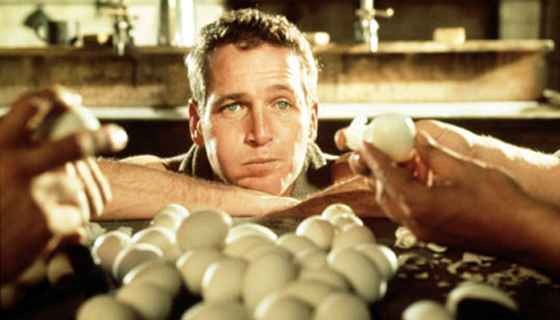
I came across this old limerick and immediately the movie Cool Hand Luke came to mind and the scene where Luke, played to perfection by Paul Newman, bet his fellow inmates that he could eat 50 eggs.  Great scene.  Great movie.

Luke was and is one of my favorite movie characters of all time.  His contrarian nature constantly put him at odds with the world.  He just didn’t seem to fit in with all its rules and was in a never ending rebellious struggle with those in authority.  It was easy to identify with Luke as a young man, especially in the way he channeled his rebellion.

Cool.  Never showing the anger and frustration that was obviously inside him.  He had a sort of stoic acceptance, even a smile, when he appeared to totally defeated by the forces he opposed.

It’s a great film.  It has drama, tragedy, humor and moments of defeat and triumph.  It’s everything a movie should be.  very human.

Funny how a little found limerick can trigger so many memories and feelings.  Something out of nothing.

Or as Luke might say:

Sometimes nothing can be a pretty cool hand…

Read Full Post »

« Newer Posts - Older Posts »