Feeds:
Posts
Comments

Archive for the ‘Quote’ Category

The aspects of things that are most important for us are hidden because of their simplicity and familiarity.

– Ludwig Wittgenstein
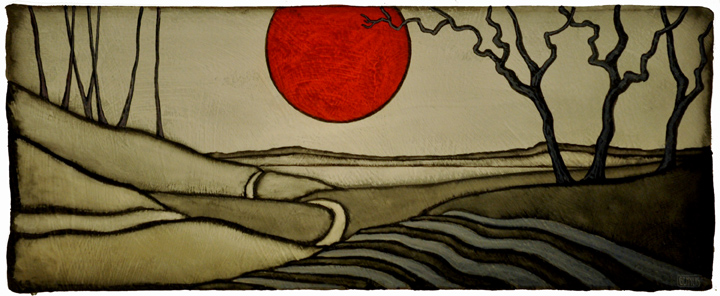
I immediately recognized a relevancy for my own work when I read the words of Wittgenstein’s quote, shown above.  I have always maintained (actually, hoped) that the strength of my best work has been in its simplicity of expression and use of familiar iconography, imagery that finds an immediate and deep rooted connection in many viewers.    Simple and elemental, stripped of detail but not meaning.

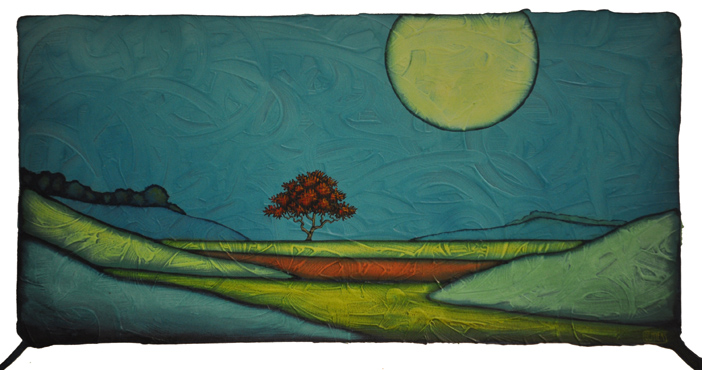
I think this new piece, an image of about 8″ by 18″ on paper, fits into this description.  On first examination, this is a very simple piece.  It is stark in it rendering.  Simple lines and shading, with hardly any detail and only a bit of color.  The contrast of the red sun/moon dominates the center of this piece and brings everything into focus, moving the eye far forward into the scene, creating a sense of depth that shrouds the viewer.  The rising trees on either side further funnel the concentration inward.  This focus creates a meditative atmosphere, for me at least, and that speaks to  the aspects of things that are most important for us, as Wittgenstein put it.  The whole of this piece is greater than the sum of its parts. 

Or its merely a simple  composition, pleasant to look upon.  Its all in the eye and mind of the beholder.
Read Full Post »

If at first you don’t succeed, try, try again. Then quit. There’s no point in being a damn fool about it.


-W.C. Fields
 
*********************
Okay, maybe those aren’t the most inspirational words ever uttered.
– 
But I’ve been thinking about the nature of failing and succeeding ever since reader Tom Seltz posed a few questions on the subject to me the other day.  I wrote yesterday about how failure for what I do was truly subjective, completely comprised of shades of gray.  But as I thought about it through the day I came to same conclusion for what is considered success for my paintings.  The perceived success of a piece is also truly subjective.  It has happened many times that a piece that I felt succeededgreatly for me has languished and raised little attention in the galleries.  I know that this doesn’t necessarily designate it as a failure but it points out the subjective perception of art.
I think this differs for various types of art.  Obviously, in portraiture there are more objective aims that must be met in determining the success or failure of a piece.   Ask anyone who has taken on a portrait commission.  I immediately think here of a portrait of George Stephanopoulos that was painted by Joseph Solman in the 1990’s when Stephanopolous was still part of President Clinton’s team.  Solman, who died  in 2008 at the age of 98 and one of the leading lights of the Modernist movement of the 30’s, painted Stephanopoulos in tints of green.  I thought it was a spectacular painting, a rousing success, when I saw it but Stephanopoulos had a differing view, seeing it instead as a failure, refusing to buy it.  Two polar views of the same painting.  Sadly, I can’t find an image of it to show here.   Painters who work in an ultra-realistic manner face the same objective viewing of their work. 
My work tends to be more about expression and emotion rather than sheer representation so this creates even more gray area for objective analysis.  I don’t really care about exactitude in rendering so long as the emotion that I’m seeking comes out and a sense of rightness exists around whatever I am depicting.  While I don’t have a great concern for the object being perfect, it can’t be absolutely wrong.  This emotion and sense of rightness are the main objectives for my work  so there is little to go by as far as judging a work a failure or a success.  And I like that.  I would rather the individual judge my work for what they see and sense in it rather than than by having them judge how it compares to reality.
I know I’m way off target here and not sure I’ve made my point  but I’m leaving it to be at this point.  Keep in mind, this is just thinking out loud here.  I may change my mind about the whole thing completely by tomorrow. 

Read Full Post »

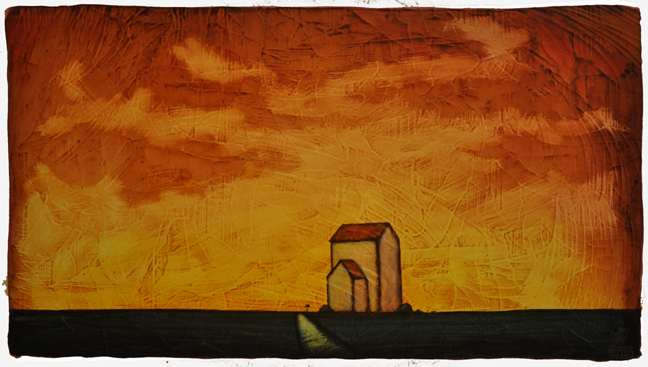
This is a new 12″ by 24″ painting that sits in my studio at the moment.  It draws a lot of my attention at the moment and I’ve been enjoying it over this time.  I find this a very hopeful piece, the whiteness of the house’s reflection of the bright rising light set in contrast to the dark foreground.  It’s this contrast that creates the hope I see.  Like many things, hope is relative to the conditions of the situation.

 I’ve left the landscape bare of other trees other than those in the foreground which form a stage-like setting for the scene beyond, wanting to create  more focus on the starkness of the house.  The path moves from dark to light and also conveys this sense of hope, of moving towards a more illuminated situation.

I’m thinking of calling this Obscurity.  I know that this doesn’t convey the hope of which I speak but I have been thinking of a line from John Locke’s An Essay on Human Understanding that has been bouncing around in my head for a week or so.  Locke states: 

 Untruth being unacceptable to the mind of man, there is no defence left for absurdity but obscurity.

It sounds wonderful.  In a perfect world.  I can’t help but wonder if in fact the opposite might apply to our times: Untruth being acceptable to the mind of man, there is no defence for rationality but obscurity?  This thought has hung hauntingly on me for some time and maybe I see this house as a refuge of some kind for rational thought in what seems an irrational time.  A place of obscurity.

Or maybe it’s just a house. After all, sometimes a cigar is just a cigar.

Read Full Post »

Dreaming

“Without leaps of imagination or dreaming, we lose the excitement of possibilities. Dreaming, after all is a form of planning.”
— Gloria Steinem

***********************

I love the last sentence of this quote.  Without dreaming we would remain static, tethered to the present moment and state of affairs.  Would we have soared like birds without the dreams of the Wright Brothers and other aviation pioneers?  Would we have reached out  to the universe without the dreams of early aerospace engineers?  Would any of the great structures of the world been built without dreams?

If we can dream it, we can do it.  We will find a way.  But we have to dream first.

I remember talking to an older waitress  that I worked with many years back.  Her life was always filled with drama and she always seemed discontented with her lot in life.  I asked her what she wanted from her life and she said she didn’t know.  Maybe a good job where she made enough money to be comfortable.  Asking further, it seemed that she had no dreams for herself, no specific desires.  She saw herself as nothing more than she was at that moment.   It became clear that she had no way to formulate a future without a dream to plan from, a map to read as  she started her journey forward.  She was simply in the car with no knowledge of where she wanted to go. 

That’s  a sad little episode.  I knew I couldn’t make her dream and I saw so many other people at that time in the same  car, without maps and with no real goals or dreams to work towards.  I tried my best to tell them, to show how I was working toward my dreams as an artist, taking small steps.  But it didn’t always resonate and no lightbulbs suddenly turned on over the heads of those people. 

Maybe it just wasn’t the time for an epiphany for them.

But I still have hope that someday they will realize that having a dream is a small step toward a better life.  I’m not talking about a better life with more things and money.  I’m talking about a better life lived with purpose and intent.  That provides the satisfaction that comes with following our dreams.

So, as this year is ending, think about your life and dare to dream.  Take that first baby step forward.  A new year is coming.

Read Full Post »

Was That Me?

As machines become more and more efficient and perfect, so it will become clear that imperfection is the greatness of man.

 
——-Ernst Fischer 

****************************************************************

I’ve wondered about the concept of perfection for some time  and quite some time back came to that conclusion that perfection is not a human quality, that we are defined by our imperfections.  That’s somewhat what the quote above says.  When I read it, it struck me at once but I had never heard of the writer, Ernst Fischer.  Looking him up, I found him to be an Austrian Marxist writer who waved the banner for Stalinist policies for many years but in his later years ( he died in 1972) came to regret his past.  His memoir of his life began with a chapter that was titled Was That Me?, indicating his astonishment at looking back and seeing the phases he went through in his life.

I think most of us could start our own memoirs with that same first chapter title.  I know I could, even though I feel that I am very much the same at the core now as I was then.  My actions were not always consistent with that core, however.  I was, and am,  a walking exhibition of flaws, imperfections.  As we all are.  Maybe it’s when we begin to align our actions to who we are at the core that life begins to appear become easier to swallow and our imperfections become less evident. Not worn on our sleeves.  I’m not talking about acquiring perfection, just recognizing the flaws that make up each of us and accepting them.  Life is in toleration.  Of ourselves and others.

Please bear with me here.  One of the problems of doing a daily blog is that I often post things as though I were writing them in a journal, unedited and just as they fall out of the mind.  They are not always fully realized thoughts or ideas and will soon be questioned in my own mind,  like reading an old journal written when much younger and wondering , “What was I thinking there?” or “Was that me?”  You hope that, as we age and gain experience, that this is a less frequent happening in our lives.  But writing in this public forum, forcing out words each day, it sometimes reappears. 

One’s imperfections become apparent. 

Phew!  I don’t know what I just said here and I don’t really want to reread it so I’ll let it hang out there for now, flawed though it may be.

The piece at the top is a tiny painting, 2″ by 4″, that I call Red Eye.  For some reason unknown to me at this point, I felt it fit this post.

Read Full Post »

Solitary Confines

Whosoever is delighted in solitude is either a wild beast or a god.

—-Francis Bacon, Sr,

******************

Monday morning and I’m here in the studio, wondering why I continue to do this blog, to get up each day and struggle to say something new.   In some ways  it comes between me and the precious solitude I have set up for myself here.  It brings in the outside world and exposes my weaknesses and flaws to them.  It frustrates me at times.  It takes away time better spent. 

At least, I think the time might be better spent.

But I do it. 

From the first few days of doing this, I viewed it as a form of art.  I would try to be consistent, try to keep to a certain standard that I felt inside, just as I do with my painting.  I would just put it out there so that the world, if interested, could see it and react. Like painting.

But it is different from painting.  It takes from my solitude whereas my painting adds to it, and that is a big factor for me.  I understand the quote above.  I have often felt the wild beast, the feral dog that exists just outside the human world, sometimes venturing in when the need arises but always retreating to my solitary confines.  A beast, not a god.

And I’m comfortable with that.

But sometimes, some days, there are moments when I feeel that this very act of writing this blog takes away my cover, my solitary den.  Today is such a day.  But I will retreat and hover for a while on the periphery and come back again tomorrow.

Maybe.

Read Full Post »

Disparity

In expanding the field of knowledge we but increase the horizon of ignorance.
——Henry Miller

*****************

       I have written here in the past about the growing imbalance in income and wealth between the haves and the have-nots of this country, about how unhealthy it is for us as a nation to have so many people living below the poverty line.  One in seven, a little over 14%,  of us lives below the poverty line and for children it’s an even worse one in five, 20%.  For a country so full of itself in proclaiming ourselves the best at everything  (even when the numbers don’t bear it out) these are atrocious figures.

But I thought of an equally alarming disparity in our country, and the world,  when I came across the quote above from author Henry Miller.  We have a definite gap in education and knowledge in this country that runs pretty much through the same groups as the poverty line.   We are quickly becoming a more ignorant society, placing less and less emphasis on knowledge and wisdom.  In fact, we have become a country that is suspicious of anyone displaying a modicum of either, labeling them as elitists.

 We are at a point in human existence when we have more knowledge at our fingertips than at any time in prior history yet we have all the same problems that we have had for millenia.

Ethnic wars.  Racial intolerance.  Religious intolerance.  Subjugation.  Ignorance and poverty.  Famine and disease.

For all our knowledge of how we might best survive this world, these things continue and at exponentially higher levels.  Yes, we live in a time of wonder on many levels, with breakthroughs in medicine and technology.  But until we can make our knowledge accessible to everyone, at every social strata, we are doomed to be mired in the problems that have haunted us forever.

Do I have an answer?  Of course not.  In fact, I’m not even sure I’ve addressed the real problem with these few words.   But I am worried about these gaps between us.  In an increasingly more densely populated world, it makes for a volatile and dangerous situation.

 And that is not in anyone’s best interest.


Read Full Post »

A Cheerful Nature

There is one thing one has to have: either a soul that is cheerful by nature, or a soul made cheerful by work, love, art, and knowledge.

———Friedrich Nietzsche

***************************

Interesting quote.  I know that my life is made more cheerful from work, love and art. It’s the knowledge part that I find myself questioning.  Sometimes it feels that knowledge takes away cheerfulness, as thought the more we know the more dire the situation seems.  But I realize that I’m confusing knowledge with information.  Knowledge is taking information and having the ability to use and cope with it, to see how information fits into a larger framework.  A distinct difference there and one that most of us confuse. 

We’re bombarded with new information all the time, in an endless barrage of charts and numbers and words.  We are living in the world of information today, after all.  And after taking it all in feel as though we’ve obtained knowledge. 

 Information, yes.  Knowledge, no.

So, maybe Nietzsche is right after all.  Having true knowledge, an ability to cope with all this information in a coherent manner, would cheer me up. I guess I’ll keep trying to gain some.  I would so much more enjoy living in the world of knowledge than the world of information.

Read Full Post »

Southern Gardens- Paul Klee

I was asked yesterday if I talked to my paintings.

  Interesting question.

I talk to animals.  I talk to trees and plants.  I talk to my car. I talk to my studio, which actually has a name. I talk to ghosts, present or not.   Whether any of these things or beings listens is another matter.

But talk to my paintings?

It immediately brought to mind a section of a famous lecture that I had been reading recently and had really resonated with me.  It was On Modern Art,  delivered in the 1920’s by Swiss artist and a personal favorite of mine Paul Klee :

May I use a simile, the simile of the tree? The artist has studied this world of variety and has, we may suppose, unobtrusively found his way in it. His sense of direction has brought order into the passing stream of image and experience. This sense of direction in nature and life, this branching and spreading array, I shall compare with the root of the tree.

……..From the root the sap flows to the artist, flows through him, flows to his eye. Thus he stands as the trunk of the tree. Battered and stirred by the strength of the flow, he guides the vision on into his work. As, in full view of the world, the crown of the tree unfolds and spreads in time and space, so with his work.
……..
Nobody would affirm that the tree grows its crown in the image of its root. Between above and below can be no mirrored reflection. It is obvious that different functions expanding in different elements must produce divergences. But it is just the artist who at times is denied those departures from nature which his art demands. He has even been charged with incompetence and deliberate distortion.
……..
And yet, standing at his appointed place, the trunk of the tree, he does nothing other than gather and pass on what comes to him from the depths. He neither serves nor rules–he transmits. His position is humble. And the beauty at the crown is not his own. He is merely a channel.

This very much sums up how I’ve always felt about art, especially my place as an artist.  A mere channel or transmitter.  And when I look at my paintings, it is not in the form of a conversation so much as listening  to what the painting has to tell me.  I paint because I question and, at best, the paintings provide some answers and insight that I might not find or see otherwise.

So, do I talk to my paintings?  Not so much.  But do they talk to me?  Yes.  And I do my best to listen…

.

Read Full Post »

 People are like stained glass windows: they sparkle and shine when the sun is out, but when the darkness sets in their true beauty is revealed only if there is a light within.

                      –Elizabeth Kubler-Ross

********************

Nightglow-- GC Myers 2010

I was having trouble describing what I saw in this painting, Nightglow, so I went looking for other people’s word to help me.  I came across this quote from Kubler-Ross, the famed psychiatrist who pioneered the study of death and dying and introduced the Five Stages of Grief to us.

It’s a simple quote and a simple premise- that we are measured not by how we behave when things are at their best but by how we rise to face obstacles and problems.  How we gather light in the darkness and how we reflect it and give off our own light.

One always hopes that they are the one who gives off the light, that they possess the ability to shine brightest at the darkest moments.  Perhaps it’s just a romantic notion of a heroic quality that evades most of us.  But we can, and should, aspire to such a quality.  It is far too easy to respond to darkness with our own darkness.  We see this every day, in so many situations, and continue to stumble through the murk.

Light will show us the way through darkness every time.


************************************************
Nightglow is part of the New Days show at the West End Gallery in Corning. 

Read Full Post »

« Newer Posts - Older Posts »