Feeds:
Posts
Comments

Archive for the ‘Quote’ Category

Perception

There are mighty few people who think what they think they think.

–Robert Henri

**********************

I was reading some The Art Spirit from artist/teacher Robert Henri when I went to do some research on his career.  I came across all the normal things, including the images of the numerous portraits he had painted. All good and nice.   But it was the quote above that stuck with me.

Do we really match our own images of ourselves?  Does the rest of the world see us in the same way as we imagine ourselves to be?  Do we really see our own flaws clearly or are we like the person who goes to a palmreader and believes it because they reinforce everything positive that we believe about ourselves in their reading?  Are we ever as good as we believe or as bad as others might see us?

If we saw ourselves as others do, would we be pleased or disappointed?

I suppose the ultimate follow-up to such questions is Does it matter

I don’t know why I wrote this this morning as there is no specific direction in which I’m taking this.  No answers.  No personal revelations.  Just a few words from a person in the past made me consider this. 

Oh, well.  Time to work.  But I’m sure this will be on my mind for most of this day.

Read Full Post »

The Goal Ahead

Nothing can stop the man with the right mental attitude from achieving his goal; nothing on earth can help the man with the wrong mental attitude.

–Thomas Jefferson

******************

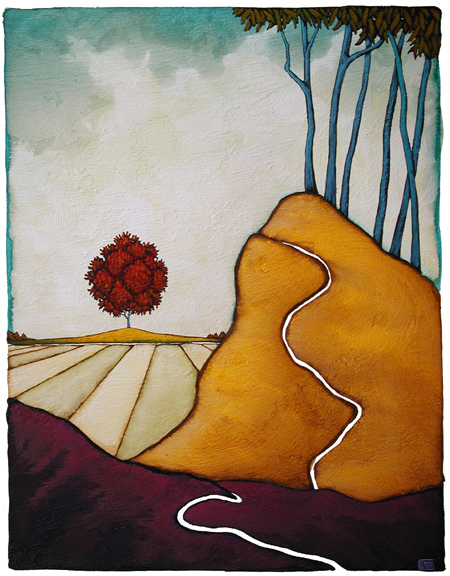
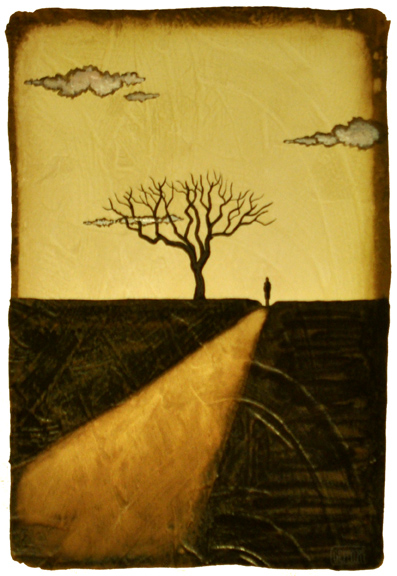
I came across this image of a painting from a number of years ago that I have always really liked and have always felt an immediate response to my interpretation of it.  It always reads the same to me, a sentiment that  pretty much jibes with the quote from Jefferson above.  So often we live as though we are flotsam on the sea, aimlessly adrift on currents that we don’t control.  I know I have been guilty of this at points in my life.  None of my actions at those times were leading in any specific direction and at times made me feel as though I were in a whirlpool that kept spinning me in all directions, leaving me confused and despondent.

A goal is purpose, a reason for every step forward.  A reason to fight for every day, every moment we have on this earth.  Once we have a goal, a purpose, time becomes precious.  Without purpose, time becomes meaningless.

That’s what I immediately see in this piece and it always tweaks me a bit, gets me thinking about how I might be drifting away from my own purpose and how my own time becomes ever more precious with every passing day.  It is a gentle slap on the cheek for me to move, to take action now.

And I will.  Have a great day.

Read Full Post »

Invisible Gifts

There is a destiny that makes us brothers: none goes his way alone,

All that we send into the lives of others comes back into our own.

–Edwin Markham

*************

This is a smaller piece that I recently finished.  This was a little different in that I started it with the intent of communicating a specific message and feel.  I wanted to get across the idea that we all are connected to the world in ways that seem very invisible at times.  We reach out and touch people in ways we may never know and are touched in ways that sometimes mystify ourselves.  We often feel alone in our journey but our lives overlap multitudes that we often fail to see or acknowledge.  Our words and actions, even the smallest and least thought out, make their way into the fabric of the universe and bind us to it. 

As much as we may dispute it, we are not alone in this world.  We are part of its mesh and are always in contact, even in the darkest of times. 

Maybe it can be called karma or something akin to it.  I don’t know.

My words fail me here, as is often the case especially when trying to describe things already shrouded in mystery.  Just thinking…


Read Full Post »

A place belongs forever to whoever claims it hardest, remembers it most obsessively, wrenches it from itself, shapes it, renders it, loves it so radically that he remakes it in his own image.

–Joan Didion

***********

My friend Linda from Texas one day in her blog  brought this quote from Joan Didion to my attention and it has stuck in my mind for some time.  It seems to especially apply itself to those places and memories from our past that have long passed from the sight of the general public, places that I often run across when doing genealogical research.  Towns that have vibrant stories and a rich , interesting past but are nearly vacant now, the memories of that place now resigned to an existence in a few aging minds and a few timeworn photos.

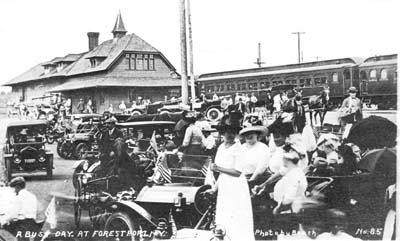
My nephew and his wife recently went up through the Adirondacks and I told him to look for the village of Forestport where my grandmother’s family had a large presence in the late 1800’s and early 20th century.  Her father, my great-grandfather was a prominent member of the logging industry there, employing hundreds of loggers who harvested the timber of the Adirondack and sent it on barges down the Black River Canal to the Erie Canal and onward to build the booming cities of the east.  After his trip, he said that he had been through Forestport and there wasn’t much there.

In my research, the town had taken on its own life.  There are many photos like the one above of the rail station where my grandmother used to come and go (she might even be in that crowd) give evidence of a bustling place full of life.  There are a few books that document the town at that time, talking about the many characters who built the village in the southern forest of the Adirondacks and rebuilt after it burned to the ground on several occasions.  Other books document its place on the Black River Canal, the barge builders who worked there and the men who kept the locks made the canal work.  All attest to a place full of life.

Yet now that is all nowhere to be seen.  That life is a mere reflection in a few minds who have any interest in such places.  Like me.

I wonder often how close the memory I have wrestled from reading and looking jibes with what actually was.  Have I added more life, more vibrancy than actually existed?  I suppose that’s where Didion’s words enter the equation.  Because I care for some reason, that past, that memory of place has become my possession somehow.  Remade in my image, as she said.

It’s an interesting concept and one that doesn’t necessarily just pertain to place alone.  It may work for all memory, all history– events and people, for instance.  History belongs to those who remake it in their own image, for better or worse.

Read Full Post »

The Longshoreman Philosopher

Power corrupts the few, while weakness corrupts the many.  Hatred, malice, rudeness, intolerance and suspicion are the fruits of weakness.

–Eric Hoffer  ( The Ordeal of Courage  1963)

************

Read the above quote and was captovated by the idea behind it and tried to fit its content into what I observe.  There was a certain resonation and I wanted to know more about its writer, Eric Hoffer.  I am ashamed to say I knew nothing of his life or his work, this man who died in 1983 known as the longshoreman philosopher.  But thanks to the internet, there is a wide array of available resources including several sites who focus solely on the work of Hoffer.  Below is the short bio from the website of The Eric Hoffer Project:

Former migratory worker and longshoreman, Eric Hoffer burst on the scene in 1951 with his irreplaceable tome, The True Believer, and assured his place among the most important thinkers of the twentieth century. Nine books later, Hoffer remains a vital figure with his cogent insights to the nature of mass movements and the essence of humankind.

Of his early life, Hoffer has written: “I had no schooling. I was practically blind up to the age of fifteen. When my eyesight came back, I was seized with an enormous hunger for the printed word. I read indiscriminately everything within reach—English and German.

“When my father (a cabinetmaker) died, I realized that I would have to fend for myself. I knew several things: One, that I didn’t want to work in a factory; two, that I couldn’t stand being dependent on the good graces of a boss; three, that I was going to stay poor; four, that I had to get out of New York. Logic told me that California was the poor man’s country.”

Through ten years as a migratory worker and as a gold-miner around Nevada City, Hoffer labored hard but continued to read and write during the years of the Great Depression. The Okies and the Arkies were the “new pioneers,” and Hoffer was one of them. He had library cards in a dozen towns along the railroad, and when he could afford it, he took a room near a library for concentrated thinking and writing.

In 1943, Hoffer chose the longshoreman’s life and settled in California. Eventually, he worked three days each week and spent one day as “research professor” at the University of California in Berkeley. In 1964, he was the subject of twelve half-hour programs on national television. He was awarded the Presidential Medal of Freedom in 1983.

“America meant freedom and what is freedom? To Hoffer it is the capacity to feel like oneself. He felt like Eric Hoffer; sometimes like Eric Hoffer, working man. It could be said, I believe, that he as the first important American writer, working class born, who remained working class-in his habits, associations, environment. I cannot think of another. Therefore, he was a national resource. The only one of its kind in the nation’s possession.” – Eric Sevareid, from his dedication speech to Eric Hoffer, San Francisco, CA, September 17, 1985

I think I have found some new reading material for the winter…

Read Full Post »

I came into the studio this morning and immediately sat down to read my emails.  Among them was the most recent post from American Folk Art@ Cooperstown titled Ralph’s Take On Rembrandt.  It concerned the late and great American folk artist Ralph Fasanella and his reaction to criticism and unsolicited advice.  I finished reading and burst out laughing.  Boy, did it hit close to home!

Over the years, I have been approached by several people who think they are doing me a great service by telling me that I should change the way I paint in some way or that I should try to paint more like some other artist.  Early on, when I was first exhibiting my work, I had another more established artist tell me that I should change the way I paint my figures, that they should look the way other artists paint them.  I responded to this artist and the others who offered me their advice with a smile and an “I’ll look into that.”  But  that one time,  I also mistakenly heeded the older painter’s words, being inexperienced and seeking a way as I was, and stopped painting figures for a while before realizing that this was not good advice at all. 

Here’s the post about Fasanella and his response to such advice. 

Ralph Fasanella had trouble painting hands. A lot of trained artists do too, so it is not surprising that a union organizer who turned to drawing suddenly at the age of 40 would struggle with hands early in his career. But he did have something that proved better than years of formal training: he believed that he was an artist and that what he was doing – painting the lives of working people – was a calling that deserved his complete attention and all-consuming passion.

And that made him react when anyone suggested that his paintings weren’t up to snuff. He said that he was painting “felt space,” not real space. His people and the urban settings he placed them in were not realistic in the purest sense of the word, but they sang with spirit and emotion. As Ralph said, “I may paint flat, but I don’t think flat.”

Rembrandt Hands

His most memorable quote, and the one that says the most about him, occurred very early in his artistic career, when someone told him that his hands looked like sticks. He ought to study Rembrandt’s hands, they said, in order to get it right.

His response is priceless: “Fuck you and Rembrandt! My name is Ralph!”

I may not really adopt Ralph’s approach but you can bet his words will be echoing in my head the next time someone says “You should paint like…”

Read Full Post »

We dance round in a ring and suppose, While the secret sits in the middle and knows.

–Robert Frost

**************

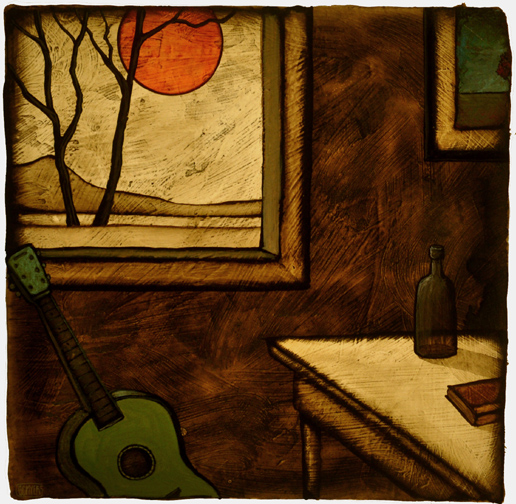
This is a new painting,  in size about 11″ square  on paper, that I will be showing at my next show that opens in a little over two weeks at the West End Gallery in Corning.  I call this piece Secret Inside.

I really didn’t know what to think of this piece after I painted it.  All of the elements fell into place strictly from a compositional standpoint, without a lot of rumination over meaning or intent.  Theysimply worked in the context of the scene.  It wasn’t until I had time to step back and study it for a bit that it started to reveal its meaning to me.  Or at least what it means to me.  You might see it differently.

I began to see the interior scene as the secret self, the part of us that we seldom expose to the outer world, which is seen out the window.  The guitar represents our hidden self-expression and creativity.  The painting on the wall (looks suspiciously like one of mine) represents the desire for beauty and the book on the table, the desire for knowledge.  The empty bottle symbolizes our weaknesses, our vices.  Perhaps the desire to forget. 

The table shows what might be seen illuminated in a glimpse from the outside and the overall darkness of the interior reveals itself as that dark part of us that is never visible to the outer world.  Or which we hope is never visible.

As I’ve said many times before here, this is only my personal take on this.  You might see something completely different, perhaps something much less symbolic or you might see it as something darker, more sinister. 

It all depends on your own secrets inside.


Read Full Post »

Everyone has his own specific vocation or mission in life; everyone must carry out a concrete assignment that demands fulfillment. Therein he cannot be replaced, nor can his life be repeated, thus, everyone’s task is unique as his specific opportunity.

——Viktor Frankl

**********************

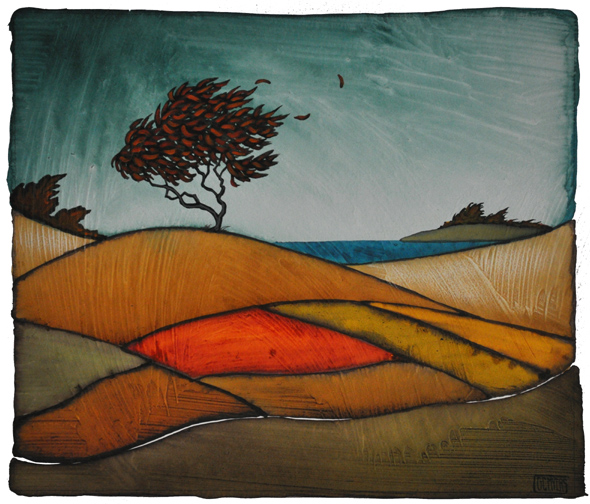
The words of Viktor Frankl, the WW II concentration camp survivor who went on to greater fame as a psychotherapist and author, seemed to ring true for this square painting after I finished it.  I saw the Red Tree here as one that finally saw its uniqueness in the world, sensing in the moment that with this individuality there came a mission that must be carried out.

A reason for being.

I think that’s something we have all desired in our lives.  I know it was something I have longed for throughout my life and often found lacking at earlier stages.  I remember reading Frankl’s book, Man’s Search For Meaning, at a point when I felt adrift in the world.  I read how the inmates of the concentration camp who survived often had  a reason that they consciously grasped in order to continue their struggle to live.  It could be something as simple as seeing the ones they loved again or finishing a task they had set for themself. Anything to give them a sense of future.  Those who lost their faith in a future lost their will to live and usually perished.

 At the time when I read this, I understood the words but didn’t fully comprehend the concept.  I felt little meaning in my life and didn’t see one near at hand.  It wasn’t until years later when I finally found what I do now that I began to understand Frankl’s words.

We are all unique beings.  We all have unique missions.  The trick is in recognizing our individuality and trusting that it will carry us forward into a future.

I’ve kept this short.  There are many things that I could say here but the idea of finding one’s mission, ones meaning, is the thought that I see in this piece.  This paintings is titled The Moment’s Mission and is 11″ by 11″ on paper.  It is part of the Principle Gallery show that opens Friday.

Read Full Post »


When he reached the ferry, the boat was just ready, and the same
ferryman who had once transported the young Samana across the river,
stood in the boat, Siddhartha recognised him, he had also aged very
much.

“Would you like to ferry me over?” he asked.

The ferryman, being astonished to see such an elegant man walking along
and on foot, took him into his boat and pushed it off the bank.

“It’s a beautiful life you have chosen for yourself,” the passenger
spoke. “It must be beautiful to live by this water every day and to
cruise on it.”

With a smile, the man at the oar moved from side to side: “It is
beautiful, sir, it is as you say. But isn’t every life, isn’t every
work beautiful?”

——-Herman Hesse, From “Siddhartha

****************************

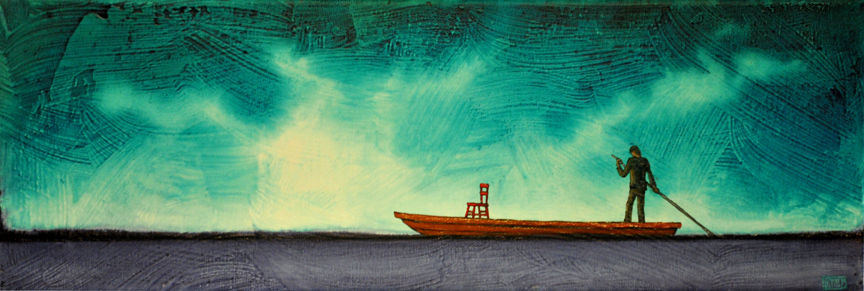
This is is a new piece, also from the upcoming Principle Gallery show.  It’s a small piece, 6″ by 18″ on canvas, that I call simply Ferryman.  I have used the image of the ferryman through the years, usually in very simple, quiet compositions.  It would be easy to associate the image with that of Charon, the boatman of Greek mythology who carries recently deceased souls across the river Styx in Hades.  There is that feel about this image,  especially with the red chair sitting empty in the boat, an image I have often associated with the dead and memory of the past.

 But I see this particular ferryman in a different way, more like the philosophic ferryman of Hesse’s Siddhartha above.  The passage with this ferryman is  more about transformation than transportation, a spiritual crossing from existence, one state of being,  to another.  The brightness of the light breaking through in the sky seems more attuned to this reading of the image as well, as though the passage is taking one across to a state of higher enlightenment.  There’s still a somber quality but it is different than that which is often attached to death.  It’s more the feeling of knowing that you are being transformed on this voyage and the past you is no more.  Gone forever.

As always, this is just how I read it.  You may see more, you may see less.  All views are equally valid.

Read Full Post »

The Need for Solitude

The artist must actively cultivate
that state which most people avoid:
the state of being alone.
-James Baldwin

**********************

I spoke with a drawing class from a local college yesterday.  I always feel like I could have done a much better job with these things and yesterday was no different.  I left thinking that I hadn’t fully expressed fully all the advice or warnings I might have wanted to offer.  I had sped over the idea of taking a  mindset for their work that makes it apparent that they view their work as important.  The idea here is that if you don’t take your work seriously, how can you expect others to  do the same?  I don’t think I got that fully across.

The one thing I did stay on was the value and need for solitiude in their work, how they must embrace being alone with their thoughts and work in order to take their work to its fullest potential.  They should be honest with themselves and if they are uneasy about being and working alone, this is not a path they should follow.  I told them that the solitude was actually the big attraction for me and that, even as I spoke with them, I was wishing I was back in the studio.  Alone.

Creation is most often done in solitude.  There have been successful artistic collaborations through the years but they seldom have the impact and power of the singular voice and vision.  And this is most often forged in solitude.

Maybe I’m biased towards this idea because of my cultivated  affinity for being alone.  I don’t know nor do I really care.  As the glorious Garbo said, ” I just want to be alone.”


Read Full Post »

« Newer Posts - Older Posts »