Feeds:
Posts
Comments

Archive for the ‘Quote’ Category

I’ve been a fan of the work of Chuck Close for some time, admiring the grand scale that much of his work assumes as well as his evolution as an artist, especially given his challenges after a spinal artery collapse left him paralyzed from the neck down in 1988.  He regained slight use of his arms and continued to paint, creating work through this time that rates among his best.  He also suffers from prosopagnosia which is face blindness, meaning that he cannot recognize faces.  He has stated that this is perhaps the main  reason he has continued his explorations in portraiture for his entire career.  The piece shown here is a portrait of composer Phillip Glass that was made using only Close’s fingerprints,  a technique which presaged his incorporation of his own unique form of pixelation into his painting process.

His determination to overcome, to keep at it, is a big attraction for me and should be an object lesson for most young artists (and non-artists, also) who keep putting off projects until all the conditions are perfect and all the stars align.  Waiting for the muse of inspiration to take them by the hand and lead them forward.  Sometimes you have to meet the muse halfway and Close has this advice for those who hesitate:

The advice I like to give young artists, or really anybody who’ll listen to me, is not to wait around for inspiration. Inspiration is for amateurs; the rest of us just show up and get to work. If you wait around for the clouds to part and a bolt of lightning to strike you in the brain, you are not going to make an awful lot of work. All the best ideas come out of the process; they come out of the… work itself. Things occur to you. If you’re sitting around trying to dream up a great art idea, you can sit there a long time before anything happens. But if you just get to work, something will occur to you and something else will occur to you and something else that you reject will push you in another direction. Inspiration is absolutely unnecessary and somehow deceptive. You feel like you need this great idea before you can get down to work, and I find that’s almost never the case.

Amen to thatThe process provides the inspiration.  I’ve stumbled around for some time trying to say this but never could say it as plainly and directly as Close has managed.  Thanks, Chuck.  I think I’ll take your advice and get to work.

Read Full Post »

There are only two mistakes one can make along the road to truth; not going all the way, and not starting.
—Buddha

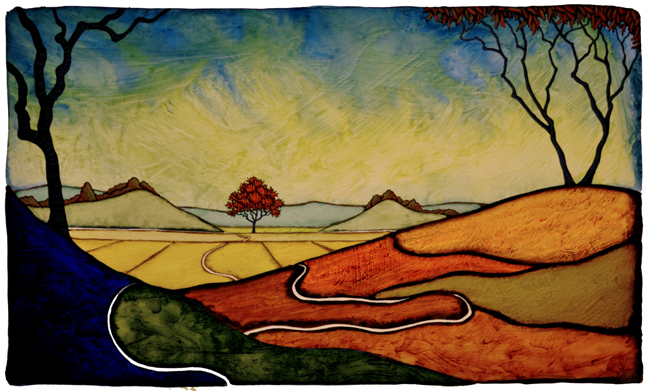
This is a new painting that recently went to Watts Fine Arts in Zionsville, outside of Indianapolis.  It’s a large canvas, 20″ tall by 60″ wide, that is called Where the Road Ends
 
I often use a pathway or road leading into my work, the idea being that it serves as an invitation for the viewer to enter the scene.  Sometimes the path simply cuts through the landscape and runs to a horizon, a symbol of  the continuity of the journey.  But sometimes the path seemingly ends and I find myself at these times asking myself what that means, both in the context of the painting and in my mind.  Is it the reaching of a goal, such as the truth to which Buddha alludes above?  Or is it merely a road that comes to an end?   
 
Probably both are correct.  In the process of painting I don’t go forward with this final image in mind.  The road neither ends nor goes on when I am in the midst of painting.  It’s just there.  But at a certain point, the composition demands that a decision be made, to either continue with it or to let if disappear behind a knoll.  The easier decision is always to continue, to let the path represent  the continuum of time.  It is natural and something we can all relate to in some way.  We understand theconcept of the journey.
 
But to terminate the road means that there is some sort of finality, an endpoint.  Be it wisdom, truth, death or some other sort of epiphany, this terminus presents a great opportunity for symbolism.  Enter the single Red Tree.  Set against the end of the path and the  landscape that opens to lines of distant hills, it becomes an icon for that for which we strive. 
 
 Perhaps it is a symbol for our wiser self in the here and now, enlightenment found.  Perhaps for some it represents an afterlife, the step beyond our earthly journey.  Or it could be any number of other readings.  But however it is read, the Red Tree here, sitting away the end of the road, demands engagement from the viewer, demands that they consider its meaning to them.
 
And I like that.
 

Read Full Post »

“Any great art work … revives and readapts time and space, and the measure of its success is the extent to which it makes you an inhabitant of that world – the extent to which it invites you in and lets you breathe its strange, special air.”

Leonard Bernstein

^^^^^^^^^^^^^^^^

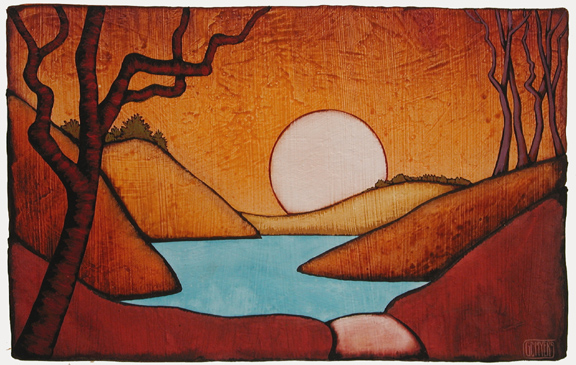
I came across this quote from Leonard Bernstein that I really thought captured what I hope occurs in my work.  I think that my work is most successful when people allow themselves to feel themselves as part of the landscape before them, to enter and breathe in that strange and special air, as Bernstein describes it.  I know that this is the case for myself.  I have written about this here before, about how these landscapes, with their blue and orange fields and bright red trees, feel as real to me as looking out my studio window.  The fact of the blue in the field is overruled by its harmony within the composition which creates that sense of rightness to which I often refer.

Maybe this sense of rightness is what makes up that strange and special air.  I don’t know.  I only know that I still seek words or explanations to describe why a painting works, by which I mean has an emotional impact on the viewer.  The new painting above is such a piece for me.  It’s a 15″ by 25″ image on paper that I am calling, thanks to Mr. Bernstein, A Strange & Special Air.

I could sit here and try to break down the painting, talking about color and contrast, texture and depth.  Line quality and composition.   All of the things that I might momentarily consider while I’m at work on such a painting.  But when all is said and done, I still have no idea why it has its own life, its own strange and special air.  Except that I feel that I am there when I look at it. 

And glad of it.

Perhaps that is enough and all that needs to be considered.  For now, I accept that and will be satisfied to dwell in this landscape with its strange and special air.

Read Full Post »

I have decided to stick with love. Hate is too great a burden to bear
—-Martin Luther King, Jr.

^^^^^^^^^^^^^^^^^

This morning, on the day honoring Martin Luther King, Jr., has me thinking about those who dream of a perfect world.  The cynic in me says that this is a pipedream, that perfection is beyond human means.  That we are flawed and doomed creatures.  But the optimist in me says that perhaps we are never as  far from perfection as we seem.  That we have the possibility of an ideal world near at hand if we could only push aside our hatred and our pettiness long enough to take notice.   As King said, Hate is too great a burden to bear.  And all too many of us are weighed down with hatreds that sap of us our energy, our joy and our ability to see the beauity and possibility of the world around us.

 I have chose the piece above to illustrate this thought because it is to me a representation of a world where the burden of hatred is cast aside.  Called In a Perfect World, this piece is about the ideal setting where the individual can exist without bias, without envy or anger– freed from all the draining negativity of such hatred.  Of course, this is a place that can only exist inside each of us.  It must first become our internal landscape because real change must take effect internally before it can become a greater reality. 

So for now, this perfect world may only exist on this canvas or in my mind.  But maybe one day, it could become a real landscape.  What do we have to lose?

Read Full Post »

Last week, a friend forwarded me a link to an online article from the December 21st edition of a  Greensboro, NC newspaper,The Rhinoceros Times.  It was from a column called Uncle Orson Reviews Everything and in this particular column, Uncle Orson took on a variety of subjects including flash mobs, Andy Serkis ( the actor who portrayed Gollum in the Lord of the Rings films) and a book from Stephen GreenblattThe Swerve: How the World Became Modern.  He then went into a description of the shopping district of Alexandria, VA from a recent visit that included a visit to the Principle Gallery.  He writes:

I’ll confess that I spend my longest visit in Principle Gallery, which specializes in one of my favorite genres of art – hyper-realism and abstracted realism. My wife and I visited once before and fell in love with the art of GC Myers, a painter of symbolic landscapes with a bold earthtone palette.

A piece of his has stood now for years above the fireplace in our family room, where it is the focal point as you walk down the hall. It’s a place of honor – and we can’t bear to rotate any other piece in to replace it, even temporarily.

Myers makes it a point to keep his originals low-priced enough that regular people can afford them, though this means he must paint many of them! He’s a hard-working artist – but with a powerful vision, and art that rewards long contemplation.

He goes on to write about his admiration for the gallery and its many other extremely talented artist.  Needless to say, I was surprised and pleased at being the subject of his words, even the fact that he took notice of my desire to keep my work accessible to people of most income levels, a subject  I will talk in greater depth about in a later post.  I wondered who this Uncle Orson was and going back to the top of the page located a photo that I had missed earlier with the words By Orson Scott Card underneath. 

Orson Scott Card, it turns out, is an extraordinarily famous writer who has written over 60 books in several genres but is best known for his landmark science-fiction series that begins with Ender’s Game, a book that  won both the Hugo and Nebula Awards and came in third in a poll from NPR for the Top 100 Science-Fiction and Fantasy Books, with only Tolkien’s The Lord of the Rings snd Douglas Adam’s The Hitchhiker’s Guide to the Galaxy finishing above it.  Ender’s Game is currently in production for a long awaited film version,  to be released in 2013.

Now I must confess, I had no idea who Orson Scott Card was beforehand or the extent of his notoriety.  While I was an avid sci-fi and fantasy reader in my younger days, it was about the time that Ender’s Game came out that I lost track of the genres.  It wasn’t until I was at a family get-together a few days after Christmas that I realized how well known he was.  When I mentioned this Rhino Times article and said it was by the man who wrote Ender’s Game, my two nephews, both intheir 30’s now, were pretty excited as it had been a pretty big book in their lives.

 Even my sister, coming from the kitchen, asked, ” Orson Scott Card has one of your paintings? Well, my estimation of your work has just went up!”  It seems she had read it as well. 

As I have said here before, I am unaware of many things in this world.  So, Uncle Orson, excuse me for not knowing your work before this and thank you for your kind words in your article.  They are most appreciated and I am honored to have a painting in a place of honor in your home and hope it continues to give you enjoyment for many years to come.

And I will be reading Ender’s Game soon.

Read Full Post »

Strength of Character

Strength does not come from physical capacity. It comes from an indomitable will.

Mahatma Gandhi

***********************

This is a painting from a few years back titled Strength of Character, a 26″ by 30″ image on paper.  It’s one of those rare paintings that has always garnered a lot of attention when shown but has never found a home which has always puzzled me because I consider it an iconic piece from my body of work. 

It uses the Red Tree as a central figure and uses spare detail and strong color to convey a very simple message, one that might well spring from the words of Gandhi quoted above.  The twisted trunk of the tree tells of the adversity the tree has faced, of the obstacles of the hard rock it has forced its way past to emerge to display its red foliage which it wears like a victor’s laurels.  This piece is all about perseverance and maintaining one’s will throughout.  Indomitable.

The color in the piece is really interesting to me.  It has several layers that create a great depth in it, giving the painting a level of complexity that belies its simple constuction.  The overall effect is one that I have struggled to recreate but have never been able to accomplish with anything near the  level of grace or fluidity that I find in this piece.  This color and the fact that the painting still stays with me makes this a very enigmatic piece.

Why it has yet to find a home is not a question I can answer.  I can never say why a painting leaves quickly or stays around for a while.  The pure subjectivity of art is often hard to follow or translate, even in my own work.  But the fact that it remains has never made me think for a moment that this was anything but a painting of my highest level.  It may just take a while for others to see that.

Read Full Post »

Taking Off the Mask

Man is least himself when he talks in his own person. Give him a mask, and he will tell you the truth.

—–Oscar Wilde

I read this quote from Oscar Wilde and it made me think about painting serving as a mask for some artists, allowing them to say things in paint that they see as their truth that they might not be able to express otherwise.  I might fall into that category in some regards.  I certainly hope my work reflects some sort of inner truth.  Or, at least, reflects an aspiration for what I desire for my own truth.

For instance, my work often is placid and calm while I often do not reflect that same attitude personally.  I aspire to be calm and placid and sometimes I do find it for short periods of time.  Maybe the aspiration to be this way will eventually become an ultimate truth.  Maybe this sort of personal  truth can be created, like the face behind the mask beginning to take the shape of the mask.

I don’t know.  Maybe it’s something that we shouldn’t dwell on for too long.  I thought of this quote when I was finishing this recent painting, titled True Self, a 7″ by 15″ piece on paper.  I wondered if this image on the sheet before me was any part of my own truth.  I know that I wanted it to be such but there was part of me that felt unsure, sensing that the reality didn’t yet meet the aspiration.  But it felt like there was at least a small bit of my truth in there somewhere. 

Perhaps when I finally take off the mask I will find it was not a mask but a mold.


Read Full Post »

Whenever I take up a newspaper, I seem to see Ghosts gliding between the lines. There must be Ghosts all the country over, as thick as the sand of the sea…. We are, one and all, so pitifully afraid of the light.

Henrik Ibsen, Ghosts

Another newer painting, this one on paper and measuring about 9″ high by 26″ wide.  I call this piece The Ghost in Memory, using the Red Chair here as an icon for memory, both personal and collective.   Although the Red Chair can have many differing  interpretations for many people, I often see it  as a symbol for memory personally, seeing in it people, places and events from my past . 

Stylisyically, this painting bridges the gap between some of my recent monochromatic work and my typical pieces filled with color.  The sepia pall that hangs over the scene gives it a feel of ghostly nostalgia that was unintended during the painting of it.  There is a waviness in the wash of color that creates vague amorphous shapes that seem to be making their way to the horizon as though being coaxed forward by the hazy light of the sun.  The blue of the trees in the foreground that create a frame for the scene contrast sharply as though marking the boundary between a world that we see and one which is hidden from us.  The Red Chair straddles both of these worlds here.

This is a very simply composed piece with a spare color palette yet it has, for me, a nice depth of feeling and meaning.  It wastes nothing and all of the elements contribute to the overall atmosphere in it.  Though the color is subdued, it still dictates the emotion of the piece.  The sepia gives it an eerie feel yet still has a warmth in it that makes it still inviting.

As to what the actual meaning is here, I leave that up to the viewer to decipher on their own.  Is it about ghosts?  I can’t say except to say that I believe that ghosts exist mainly in our own minds and memories.  That is where most of us are haunted.


Read Full Post »

Color which vibrates just like music, is able to attain what is most general and yet most elusive in nature.

– Paul Gauguin

****************

I came across this line that Gauguin had written in a letter to the poet Andre Fontainas and it made me think about how I often compare painting to music, how I try to find that  rhythm, maybe the vibration to which Gauguin alludes, in my work that has the same effect on the viewer’s unconscious mind as does music.  That thing that would make my work, like music, communicable across all boundaries.  Something that would easily be absorbed as an emotional response without first having to dissect it intellectually, like music that you hearfor the first time and react to without thinking, often finding it still vibrating in your mind for days and weeks afterward.

It’s a grand aspiration and I am never sure if I ever reach that goal.  But I do keep hoping and trying.

I chose the painting above to illustrate this post because I like the simplicity and harmony of it.  Titled Ever, it’s a 15″ by 18 ” piece on paper that is as much an abstraction, with its spare forms and lines,  as it is a depiction of reality.  My hope is that the color and harmony of this piece creates a vibration or rhythm that overcomes the unnaturalness of it, allowing it to makean emotional  contact before the mind finds some intellectual objection.

Again, a grand aspiration.

Reading back over this, I have to say that I don’t sit before my easel or table and ponder these concerns before I start to work.  I often only think about these matters when I come across a line,  like the one above from  Gauguin, that makes me wonder about my own aspirations for my work, what they are and how they compare to the painters of the past whose work I admire.  I guess I am looking for a commonality in our views that connects us somehow, even though our work may not reflect this bond.

Another grand aspiration. 

Read Full Post »

I’d go out to my snowfield and dig out my jar of purple Jello and look at the white moon through it. I could feel the world rolling toward the moon.”

-Jack Kerouac, The Dharma Bums

******************************************

This line from the Jack Kerouac novel was sent to me yesterday by my friend Miescha who had thought of my paintings when she had come across it.  I really liked the association she found in those words and my work and especially the connection she found with it in Kerouac.  When I read the line I was immediately transported back in time to a trip I made with my brother when I was fourteen years old to the Adirondacks to hike around Mt. Marcy.  Kerouac’s On the Road was in my backpack.

It was in the midst of a very hot summer and we hitchhiked, first from the horse track in Canandaigua to Syracuse then from there up through the mountains.  It was a different time, obviously, to see a fourteen year old to be hitching with his older brother and not think it completely out of the ordinary. Probably not something many parents would even consider letting their kids today but for me it fostered a real sense of independence.

 I remember distinctly so much of that trip, especially the people who gave us rides.  The older guy who was commuting northward, drinking canned beer which he shared with my brother.  I politely turned him down when he offered me one.  Whenever we passed a female of any sort he would stick his arm out the window and pound the side of this car as he let out a wolf-like howl.  Then there were a couple of young gypsy housepainters from Lubbock, Texas who played an eight-track of the Doobie Brothers and offered us beer and pot, both of which I again declined.  After they let us out, my brother told me to take the beer and pot and simply hold it for him for later.

Then there was a couple of Italian tourists with their  son who was only a couple of years younger than me.  They didn’t offer any beer or drugs which was fine with me.  I remember the awe of the father as we climbed through a pass in the mountains where the highway had been carved through the stone, leaving shere walls of stone on either side of the wide road.  He spoke in Italian to his son as he pointed at the  stone in admiration.  I had the feeling he was some sort of engineer.

I also remember a long day coming out of the mountains and being at the Thruway entrance near Albany, trying to get a ride through to Syracuse on a Sunday evening, a tough get for a young man and a boy together.  We sat there for about six hours and I finally fell asleep in exhaustion, laying on the road shoulder against the guardrail until a kind soul gave us a ride all the way home, smoking pot with my brother as I slumbered in the back seat.  We walked the last few blocks in the early morning heat through  the streets and I remember a feeling of great contentedness.

The trip and the Kerouac novel’s depiction of the frantic pace of that early Beat generation made the idea of the open road seem irresistible in the mind of a young teenager, a feeling that haunted me for years until it finally faded into the past as my aspirations of being Dean Moriarty turned to the quieter. stabler reality of my current life.  I was never cut out to be that nomadic figure.  I know that now.  But the inspiration it provided those many years ago has remained with me and I still carry that memory of that feeling of being young and alive and on the road.

Funny how a few simple lines can bring back so much memory.  Thanks, Miescha.

Read Full Post »

« Newer Posts - Older Posts »