Feeds:
Posts
Comments

Archive for the ‘Quote’ Category

Give me a place to stand, and I will move the Earth.

Archimedes

^^^^^^^^^^^^

This is actually a condensed and long accepted version of  Archimedes‘  words.  It was really about the power of lever in physics.  He actually said: Give me a lever long enough and a place to stand  and I will move the Earth.  But the lever has been dropped over the 2200 or so  years since he lived and has come to signify something more than a statement about physical mechanics.  It is an almost existential statement about the power of the individual in changing the world.  The small somehow defeating  the overwhelming forces set against them.

David versus Goliath. 

 David’s lever was the sling and stone he used to take down the giant.  Every underdog has somehow identified a strategic advantage that has enabled them to triumph against all odds.  Something that plays to their own strengths and magnifies their greater opponent’s weaknesses. 

What is the lever you will use to move the Earth?

I call the painting above A Place to Stand after these words of Archimedes.  It is a new piece that is a 24″ by 30″ canvas that is a very simple composition that relies on the juxtaposition of the single Red Tree set against a powerfully set sky that seems ready to overwhelm the diminuative tree.  Yet, against all the elemental force  of wind and weather that  the sky can muster, the tree perseveres.  It uses the flexibility of its trunk and limbs to absorb the wind and its bark protects it against the heat and cold. 

It stands alone, without protection.  Yet it stands.   Just standing  strong where you are is a lever powerful enough to change the world. 

Perseverance is often its own victory.

Read Full Post »

The man who insists upon seeing with perfect clearness before he decides, never decides. Accept life, and you must accept regret.

****************

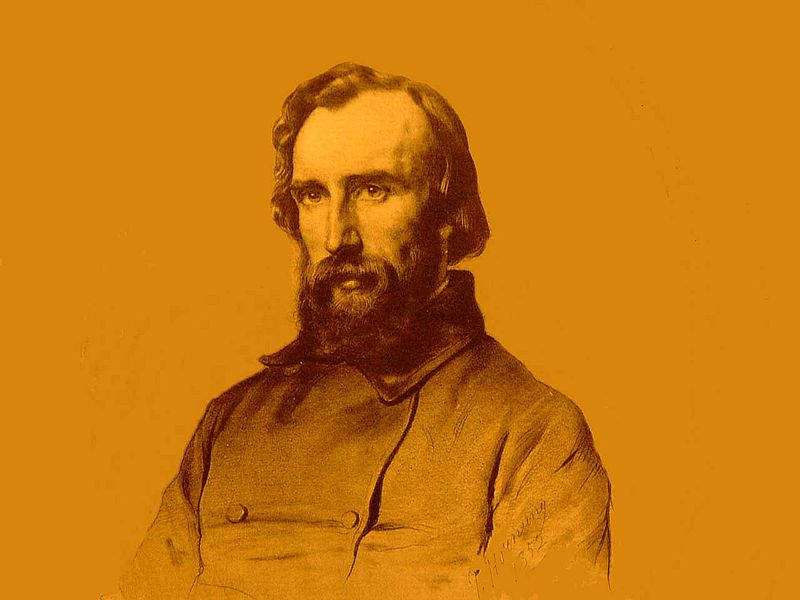
One of the great things about the cyberworld is the ability to find the work, either in image or words, of those people that might easily go unnoticed in the past.  You can now come across a few words or images that intrigue  you and within moments have access to a world of information about the writer or artist.  Such was the case recently when I stumbled upon a few quotes from the writer of the words above and  shown in the portrait above, Henri-Frederic Amiel

Born in 1821, Amiel was a Swiss professor, poet and writer who died in 1881, leaving no major marks on the world before his death.  Although esteemed, his poetry was not celebrated and he made no major breakthroughs as a professor of moral philosophy in his time.  It was after his death that Amiel began to live on in the form of a personal journal that he kept from the 1840’s until the time of his death.  Called the Journal Intime, it is a wondeful inner exploration of the man, exposing a depth of thought apllied to universal truths.  His words, written over 150 years ago in many cases, seem as fresh and as true today as then, a fact that made the Journal Intime a timeless classic  in much the same manner as the essays of Ralph Waldo Emerson

However, despite its acclaim after it posthumous publishing, the book has faded from the modern consciousness  and may not grace the shelves of many libraries.  But thanks to the online world, it is a book that is now readily available to those wishing to read these thoughtful words.  It is available on most book sites and is available free at a number of sites including Project Gutenberg.

So many of the quotes that have been pulled from the Journal Intime ring true for today, including those that could be applied to subjects that are hotly debated in this country such as healthcare and taxation of the richest of us:

In health there is freedom. Health is the first of all liberties.
Sacrifice still exists everywhere, and everywhere the elect of each generation suffers for the salvation of the rest.

I was probably drawn to his words by two that said what I have said for some time.

The great artist is the simplifier.

Learn to… be what you are, and learn to resign with a good grace all that you are not.

The Journal itself is not an easy read.  It is a winding road through the life of one man and doesn’t always reveal its truths quickly.  So if you wish to quickly absorb some of Amiel’s aphorisms, I suggest checking out his pages at BrainyQuote or ThinkExist.

Good stuff…


Read Full Post »

A gem cannot be polished without friction, nor a man perfected without trials.

–Chinese Proverb

^^^^^^^^^^^^^^

I call this new painting Gem.  It’s an 18″ by 26″ piece on paper.  The gem part came obviously from the deep and rich colors that run through and define  it.  It reminds me at first of a colorful bracelet or brooch dotted with bright gems.  Rubies and sapphires, emeralds and amethysts all set in a citrine yellow sky.  It definitely has a jewelry-like  appearance.  Bright and easy.  Almost a trifle.

But there seems to be a feeling in this piece that goes beyond the playful interplay of the surface colors, something that takes it far from being a trifle.  There is for me a feeling of self-realization in the central figure of the Red Tree, a sense of knowing and understanding one’s self.  It’s a sense that comes from knowing one’s strengths and weaknesses,  a realizing of all that one is and is not in an instant, a flash of insight.  And though it comes in as a sudden thought at a singular moment, it is formed through a lifetime of living, taking into account all successes and failures equally.  The trials that form  character, as the proverb above states.

Our lives are very much like a gem-studded bracelet, easy to see with all surfaces shining bright.  But the gems here have underwent eons of transformation through pressure and friction to reach that easy shine.  Maybe that’s what the white ribbon of the trail going through this painting signifies for me, a long and sometimes hard road to reach that final gemlike quality. 

Maybe.  All I really know is that this painting seems easy to take in at first but lingers on the way down.  And there is a great satisfaction in that discovery of something below the surface, an added depth that belies the shine of the gems.

Read Full Post »

Archaeology is the peeping Tom of the sciences. It is the sandbox of men who care not where they are going; they merely want to know where everyone else has been.

Jim Bishop
 
*************************************************************
 
   Maybe I fit into the quote above from the  late journalist Jim Bishop and maybe that’s why the idea of incorporating archaeology into my work, as I have done with my Archaeology series over the last few years, has been so appealing to me.  The idea of diverting our eyes from where we are headed to instead see where we have been, to examine those things which have shaped us as we stand now, is indeed intriguing to me.  We are the products of our past and where we are headed is often determined in the how and the why of the past.  Unfortunately, and to our detriment I fear, we often fail to look back and, as a result, are continually reliving  pasts that could and should  have been avoided.
 
This thought is definitely behind the title of this new piece, Archaeology: Formed in the Past, a 10″ by 16″ painting on paper.  I see the central Red Tree here as being formed and twisted by the artifacts below the surface, remnants of the past.  The trees in line behind stand  like stoic witnesses to this history.  The artifacts contain tools and toys, books and bottles, shoes and other items of the everyday– the things that make up a life and a world.  There is also evidence of the creative side of life here– a painting, paint brush, a drama mask, a ukulele and an artist’s mannequin. 
 
It’s always interesting to look at these pieces after finishing them and to see how they come together to offer up some sort of narrative in the collection of artifacts.  Interesting because I don’t really think about how the items will interact as I am painting.  No forethought at all really.   They’re just painted in rhythm as they come to mind, often just because a shape or form fits at the moment.  So when I see the commonality of thought and narrative  running through them, I wonder what the source might be. 
 
Is it just a reflection of my own psyche and interests? 
 
Perhaps.  Probably.  But even so, there’s something somehow compelling in sifting through the debris, even the debris of one person’s mind.

Read Full Post »

It took me four years to paint like Raphael, but a lifetime to paint like a child.
–Pablo Picasso
****************
This short sentence from Picasso is  one of my favorite quotes.  It both makes me smile whenever I hear it and brings to mind my own struggles with recognizing my own creative voice, something that used to be a real internal battle in the early formative years.  There was always a pull between the craft side, as might be represented by Raphael in Picasso’s quote, and the side where one paints naturally and intuitively, as the child might.
 I knew I would never paint like a Raphael.   I never cared to tie myself to any one tradition of painting and wanted the liberty of free expression, the ability to freely display emotion, even in the most mundane scene.  Wanted my own voice, preferring the colloquial over the classical. Kind of like wanting to sing like Woody Guthrie versus singing like Pavarotti.  For as beautiful as Pavarotti’s voice might be I found a quality in Guthrie’s voice and songs that spoke more directly to me.  Native simplicity I suppose it might be called.  Over the years, my voice has evolved and there are pieces where there is often a bit of this native simplicity in the work that really pleases me, makes me feel as though I am somewhat painting in the way a child might.  Or at least in a way that might speak as well to children as it did to adults.
The piece shown here is such an example.  A 10″ by 30″ canvas, it is an extension of the work I have done recently, work that I have called internal landscapes.  Called Native Rise, it is painted very intuitively and speaks plainly.  It has an attractive harmony in its elements that lets it speak easily and be asorbed quickly – if you like this sort of voice.  For me, I see this piece as being very symbolic of my true voice,  how I see and express the world as I internalize it.  It is painted easily and in my own voice.   And like my own voice, it is far from perfect but tries to speak plainly.  And truthfully as to how I see my world.
At least, that’s the way I see it   It’s funny how much more difficult it is to describe  with words my own native painting voice, something that comes so easily on the canvas.  Perhaps one shouldn’t try…

Read Full Post »

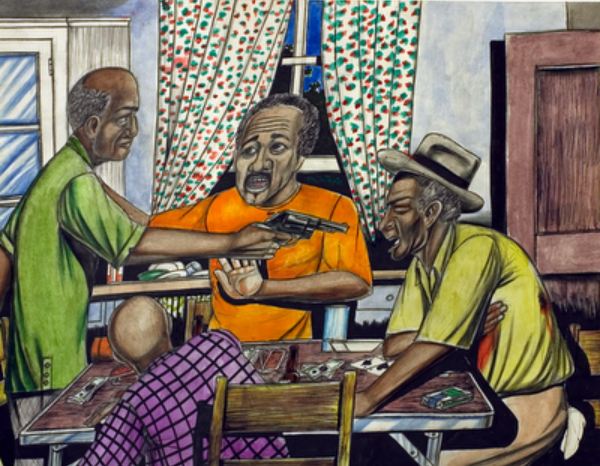
“Known in New Orleans art circles as a sort of ‘Goya of the ghetto,’ Ferdinand has described his work as rap in pictures, while some critics have placed his utterly honest depictions of inner city decay within the social realist tradition of Courbet.” —Times-Picayune

****************************

I was on a site that had a few images of some self-taught and outsider artists and saw one of the pieces from Roy Ferdinand.  In a lot of the work from outsiders artists there is often a child-like quality in the work, a feeling of naivete expressed in the rendering and brushwork.  Looking at Ferdinand’s work, there was a definite sophistication and stylization that really differentiated from the typical outsider.  It made me want to know more about this guy and, in my search, I came across the quote above calling him the Goya of the ghetto,  pretty high praise, I was really intrigued. 

Ferdinand was born in 1959 and hedied from a long battle with cancer in 2004 in New Orleans.  Though his work showed more sophistication, he did share much in common with other outsider artists.  Coming from a world of poverty, for example.  He depicted the hard world of the urban streets of New Orleans.  Often, there was implied violence and explicit sexuality in his work, with gangsters, drug dealers and junkies, pimps and whores often populating his images.  The pictures were gritty and tough snapshots of his time and place.

And while much of his work dealt with the harsher elements of his life, Ferdinand also painted the everyday gentler side of his world, providing a full view of his New Orleans.  I particularly love this piece, showing an older woman holding a piece of corrugated metal with a rough outsider-ish image painted on it.  I suspect it is her own painting she is holding from the gentle smile of pride on her strong face, which is rendered with tenderness, and the other piece of corrugated metal in the bottom corner with a simlilar painting on it.  Moreover, it’s just a lovely image and moment, far removed from the world he often painted. 

To my eye, his work has real eye appeal.  The colors work well together and there is a real harmony in the images as a whole.  The drama of many of his scenes only serves to make these images more compelling and probably will make them grow in stature through the years.  It would have been interesting to see what Roy Ferdinand would have painted in the aftermath of Katrina.  It would have been epic work for an artist so tied to the streets of New Orleans.  It’s a shame such a distinct and powerful voice wasn’t around to document it.

Read Full Post »

And therefore as a stranger give it welcome.
There are more things in heaven and earth, Horatio,
Than are dreamt of in your philosophy.

Hamlet, Act I, Scene V

^^^^^^^^^^^^^^^^

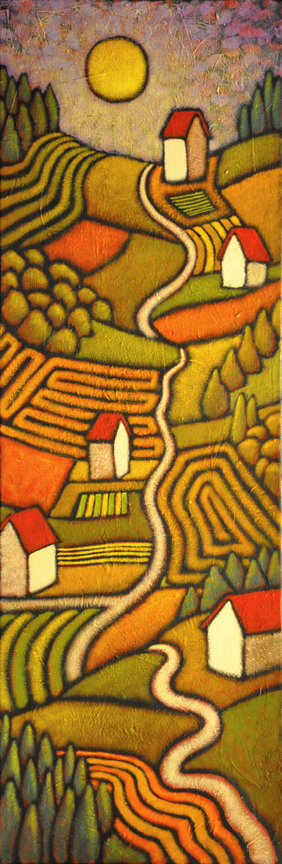
I call this new painting Heaven and Earth.  It’s about 7″ wide by 35″ tall on paper and is very much in the same vein as the very  large painting that I recently completed and featured here, The Internal Landscape.  This piece features a nocturnal scene however with a deep blue sky punctured by the light of stars.

The title might refer, in a way, to the lines above from Shakespeare’s Hamlet, where Horatio and Marcellus barge in on Hamlet’s conversation with the ghost of his father.  Horatio is a rationalist, philosophically, and to him  the idea of ghosts seems absurd so that when Hamlet asks him to swear to not  speak of what he has seenl he is mystified.  Hamlet then utters the lines — There are more things in heaven and earth, Horatio,/ Than are dreamt of in your philosophy.

I suppose this painting is saying much the same thing, that we live both in the world that we know and in a world of which we are unaware.  The stars above are, and have been, always with us but we know little of them, really.  The river  runs but we often know little of its journey and the roads travel to places we shall never see.  And around us at all times are radiowaves carrying voices and images from every corner of the globe, unseen and unheard.  And perhaps among all this  are the ghosts like Hamlet’s father, moving unnoticed by our eyes focused on that which we know and see.  Or, at least, are trying to know.

I guess the takeaway here is that there is often more than meets the eye, even when the scene before you might seem enough.

Read Full Post »

He draws earth as another might draw the exciting and desirable strong body of a man or woman.  His earth is essentially a naked savage earth living out of doors, not so much a cruel and terrifying savage as a wild and free one.

–Grant H. Code on the work of Rockwell Kent

**************************************************

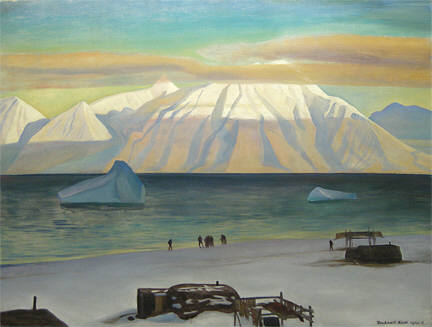
I’ve written about my admiration for the work of Rockwell Kent here in the past, about how his landscapes have a mystic feel, seeming more than mere depictions of this world.  There is an existential aura about them so that when I look at them there seems to be  an added layer of mood and emotion.  It reminds me of the paintings of Edward Hopper that have that peculiar feeling that hints at more than the scene depicts. 

Some of my favorite pieces from Kent are his Greenland paintings, done during the several extended periods that he spent there during the late 1920’s and 30″s.  The colors are beautiful and clear with subtle gradation in the sky that gives it a light and free feel with massive icebergs and mountain faces providing a wonderful counterweight.  As the writer Grant Code wrote above in 1937, Kent  depicts a landscape that is wild and free, not a cruel and terrifying savage.  It’s just spectacular work that has an ethereal air that I can only hope for in my own work. 


Read Full Post »

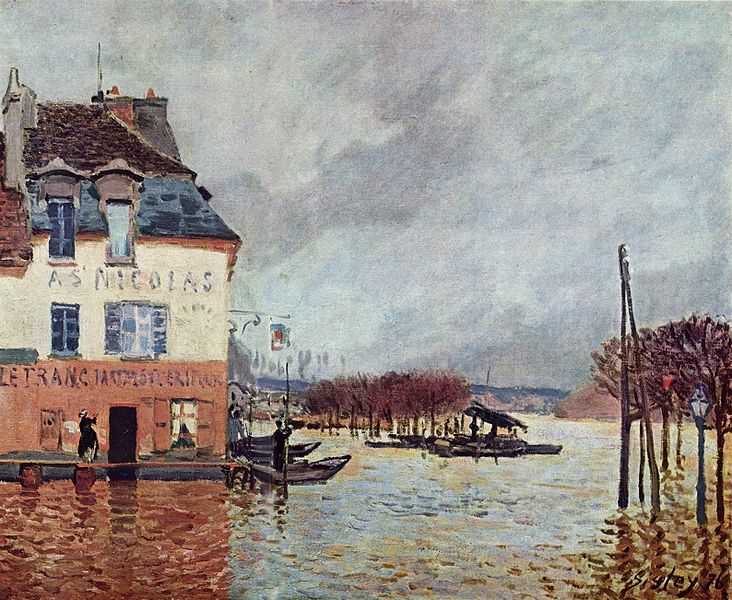
Every picture shows a spot with which the artist himself has fallen in love.

— Alfred Sisley


********************

I’ve  loved the Impressionist landscapes of Alfred Sisley (1839-1899) for some time now.  I always liked the fact that he was solely a landscape artist that worked en plein air, never feeling the need or desire to paint still lives or figures.  He found his avenue of expression in the landscapes that he painted and always in the Impressionist style which fit his found voice.  There’s a sort of purity in his loyalty to his style and subject that I find endearing.

When I came across the quote at the top of this post, I thought at first he was talking about a physical location where the artist had actually fallen in love.  But reading it again, I realized that he meant a spot in each painting where the artist sees that stroke, that shape, that bit of color that made him want to express himself in paint in the first place.  I knew exactly what he meant at that moment. 

I am often asked to pick a favorite painting when I am at exhibits of my work, a question that I am often unable to answer fully. It is just for what Sisley expressed with these words that this remains juch an impossible task.  In nearly every painting that I have chosen to show over the years there is that spot that would shine out to me whenever I would look at it, a spot on the surface where the work seemed to take on its life for me.    It is usually something small and subtle, a small and simple line or the smudge of one brushstroke in what might seem an innocuous field of color.  Small but oh so important because when it meets my eye it rekindles a flame that is indeed love.

It’s a difficult thing to explain especially about a painting, something that many see only as an object.  But seeing that spot where it flares outward alive brings the artist that same excitement that seeing the one you love walk into the room brings to those in love. Seeing that spot in the painting is like meeting the eyes of your love and saying so much without uttering a word.  That may be the best way to put it.

Read Full Post »

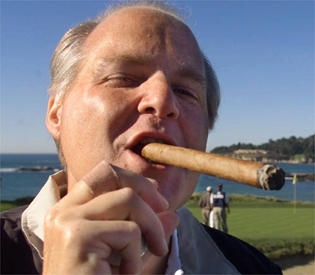
I didn’t want to weigh in here on the ongoing Rush Limbaugh controversy where  his normal disgusting vitriol went to new levels as he made personal attacks on a Georgetown student. The attack came on Sandra Fluke, who was testifying before Congress on the need for the inclusion of contraceptive coverage in health care plans, in her case for its use in preventing ovarian cysts.  Among the many stupid things Limbaugh said concerning this issue, he called her a slut, prompting a firestorm of protest from people everywhere.  This resulted in organized boycotts of those corporations that support Limbaugh by advertising with him which finally brought a tepid apology from Limbaugh, obviously done to try to stem the stream of advertisers running away from him.  Like I said, I didn’t want to become involved with this but in the midst of this whole thing there have been some enlightening moments of standing up for civility that I wanted to highlight here.

The first was from Dave Friend, CEO of Carbonite, who wrote after pulling their current and all future advertising from Limbaugh’s show:

 No one with daughters the age of Sandra Fluke, and I have two, could possibly abide the insult and abuse heaped upon this courageous and well-intentioned young lady. Mr. Limbaugh, with his highly personal attacks on Miss Fluke, overstepped any reasonable bounds of decency. Even though Mr. Limbaugh has now issued an apology, we have nonetheless decided to withdraw our advertising from his show. We hope that our action, along with the other advertisers who have already withdrawn their ads, will ultimately contribute to a more civilized public discourse.

The other was a statement released by John J. DeGioia, the President of Georgetown University, who made this elegant case for the need for civil discourse:

Dear Members of the Georgetown Community:

There is a legitimate question of public policy before our nation today. In the effort to address the problem of the nearly fifty million Americans who lack health insurance, our lawmakers enacted legislation that seeks to increase access to health care. In recent weeks, a question regarding the breadth of services that will be covered has focused significant public attention on the issue of contraceptive coverage. Many, including the United States Conference of Catholic Bishops, have offered important perspectives on this issue.

In recent days, a law student of Georgetown, Sandra Fluke, offered her testimony regarding the proposed regulations by the Department of Health and Human Services before a group of members of Congress. She was respectful, sincere, and spoke with conviction. She provided a model of civil discourse. This expression of conscience was in the tradition of the deepest values we share as a people. One need not agree with her substantive position to support her right to respectful free expression. And yet, some of those who disagreed with her position — including Rush Limbaugh and commentators throughout the blogosphere and in various other media channels — responded with behavior that can only be described as misogynistic, vitriolic, and a misrepresentation of the position of our student.

In our vibrant and diverse society, there always are important differences that need to be debated, with strong and legitimate beliefs held on all sides of challenging issues. The greatest contribution of the American project is the recognition that together, we can rely on civil discourse to engage the tensions that characterize these difficult issues, and work towards resolutions that balance deeply held and different perspectives. We have learned through painful experience that we must respect one another and we acknowledge that the best way to confront our differences is through constructive public debate. At times, the exercise of one person’s freedom may conflict with another’s. As Americans, we accept that the only answer to our differences is further engagement.

In an earlier time, St. Augustine captured the sense of what is required in civil discourse: “Let us, on both sides, lay aside all arrogance. Let us not, on either side, claim that we have already discovered the truth. Let us seek it together as something which is known to neither of us. For then only may we seek it, lovingly and tranquilly, if there be no bold presumption that it is already discovered and possessed.”

If we, instead, allow coarseness, anger — even hatred — to stand for civil discourse in America, we violate the sacred trust that has been handed down through the generations beginning with our Founders. The values that hold us together as a people require nothing less than eternal vigilance. This is our moment to stand for the values of civility in our engagement with one another.

He’s absolutely correct.  This is our moment to stand for the values of civility.  While I believe that Limbaugh has the right to say whatever absurd crap comes into that pumpkin head of his ( sorry, I couldn’t resist one small personal attack!), it is also the right of us who find his hate-filled schtick disgusting to show our displeasure by voting in the free market by boycotting those who enable this hatespeak with their advertising dollars.  Many companies have alredy pulled their backing which brought the lukewarm lip-service from Limbaugh. 

But others persist.  ProFlowers, for instance.  They even have a Rush discount.  They issued a statement that is even more tepid than Limbaugh’s apology. If you wish to take a stand against Limbaugh’s brand of hate politics, there are numerous boycott sites online that list all of his sponsors.  Perhaps this will serve as a warning to those who wish to only engage in personal attacks that we, the public, are willing to take a stand.

And if you’re a listener of Limbaugh, which I doubt you are if you’re here, ask yourself why you choose to spend your time listening to such a person.  Has he made your life better in any way?  Has he solved any problems in your life or in this world at all?  Does the Limbaugh brand of hatred really speak to your view of the world?  Think about it– turn off Rush and take a stand for civility.

Added Monday:  ProFlowers, along with a number of other companies, has dropped their sponsorship of Limbaugh show.

Read Full Post »

« Newer Posts - Older Posts »