Feeds:
Posts
Comments

Archive for the ‘Quote’ Category

Values?

There is a cult of ignorance in the United States, and there always has been. The strain of anti-intellectualism has been a constant thread winding its way through our political and cultural life, nurtured by the false notion that democracy means that “my ignorance is just as good as your knowledge.”

——Isaac Asimov,

           Newsweek,  1980

************************************************

This statement from legendary sci-fi writer Isaac Asimov has been kicking around for over thirty years now and it seems like the cult of ignorance to which he refers has been growing and gathering in strength over this time.  It really struck home for me this weekend when I saw a statement from former Republican presidential candidate Rick Santorum from his appearance at the Values Voters Summit.  Speaking before the gathering of social conservatives, he said:

“We will never have the media on our side, ever, in this country.  We will never have the elite, smart people on our side, because they believe they should have the power to tell you what to do.”

Never have smart people on our side?  What a strange thing to claim as a rallying cry!

But beyond the absurdity of that statement, it really goes back to Asimov’s quote.  There has been a culture of anti-intellectualism that has been brewing for some time now, a group of people who demonize science and scientific research as being part of some left-wing conspiracy that seeks to ruin the world with their so-called “evidence” on climate change and evolution, among many other things.  Instead these social conservatives seek to usurp family values as their own , as though the “smart” people couldn’t possibly have the same level of love or care for their own families.

 A few weeks ago I read an account of a gathering of these like-minded folks in the Scranton area in support of the Romney campaign.  One of the participants said that she was there because she believed in family values which were qualities that the people that made up the Democratic side didn’t possess.  She said that these people on  the other side were single moms, minorities, gays and immigrants.  All lacking the same family values that she and her conservatives friends held high.  I could only shake my head in disbelief at the audacity and ignorance of her words.  It really pointed out the stakes in this election.

I have tried to keep politics out of this blog for some time although my political leanings are fairly evident to anyone who takes the time  to read.  I don’t want to tell anyone how to live their lives and I want to live mine as I see fit.  Plain and simple.   But this is an important election that is coming up in November and I feel as though I have to at least speak up against the shrill  and self-righteous voices coming from the right because they speak for nobody that I know.  All of the single moms, gays, minorities and immigrants that I know have more dignity, compassion and family values than this woman ever had.

I have stood by for the past several years and have heard and read all of the stupidity and exclusionary rhetoric I can stand.  I may not be the smartest guy in the world and am , in fact, very seldom the smartest guy in any room I enter.  But, unlike these people who revel in their ignorance and denial of facts and science, I aspire to and revere greater  knowledge and wisdom.  And that’s what I see this election season as being about.  It’s not just a presidential election, Obama or Romney.  It goes deeper that that, into all localities.  It is a cultural referendum.  A choice between this vision that denies science and wants to return to a  time in America that only existed in their fact-deprived minds and one that looks forward and accepts the challenges that the future presents.  It’s a time to put this celebration of  ignorance behind us.

Sorry for the detour off the art path.  I’ll try to stay on track in the future…

Read Full Post »

No Rules

I do what I can to convey what I experience before nature and most often, in order to succeed in conveying what I feel, I totally forget the most elementary rules of painting, if they exist that is.  In short, I allow faults to appear, the better to fix my sensations.

–Claude Monet, 1912

**********************************

I have had this little sign hanging in my studio for the last 16 years or so, a rough reminder to myself when I begin to feel like my work is bending to the rules and judgments of others.  It reminds me that I am working in my own realm, my world.  I control the parameters of what is possible, of what defines reality in my work.  The rules of others mean nothing in my little painted world.

Over the years  I have glimpsed this small sign at times when I have been feeling that my work is stagnating or beginning to adhere to  accepted conventions  and have been spurred to push my work in some  new direction.  Heightening the intensity of color or introducing new hues that seems incompatible with nature, for example.  It’s as though these two words are prods that constantly  tell me that nobody can control me when I am here in my created world.  There’s a great liberation in this realization and I find myself trusting my own judgment of my work more and more.  Because I have created  my own criteria for its reality, criticism from others means little now.

I think that’s what I am trying to get at here, that an artist must fully believe that they are the sole voice of authority in their work, that they, not others, determine its validity. Maybe that’s why I am so drawn to  Outsider artists, those untrained artists who maintain this firm belief in their personal vision and create a personal inner world of art  in which it can live and prosper.  Rules mean nothing to them- only the expression of their inner self matters .

Read Full Post »

I recently came across this piece of writing from Eugene V. Debs that struck a chord with me, reminding me of this particular painting from a few years back, The Heart’s Standard Bearer.  I think it captures what I would like much of my work to represent– the flag of high hope and high resolve, as he puts it.  I know that in these politically divided times invoking the name of Debs is probably a risky proposition.

He was, after all, a prominent Socialist, a term which raises the hackles of many, most who have no true idea of what it truly means or has represented in the not-so-distant past.  Debs, who lived from 1855 until 1926, was absolutely committed to the fight for fairness and rights for the poor and the working class, spending several stints in prisons over the course of his life for the stands he took.  He ran for president from his cell in 1920, the last of the five campaigns he led for the high office as the candidate of the Socialist Party.  You may cringe at the current populist interpretation of socialism, but you should realize that we have all benefited from the efforts of Debs and others like him who fought for living wages and decent working conditions for all citizens and against exploitation of all sorts.

I am often asked why I use the color red in many of paintings.  Red trees.  Red chairs. Red roofs.  Red fields. I always struggle to describe what meaning it has for me.  But reading this made me feel that the red in many of my paintings might somehow be, as described in Debs’ words, the pure red that symbolizes the common blood of the human family, the equality of mankind, the brotherhood of the race.

Debs’ The Crimson Standard was published in 1905 in Appeal to Reason, a weekly progressive/socialist publication of the era that featured the writings of Upton Sinclair, Jack London and Helen Keller.  It was an extremely popular magazine, with the fourth highest circulation of any weekly at the time.  As I said, socialism was not the anathema then as now.

**************************

A vast amount of ignorant prejudice prevails against the red flag. It is easily accounted for. The ruling class the wide world over hates it, and its sycophants, therefore, must decry it.

Strange that the red flag should produce the same effect upon a tyrant that it does upon a bull.

The bull is enraged at the very sight of the red flag, his huge frame quivers, his eyes become balls of fire, and he paws the dirt and snorts with fury.

The reason for this peculiar effect of a bit of red coloring upon the bovine species we are not particularly interested in at this moment, but why does it happen to excite the same rage in the czar, the emperor and the king; the autocrat, the aristocrat and the plutocrat?

Ah, that is simple enough.

The red flag, since time immemorial, has symbolized the discontent of the downtrodden, the revolt of the rabble.

That is its sinister significance to the tyrant and the reason of his mingled fear and frenzy when the “red rag,” as he characterizes it, insults his vision.

It is not that he is opposed to red as a color, or even as an emblem, for he has it in his own flags and banners, and it never inflames his passion when it is blended with other colors; but red alone, unmixed and unadulterated, the pure red that symbolizes the common blood of the human family, the equality of mankind, the brotherhood of the race, is repulsive and abhorrent to him because it is at once an impeachment of his title, a denial of his superiority and a menace to his power.

Precisely for the reason that the plutocrat raves at the red flag the proletaire should revere it.

To the plutocrat it is a peril; to the proletariat a promise.

The red flag is an omen of ill, a sign of terror to every tyrant, every robber and every vampire that sucks the life of labor and mocks at its misery.

It is an emblem of hope, a bow of promise to all the oppressed and downtrodden of the earth.

The red flag is the only race flag; it is the flag of revolt against robbery; the flag of the working class, the flag of hope and high resolve – the flag of Universal Freedom.

Read Full Post »

“When I am in my painting, I’m not aware of what I’m doing. It is only after a sort of “get acquainted” period that I see what I have been about. I have no fears about making changes, destroying the image, etc., because the painting has a life of its own. I try to let it come through. It is only when I lose contact with the painting that the result is a mess. Otherwise there is pure harmony, an easy give and take, and the painting comes out well.”

–Jackson Pollock

*************************************

Well put words from Pollock, words that very much fit with how I feel about my own work and process, even though our works seem to have little in common in appearance.  I think it’s the harmony that he speaks of that is our common ground.  At least, I hope.

Note:  The show, Internal Landscapes: The Paintings of GC Myers, has opened two days early at the Fenimore Art Museum in Cooperstown.

Read Full Post »

We know what we are, but know not what we may be.

–William Shakespeare

^^^^^^^^^^^^^^^^^^^^^^

Interesting line from the Bard.  Awareness of what we are is a good thing but we should not be satisfied.  We can always be better, be more than we are now.

 More tolerant and understanding of the plight of others.  More patient. More generous.  More kind.  More peaceful.  More willing to listen, to learn.  More loving.

Just better.

That’s what I see in this piece, Knowingness, an 18″ by 26″ painting that is part of my show opening tomorrow at the West End Gallery.  It’s about knowing what you are and, while being at peace with this knowledge, realizes there is always the possibility of being more.

 It may be the beginning of real wisdom.

I can’t say for sure.  I don’t think I’m at that point yet but, with this painting serving as a reminder,  remain hopeful.

Read Full Post »

Of all our possessions, wisdom alone is immortal.

–Isocrates

***********************

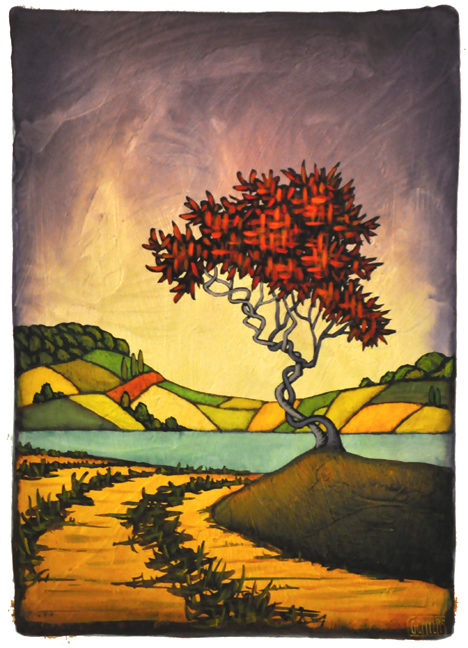
This is another new painting from my upcoming show, In Rhythm, at the West End Gallery that opens this coming Friday.  Titled All We Have, this 8″ by 12 ” painting on paper has numerous meanings for me,  mainly focusing on the only things we ever  truly possess — our love, wisdom, memory and the precious time we have on this earth.  I could easily give up all of my personal possessions but to lose any of these other things would stagger me  much more greatly as they are the things that give my life meaning and worth.

I see this represented in this painting, from the obvious symbolism of the intertwined trees for love to the field rows which act here as a symbol for the passing of time .  Even the colors of the sky have meaning in this piece for me, the purplish hues having a weightiness that reminds me of thought and wisdom.  Or. at least, what I take to be wisdom.

I’m not sure I’m really qualified to identify wisdom at this point.  Maybe some day.

But I do like this piece and what I see in it.  Perhaps, like the wisdom I desire, it is an aspiration for the only possessions that are truly worth the work…

Read Full Post »

We who lived in concentration camps can remember the men who walked throughout the huts comforting others, giving away their last piece of bread. They may have been few in number, but they offer sufficient proof that everything can be taken away from a man but one thing: the last of the human freedoms — to choose one’s attitude in any given set of circumstances, to choose one’s own way.

–Viktor Frankl

***********************

I ran this quote from Viktor Frankl a couple of years back in a post about how a painting reminded me of Frankl’s work, as outlined in his classic book Man’s Search for Meaning.  In it, he wrote of his survival in  a Nazi concentration camp during World War II and how he noted that those who endured were those who found a purpose to live outside of themselves.  It could be as simple as needing to live to see their spouse once more.  It was a goal, a purpose that they could see in the future beyond the horror that engulfed them in the present.

Those who saw no purpose, no future, seldom survived.

That is as condensed a version of what I gleaned from Frankl’s work as I can give.  I know that it transformed my own view of life at a time in my own life when I seemed to exist without purpose, a time that now seems eons ago, thankfully.  Frankl’s work has continued to spring up in my thoughts over the decades, always inspiring me to look for purpose in my existence.

So when I recently  finished this 24″ by 30″ painting on canvas, I wasn’t surprised that his work again came to mind.  There is a sense of direction and purpose in this piece that fits with how I think of his work.  The Red Tree has a certain dignity and spirit, like an unquenchable fire, and the winding path goes past it into an unseen future.  The path is the purpose on which we move forward.  Yes, there are hardships and uncertainties that must be endured but there is a future if we follow this purpose.

I have titled this painting Viktor.  It both represents Frankl and his work as well as well as the work victor.  It is part of my upcoming show at the West End Gallery, In Rhythm, which opens July 20.

Read Full Post »

If they [artists] do see fields blue they are deranged, and should go to an asylum.  If they only pretend to see them blue, they are criminals and should go to prison.

–Adolph Hitler

***********

I never thought I’d be quoting this  particular German art critic here but I have to admit that this quote makes me feel better about my work.  Although the asylum or the prison have sometimes fell into my realm of possibility, it has been those blue fields (and Red Trees) that have kept me from either.

Now do I see fields as blue in the real world?  No.  Do I pretend to see them as such?  No. Maybe I’m not a lunatic or a criminal after all.  But I do see the blue fields in this painting as real.  Is that so crazy?   I don’t think so and besides, seeing them as such makes me feel less criminally inclined.

Above is a good example, a new painting that is a16″ by 20″ canvas titled Just This Side of Blue.  This translates so easily in my mind, having a reality  that I don’t question at all.  For me, it as real as anything I see in the outer world.  And the colors and the harmony they create resonate with me and pacify my tensions and angers.

Perhaps Hitler should have kept a more open mind on the place of expression in art.  In denying self-expression to others, he only demonstrated his own lunacy and criminality.  The lesson:  Be wary of those who try to control how you see things in your own mind.  That is our greatest and last freedom– the right to our opinion and reaction.

*************************

The painting shown here, Just This Side of Blue, is part of my solo show, In Rhythm, which opens at the West End Gallery on July 20, 2012.

Read Full Post »

Every man’s memory is his private literature.

Aldous Huxley
 
 
**************
 
I like this quote from Huxley.  I have often felt that all of our personal lives fit into some sort of mythic template on which all literature is based and that we often fail to see the connections between the tales of our own lives and those stories which have come down through history in the form of myth and legend.  We all live lifes that are often filled with tragedy , comedy and drama.  Heroic, even.  But we seldom perceive them as such, instead thinking of our personal memories as being merely mundane. 
 
And that’s probably as it should be.  Life is spent, for the most part, moving forward in small, day-to-day steps with little time left to see the larger pattern of our lives.  Who has the time to reflect backwards, to see how our lives fit into the templates of eternity?  Very few of us, to be sure.  But what if we could take that time to look back fully and see the patterns set in history and to see that our lives own patterns mesh into that pattern, that we are all indeed connected to and part of the same fabric?
 
Would it make a bit of difference?  Would it make us appreciate the fragility and rareness of  each individual’s place in this world. make us understand that our own history is the history of all and that our memory binds us to the fabric of history?
 
I don’t know.  But it’s something to think about.
 
Funny how the mind works.  I meant to write about the painting above, a new piece  called Distant Memory (  10″ by 16″ on paper) set for my Principle Gallery show early next month and suddenly find myself off on a theoretical journey.  Maybe its the way the foreground of the painting, with the converging rows of the field,  relates to the house and tree across the water in the upper half of the painting.  I get a sense of looking back from the present, taking a pause from the labor of the moment,  which is represented in the rows,  to a personal past set around that house that reminds me very much of the farmhouses of my youth, often taking me back to different points of my own life, my own connections to templates of time.  Even the overall color of this piece sets that tone of memory for me.  There is  something in that green that reminds me of the ferns that my mother dug up many years ago from the hillside above the Chemung River and planted in the shade of the old farmhouse that we lived in for much of my childhood.  That green often brings back that memory, one filled with an air of  coolness and the smell of damp, rich soil.  A good memory.
 
Okay. Enough for now.  Work and the present calls.  I have my own fields to tend to now.


Read Full Post »

The object of painting a picture is not to make a picture– however unreasonable this may sound.  The picture, if a picture results, is a byproduct and may be useful, valuable, interesting as a sign of what has past.  The object, which is in back of every true work of art, is the attainment of a state of being, a more than ordinary moment of existence.

— Robert Henri

I love this passage that  Robert Henri wrote in his classic  book The Art Spirit, so much that I’ve taken the key phrase from it as the title for this new painting,  A More Than Ordinary Moment.  It is a tryptych on mounted paper  with the outside panel images measuring 10″ wide by 14″ high and the center 16″ by 14″.   It is set in a large frame with three separate windows that is about 24″ by 58″ in size, giving this piece a real sense of it  being, as its titles implies, more than ordinary.

This piece very much reflects the essence of what Henri was conveying in the passage, that art is not about capturing scenes or mere subjects but was instead about capturing a state of being, the  existential feeling behind the moment.  As I  have maintained for some time, my paintings are not about depicting the reality of the outer world.  They are more about capturing and mapping the emotions and sensations of our inner selves,  those rare things found all of us if we are willing to take the time to look.  They are internal landscapes.

I get a great sense of tranquility from this piece, a feeling that comes from the colors that somehow remind me of  the warmth of the crocheted afghans I knew as a kid with those sometime garish color combinations from the late 60’s and  early 70’s with olive greens, browns and  oranges.  When I think of those afghans, I don’t remember them for what they were as objects but for what they represented with those moments beneath them when I was warm and secure.  I didn’t see this in this painting until just now as I wrote this and now, looking at the painting, it is all I see.  I am instantly transported by it to those moments of supreme security as a kid, huddled under my mother’s afghan in my father’s house, carefree and safe from the world outside our doors.

It’s a feeling that I get less  as an adult and one that I need more often. 

Read Full Post »

« Newer Posts - Older Posts »