Feeds:
Posts
Comments

Archive for the ‘Recent Paintings’ Category


When he reached the ferry, the boat was just ready, and the same
ferryman who had once transported the young Samana across the river,
stood in the boat, Siddhartha recognised him, he had also aged very
much.

“Would you like to ferry me over?” he asked.

The ferryman, being astonished to see such an elegant man walking along
and on foot, took him into his boat and pushed it off the bank.

“It’s a beautiful life you have chosen for yourself,” the passenger
spoke. “It must be beautiful to live by this water every day and to
cruise on it.”

With a smile, the man at the oar moved from side to side: “It is
beautiful, sir, it is as you say. But isn’t every life, isn’t every
work beautiful?”

——-Herman Hesse, From “Siddhartha

****************************

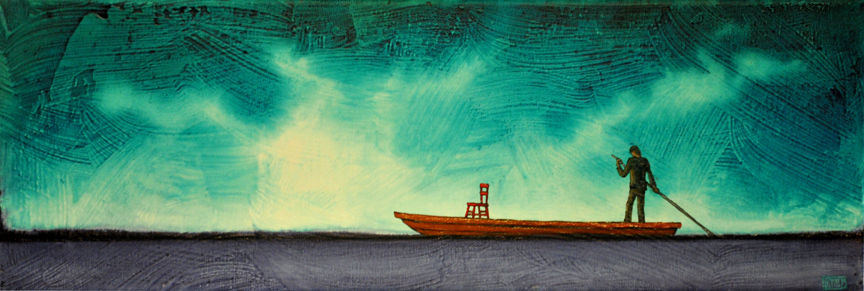
This is is a new piece, also from the upcoming Principle Gallery show.  It’s a small piece, 6″ by 18″ on canvas, that I call simply Ferryman.  I have used the image of the ferryman through the years, usually in very simple, quiet compositions.  It would be easy to associate the image with that of Charon, the boatman of Greek mythology who carries recently deceased souls across the river Styx in Hades.  There is that feel about this image,  especially with the red chair sitting empty in the boat, an image I have often associated with the dead and memory of the past.

 But I see this particular ferryman in a different way, more like the philosophic ferryman of Hesse’s Siddhartha above.  The passage with this ferryman is  more about transformation than transportation, a spiritual crossing from existence, one state of being,  to another.  The brightness of the light breaking through in the sky seems more attuned to this reading of the image as well, as though the passage is taking one across to a state of higher enlightenment.  There’s still a somber quality but it is different than that which is often attached to death.  It’s more the feeling of knowing that you are being transformed on this voyage and the past you is no more.  Gone forever.

As always, this is just how I read it.  You may see more, you may see less.  All views are equally valid.

Read Full Post »

I’ve been showing a number of the pieces here that are part of my Principle Gallery show that opens on June 10, focusing recently on the more monchromatic work, those pieces in shade of gray and sepia with less color.  I thought this painting would be a nice return to the color of my normal work.  Called Dusky Dance, it’s a 7″ by 15″ image that rests in a 14″ by 22″ mat and frame.

This image features the intertwined trees that I have sometimes painted over the years, their trunks and limbs rhythmically coming together which brings about the dance of the title.  There’s a great moodiness here in the misty orange atmosphere with the sun  softly finding  its way through. 

The landforms are kept low and simple, their compositional impact intentionally kept to a minimum.  The piece is really about the feel from the sky with its dusky oranges and yellows,  and the the way the trees twist together.  As though the the two trees are existing in only the rare atmosphere of that moment which I think is reflected in the extreme focus of this piece.  It’s simply put together but intense in its feeling, both aspirations I normally maintain for my work.  This  makes this a very prototypical piece, one that expresses much of what I feel for my work.

Read Full Post »

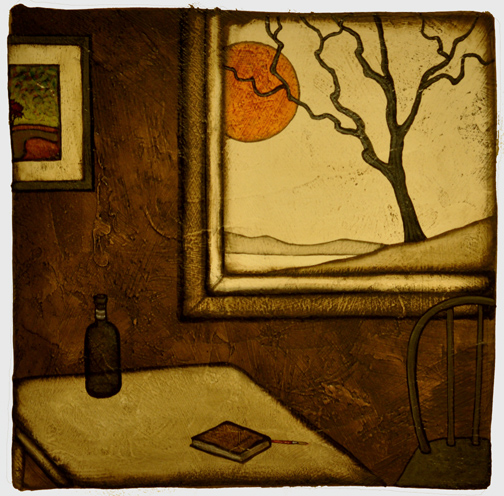
I try to have a few pieces in every show that are a bit out of my normal range, pieces that still carry the same momentum as the other work in the show but have a different look from my typical work.  This is one such piece from my next show, Now and Then, which opens at the Principle Gallery on June 10th.  This is an 11″ by 11″ painting on paper and is limited in its color with shades of brown and gray and bits of more vibrant colors.

I do these interior scenes once in a great while, usually employing a window or door as part of the composition.  I enjoy the contrast between the sharp angular geometry of the interior space and the more rolling curves and arcs of the outer landscape.  The window also provides a contrast in darkness and light for this piece, the darker tones of the interior making the lighter exterior scene pop in this composition.

Like my landscapes, I still try to keep details to a minimum.  The interior scene provides more opportunities to embellish, to add more points of interest such as the few things on the table, but I want the larger forms to be the expression in this piece.  I want the piece to still read easily from a distance.  This is similar to the way I felt about my earlier Archaeology series.  There was an area of great detail but I wanted that to be secondary to the whole scene, preferring that the viewer be drawn to the overall feel of the piece first then noticing the detail after.  Also like some of the Archaeology pieces, I’ve added bit of self reference here in the form of the painting on the wal, a small red tree. 

I always like these pieces if only for the difference they display from my other work and the fact that they feel more personal to me, as though the outer scene here is the one I regularly share with the larger world and the interior scene is the part that I don’t show, that part of the self I keep in reserve, hidden from the outer world.   Maybe that is the meaning here.  As for any other message,  I don’t know what they say to others. don’t know if that really matters in the case of these pieces.  Perhaps they are simply what they are, shades of brown and gray and bits of color…

Read Full Post »

Symphony

I wrote yesterday about how my upcoming show at the Principle Gallery was beginning to take shape in the studio.  I’ve been thinking about this and thought I might add a few points, maybe clarify things a bit.  Or muddy up the thought process even more.  There’s no telling  at this point.

I view the show not as a group of individual paintings but as a cohesive collection with common threads that run through them, emotional connections that create a unity of feeling across the group.  This is a hard thing to explain and goes beyond subject matter or style and technique when I’m trying to take in the group as a whole.  It comes down to a gut sensation, that feeling of rightness that I’ve struggled to describe before.  For instance, there are a few pieces that I could show with this group but , while they are strong and fully alive, their emotional resonance is slightly out of line with the rest of the work.  I don’t even know where to start in defining this emotional resonance that I’m talking about here.  It’s as though each piece is emitting a tone or a note and I’m trying to choose those pieces that harmonize with one another.

Maybe it’s like a composer putting together a symphonic piece, trying to unite all these disparate instrument and sounds into one united voice.  You can pick out the different themes and tones of the individual instruments but it is the power of the whole that draws you in.

Maybe I shouldn’t view the work for my shows in this manner, should not worry  how the work is assembled as a group.  I mean, it may not even be noticeable to anyone but me.  But I do recognize it when I look at the shows as whole entities and that me feel there is something in it , something that makes the work come together to create something more powerful than the individual elements.  And this unity ultimately enhances each piece.

I don’t think I can really explain this, it being a pretty nebulous concept.  But it does occupy my thoughts for these weeks leading up to a show.  Hopefully, this will be evident in the show.

By the way, the triptych at the top is part of this show, part of the symphony.  It is a work on paper that frames out at 16″ by 34″.  There’s great warmth in this painting, a great sense of security for me.  But the title is still evading me at this time so if you have any suggestions, I would gladly listen.

Read Full Post »

I’m in the final days of painting for my upcoming show at the Principle Gallery in Alexandria.  I’ve titled this show Now and Then and it opens June 10th.  This past weekend really was extremely productive in the studio, with several pieces finally finished and the overall feel of the show taking  shape.  I had struggled for some time to find real definition for this show, that key factor that hopefully makes  each show distinct.  The past few days has me thinking that this show has found its distinction.

I think that it is defined by a fairly large group of works on paper such as the one shown above,Call to Waking.  This is an 11″ by 11″ image that is a mix of black inks and a sort of sepiatone that is actually a mix of many colors.  As I have described before, my process involves putting a lot of paint on the surface then pulling much of it off, soaking it up with brushes then squeezing them out.  In my old studio, I often found myself squeezing this paint on to the floor which left a huge blackish stain on the flooring there.  I try to be a bit more careful in my newer studio and have made a habit of collecting this paint, which often results in the creation of a color like the sepia of this piece. 

 There are a number of pieces in this show that have either this sepia or black/gray as the base color.  I have shown a few at a time in the past but this will be a substantial group and will provide an interesting juxtaposition between this work and my prototypical work. filled as it is with strong colors.  Seeing the two differing styles side by side in the studio has really shown this contrast.

Many of these pieces have bits of color in them, a faintly red tree or an orangish sun/moon  that pops from the gray/sepia background, but this piece is devoid of color.  I felt that the sepiatone had a warmth in itself and the contrast of the light breaking through the sky provided its own pop.  I felt that  any more color, say with  red roofs, would actually be a distraction here, altering the ample mood that has been created.  I think it works well as it is.

Well, although I could say more, I have work to get to.

Read Full Post »

A newer painting, this one an image of about 18″ by 26″ on paper.  The composition is intentionally simple in that  this piece is obviously very much centered on its color and texture.  The stringlike twirls of its texture create a real feel of motion and energy underneath the image, the hint of the hidden forces of nature  that exist just beyond our ability to recognize or comprehend them.  I don’t know if I would call these  purely physical forces or if they somehow become a spiritual force as well.  For this painting, let’s assume that they are both.

I see the Red Tree here as being enmeshed in both the visible world and in the world of these hidden forces.  While trying to find a way of describing this energy, these hidden forces of life, I came across the writings of Sri Aurobindo, anIndian philosopher/yogi who was very influential in the the first part of the last century.  Some of his writings describe the spiritual evolution of man into what he called the Supramental Being.  Here is how it is described in Wikipedia:

Sri Aurobindo’s vision of the future includes the appearance of what may be called a new species, the supramental being, a divine being which would be as different and superior to present humanity as humanity is to the animal. It would have a consciousness different in kind than the mind of the human, a different status and quality and functioning. Even the physical form of this being would be different, more luminous and flexible and adaptable, entirely conscious and harmonious. Between this supramental being and humanity, there would be transitional beings, who would be human in birth and form, but whose consciousness would approach that of the supramental being. These transitional beings would appear prior to that of the full supramental being, and would constitute an intermediate stage in the Earth’s evolution, through which the soul would pass in its growth towards its divine manifestation as the supramental being in the earth nature.

It is an interesting concept and one that I feel fits the imagery of this painting.  However,  I did think about how the concept was similar in nature to Nietzsche’s Superman  or Ubermensch  and the use of that idea by the Nazis,  how it could easily be diverted from its original meaning and twisted to rationalize behaviors far from the true nature of the concept.  It’s unfortunate that many ideas that are concerned  with the betterment of all people are often perversely used to divide and destroy people.  Here, I am thinking of this concept in the purest sense, of the elevation of the individual to a higher state of being, aware of and in harmony with all the forces of this world.

Or it’s just a tree blown by the wind…

Read Full Post »

The aspects of things that are most important for us are hidden because of their simplicity and familiarity.

– Ludwig Wittgenstein

I immediately recognized a relevancy for my own work when I read the words of Wittgenstein’s quote, shown above.  I have always maintained (actually, hoped) that the strength of my best work has been in its simplicity of expression and use of familiar iconography, imagery that finds an immediate and deep rooted connection in many viewers.    Simple and elemental, stripped of detail but not meaning.

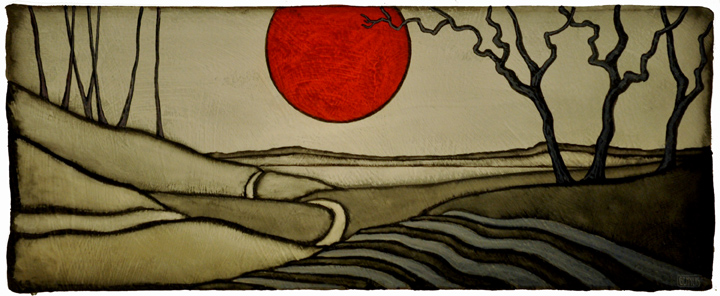
I think this new piece, an image of about 8″ by 18″ on paper, fits into this description.  On first examination, this is a very simple piece.  It is stark in it rendering.  Simple lines and shading, with hardly any detail and only a bit of color.  The contrast of the red sun/moon dominates the center of this piece and brings everything into focus, moving the eye far forward into the scene, creating a sense of depth that shrouds the viewer.  The rising trees on either side further funnel the concentration inward.  This focus creates a meditative atmosphere, for me at least, and that speaks to  the aspects of things that are most important for us, as Wittgenstein put it.  The whole of this piece is greater than the sum of its parts. 

Or its merely a simple  composition, pleasant to look upon.  Its all in the eye and mind of the beholder.

Read Full Post »

This is a painting, a 24 ” by 36″ canvas,  that I thought was completed a few months back.  I say thought because I felt at that time that it was exactly where I thought it should be.  But there was something about it that kept me from putting it up on this site over the time since.  I kept looking at it and had very conflicting emotions about it.  On one hand, it stood up on its own and had its own momentum and fullness.  It seemed okay.  But on the other hand, there were parts of the painting that seemed a bit too dark and became distracting because there was a flatness in the darkness of the color.  It just created  a nagging doubt in my mind.

Finally, I knew I had to address those doubts and grudgingly put it back on the easel.  I inserted a lot more lightness into this piece,  focusing mainly on the lower third of the painting.  The blue of the foreground really pops now and the lowest blocks of green in the fields of the foreground emerge from darkness.  The changes created a greater sense of depth in the piece which really opens up the whole painting, bringing more  clarity to it.

Time allowed me to see something different in this painting, something beyond my intitial response to the color and composition.  It may have been complete before but now it feels as though that fullness is more visible for all to see.   Now there isn’t a doubt captured in a  darkness that makes me take my focus from what the painting is trying to say.  This lightness and clarity allows the painting to fully convey itself now.  And I think that makes this a better piece.

Read Full Post »

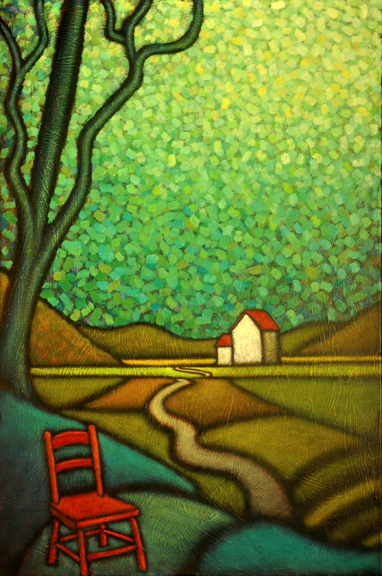
I’ve been continuing this recent series of  patterned  landscapes, most on paper,  in the studio the past few weeks, falling into a very nice rhythm as I proceed.  This is a recent completion, an 18″ by 25″ image on paper, that has the Red Tree as the central figure in a quiet but bright composition.  The patterned fields of the landscape, like many of the paintings in this series, takes up about half of the composition, solidly built as a foundation to hold up the breaking sky above.

I’m still thinking about what to call this piece.  There is a sense of the idyllic in the scene, hunkered away safely from the intruding fingers of the greater world.  I suppose that’s why I find this work so satisfying as I paint.  There’s a comforting aspect in this work for me.  Soothing. Pacifying.

There’s also a simplicity in it but I would not call it naive.  I have a feeling that while this is an idealization and the landscape portrays the comfortable and safe, there is also an awareness of the world outside.  As though the Red Tree is cognizant of its good fortune in being rooted in this tranquil place.  Perhaps that should be its title- Good Fortune.

Let me think on that…

Read Full Post »

Walk while ye have the light, lest darkness come upon you.

—— John Ruskin

 
*******************
 
These words from Ruskin might have meaning in both a practical and a spiritual sense.  Simply put words of advice for the traveler: Move forward while the road ahead is visible.  Words that apply also to the internal traveler, those trapped in a twilight world inside where they always seem on the edge of darkness.
 
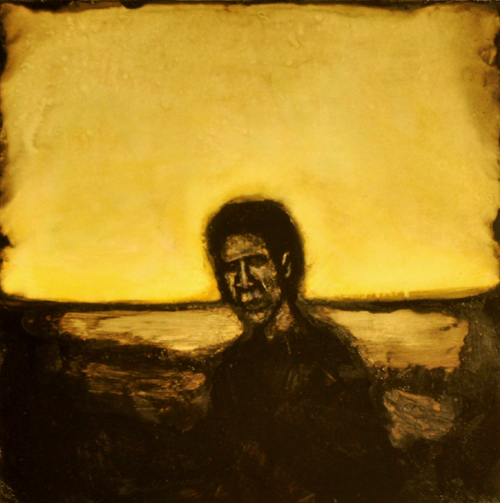
I think this fits this new piece that I call Knowing Darkness.  It’s a small painting, just 6″ by 6″ on masonite, done in a style that I have used periodically pver the years, most notably in my Outlaws pieces of a few years back.  The Outlaws were  singular figure, some with handguns, all done in this same dark black/sepia tone where the image is not really light  painted on but darkness carved away.  The technique is a throwback to my earliest attempts at painting when I was still thinking of the surface as being a solid surface in which the image was sculpted. 
 
While these pieces are always darkly introspective, they always seem to bring me a certain excitement in doing them, as though the bits of light being revealed are new light for me as well.  Like I am pulling away a certain personal darkness with each bit of white surface that breaks through.  In that respect, I find these pieces more hopeful than their outward appearance suggests.
 
This piece is no different.  When I look at this piece it says to me that you can know darkness without dwelling in it. 

Read Full Post »

« Newer Posts - Older Posts »