Feeds:
Posts
Comments

Archive for the ‘Technique/History’ Category

****************************

Life is too short to be little. Man is never so manly as when he feels deeply, acts boldly, and expresses himself with frankness and with fervor.

Benjamin Disraeli

****************************

I gave a talk last week with a local arts group, the Elmira Regional Art Society. There was also a  painting demonstration where I first laid out a composition in red oxide then laid in a few preliminary layers of color on an 18″ by 36″ canvas. The thought was just to give an idea of how the process progresses in a condensed timeframe. As a result, I painted very fast, much quicker than I normally do.

But the demo turned went well and I was fairly pleased with the end result, shown here. Quite honestly, going in I had planned on painting over the demo image and reusing the canvas. But this had good rhythm and the first layers of colors pointed me in a good direction, one that made feel I should keep working on this piece.

So, over the weekend I went at it.

I spent some time looking at the piece and didn’t feel too good about the way the central mound rose out of the field rows. It had the effect of stopping my eye so I went back in and extended it to the bottom of the canvas. This also had the effect of giving the field with the rows more dimension and depth into the picture plane, which is something I am often looking for in these pieces. There is a side by side at the bottom which shows the change in the composition as well as how the colors evolved.

Along with brightening parts of sky, finding a harmony in the colors was the biggest part of the remaining work on this painting. Some forms took on  new color and some were deepened and highlighted.

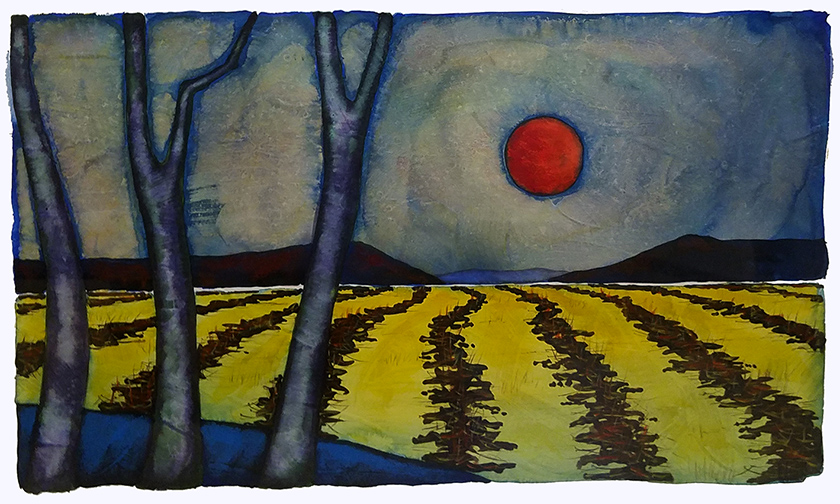
The final move came in placing the Red Tree which focused the whole piece. It has the feel of a flame for me, with the sky behind it reflecting its light. I call this painting Fire on the Mountain.

I am pleased how this piece emerged, given how it began and the fact that there were no expectations for it. Sometimes that happens.  Thanks for everybody from ERAS who attended the talk. With your questions, comments and good humor, you all had a part in making this piece work.


Read Full Post »

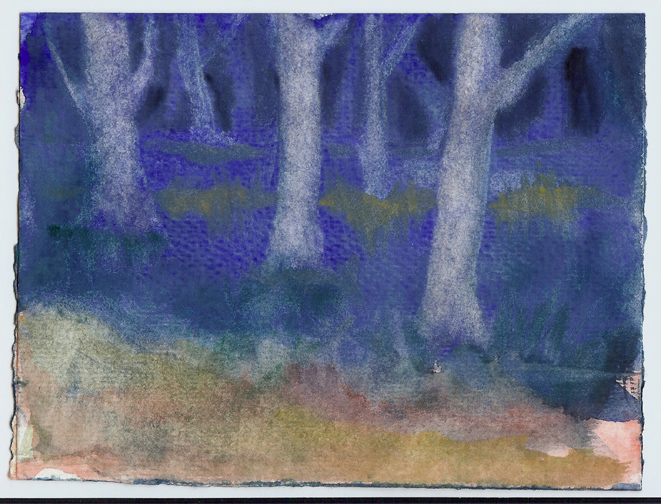
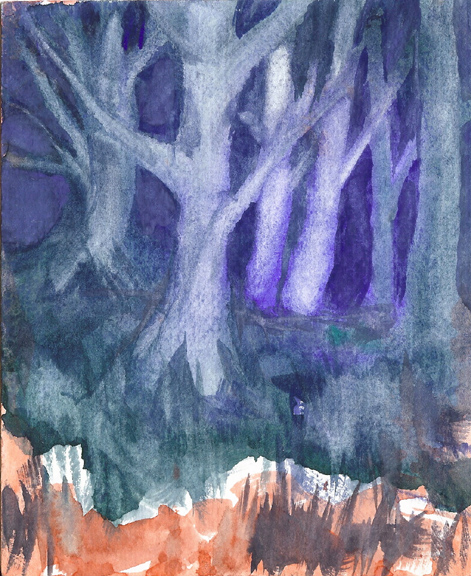
While doing a short talk and demonstration for a local arts group last week I mentioned my early work and the fact that it was mainly watercolor based. This surprised some of those in attendance who were not familiar with my early work. I tried to describe my process but thought this blog from several years back might help, at least with the images. Not so much with the words. I still don’t describe this work well. I’ve added a few images from that time.

************************

GC Myers 1994 Early ReductiveWork6I have been spending a lot of time here in the studio in the last few weeks painting in a more traditional manner, what I call an additive style meaning that layers of paint are continually added , normally building from dark to light. I’ve painted this way for many years but much of my work is painted in a much different manner where a lot of very wet paint is applied to a flat surface. I then take off much of this paint, revealing the lightness of the underlying surface. That’s a very simplified version of the process, one that has evolved and refined over the years, that I, of course, refer to as being reductive.

When you’re self-taught, you can call things whatever you please. I’m thinking of calling my brushes hairsticks from now on. Or maybe twizzlers.

This reductive process is what continually prodded me ahead early on when I was just learning to express myself visually. I went back recently and came across a very early group of these pieces, among the very first where I employed this process. I am still attracted to these pieces, partly because of the nostalgia of seeing those things once again that opened other doors for me. But there was also a unity and continuity in the work that I found very appealing. Each piece, while not very refined or tremendously strong alone, strengthened the group as a whole. I would have been hesitant to show most of these alone but together they feel so much more complete and unified.

This has made me look at these pieces in a different light, one where I found new respect for them. I think they are really symbolic of some of  what I consider strengths in my work, this sense of continuum and relativity from piece to piece. It also brings me back to that early path and makes me consider if I should backtrack and walk that path again, now armed with twenty years of experience. Something to consider.

GC Myers 1994 Early ReductiveWork 1 GC Myers 1994 Early ReductiveWork 3 GC Myers 1994 Early ReductiveWork 5 GC Myers 1994 Early ReductiveWork 2 GC Myers 1994 Early ReductiveWork 4

Read Full Post »

This Sunday morning’s musical selection is tied somewhat to a group of new work that has been rekindling my fire here in the studio. I’ve shown a couple of images of new paintings here and on social media of what I might call my Mask pieces.

Each has been a group of faces that is done in quick strokes from a single brush, starting from one point and filling the canvas. It is unplanned in almost every way. No color plan. No theme. Just intuitively and roughly formed faces that stem from a lifelong collection of faces that have been stacked in my head, culled from looking intently at clouds, woodgrains and patterns of all sorts through the many decades. Seeing them spill out in this way has been energizing in a way that I know from experience will spill over into the rest of my work even if this particular work remains for me privately.

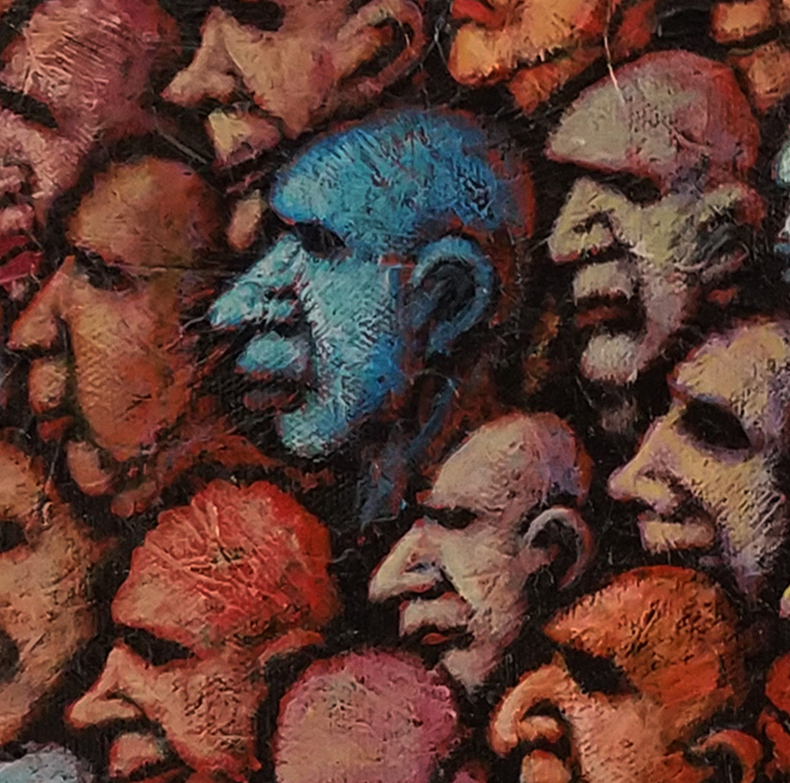
I haven’t been thrilled with how the camera is catching the images thus far. They have been quick photos that don’t fully capture much of the subtlety in the closer parts of the painting. So when the musical selection came up this morning, this section of one of the paintings jumped out at me. I thought showing it in detail would better show how I am seeing the work.

The song selection is the jazz standard Born to Be Blue, written by Mel Torme in 1946. It’s been performed by scores of singers over the years but it became a signature piece for the late Chet Baker.which is the version I am sharing below. In fact, a 2015 film biography of his life starring Ethan Hawke as Baker uses the song title as the film’s title. This version highlights his vocals rather than his horn work and features great piano playing from Bobby Scott.

Hearing it made me think of a blue face that I consider a central character in one of these pieces. At least my eye always lands on him first before roaming across the rest of the picture. The image at the top is a detail featuring him and shows better some of the surface and textures that compose the painting.

That being said, I am eager to get back to work on a new piece in this same style. Enjoy the song and have a great Sunday.

Read Full Post »

*****************************

“Masks beneath masks until suddenly the bare bloodless skull.” 
 Salman RushdieThe Satanic Verses

*****************************

This was a small piece that was began yesterday. I had finished a new painting that very much pleased me but left me feeling that it was not a jumping off point to immediately begin another piece in that same vein. In short, it left me feeling a bit blocked.

So, this piece, a 12″ square canvas, was started as a palate cleanser, something where I could just makes marks and shapes and color to fill some space, hoping that it somehow sparked something. This was basically how the Archaeology series began back in 2008. At the time, I was stumped and felt that I was at the end of my creative surge. I began working from a method taught by my 5th grade art teacher where we would simply take large blank sheets of paper and, using pen and ink, fill them in anyway we could. It’s something that I often turn to when I am feeling uninspired and it often bears interesting results.

Here, it started with a face, quickly slashed in with loose strokes, just trying to make a form with as little fuss or detail as possible. Then came another and another and so on. Each inspired the next. They went down in my normal red oxide at first then I went back at each face with quick, rough strokes of other colors, letting the tones and shapes play off one another. It was meant to be coarse in its execution, done fast and without much conscious thought, giving it a bit more expressionistic feel.

What they are, I don’t know. I wasn’t trying to represent anyone I knew or had seen. Just the general faces that have often popped out in my drawing over the years. But many of them have been with me for many years now. Some of them appeared when I was a small child and would try to find them in wallpaper patterns or in the edges of curtains. Everything could be made into a face, so it seemed.

And some I see as being from images culled from medieval texts, even down to the way the lips are modeled. Not done purposely, but they appear that way to me.

But most I recognize here  have been with me since my childhood, some that are friendly and some that deeply bother me, leaving me with an uneasy feeling as though I recognize them from past unpleasant personal experience.

Maybe from this life or some other earlier incarnation, if there are such things. Maybe it’s just a matter of facial and image recognition present in us all that pulls from sort of collective consciousness, that makes us respond to certain shapes and forms. Like I said, I don’t know.

Or maybe it’s just a psychological biopsy of the facets of a personality. Again, I don’t know.

But as a palate cleanser, it has served its purpose. It has amped me up a bit and I could see this small piece growing into larger painting, say 4 or 5 foot square. I could see that having a great impact on the wall, even if it’s only the wall here in the studio. But I don’t know if it will go anywhere beyond this.

Don’t even know if I will completely finish this particular or if I should even try to put eyes in the dark holes where they should be in these faces. I like the feeling that the dark pits give the piece. It gives the faces the appearance of being masks.

And maybe that is what our faces really are- masks.

As always, I don’t know if that’s true. But I do now that if this piece transforms into a larger series I will call it the Masks.

We shall see.


Read Full Post »

I’ve got several things on my plate this morning so time is short. Thought I’d rerun the post below because it describes a bit the dark to light process I often use. I also liked this simple painting but, as I write below, I wasn’t sure about it at the time, wasn’t sure it would translate well to others. Time has passed and I still find myself liking this painting. Plus, it quickly found a new home so someone saw something similar in it. Give a look and have a great day.

**************************

***********************

“A painter should begin every canvas with a wash of black, because all things in nature are dark except where exposed by the light.”   

-Leonardo Da Vinci

***********************

I’ve been working on a number of pieces lately that start on a black base of paint, rising from the darkness as each subsequent layer adds more and more light. I still think of this additive process as being a form of sculpture, one that starts with a flat surface and builds out in contours that give it definition and texture. Each layer of paint is like adding clay to the supporting armature of the sculpture. It’s a process that is hard to pull away from when I immerse myself in it. There’s something about seeing the colors grow more and more vibrant on the surface that becomes mesmerizing. I guess that’s why I often refer to this work as obsessionism.

This small experiment, a 10″ by 12″ piece on paper, is in this vein. It’s one of those pieces that I’m just not sure about because I like it but I’m not sure if I like it for what it actually is or for the experience, the obsession of the moment in painting it.

Or because it is simply from my own hands, part of myself. Like a parent looking at something their child has done and wondering if they like it because it is truly good or simply because it was done by their child, their flesh and blood.

Sometimes I can finish a piece and it instantly stands apart and on its own, complete and independent. Ready to move on like a young person proclaiming their emancipation from their parents. Other times, there are pieces that cling closer to me, perhaps too attached to yet stand on their own, at least in my eyes. Because I am unsure, I become more protective of these pieces because they do feel more personal, more of me.

It’s a hard thing to describe, this uncertainty in a piece, especially when it feels objectively right. Can a parent ever fully take out their own subjective view of their offspring and see them objectively as they really are?

Read Full Post »

I have been looking at this painting quite a bit lately. It’s from back in 2010 and is titled Raise Your Eyes. Featured in my 2012 exhibit at the Fenimore Art Museum, it’s a piece that I find myself coming back to examine quite often.

It’s different in many ways from the larger body of my work. For one thing, there are plenty of windows and doors, things I seldom use in my regular work where I prefer the blank  anonymity of windowless and doorless houses. This painting is all detail, even though its not extremely fine detail.

In some ways it reminds me of my Archaeology series, mainly because there is so many small touches to examine beyond the greater whole. I think that’s why I come back to this painting so often. Every new look reveals something I haven’t noticed since I first painted it. There are so many individual decisions here that dictate how the painting comes together, how it reads and expresses itself. Each window and door, each ledge and building top is a decision. Looking at them closer makes me appreciate the thought process behind it.

I mention  this painting today because I am working on a new piece that is based loosely on it. At least, it goes back to the process behind it and fills the canvas with thousands of small but vital decisions. It’s been exciting to revisit and I like what I have so far. Keep an eye out for it in the near future.

I also thought it might be a good painting to remind you to support your local small businesses on this Small Business Saturday. Every artist and every gallery owner is a small businessperson that rolls much of their income back into their respective local economies. Your patronage of artists and galleries. as well as so many other small local businesses, is vital to your local community.

I know that I can’t do this, can’t maintain a career as an artist without your support. And I am deeply grateful for that support and hope you’ll continue to patronize the galleries that show my or anybody else’s work.

Art is more than decoration, more than a product. It is an expression of humanity and a message that, in its best form, communicates through time. It is who we are.

And that is worth supporting.

Read Full Post »

I have a new painting in a show that opens this Friday, November 16, at the the West End Gallery. The name of the show is “Masterpieces: A Collection of Kick*** Artwork” and it focuses on the process of the artist behind each piece. There are photos, studies and writings that document how each piece came to be.

From the work I have seen from the show thus far, it lives up to its name.

My contribution to the show is  48″ high by 24″ wide painting on canvas that I am calling And the Glimmer Comes... It is shown here on the right.

I decided for this show to do the painting for this show using studies and drawings, something I almost never use.

Normally, I start with a surface that is prepared with multiple layers of gesso and, more often than not recently, a top layer of black paint. Then I just begin with a block of color, usually the red oxide that I use for composing my underpainting and usually in the lower half of the composition.

Then I let the painting grow organically, the first block of color guiding me to the second and the second to the third and so on. After the piece is fully composed this way, I build out the colors from darker to lighter tones.

In the very simplest terms, that is my normal process.
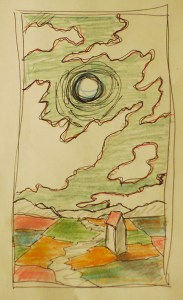
Rough Sketch- GC Myers

But for this piece I decided to go with two studies. The first would be a rough sketch that would set out the basic composition of the painting. When I say rough, I mean rough, as you can see. I take only a minute or so to create it as I am only looking for a basic silhouette, a blocked out map to follow with little detail or nuance. It is not meant to be anything on its own, just a bit of shorthand to guide me in the next step.

The next step is the creation of a study, a smaller (24″ by 12″) version of the final larger painting. I followed the sketch with my underpainting and it was pretty much in line. But I have a small problem in making studies which are usually more loosely painted than the final version. My problem is that once I begin painting I treat that piece as a final version. I have spent many years treating every piece I paint as nothing less than a complete painting unto itself, something that is not less or subservient to any other painting in my body of work.
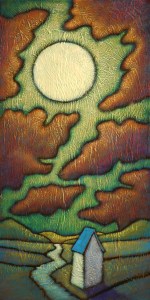
Lightbreak–24″ x 12″ – GC Myers

Once I started working on this “study” I couldn’t help but continue smoothing off the piece, making it whole. It was not a study at all as it quickly evolved into an autonomous painting with its own voice, its own life.  I am showing it as such with the title Lightbreak.

My next step was to transfer this image to the larger canvas. My first move was to block in the house much as it was in the sketch and the smaller version, although I did add an addition and another small roof to it. At this point I  could see new potentials in the open space of the larger canvas as well in the unique texture it possessed. It just begged for and explicitly pointed me to something different from the other pieces.

I immediately changed the composition to add a couple of rolling knolls leading a body of water that would extend to a horizon between two tongues of land that would jut in from either side. It began to speak in its own voice at once and was telling me how to proceed with the sky.

The larger surface created more open space so I opted for an additional underlying layer of clouds that would have a darker tone to contrast with those in the forefront. Doing so created an interestingly shaped negative space comprised of the blue-green color of the sky in its middle, That form became a structural element in this piece.

Building out the colors brought changes as well. The piece of land in the forefront were richer in color and more vibrant, mainly because I felt that the larger space it occupied required a bolder and more pronounced treatment. It acts as a strong foundation in this painting.

The final touches come in creating the glimmer at the horizon. That simple step made the whole of the painting gather together, creating a wonderful geometry between the various elements of the painting. It felt to me like the high note of climax in a dramatic aria.

That is a very condensed version of how the final painting came to be. Whether it lives up to the title of the show is not for me to say. The most I can say is that I feel this painting fits well among what I consider my better work. So maybe in that aspect it lives up to the show’s title.

Come out to the West End Gallery and see for yourself.


Read Full Post »

I had a dream a week or so back.

It wasn’t particularly odd. I didn’t feel like I was somehow out of place and didn’t recognize my surroundings. I had no strange abilities. No, it all seemed very normal. In fact, I was still a painter in this dream.

The gist of the dream was that I feeling a bit down about my work. Then out of the blue I received a phone call from a person identifying themselves as the editor of a large national magazine who wanted to do a story on my work. I was excited in the dream, as would be expected.

The dream ended with me asking what this magazine was that so wanted to do a big story on my work.

The voice on the other end replied, “Finger Painting Magazine.”

I woke up at that point and I began chuckling in the darkness.

My big break!

Womp womp.

I thought about that dream again yesterday. It still made me chuckle but I thought maybe I should try painting without a brush, using only my fingers, at least once. Maybe there is something to this finger painting stuff.

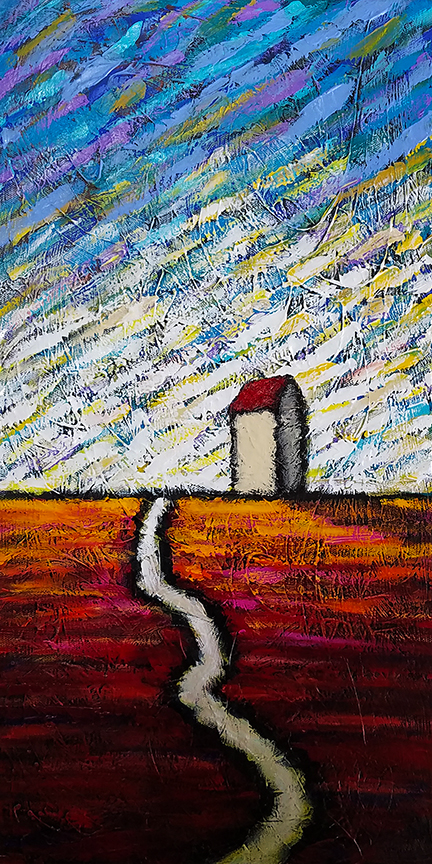
So I grabbed a canvas and got at it. I decided that I should keep it simple while I work on my strokes so I went with my most basic of compositions. Sky. Ground. Path. Red Roof.

Using only my fingers definitely gave it an immediacy and excitement. The piece changed quickly with a smear here and a daub there. The quickness of the process seemed to require more boldness. I used a couple of higher toned colors in more prominent roles than I normally would when using a brush. And I think it worked in this piece.

I began to realize that my hand was a combination of many brushes. Each finger had its own size and quality so there five brushes right there. Putting two or three fingers together made a couple more. And my palm was a broad brush as well.

Actually, as I got toward the finish of the painting I began to realize it didn’t look much different than my normal work. A little more ragged on the straight edges but that is not necessarily a bad thing. And it was not as messy as you might think. I actually ended up with less paint on my hands than I normally do when using a brush.

Maybe I have been wasting my time with brushes.

I did a little research this morning. There is no Finger Painting Magazine but there are several painters who use only their fingers. Some are quite striking and one was written about in an article I remember seeing not too long ago. She paints icebergs and other frozen landscapes on a grand scale. Great work.

Maybe there should really be a Finger Painting Magazine.


Read Full Post »

Last week a notification came up on my Facebook feed of a painting of mine that was being offered for sale locally. It wasn’t the best of photos but I immediate recognized the painting. It was from back in 1999 and was titled Black Opal Night. The price was very reasonable and I immediately contacted the seller, offering to buy the painting back.

In our back and forth, she asked why I was buying this painting back. It seems that artists buying their work back is not a normal thing.

I replied that it was from the years between 1996 and 2000, a five year period that was pre-Red Tree and an evolutionary step to my subsequent work. It was also a time from which I have practically no remaining work and would love to have a few more pieces. I have been very fortunate in that almost all of the work from that time have found new homes. The few that remain with me are pieces that most likely should have never left the studio in the first place. They have major flaws– poor color quality, composition balances that seem off a bit and so on– which I would now consider disqualifying, that would keep me from showing it publicly.

I may have been a little less discerning in earlier times.

This piece, from what I could see in the photo and could glean from my memory of it, didn’t seem to fall into this category.

Another part of wanting to acquire this piece was that my documentation at the time was pre-digital and spotty. I most likely have slides of this piece but the slide itself is most likely poorly shot. And a poorly photographed slide is still a poor image when transferred to a digital format, which is still an iffy process for me. It would be good to see a painting from the time and get proper photos. I have to admit that the photo here was taken through glass so it is not a perfect image. But it works.

So I picked this up over the weekend and I couldn’t have been more thrilled. First, the image itself looked new even though the frame, a blue-green color that I no longer use, was a bit less fresh looking. It was definitely of the time. I could see where I was at the time from a process standpoint, how I was still embracing techniques that are now deep embedded.

I often speak at gallery talks about the 60 or 70 thousand hours spent in the studio over the past two decades. This piece was from the beginning of that time and offered a glimpse of how the work had evolved and changed. This piece was pushing at the edges of my abilities at the time which gives it an excited feel. I can almost feel my excitement in painting it from the time. There are surface flaws that are integral to the energy of this painting that give it a rawness that I think was a big part of the strength of that early work.

That rawness is something I don’t see as much in recent work. Oh, the excitement is still there but the expression of it is more refined, more controlled. And looking at this painting makes me wonder if I am pushing myself enough. Am I staying too far inside the lines? How do I regain that raw energy?

And maybe the answers to these questions are the real reasons for me re-acquiring this painting. Even though it’s simply an older painting in my body of work, it has given me so many things to ponder.

Let’s see where it goes from here.


Read Full Post »

I was not sure where I was going, and I could not see what I would do when I got there. But you saw further and clearer than I, and you opened the seas before my ship, whose track led me across the waters to a place I had never dreamed of, and which you were even then preparing to be my rescue and my shelter and my home.

― Thomas Merton, The Seven Storey Mountain

+++++++++++++++++++++

Well, my annual show at the West End Gallery comes down in just a few days. This year’s edition is called The Rising and Thursday is the last day to see the show.

It is a show in which I feel a real sense of pride. When I am prepping for a show, my goals for it are often vague and undefined. I feel that I want certain things for it and from it but when I try to verbalize these goals, the words evade me. I find myself like the sailor in the Thomas Merton quote above: I was not sure where I was going, and I could not see what I would do when I got there. 

I knew it was going somewhere. I just didn’t know where. I let intuition and reaction guide me and it often worked out fine.

But this show, much like my June show at the Principle Gallery, felt more preordained and focused and less haphazard in it’s final edited version, the one that hit the walls of the galleries. I still allowed for the role of intuition and the unconscious in the process of painting each piece. That is a necessity.

But where I could make conscious decisions, I did just that. I chose to simplify forms and chop out the fussiness of detail. Deepened colors. As much as I like them and appreciate their popularity, I reduced the number of small paintings and went with works that were a bit larger. It streamlined the look of the show on the wall, made it feel less cluttered, and gave each piece a bit more room in which to expand.

They weren’t big things but enough to make the work in the exhibit to be presented with fuller impact. I felt like this and the Principle Gallery show were my most mature and complete exhibits to date.

The response to the show has been great which is gratifying on many levels. A number of the original paintings from the show have flown the coop to their new homes but there are a few replacements that I feel fill the void they leave behind. One new piece is shown above. It’s Star Navigator, a 24″ by 8″ canvas that feels very much like it jibes with the words of Merton at the top.

I hope you can make it out to the West End Gallery in the next few days, if you haven’t had a chance to see The Rising.

Read Full Post »

« Newer Posts - Older Posts »