Feeds:
Posts
Comments

Archive for the ‘Technique/History’ Category

I’ve been showing a lot of new work lately that I will be showing at my upcoming show in june at the Principle Gallery in Alexandria, VA.  This is a 24″‘ by 30″ painting that I finished back in February which has been above my studio’s fireplace for most of that time. I look at it several times a day and have yet to want to alter it in any way.  I find the sparseness of detail adds to the coolness and focus that I think make this piece work.

I didn’t have a title for this piece, even after months of looking at it.   I sometimes struggle with titling certain pieces that I’ve lived with for a while and seem to strike an inner chord with me.  This was one such painting.  But the time has come to start putting names to paintings.  I have a certain way of doing that that I’ve outlined before where I will set up a piece, pretending that I have never seen it before. I will turn away from it then turn back quickly, taking it in and grasping whatever first strikes me about the piece.  Color, shape, mood—–whatever jumps at me.  Then, taking that first impression, it becomes easier to find the right name.

But sometimes it doesn’t work and there are pieces that don’t adhere to this method.  Like this piece.  So I wait and hope something jumps out at some point or that I stumble across the right words for it.  I was looking for something else earlier and came across an old song from the late 60’s from a group, Marmalade, a Scottish band that had long since left my memory.  While their band’s name was forgettable, their best known hit, Relections On My Life,  was not.  Great song that rekindled old memory and I immediately knew I had a title for this painting: Reflections on a Life.

Sometimes you find things in unlikely places.  For those of you who don’t remember Marmalade, here they are:

+
Read Full Post »

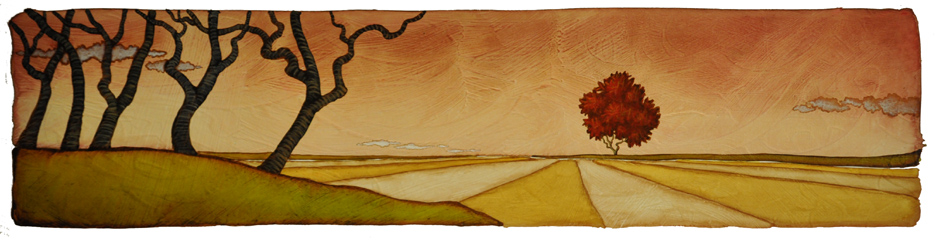
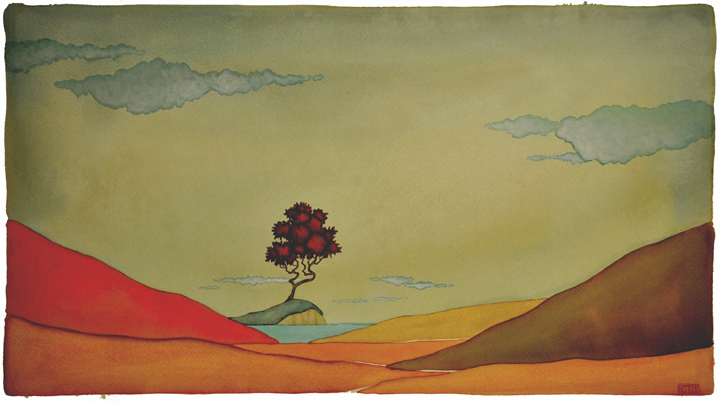
This is a piece that I finished in the last few days.  It’s a real throwback to my first forays into painting, done in a very watercolor way on untreated paper.  It’s 13″ by 23″ and is very transparent.  I’ve tried to maintain a certain complexity of color and strength of line yet the colors are lightly saturated, almost delicate.  I’m not sure how well this will translate on a computer screen. 

I’ve started doing a handful of paintings in this manner in order to focus on subtlety of the color and to allow the forms of the landscape and sky to carry the weight of meaning in the the piece.  It’s a tricky proposition to pull back from deep colors and texture yet still maintain strong edges.  I find that this type of painting works best with simplified forms that seemingly act as abstractions, giving the work an almost organic feel, if that’s the right word.  This feel plays well with the red tree which maintains its role as the focal point and inviting presence in the piece.

I like this work .  While it has a slightly different  appearance based on technique, it fits easily into my body of work.  There is an ethereal feel, something I strive for in much of my work,  that is enhanced by the transparency of the paint. 

Okay.  Back to the paints…

Read Full Post »

Blue Vigil- GC Myers

I’m about a month away from my annual show at the Principle Gallery and my studio is a mess.  There are paintings scattered about in varying degrees of completion.  Some are done and many need little touches here and there.  Some are still in early stages of development, still having many different potentials.  Some are still in my head, the result of ideas that blossom in this chaotic time of my year.

It’s hectic and I always seem to be behind my time schedule.  So much to do.  But it still remains one of my favorite times of my painting year if only for those new paintings in my head.  The intensity of the painting that comes with a looming deadline always seems to inspire new concepts and ambitions for my work which keeps me excited in the studio which makes my time spent alone there very easy to bear. 

This new excitement may come from working with a simple color or form or from a slight tweaking of  my technique.  It may come from revisiting concepts from the past that I haven’t used recently.  Or by a change in the materials I use.  A different canvas, paper or gesso often spurs me on.

This need to feel excitement in my own work is very important for me.  The main reason is simple.  If I cannot be stimulated by my own work, how can I expect others to be excited by it?  I’ve always believed that you can usually tell when a painter is inspired by their work.  There’s a confidence and surety in the rhythm of these pieces.  Perhaps this excitement is that which gives their work a signature “look”.

The other reason for this need to excite is that it fosters growth and change in the body of my work.  The changes may be small and imperceptible to many but they mark subtle expansion for me.  I see it when I scan back through the work over the last decade. Each year brings something new which changes the overall face on my body of work.  It may often seem much the same but it is actually an evolving continuum.  And I find excitement in this evolution…

Read Full Post »

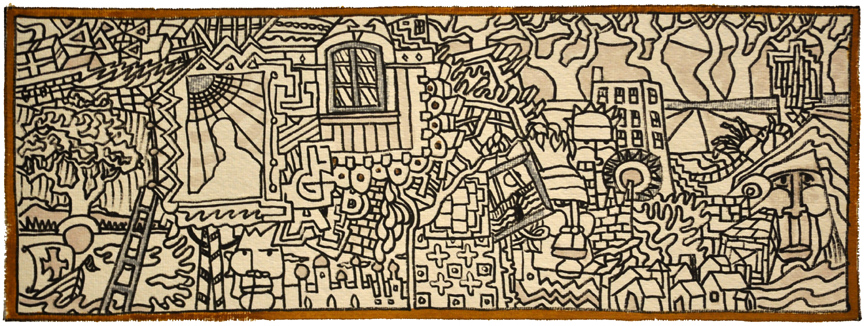
Kabuki TV-- circa 1994

Just looking through some old things, mostly little pieces that are from the time when I first started painting, and I came across this.  At the time  I was playing around with color and masking, where you put something such as tape on the painting surface and paint over it then peel it away to reveal the unpainted surface underneath.  It can be a big part of traditional watercolor painting and I wanted to see if it fit with the way I thought and wanted to paint.  It didn’t.  But I did come up with this little abstraction that always catches my eye and makes my mind’s gears turn.

It’s always interesting to see these little pieces because it inevitably triggers memories of that time when every day was bringing new discoveries as I tried to learn more and more about color and different mediums.  Sometimes things clicked and it was revelatory to discover my strengths.  Other times, it was a struggle and the end product was muddled, labored.  But there was still something to be learned there.  Like identifying my weaknesses and learning how to strengthen these areas or, at least, downplay them.

I guess that this is the process for development in any area of your life,  playing up your strong suits and trying to cover your weaknesses.  Perhaps that is why I like to see these old experiments, to be reminded of my growth, artistically and personally, through the years. 

At least, what I perceive as growth.

Read Full Post »

GC Myers - The Past Returns


It’s the first day of May and I’m entering the stretch run in my preparations for my upcoming June show at the Principle Gallery in Alexandria.  The body of work is starting to take real shape and I’m getting a feel for how it will hang together during the show.  Themes emerge.

This year, I am devoting part of the show to work that is a return to my earlier work, painted in more transparent layers and more subdued tones of color. 

The piece shown here is indicative of this work.  I call this piece The Past Returns and it is 18″ by 18″ on treated cotton rag paper.  This piece to me is very much an homage to the first Red Tree paintings in color and form. 

This piece even has the visible spew line at the upper left corner where the liquid paint sometimes breaks free as I’m working it and rushes out of the picture plane.  I remember an older gentleman approaching me at an early show and pointing out this feature on my painting.  He told me how much he liked the spew lines, a term I had never heard.  He explained that he had worked in a foundry and that was their term for the excess metal that broke free of the mold.  I liked that and have called them spew lines since then.  I haven’t shown spew lines for some time, choosing to scrub and paint them out.  But seeing this one brought back the feeling of those earlier pieces and gave it an organic feel, exposing more of the process.  It had to stay.

Sometimes the past returns and it is a good thing…

Read Full Post »

There’s new exhibit that opens at the West End Gallery in Corning next week.  It’s titled The Process- Start to Finish and features the gallery’s roster of artists showing sketches and studies for finished pieces of work.  The idea is to give the viewer a better understanding of how a piece of art evolves through the process. 

Now, I never really do studies and very little sketching for my paintings so this didn’t really seem like a show fitted to my process.  But I remembered that a couple of years ago, at a point when I was floundering a bit and somewhat lost direction, I did a series of sketches (actually, I call them doodles) that eventually evolved into my Archaeology series.

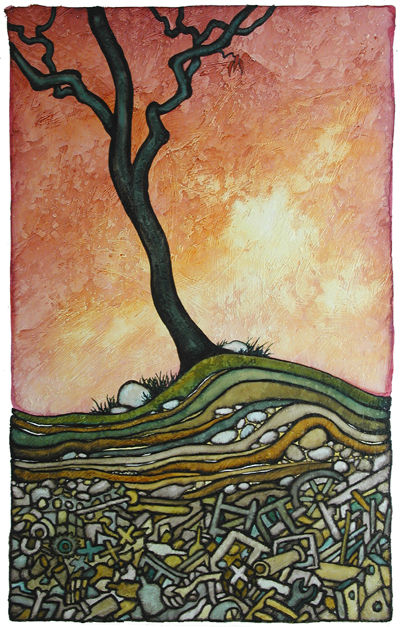
Archaeology: New Day

Done on 12″ by 24″ sheets of watercolor paper with a finepoint Sharpie marker, which I liked to use because it forced bold lines and better simulated the way I used a brush as a drawing device when I painted.   They were basically exercises where I would start at any given point on the sheet with a mark and simply fill the space with shapes and lines.  Kind of  a stream of consciousness thing.  There was no intent .  I was just trying to find something that would fire my then faltering imagination. 

I did this for about a week, filling a number of these sheets until I began to realize that this sketching  process could lend itself well to a different type of painting for me.  One that combined my typical landscapes and iconography with areas of this intuitive doodling.  Thus came the Archaeology series.

So I guess I do have a sketch of sorts for this show.  The piece shown here, Archaeology: New Day, was one of the first in the series.  You can see this by way the underground elements are formed in the same marker-like manner as the sketches as opposed to later pieces in the series where each element is painted as though it is almost floating in an underground basin.  This piece, which remains a personal favorite,  will be at the West End for the show. 

This exhibit opens May 7.

Read Full Post »

I’ve started working on a series of paintings that are a return to my earlier work, back when the Redtree was first coming into view,  in the way they are painted.  Done on gessoed paper, I am using thinner, more transparent paints that allow the gesso base to show through, creating its own light and glow.

It’s a much different mindset than the one I’ve been employing in much of my recent work.  There is more restraint.  While it is still very much about color and texture, like the newer work, there is more delicacy and subtlety.  The colors are less saturated.  The transparency of the colors have a different effect even on a heavily textured base.  The linework is finer and the whole piece is really about how the blocks of color come together and interact. 

The feeling of the work, as a result, has a slightly more ethereal feel.  A lightness and coolness.  More atmospheric and less earthy than some of the newer work.  This being said, I don’t feel either style is superior to the other in that both reflect the same underlying emotions.  To me, they say the say the same things, only in different manners.   

This piece is a little over 5″ by 21″.  It’s still too new to have developed a title yet.  That will come soon enough…

Read Full Post »

This is a painting titled Light Imminent that I’ve been working on for several months, on and off.  I used it some time back in a short film I put together in which I was working on this piece in an earlier stage of its development.

It’s a pretty big piece, 20″ by 60″ on canvas, so it sort of dominated the space where it sat incomplete for a long time, always in the edge of my vision.  It was, once again, a matter of letting a piece sit until it was ready to be completed, to have the last few pieces added which brings everything together.  The time it sat allowed me to really take in and weigh all the parts and make subtle decisions about the finishing touches.

For some pieces, this time spent resting is invaluable.  There is no rush to finish and options are given a chance to grow.  There are pieces that don’t require this period of mulling, that have an inevitability from the first few strokes that tell me where it wants to go.  There’s a sense of satisfaction in both types of painting.  Those that sit have the satisfaction of seeing the idea and feel of the piece take shape over time.  There’s a real sense of contemplation in this work.  Those that take shape quickly have the satisfaction of sudden birth, a burst of energy that takes form and becomes alive before your eyes.

I see the contemplative nature of the slower process in this painting.  It’s in little things that I probably am the only to notice.  A sharper edge here or there.  The modeling and strokework of the central tree.  A stroke or two added in the sky to bring the light to higher effect.  Little things.

Now I’m in the last few days of taking it in before it leaves to go out in the world.  Hopefully, it will find someone who sees some of what I see in it…

Read Full Post »

Sometimes in the winds of change we find our true direction.

——–Anonymous

I’ve finished a couple of paintings over the last few days, pieces that I will show here in the next week or so.  This is a 12″ by 36″ canvas and is sort of a revisiting of a theme and a visual motif in the way the sky is painted.  I wanted a sense of motion and flow in the sky.  Controlled, directed chaos.  Like the wind itself.

I love painting the skies in this type of painting.  It’s thousands of paint strokes, layer after layer, built up.  There’s a real meditative quality in this manner of work, where I can lock into the surface and not feel as though there’s a task before me.  Time drops away and all I see is the next stroke to be painted.  It’s a strong and interesting feeling that really connects me with the work.

I sometimes worry that I see more in this work because I’m looking at it with the memory of this feeling achieved while painting.  The outside viewer doesn’t have this memory and can only judge it on their own experience and reaction to what is before them.  When I’m evaluating my paintings, I try to look at the work with a detached eye, putting aside personal memory and influence, but it’s hard to do so completely.  Those memories are strong.  I can only hope that the viewer gets a sense of the feeling from their own eye, that it somehow comes through and reveals itself to them in the brushstrokes and surface of the painting.

Often it does.  Sometimes it doesn’t.

That’s painting…

Read Full Post »

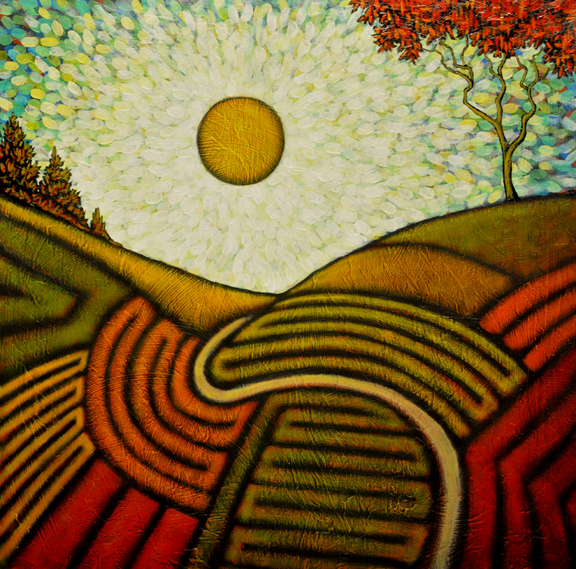
This is a painting that I’ve been working on for the past several days that I’m calling Through the Labyrinth for the time being.  This piece, a 24″ by 24″ canvas, is part of what may be a new series for this year.

I see this series progressing as a group featuring the look of my typical landscape with a patchwork of fields consisting of blocks of saturated color and random geometric patterns.  I really want to maintain  a rhythm in these fields and make them feel natural and easily translatable to the eye.

By that, I mean I want to take something that when looked at from a purely analytical stance may not be totally natural or rational and make it appear to be so within the framework of the painting.  There’s an example of this in this painting, one that I have used in the past.  If you look at the sun, you recognize it as the sun.  But when you stop and think about it, this sun defies logic.  It is darker than the light emanating from it.

This was initially done without forethought and didn’t even occur to me until a couple of other painters pointed it out.  It always translated naturally in my head as the sun, the light source, despite its comparative darkness.

This is the type of visual translation I want to continue with this next possible series. At this point, it’s still only a possibility.  I’ve worked on a couple and have another one, a large piece, taking shape in my mind.  It’s all a matter of maintaining a natural, organic flow through the piece that creates an environment where the viewer is made comfortable and secure, allowing them to accept it as a credible reality.  This sense of trust allows the piece to take on a real sense of place.

We’ll see how this goes.  This piece is a good step forward.

At least, I think so…

Read Full Post »

« Newer Posts - Older Posts »