Feeds:
Posts
Comments

Archive for the ‘Technique/History’ Category

GC Myers- A Journey Begins

GC Myers- A Journey Begins

One of the interesting things about doing Gallery Talks, especially when there are a number of people who have followed your work for a while, is the feedback I get about the direction of my work or what has come or gone in it in recent times.  I hadn’t even noticed until someone asked that my Red Chair was lacking from the walls of the Principle Gallery and upon thinking about it I realized  that it had not appeared often in recent times.  I wasn’t surprised.  After doing this for a while, I’ve come to understand that themes and imagery cycle in and out of my work, attaching for a while to my psyche then falling to the back, only to resurface at a later time.
GC Myers- Night Watch

GC Myers- Night Watch

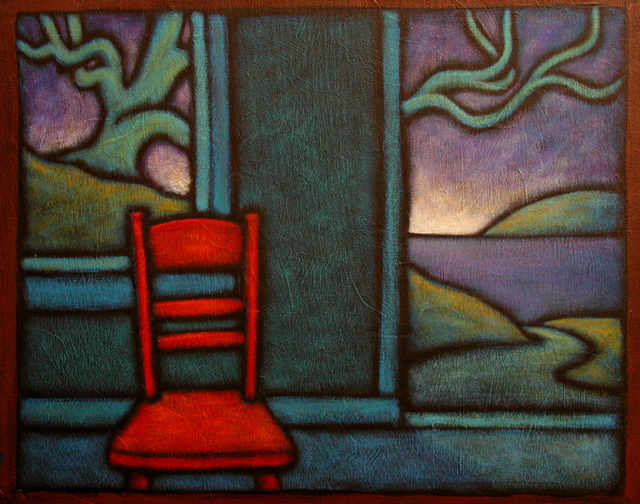
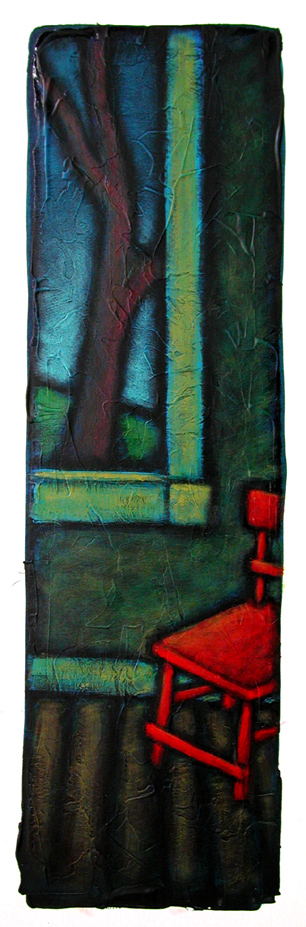
But having someone raise that point prodded me a bit and that Red Chair is in my mind again.  I have a few images swirling that will soon be out, I am sure.  But it also made me go back through my files looking for that Red Chair.  2002 was the high water mark for its appearance, especially in interior scenes painted in that style I refer to as my Dark Work— dark blues and greens over a black base.  Several of them remain with me and are among that work with which I will not part.

But I thought it would be interesting to show how a series of specific imagery, in this case the Red Chair,  goes through a specific time period, how certain elements are added or highlighted or fall away.  The one constant is the weight that the Red Chair brings to each image.  There is a tangible sense of  presence in each, as though the Red Chair alive and contemplating in the moment.  I think that is the appeal for me in these pieces– they don’t feel like still lifes but more like portraits.

Anyway, here is how the Red Chair moved through 2002:

GC Myers- Galvanic Memory

GC Myers- Galvanic Memory

GC Myers- Little Red Riding Chair
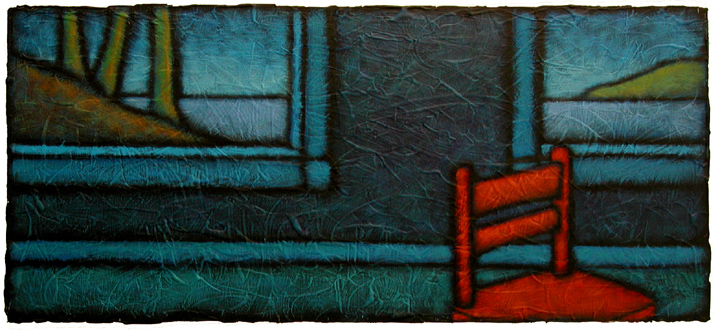
GC Myers- Little Red Riding Chair

GC Myers- Inner Sanctum
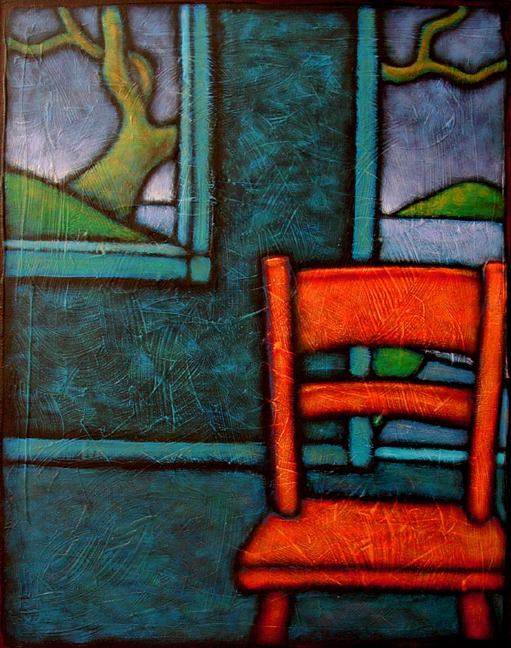
GC Myers- Inner Sanctum

GC Myers- An Inward Look
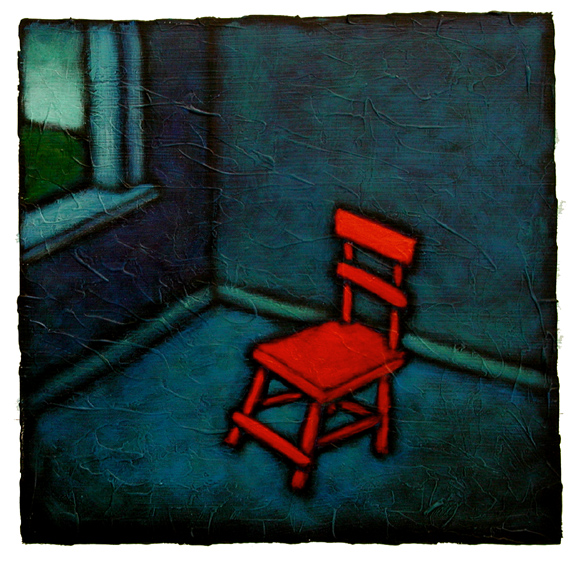
GC Myers- An Inward Look

GC Myers- Small Piece pf the World

GC Myers- Small Piece pf the World

GC Myers- Reason to Believe
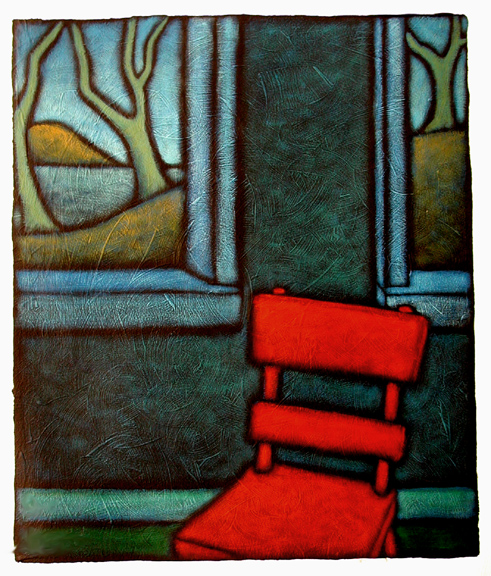
GC Myers- Reason to Believe

GC Myers- Introspection

GC Myers- Introspection

Read Full Post »

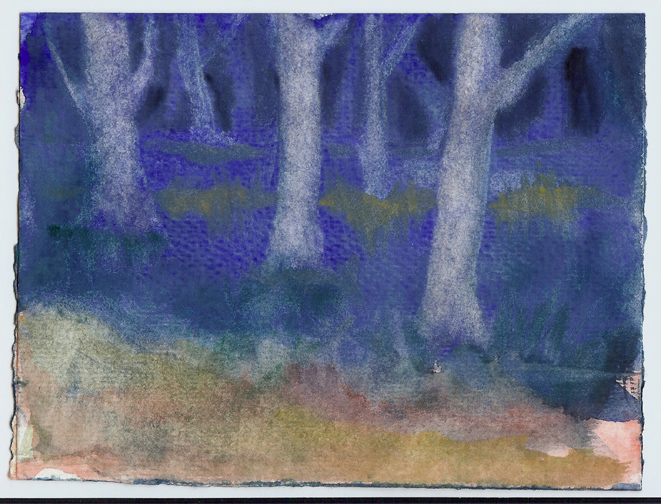
GC Myers- Blue Night Discovery

GC Myers- Blue Night Discovery

I have a small group of new work accompanying me to the Principle Gallery this Saturday for my 1 PM Gallery Talk there.  There are also two older paintings, one a piece that I wrote about here a couple of weeks ago, The Elusive Path.  It is from 1990 and is one of the first Red Tree paintings but was trapped in a bad frame that sapped away much of its potency.  A new and more fitting frame has allowed its true self to shine through.

Another older painting that will be coming with me is shown above, Blue Night Discovery.  Unlike The Elusive Path which had a horrible dull green-blue frame, this painting had a decent looking frame.  The problem was that the mat surrounding this painting on paper was extra wide and the frame was massive.  It was huge and cumbersome, much too weighty for this work.  The framed piece felt like a slab of rock when I would pick it up and I seldom looked at it because it was such a chore to drag it out.

It was buried in the very thing that was supposed to set it forward and present it in its best light.

GC Myers- The Elusive Path

GC Myers- The Elusive Path

I had went through a period of these large, heavy frames and extra wide mats and over the years I have changed most of these paintings back to smaller, more reasonable frames that don’t overwhelm the painting.  So many so that I have a huge stack of these massive frames in a basement room.  There’s enough wood there to build an addition on my studio. Looking at these frames,  I can now safely say that the idea of these wide mats and heavy frames was a misjudgement on my part.

But there is a bright side to this realization.  For all of these frames, the  paintings that had been held captive have almost all found new homes soon after being re-presented in a manner that allows them to show what they really are, to let them exhibit their own qualities.  Seeing Blue Night Discovery out of that huge frame let me see it with cleared eyes not distracted by a setting that had little to do with the piece itself.  I had discounted this painting in my mind for years because of this distraction but now saw the strong forms and saturated colors, the contrasts of the dark of the  blues against the light light of the moon.  It made me remember the time when I had painted it and those positive feelings to which it had given rise.

It seemed new again in my eyes.  All because it was in a new position, a gem in its proper setting.

Read Full Post »

GC Myers- Observers (with frame)Sunday morning and I think I’m much more decompressed than yesterday morning after the show.  All back to normal, whatever that is.  This show has made me think on a wide variety of subjects, about purpose and meaning beyond what I see in the work as well the potential for legacy in these paintings– would they endure into the future?

A good friend stopped in the studio yesterday and we talked for a moment about the subject of legacy.  I pointed out that legacy is a big if for any artist and that I can only do what I do — where it ends up in the future is something that is far beyond my own control.  It could be in enduring collections or it could be in garage sales and dumpsters– you never know what the vagaries and tastes of the future hold.  I witness this all of the time when I go through the  records from the auction houses and see painters who were celebrated in their time who are now basically unknown.  Their work sells for a pittance, far below what one might expect from reading about their fame when alive.

As an artist, you can only hope that your work has a transcendent quality that allows it to live out of the time of its creator and be of the time in which it is viewed.  I don’t know how you do that outside of maintaining consistency in your own vision and hoping that it is one that somehow speaks to those in the future.  But there is always the question  that if your work does move ahead, does maintain life and attracts future collectors, what would your legacy work be?

I know that this a fool’s game– no one has the ability to predict that future for their own work.  You can’t be objective when you are so close to it, can’t discern your own personal feelings for it from how it reads to the outer world.  But there are pieces that I see that nag at me, that have a weight that tells me that they may be vital pieces in a potential legacy.  Pieces that I could see easily living in the future.  There are a number in the current show, including the piece above, Observers.

These pieces have an intangible quality that I wish I could more fully understand so that I could better describe it.  Or capture in a way  so that it would be in all of my work.  There is just something that seems beyond me, something that is beyond this time.

Could I be wrong?  Of course.  I have been wrong many times in the past and will no doubt be wrong in the future.  But for my work I can hope that in this instance I am correct and that they hold on.

Actually, this was all just an elaborate lead in for a little Sunday  morning music , some soul stirring from the Alabama Shakes and lead singer Brittany Howard.  It is a song titled, of course, Hold On.

Have a great Sunday!

Read Full Post »

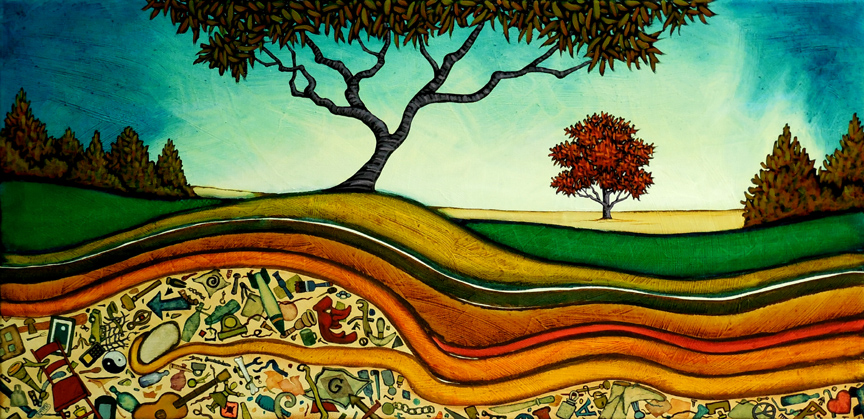
Archaeology: All We Leave Behind

Archaeology: All We Leave Behind

As the title suggests, there are a few paintings from my Strata and Archaeology series in the Layers show that opens Friday at the West End Gallery.  The piece above, Archaeology: All We Leave Behind, is a 12″ by 24″ canvas is the latest and perhaps last entry in the Archaeology series.

I am considering retiring this series that started back in 2008 although I can’t say I won’t revisit it at some distant point in the future.  It has been a series of paintings that has been among my favorites, both in painting and in delving deeper into them, as well as being important to my development as an artist.  When I first started the series, it came at point when I was in need of inspiration and was questioning my future as an artist.  These paintings gave me footing, a firm base to rest on while I gathered what I needed to move on.

Looking at these pieces, I am almost always surprised when I get to inspect the underground artifacts.  So many of the items  were painted  without any forethought or afterthought so once they were done and I had moved on to the next item in the debris field, they sometimes escaped my notice of their singularity.  They just became part of a larger pattern of forms and color.  But going back and looking at the items later gives me little surprises that sometimes make me smile and sometimes scratch my head, wondering what the hell some not quite recognizable thing is or what I might have meant by its inclusion.

But all things must come to an end, which is actually the theme of this series.  And this piece, which took over a year to complete as I worked on it a bit at a time,  seems like a fitting end.  And if it does end up being the last in its line, what better place to show it than where my little journey as a painter began back in 1995, the West End Gallery.

Here’s another Archaeology piece in the show, Archaeology: Formed in the Past,  one from a few years back that has a favorite of mine from the minute it was completed:

Archaeology: Formed in the Past

Archaeology: Formed in the Past

Read Full Post »

GC Myers- The Empowering smWhat we achieve inwardly will change outer reality.

-Plutarch

**********

I am in the very last day of preparations before delivering my show to the West End Gallery for next Friday’s opening of my show, Layers.  It’s a day that mixes the tense anticipation of how the work will be received at the show with the relief of finishing all the tasks required to make it happen.

Fear and elation from moment to moment.

This is just an accepted part of the process by now.  But it’s all too easy to let the fear part of this little dance grow, to imagine worst-case scenarios where the show is an abysmal flop and the work fails to move a single person on any level.  I can only imagine that  anyone who creates or performs has these fears.  The trick is to not succumb to them, not let them drown out what you know to be true in your work.

That’s where the elation part of the process comes in.  When I am framing and prepping, the work is arranged in stacks so that I can’t see much of it as I go through the process.  I am engrossed in doing these tasks and put the work itself out of my mind as I proceed.  But as I go along, I get to each individual piece, turning it over to reveal an image that had escaped my mind.  It’s exciting, like seeing it for the first time, and I find myself appreciating aspects of the painting that I had overlooked or not even noticed when it was consuming me in its creation.  It’s a moment that wipes away the fears and reinforces my own belief in the work.

That’s what happened yesterday with this piece, an 18″ by 18″ canvas painting that I call The Empowering.  It had slipped from my sight and memory and upon turning it, it just seemed to glow among the other work.  It really bolstered me and had me setting up pieces in my framing space so that I could see it alongside the other paintings in the show.  The fears were washed away and I was left with a great sense of internal satisfaction that this group was already a success, regardless of my fears.

Here’s hoping that Plutarch’s words hold true and this inner belief becomes an outward reality.

Read Full Post »


There’s a lot going on so I am a little short on time.  I thought I would rerun a post from this day four years ago that jibes well with a thought that has been going through my mind lately.  A while back, my friend Linda Leinen (you might recognize her as Shoreacres in the comments section) referred to a Robert Frost line– No tears in the writer, no tears in the reader. No surprise in the writer, no surprise in the reader.  I have long contended that one of the most difficult parts of my job is maintaining that sense of excitement for myself in the studio, finding that thing that brings me wonder and surprise.  For me, that normally comes from varying the ways in which I work with the materials that I use in my work.  The materials always seem to hold the key to new surprises, new breakthroughs.  Which brings me to the post below.

*************************

Helen Frankenthaler- Savage Breeze

Helen Frankenthaler- Savage Breeze

There are no rules. That is how art is born, how breakthroughs happen. Go against the rules or ignore the rules. That is what invention is about.

–Helen Frankenthaler

************************

I’m using this quote from Helen Frankenthaler, the famed Abstract Expressionist, as a sort of follow-up or addenda to yesterday’s post about change.  I remember reading about Frankenthaler when I was first beginning to really paint with purpose.  In an article that I read but can’t locate now, she spoke of how she came to her trademark stain paintings where very thinned oil paint is applied to unprimed canvas.  She said it was almost by accident that she first experienced the absorbing of the paint by the raw cotton canvas and how that it caused a reaction, a breakthrough, in her thinking about how she wanted to express herself within her work. 

She felt that all artistic breakthroughs were the result of a change in the way one saw and used their materials.  It could entail changing the type of material used or using them in a more unconventional manner, as her above quote stating there are no rules infers.

This immediately clicked with me at the time I read it.  I had been trying to shape my way of thinking to fit the materials I was using at the time.  Unsuccessfully.  What I needed to do was change the materials to fit the way I was thinking.  Allow my thought process more free rein and not cater to the restraints of materials.

That may sound kind of abstract but it allowed me to start working with my paints and grounds in a much different way, forming my own process that worked well for my way of thinking and has become entrenched in my thought process.  Even though it may be outside more traditional forms of using these same materials,this process has over time become as rigid in my use as the techniques used by the most steadfast adherent of the most traditional school of painting.  This is sort of what I was referring to when I mentioned the end of the cycle, as far as art is concerned.  You reach a certain point, a mastery of your materials, where there are few accidents, few surprises in the materials’ reactions and, as a result, fewer surprises in your own reactions. 

For most, this is the goal.  But I want that surprise, that not knowing exactly how the materials will react and that need to solve the problem presented by the need to express with the limitations of the materials used.  So I try to continually tweak, create a little tension in how the materials react to my use of them, to create a sense of surprise.  Breakthrough.

Read Full Post »

GC Myers- Time TravelerI finished this new painting, 18″ by 26″  on paper, a few days ago and have been regularly taking it in as it sits in my studio, waiting to be framed for my upcoming show, Traveler, at the Principle Gallery.  I think I am calling this piece Time Traveler but it’s still up in the air as I ponder it for a few more days.

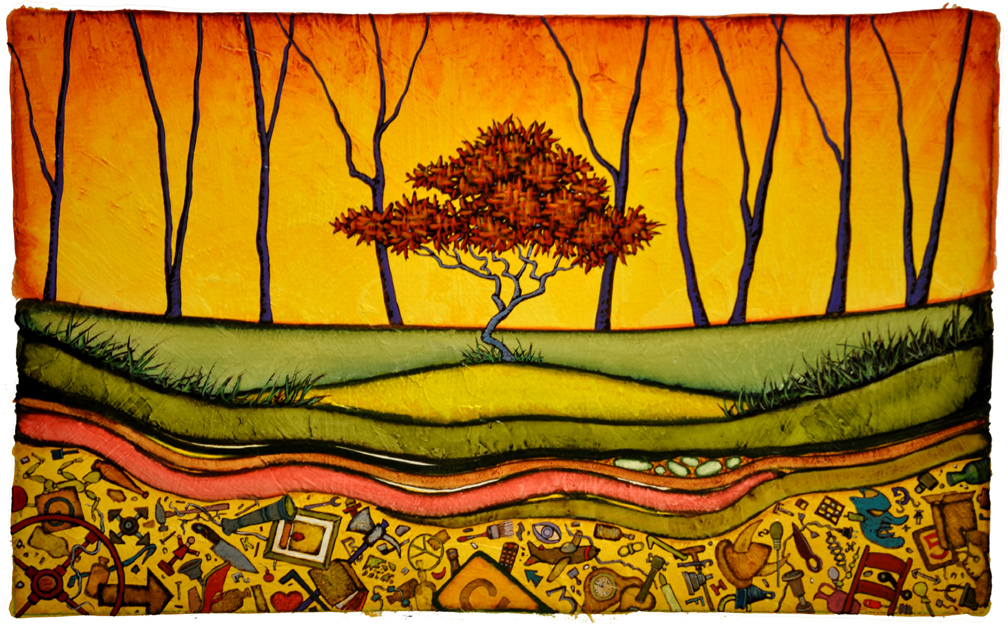
It’s one of a few pieces that will be in this show that are from the Strata series, which are similar to my Archaeology pieces but more focused on the patterns and colors of the underground layers and boulders rather than on artifacts.  I like this mix of the straight representation of the Red Tree in the top half  set against the organic and almost abstract forms of the lower half, giving it a striking visual contrast while still maintaining  harmony.

I normally don’t like to dwell on technique here but  this is also a little technically different from my typical work.  I normally work in one of two ways–in a  reductive manner, where the paint is applied very wet, in puddles,  then removed leaving a transparent and luminous surface or in a more traditional additive manner in which paint is applied in layers building from dark to light.  Usually one one process is used in a piece but the Strata series allows me to easily mix the methods which adds to the visual contrast between the upper and lowers segments.

As I continue to consider this piece, I thought I would play a song this Sunday morning that mentions time.  I thought I would play Time Is On My Side which was a big hit for the Rolling Stones in 1964.  I always assumed it was written by Jagger and Richards but it was actually a cover.  The song was written my Jerry Ragavoy under the pseudonym Norman Meade.  It was first recorded by jazz trombonist Kai Winding in 1963 with the only lyrics being Time is on my side sung by back-up singers Dionne Warwick and Cissy Houston.  It’s an interesting version that I am including below but I really wanted to focus on the version from the Soul Queen of New Orleans, Irma Thomas, which was released around the same time as the Stones’ version.  It has the added lyrics that most of us know and is just a dynamite performance.

Enjoy and have a great Sunday!

Read Full Post »

GC Myers Failed Painting detailThe image shown here is a tiny part, a background detail,  of a painting that I worked on for several days a month or so back.  I would show you the whole painting as it is at the moment, which is a canvas covered with black paint.  This little detail is the only part of this piece  that I feel comfortable showing and the only bit of it that you will ever see because this painting  just did not work.  At all.  It started wrong and over the days I worked on it continued to get even more wrong.  Even sitting here, looking at this detail, I am tempted to take a brush loaded with black paint to my computer screen to paint away the memory of its wrongness.

Just plain wrong.

It started as a much too concrete idea,  one that was too clever and too thought out.  I have always maintained that I am not smart enough to rely on my conscious brain to create ideas that can come alive and that my work is at its best when it flows from  intuition and reaction and feel.  This painting was surely proof of that.   I tried to force my brain into this painting in every way and it never took on any sort of organic feel, never had a rhythm, never came remotely to life.  I made dozens, maybe hundreds, of conscious decisions in this painting and it seemed as every one was wrong and made the whole thing a greater mess.

I knew within a day or so that it was futile, that this patient was dead on arrival.  But instead of rolling it into the morgue, I decided to try to bring it to life as though I were Dr. Frankenstein working over his poor monster.  This painting certainly resembled the Frankenstein monster– a good part here and there but stitched together crudely and an overall abomination.  It was as abject a failure as I had created in some time.

It was my monster.

I kept the beast around for several weeks and it became too painful to bear, seeing this tortured monster in the corner, more dead than alive.  I could have put it away to remind me of the folly of my own cleverness but I just wanted it gone,  all evidence of it erased.  So I broke out the brush and within moments it was but a memory.  Of course, I took a photo just in case I needed a reminder of  my own fallibility and failings.

I have quite a pile of such reminders, some more monstrous than others.

This monster was gone but it had taught me a lesson which was to keep the mind clear, to try to not force life where it has not taken hold on its own.  Trust the inner parts, my intuition and subconscious.  The life of a painting can’t be forced.   There is a natural rhythm needed that you can’t create.  You must find it and embellish it so that it becomes visible to others.  In this way, painting becomes less like the surgery of Dr. Frankenstein.

We know how that story ends.


Read Full Post »

GC Myers 1994 Early ReductiveWork6I have been spending a lot of time here in the studio in the last few weeks painting in a more traditional manner, what I call an additive style meaning that layers of paint are continually added , normally building from dark to light.  I’ve painted this way for many years but much of my work is painted in a much different manner where a lot of very wet paint is applied to a flat surface.  I then take off much of this paint, revealing the lightness of he underlying surface.  That’s a very simplified version of the process, one that has evolved and refined over the years,  that I, of course, refer to as being reductive.

When you’re self-taught, you can call things whatever you please.  I’m thinking of calling my brushes hairsticks from now on.

This reductive process is what continually prodded me ahead early on when I was just learning to express myself visually.  I went back recently and came across a very early group of these pieces, among the very first where I employed this process.  I am still attracted to these pieces, partly because of the nostalgia of seeing those things once again  that opened other doors for me.  But there was also a unity and continuity in the work that I found very appealing.  Each piece, while not very refined or tremendously strong alone, strengthened the group  as a whole.  I would have been hesitant to show most of these alone but together they feel so much more complete and unified.

This has made me look at these pieces in a different light, one where I found new respect for them. I think they are really symbolic of some of  what I consider strengths in my work, this sense of continuum and relativity from piece to piece.  It also brings me back to that early path and makes me consider if I should backtrack and walk that path again, now armed with twenty years of experience.  Something to consider.

GC Myers 1994 Early ReductiveWork 1 GC Myers 1994 Early ReductiveWork 3 GC Myers 1994 Early ReductiveWork 5 GC Myers 1994 Early ReductiveWork 2 GC Myers 1994 Early ReductiveWork 4

Read Full Post »

GC Myers- Steps to Solitude smMaybe I decided to use this image  because it was -8° when I headed out for my stroll through the woods to the studio.  Well, not really a stroll.  More like a hard determined march, trying to cut through the sharp cold as quickly as possible.  But as I glimpsed at the still dark sky,  Venus  was shining brightly just above the treeline, so much so that it caused me stop and just wonder at its brilliance.  To my eye it had a reddish glint that made it seem  like some exotic little gem in the sky.  Beautiful enough to stop me in my frozen tracks.

This brought to mind the upcoming  Little Gems show at the West End Gallery in Corning that opens next Friday,  February 7th.   I am currently prepping a group of paintings for this exhibit of small work which is always one of my favorite shows of my painting year and one that always brings back good memories.  As I have noted here in the past, the Little Gems show in 1995 was the first opportunity I had to show my work in public.

A first step on a then unknown path.

This will be my twentieth Little Gems show, something which would have seemed unfathomable back at that first show.  I don’t paint as many small pieces in recent years, spending more time on larger work, so this is always a great time to revisit the small form.  There is something  wonderful in seeing the colors and forms compressed into a smaller space, something that brings out the gem-like quality in each.  Each element, each mark takes on greater weight in the smaller form.  There’s a different type of concentration, one that is  quicker in its self-editing and one that is definitely more intuitive.  The sizes are such that everything just happens quicker and there is less time to ponder.

And that is often a good thing.   I’ve often said that I’m not smart enough to paint when I have to think about it.   Maybe these small pieces are  proof  of this.

**********************

This piece is called Steps to Solitude and is a compact 3″ by 6″ painting on paper.  It will be at the West End by the end of this week along with several other small pieces.

Read Full Post »

« Newer Posts - Older Posts »