Sometimes songs get stuck in my head for a long time and I find myself humming or singing them without thinking for many weeks. Sometimes it can be irritating when the song is one that begins to grate on my nerves but stays on because of a catchy melody or verse. But lately, there have been two songs that keep popping up quite unexpectedly, both early 70’s soul classics with positive messages that I find myself glad in having them stick around.
The first is Be Thankful for What You Got from William DeVaughn, who I guess would fall into the category of one-hit wonder. While it may seem to celebrate the gangsta lifestyle of Cadillacs and street-cruising, it’s message is that you don’t need material possessions to hold your head high if you can simply be thankful for what you got. A very simple message but one that holds true and strengthens through the infectious beat and chorus plus its Curtis Mayfield-like vocal stylings. This is an extended version with some great cool vibraphone work and a video of striking imagery.
The second is Ooh Child from the Five Stairsteps, a family band from Chicago that preceded the Jackson Five and was for a while the first family of soul. This song was a huge hit and has been covered by a number of artists. Another simple message that really resonates.
Have a great Sunday and be thankful for what you got…
My friends at WSKG sent me a video yesterday of a new , very short feature that they call a Web Extra , which can be also used on television as a sort of filler in the interval between scheduled programs. This particular one was taken from outtakes from the interview that took place for the segment featuring my work that appeared on their Artist Cafe program as well as on WNET’s MetroFocus in the Tri-State area. The actual interview had many things and subjects that didn’t make the final cut into the finished segment. This Web Extra features some of my thoughts on the Red Tree.
I came across these photos by Dutch artist Teun Hocks (b. 1947) which reminded me very much of the work of Robert and Shana ParkeHarrison, which I have featured here twice before. Actually, it was on this same day last year that I last featured them– perhaps I am looking for an alternate reality on this date as opposed to trying to relive in some way that morning twelve years ago. The ParkeHarrisons create elaborate but real backdrops against which they photograph their Everyman in allegorical scenes– there is no digital manipulation. It is more like the worlds created in the earliest days of cinema when what was seen had to made real in some way, even the most fantastic scenes.
Teun Hocks works in very much the same vein except that he creates a painted backdrop against which he photographs himself as the sometimes comical but deadpan Everyman. Think Buster Keaton here. He then creates oversize gelatin silver prints on which he paints in oils, treating his original photo as an underpainting. The result is a beautiful image with a painterly feel that is imbued with both humor and pathos. You can’t but help feel some sort of connection with Hooks’ character as he faces a sometimes puzzling reality. Don’t we all?
I’m showing just a handful of the work of this prolific artist here as well as a YouTube video showing a larger group. Hope you’ll enjoy this on this day.
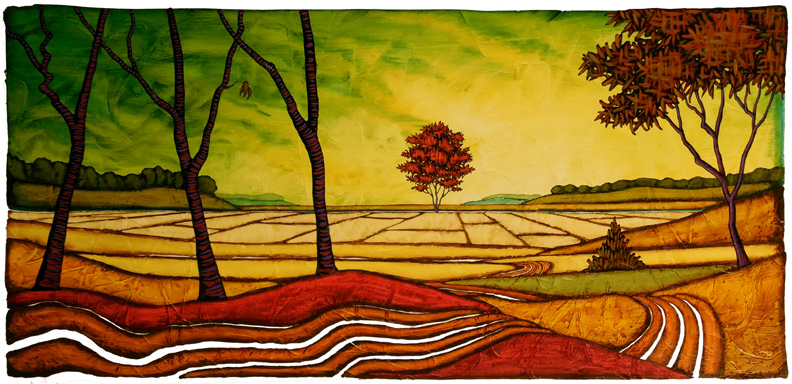
I usually take a small group of new work with me for the Gallery Talk I give each September at the Principle Gallery, which takes place this Saturday at the Alexandria gallery. It’s nice to have a few new pieces to illustrate some of the points I am trying to make during the talk. This is one of the new paintings that will be going with me, The New Revelator, a 16″ by 34″ piece on paper.
I’ve been finishing this piece over the last few days and it has underwent a dramatic transformation during the last stages, one that took it from a piece that was struggling to find its identity to one that has what I feel is a powerful presence. When I look at it I see the bands in the field that run towards the center as being not only a crop but as a representation of some sort of communal knowledge or power that runs through our world, unseen. The Red Tree stands at the center, joining this gathering knowledge with the greater power of the universe that I see represented here by the open horizon behind it. There is an ethereal quality in the descending hills, one that gives a feeling of movement through time especially when coupled with the breaking sky. The Red Tree is the new revelator here, exposing the hidden powers of the universe to those who want to see.
That might seem a bit of a stretch for some, as far as what they see in this painting. Again, I remind you that this is only what I see here, what this painting holds for me in an emotional sense. You might see it as simply a landscape with interesting forms and colors. That is good enough. Or you may not like it all which, too, is okay. Whatever the case, the painting stands as it now, hopefully revealing something for you.
The New Revelator will be at the Principle Gallery this Saturday. My Gallery Talk there starts at 1 PM and I will be in the gallery before and after if you would like to stop in and say hello.
For now, here’s an interesting version of the great old Blind Willie Johnson song, John the Revelator, from Nick Cave, who always seems to have a unique take on most things.
Yesterday I checked my blog with a search to see if I had ever written here before about that day’s subject, Long John Baldry. I found that I had only mentioned him once in a post from back in 2009. I read the older blog and it made me chuckle. It was titled You Can’t Judge a Book… from a song that Baldry had once covered and had to do with how our preconceptions are often wrong about people. It immediately brought to mind something that had happened over the weekend here at the studio.
My niece, Sarah, brought a friend and her husband to visit the studio from their NYC home. Sarah didn’t share much about her friend outside of saying that they danced together and that she was a filmmaker for one of the large big-name auction houses. I had no idea about what her husband did. That was the extent of my knowledge outside of knowing they had been married the year before in New Orleans. But they arrived and we had a wonderful visit. Both were charming and inquisitive, asking real questions and relating their own experiences in response to my answers. They made me feel comfortable in describing my work and process, not something that a lot of people can do easily. We visited for a couple of hours and they headed back to the city.
During our visit we learned a bit about the friend’s husband. I won’t use their names out of respect for their privacy. He was in the music business in some fashion. He was DJ and had spent a lot of time touring here and abroad. He also was working on soundtracking films. When I asked what sort of music he worked in, he said, in an almost apologetic way, that it was mainly rap and hip-hop. It struck me in a curious way. He went on to explain that it was the music of when and where he grew up, in the neighborhoods of NYC. Again, this was said in an apologetic manner.
I didn’t think much about until after they left and I decided to see if I could find out more about his music. He had a prodigious reputation in the rap genre, with over twenty years in the business as a DJ and producer for a pretty big name rapper. He ran his own newer record company and has released an album of his work only weeks before our meeting. I watched a couple of videos of his work and listened to several songs. I am not an authority on rap in any form but it was powerful stuff.
I was really impressed and thought back to his apologetic description of his work. I understood it then. He didn’t want to be judged and was trying to make it easy for me to not judge him. I mean, here I was, a middle-aged white guy with gray hair out in the country— not exactly a prime candidate for a hip-hop connoisseur. He had surely heard the venom directed toward his musical genre before from people who looked like me.
So, he judged me before I could judge him. I understood that. It’s what I would have done had I been in his place. My only regret is that it robbed me of an opportunity to ask the many questions that I formed in looking up his work after they had left the studio. It would have been fascinating to compare our creative processes, to see how he synthesized his influences. I got the impression from our talk that, though we worked in vastly different environments with disparate influences, we both working on a similar creative rhythm, expressing emotion within the framework of our own personal environments.
Well, the next time we will both know and won’t worry about judging one another. Here’s the original post from back in 2009:
I’ve just put the final details on a couple of paintings that will be part of my solo show at the Principle Gallery in Alexandria, VA. The show opens June 12th and I’m scheduled to deliver the work to the gallery a week before so I’m in the final stages of preparation. This is my tenth one-man show at the gallery and before that I did two shows as part of a group of painters from the Corning , NY area that was dubbed the Finger Lakes School.
I particularly remember one moment from the first show with that group. There was a pretty good crowd and several of us from the group mingled, answering questions and such. I had a small break in the conversation and I heard a female voice from behind ask her companion where we were from. Her friend answered that we were from the Finger Lakes region in New York. He said it was a pretty rural area with a lot of wineries and farms.
“Well, you know, they do look like farmers,” she replied.
I think I did a spit take. Over the years I often think back to that lady’s comment and sometimes laugh. Maybe we shouldn’t have all worn our overalls and straw hats that night. It just reminds me how people judge others by that initial glimpse and how often they end up being wrong. Actually, I’ve come to the conclusion that, in the end, I would prefer being mistaken for a farmer than an artist anyhow. Offhand, I can think of more positive attributes for the farmer. So, if you can make it to the opening look for the guy who looks like a farmer…
That brings me to a song, You Can’t Judge a Book, that was originally written by blues great Willie Dixon and made popular by Bo Diddley. My favorite version was from Long John Baldry, one of the pioneers of the British blues/rock movement in the early 60’s and a guy who had real panache, but I couldn’t find a version online. But while searching I came across an interesting jazzy version of the song from Ben Sidran. Give a listen and enjoy…
I love to watch the hands of guitarists or pianists when they are playing. Maybe it’s just a desirous envy for a talent and dexterity that I will never attain or maybe it’s just the particular rhythm of the two hands working to create this sound that has a harmony and life of its own. I don’t really know but whenever I see films of piano or guitar players I am mesmerized.
I saw Stevie Ray Vaughan at a show in Utica, NY back in 1986, I believe. It was a great show although the quality of the sound was not great, poorly mixed with a lot of distortion. From what I understand, this wasn’t uncommon for SRV shows. I just wish we had better seats to better see his playing hands.
I came across this video on YouTube of Stevie Ray Vaughan playing acoustically for a French interview from 1982. It’s shot in just the way I like, with the hands highlighted in a way that shows their syncopated dance. Just wish it were longer.
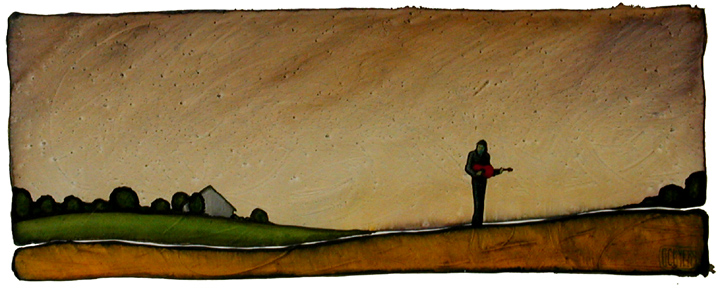
PS–The image at the top is an older oddity, an experiment from the mid-90’s, painted in watercolor and a Sharpie marker. The figure was a simplified and stylized representation of the way in which the figures from my early Exilesseries were painted, composed from blocks of color. It was never meant to be seen outside my studio but I like this for some reason …
I have been listening to my young friend Michael Mattice‘s debut CD, Comin’ Home, quite a bit lately. It’s been really well received, putting him regularly near the top of the “hot releases” in acoustic blues list from Amazon. The mp3 album has been as high as #18 on their top 100 and currently sits at #84 in acoustic blues. A really prodigious start for a self-produced album with no real promotion outside of the word of mouth created by Mike’s shows. Like I said here before, based not on sheer talent (of which he has loads) but on his devotion and drive, I see big things for him.
But the point of this is that listening to Mike brought me back to one of my first musical loves, the late blues great John Lee Hooker. Oh, I had favorite bands and songs but it was John Lee who I felt first spoke to me directly. I remember coming across an old beaten up copy of one of his albums from the 50’s when i was in my teens. It was a revelation, a sonic slap in the face with distorted electric wails coming from his guitar, all in a mesmerizing rhythm.
I didn’t know anything about the man at the time, didn’t know that he couldn’t read or his place in the history of the blues. Didn’t even know of his rebirth a few years before my finding his album as a result of the British Invasion of the 1960’s, when youngs Brits discovered and brought the music of the great bluesmen to the world’s attention, giving them new and greater fame than they had had in their primes.
None of that mattered. It was just the groove on that album that counted.
I found and listened to more of John Lee’s music over the years. I was intrigued by the constancy of much of it, the driving rhythm that is his signature which pervades most of his work. Some might call it repetition. I didn’t see it that way. It was all about nuance and subtle explorations within the form and performance. You know a John Lee Hooker song immediately but each is different and carries its own weight and emotion.
I carried that thought with me when I began painting and hoped that my work would operate in that same way. I wanted to have that repetitive quality so that the work would be easily identified as mine but to have the differentiation occur in the individual performance of the act of painting. By limiting what I painted I was able to go deeper into an exploration of the subtle aspects of the composition. They sometime looked similar but were often widely different in tone and emotion.
When it works I feel like John Lee Hooker must have when he was in his groove. One of my favorite lines from one of his albums, I believe it was a live set from Soledad Prison, was- “If you can’t dig this, you got a hole in your soul… and that ain’t good”
Here’s a video from the 60’s when he was in midst of being found by the youth around the world. It’s one of his trademark songs, Boom Boom.
Late addition: Here’s the song from Soledad Prison– Boogie Everywhere I Go. Be careful– it’s a deep groove.
One of my favorite songwriters is the late, enigmatic Harry Nilsson, who passed away in 1994. While he is somewhat still well known, it is probably not the same level of fame that his work deserves even though he achieved great fame and earned many accolades during his life. He recorded and wrote many hits, earned Grammy Awards, and cavorted with the biggest names in music. Lennon and McCartney named him as their favorite songwriter ( he also recorded an album and more with John Lennon) and Keith Moon and Mama Cass both died in his London flat. Yet how many twenty or thirty year-olds even recognize the name?
But there is still a great deal of interest in his music and life and there are those out there trying to let the world about the talent of this flawed man. This past month there was a release of a large box set spanning his career at RCA as well as a biography,Nilsson: The Life of a Singer-Songwriter, from author Alyn Shipton. Not to mention, a celebrated documentary from several years back, Who is Harry Nilsson (And Why Is Everybody Talkin’ About Him)? So, hopefully his work will stick around in the public eye a bit longer.
If you don’t know his name, you probably know the music. It is used extensively by filmmakers including this song, Jump Into the Fire, that was used in a pivotal scene in Goodfellas by Martin Scorsese. It’s a good song to pump up a dreary morning.
FYI, the painting at the top is an older piece of mine from back in 2001.
A Native American grandfather talking to his young grandson tells the boy he has two wolves inside of him struggling with each other. The first is the wolf of peace, love and kindness. The other wolf is fear, greed and hatred. Which wolf will win, grandfather? asks the young boy. Whichever one I feed, is the reply.
I came across the above, a short and often told story along with an illustration from artist Charles Frizzell, on the Facebook page called Hippie Peace Freaks. So simply put, it speaks of the dual natures that reside in each of us, that polarity that I often try to capture in my work. Our actions and choices form who we are and, hopefully, we opt to feed our peaceful wolves.
Here’s a video featuring the music of the great early bluesman Robert Johnson that also illustrates the point in a slightly different manner. In Me and the Devil Blues, his inner demon, his bad wolf, has taken a place beside him at all times.
In the aftermath of this latest show at the West End Gallery, I have been taking a small break from painting, instead trying to get some things done around my home and studio that have been put off while I was working. I have a real knack for putting off things that need to be done and there is a real backlog now of small projects waiting to be faced. Nothing big and nothing too testing, just normal maintenance things like cleaning up fallen trees around the property and the such.
I thought, while I was finishing up the show work, that puttering around with this maintenance work would be a relaxing break but I forget how ingrained my painting routine has become in me. Instead of relaxing, I find myself gathering anxiety about not having a brush in my hand, not working towards something. I don’t know how to feel about this and find myself conflicted.
In one moment, I view this inability to find relaxation beyond my work as a flaw, a symptom of a shallow or hollow nature. But in the next moment I am thankful for having found the ultimate soother in my work, to spend the greater part of my time doing that thing that gives me peace and brings me a sense of deep relaxation. Not to mention the meaning and joy it brings. I guess it comes down to me working to relax where most folks must leave work behind to feel at ease. This inversion of the norm is obviously the conflict, one that I am still struggling to reconcile even after fifteen years of doing this on a full-time basis. Maybe I will have it straightened out in my head in fifteen more.
Okay, enough of that. Here’s a little music, from around 1990, by one of my favorites, John Prine, singing his Speed of the Sound of Loneliness with Nanci Griffith.
 Sometimes songs get stuck in my head for a long time and I find myself humming or singing them without thinking for many weeks. Sometimes it can be irritating when the song is one that begins to grate on my nerves but stays on because of a catchy melody or verse. But lately, there have been two songs that keep popping up quite unexpectedly, both early 70’s soul classics with positive messages that I find myself glad in having them stick around.






 Redtree Times