I often stumble across the work of Alfred Kubin, an Austrian printmaker/illustrator/writer who lived from 1877 until 1959. It’s hard to look away from his imagery as much as it sometimes may make you wish to do so. His work is often associated with the Symbolist and Expressionist movements but it has an oddness that is distinctly its own.
Macabre and creepy may also describe it.
But it has an appeal that makes the imagery seem as though it is from a dream, familiar yet odd and distant, making you want to know the what and why of what you are seeing. As though it has some personal relevance and meaning for you.
There is not a large amount of info in his bio and his work is yet to claim universal acclaim. He lived his life in Austria, lived through both World Wars and during the second, even though his work was labeled degenerate art by the Nazi regime, was allowed to continue making art in the small 12th century castle that was his home for the last 50+ years of his life.
He also wrote a few things including a book, The Other Side, which seems to be the literary equivalent of his visual work. It is considered dark and prophetic, as it was written in 1909, of the coming World War and turmoil that would embroil Europe. It was said to be greatly admired by writer Franz Kafka, whose own work the book is often compared. I can see that comparison just in the visual images.
But like many from the past, Alfred Kubin is an artist you may not know. Nor may you like seeing his work. But it is compelling in many ways and I think you will want to at least take a look. Here’s a video of his work along with some of his images. Judge for yourself.
************
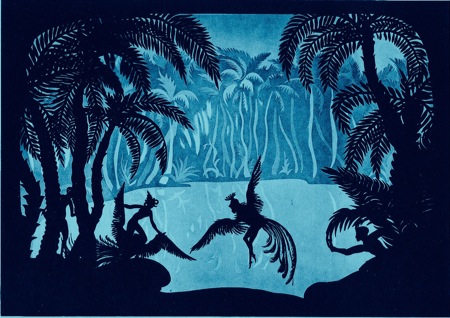
I wrote about Lotte Reiniger on this blog several years ago. In this world that is filled now with fantastic computer generated animations, her work still has the power to amaze me. The idea that this person armed with little more than a pair of sharp scissors and some paper could create these worlds of wonder is thrilling to me, an incredible manifestation of the creative vision. I thought I’d rerun the post from back in 2010 and add another of her films, Daumelinchen, from a bit later in her life. Made in 1955, it tells the story of Thumbelina. Take a look and try to remember that these are just papercut silhouettes.
***************
The Adventures of Prince Achmed (1926)
I first saw a film, The Adventures of Prince Achmed, from Lotte Reiniger several years ago in a series about early silent films. It was made in 1926 Germany and was one of the first animated films made. It’s a form of animation that Reiniger pioneered and mastered, based on Eastern shadow theatre. Using silhouette figures, each is painstakingly cut and hinged then filmed in small movements with time lapse photography to produce motion in the film. This film took three years to complete.
Lotte Reiniger At Work
In this telling of the Arabian Nights stories, I was immediately struck by the beauty and movement of the colors in the film. Each cell was tinted by hand to produce intense bursts of color that gave the film a gorgeous surreal quality. The movements of the figures in the film are smooth and natural, very subtle. I found myself so taken with watching the movements and changes that I found myself not following the story. But I didn’t care. It was beautiful to see and sparked the imagination.
Lotte Reiniger (1899-1981), born in Germany and living most of her post-WW II life in Britain, left quite a body of work from a career that spanned over 50 years, including one of the first film versions of Hugh Lofting’s Doctor Dolittle. She’s pretty much unknown in popular culture which is a great shame. Her work is marvelous and deserves to be seen.
I am kind of at ease this morning. It’s nice to not have any big obligations directly ahead of me after finishing yesterday’s Gallery Talk at the Principle Gallery. It lets me unwind from the anxiety that those kind of events create, the kind that is always there even though I try to appear at ease when speaking in front of groups of people. Fortunately, the folks who come to my talks are really good people who make it as easy as possible.
I want to thank everyone who came out on such a gorgeous day with so many other things going on to spend a little time with me at the talk. It was wonderful speaking with so many friends that I only get to see once in a great while and to meet so many new people. It was a good day all the way around and I hope everyone there felt that the time was spent well. I’ve said this before but their willingness to open themselves to me makes it easy to open myself up to them.
And that is a gift to me.
Speaking of gifts, of course, the highlight of the talk came at the end when I get to share a gift or two with them. I can’t explain how much pleasure I get out of this part of the talk. I’m sure other artists think I am crazy for giving away my work but the way I look at it is that it’s just a small pay back for all they have given me. Without their support, without their encouragement and interest through the decades, there is no telling where I would be or what I might be doing. Of if I would even be at all.
So, in my eyes I am playing with house money and just sharing a bit with my friends. Thank you so much to everyone at the talk yesterday and thanks to my good friends at the Principle Gallery– Michele, Clint, Pam, Taylor and Pierre– for allowing me to be a part of their wonderful gallery. I am so grateful–thank you.
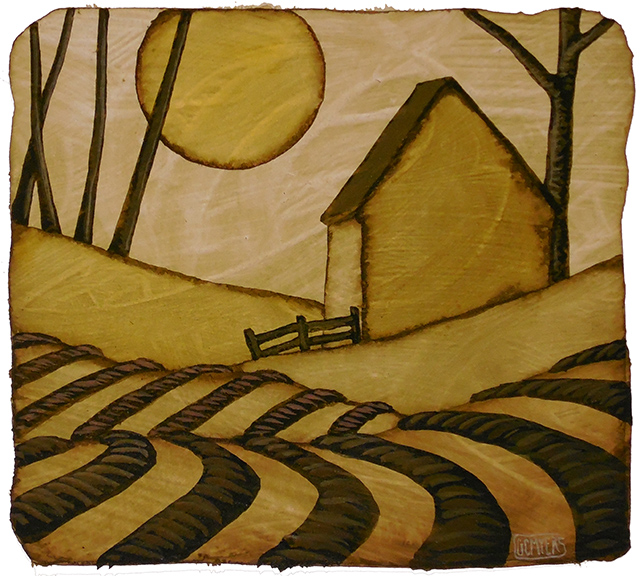
Now for this Sunday’s musical selection I was looking at the new painting above, Back in Time, and wanted an old song. While shuffling through older music I settled on the old folk tune, House of the Rising Sun. This version from the great Odetta came late in her life and delivers to the song great weight and grace. Just a great performance.
I would guess that I’ve said that phrase a couple of hundred thousand times in my life. Or maybe even a million times. But then again, I don’t know.
As years pass, I am constantly fascinated by how little I know despite consciously trying to obtain more knowledge. It turns out the only thing I really know is that there are an awful lot of things out there that I will never know.
That doesn’t make me happy but I have learned to live with it and take some comfort in knowing that I am not alone. I don’t think any of us really knows as much as we let on. Oh, some speak with absolute certainty and and an air of confidence but that’s just bravado or a simple failure to recognize their lack of knowledge. I do know that.
From personal experience, unfortunately.
So I cringe a bit now when I spot that arrogant certainty in the declarations coming from myself or others. Then I cast a doubtful eye towards these claims, my own included.
What does this have to do with the price of a gallon of milk in Kokomo? I don’t know. I’m just blabbing in order to set up this week’s Sunday morning music. It’s from the Irish singer Lisa Hannigan and is titled, fittingly, I Don’t Know. I particularly like this version shot in a Dingle pub. Lovely.
Have a good day and be wary of those who seem a bit too certain. Or not.
I am busy this morning and thought I would replay a post from several years ago. No reason except that I came across it yesterday and it really caught my eye again. The work of Arcimboldo always does. But I did add a video that shows more of his work so it’s really a replay plus. Take a look– I think you’ll like it.
****************
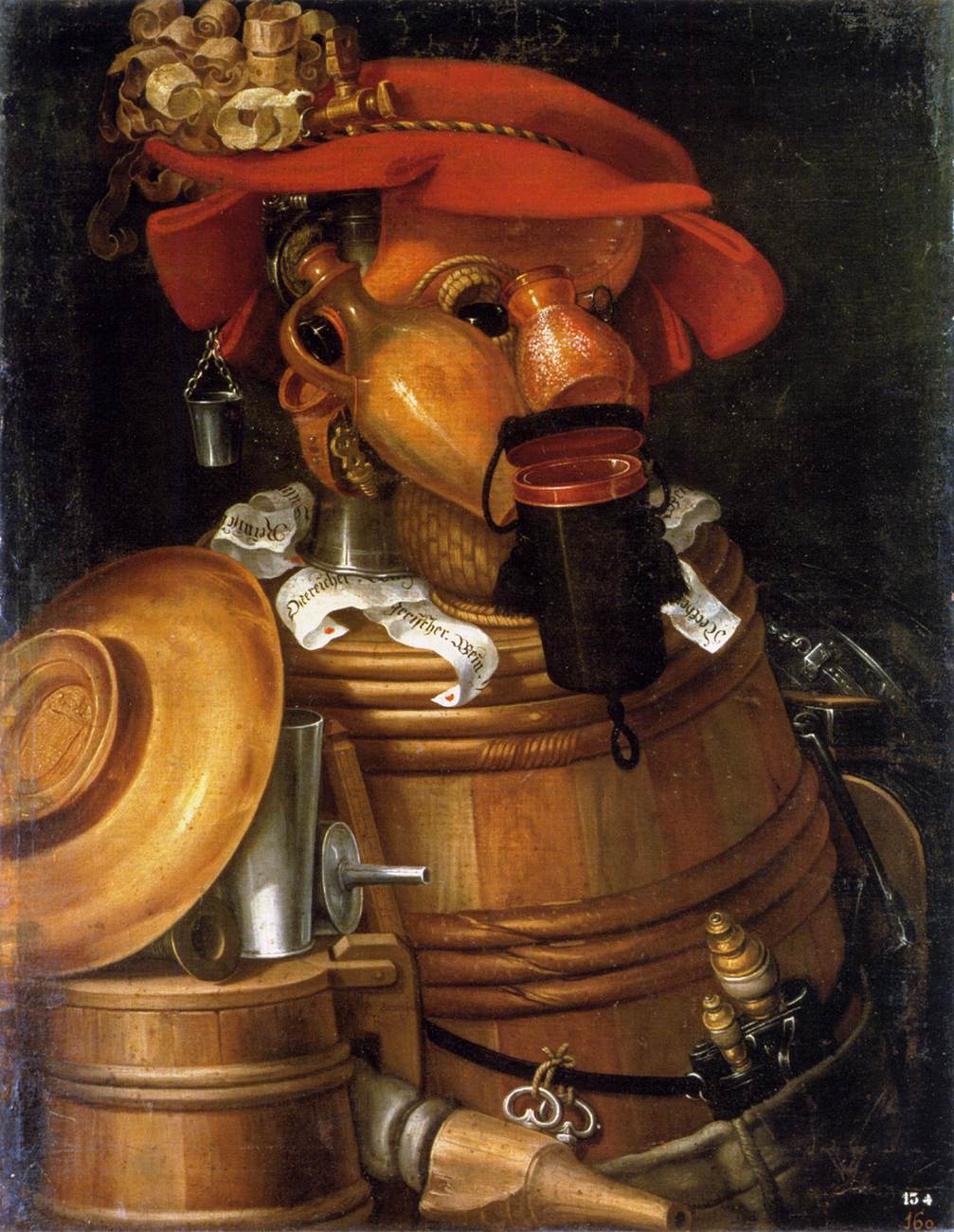
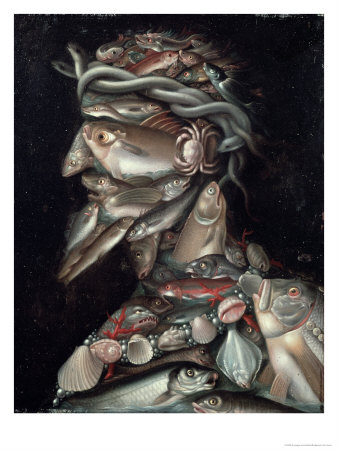
You don’t often think of work of art from an Italian Renaissance painter as being whimsical. Generally, they seem to focus on themes of religion and myth or on portraiture of wealthy patrons of the time, most beautifully painted. Then there is the work of Guiseppe Arcimboldo, who was born in Milan in 1527 and died there in 1593, although much of life was spent in the service of the Hapsburg courts of Vienna and Prague.
Arcimboldo was trained as stained glass designer and painter and initially worked in these fields in a traditional manner. Much of the work from this time has faded into oblivion, although there are examples of his windows and a fresco or two. However, it was his other work that gained him fame in his time and which has came through the ages as a constant source of fascination.
Arcimboldo- Winter 1573
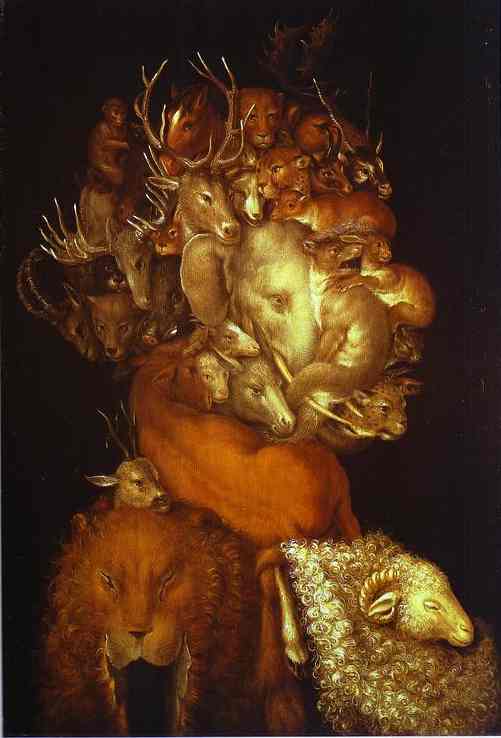
The other work was creating portraits, sometimes of his patrons such as the portrait at the top of Rudolf II, Holy Roman Emperor from 1576 until 1612 , that are composed using all sorts of objects to create the figure and features of the subject. He used fruits, vegetables, birds, books, fish and many other objects in creating these unusual figures. The final result was always striking, colorful and whimsically imaginative. And sometimes grotesque, even a bit spooky– I’m thinking here of a series of pieces that Arcimboldo created portraying the Winter season as a person, such as this example on the right, painted in 1573.
Arcimboldo’s work always brings a smile to my face while also stirring my interest in how he must have worked at the time and how he was perceived in that era. I am sure he was both admired and disliked for his unique work. Whatever the case, the work remains a fascination. I am showing several example here but you can go a site– Guiseppe Arcimboldo: The Complete Works— that features a broader view of his work. Very interesting.
Took a break from the outside world yesterday and finally got to see the film Maudie which is about the late Canadian folk artist and national treasure, Maud Lewis. Sally Hawkins lovingly portrays the artist and Ethan Hawke serves as her rough and surly husband. It is an absolutely charming and moving film, one that I would recommend to anyone who is interested in the creative drive.
Or in the human spirit.
It captures that compulsive drive that so many self taught artists, particularly folk artists, possess. It is an inherent need and desire to have a means of expression using whatever is at their disposal. Looking around my studio now, I feel spoiled beyond belief by the materials I have on hand. Or by the fact that I am relatively healthy and can hold a brush easily in my hands. Thinking about Maud makes me feel a little guilty for not using all my advantages and painting even more.
It is, simply put, a lovely film. In these dark days filled with stupidity and hatred, it is a breath of fresh air — cool Nova Scotian air!— to focus on that image of a arthritis-wracked little woman sitting in front of her humble window in her tiny remote cabin, happily painting the world as she saw it and as she wanted it to be.
You have most likely seen the work of Piet Mondrian, the Dutch painter who lived from 1872 until 1944.
Like the painting shown here. Seems so simple. Mainly black lines creating squares and rectangles that are mainly white but periodically filled with bright primary colors. Critics claim it is too simple, that it is something a grade-schooler with a ruler and some paints could replicate easily.
Maybe. Maybe not. Who cares?
But putting that side aside, his work has always remained refresh and modern through most of the last century up to this very minute. Outside of time, like it represents a future moment that exists just beyond this very moment at all times. And that factor in itself makes his work appealing to me.
I will never list Mondrian as a true influence or even a real favorite of mine, there is much to be gained as an artist from studying his work. The elegance of his structures and the space created within, for example. Or how he transformed his work through the years from a style of impressionistic realism into cubism and then into the style of his that we know so well, stripping away all detail and content down to the bare essence of being.
The video below shows that evolution beautifully, with musical accompaniment from Phillip Glass. I hope you’ll find it interesting to see how the work makes that transformation. Take a look below.
Let us note that art – even on an abstract level – has never been confined to ‘idea’; art has always been the ‘realized’ expression of equilibrium. -Piet Mondrian
Well, the work is all in place for my show, Self Determination, at the West End Gallery. I know that I put in the needed work for this show and feel that it comes through in the paintings, individually and as a group. It’s a selection of work of which I am proud. Hope you’ll agree.
The opening reception is set for this Friday beginning at 5 PM so if you’re in the Corning area, please stop in for a look. Maybe a glass of wine, a bite to eat, a little conversation and some great guitar music provided by my friend, William Groome, as well.
Hope to see you there.
Here’s a video preview I threw together just this morning. Take a look.
We’re in the Fourth of July weekend here but I am pretty busy, with still much to do to finish up work on my show, Self Determination, for the West End Gallery that opens in less than two weeks, on July 14.
I’m pretty locked in and didn’t even realize until just the other day that the holiday was approaching. I probably will work through the holiday but that doesn’t bother me. It’s my choice, my preference, my freedom to choose to do so.
Maybe that’s what the holiday is about, after all.
I was reading from David McCullough‘s book, 1776, earlier today. His description of our citizen soldiers at the onset of the American Revolution made me feel closer to that spirit of independence. He described them as unkempt and undisciplined, displaying little or no respect for taking orders from anyone but willing to work tremendously hard toward a goal.
I can identify with that.
I thought for this Sunday I would share another favorite song, one that contains some good advice for this divided nation on it’s most unifying of holidays. It’s Let’s Work Together from the seminal 60’s blues-boogie band, Canned Heat. Words to heed and a great rolling rhythm to carry you through the holiday.
I love this video from 1969 on a German music show of the time, Beat-Club. It’s kind of cheesy with bad angles and an audience that seems like they were instructed to under no circumstances show any reaction to the music. And the band is hardly the most photogenic. But it shows the band in its original glory, with lead sing Bob “Bear” Hite and guitarist Alan “Owl” Wilson, both of who died much too early, Wilson a year later in 1970 and Hite in 1981.
This past Tuesday marked the 90th birthday for the iconic Cyclone Rollercoaster at Coney Island. I have a single memory of that fabled old wooden rollercoaster, sitting in the couch-like red vinyl seats next to my dad as we hurtled through the Brooklyn sky. I thought I’d use this occasion to rerun a favorite post here along with a few more images and a video of the work of American painter, Reginald Marsh. Coney Island in the Swing Era was one of his favorite subjects so the music in the video- Sing, Sing, Sing — seems like a perfect fit.
Give a look and a listen and enjoy Mr. Marsh’s Coney Island.
************* I’m always intrigued by the paintings of Reginald Marsh, who painted scenes depicting the urban world of New York City throughout the early part of the 20th century until his death in 1954. His paintings always seemed densely packed with figures and constant movement, all rendered with easily recognizable line work and colors that were strong yet had a soft transparency. Striking.
One of his favorite subjects was Coney Island, the famous part of Brooklyn with its beach, boardwalk and amusement park. Whenever I see Marsh’s Coney Island paintings I am always reminded of the several trips I made there as a child in the late 1960’s. My parents and I would go to NY to see Mets’ games, leaving my older, busier siblings at home, and would sometimes go to Coney Island on the day when the games were at night.
It was always like entering an exotic, much different world than my country home. It was dirty with trash strewn everywhere. I remember the first time we swung into the parking lot at Astroland, the amusement park there, and thinking we’d entered a landfill as there were literally piles of paper and bottles over nearly the whole lot. If you spent much time in NY at that time, it was not an unusual sight.
But it was great fun and over the few visits there I had many memories that burned indelibly into my memory bank. My parents, and my aunt and uncle who sometimes were with us, would, after a while stop at one of the bars that opened to the boardwalk to have a cold one and I would wander alone. It was a wonderland of colorful attractions and games, their facades faded by time and sun. I have sharp images of a burned in memory of standing at one bar’s doorway and watching a singer all dressed in cowboy regalia standing on the bar with his electric guitar singing out country songs in the middle of the afternoon.
I remember seeing the crowds down on the beach and suddenly seeing everyone there pointing out to the water and yelling. Looking out, I saw two legs bobbing straight out of the water, almost comically so. The lifeguards rushed out and dragged the body in. Dead and, now that I think about it, had probably been so for a while.
I also remember going into a boardwalk arcade and approaching an older man with a gray moustache and a coin changer on his belt. I asked for change and handed him my dollar bill. He made a couple of clicks on the changer and poured a pile of nickels into my hands. As I turned to go the machines, he put his hand on my shoulder.
“Hold on!” he exclaimed in a thick accent that sounded Greek and a little angry to a terrified nine year old. He started chastising me.
“You don’t know me! Don’t ever trust anyone you don’t know. I give you money and you trust me and don’t count. You should not trust me. Now, count!”
I stood there petrified and counted out loud. It was the right change, of course, and the man’s gruff demeanor suddenly changed and he beamed a smile at me. “You understand? Now go. Have fun,” he said as he gave me a pat on the shoulder.
A little life lesson along with the change on the boardwalk in 1969.
That moment is clear as yesterday and it always reappears when I see images from Marsh or images of Coney Island.
 I often stumble across the work of Alfred Kubin, an Austrian printmaker/illustrator/writer who lived from 1877 until 1959. It’s hard to look away from his imagery as much as it sometimes may make you wish to do so. His work is often associated with the Symbolist and Expressionist movements but it has an oddness that is distinctly its own.









 You have most likely seen the work of Piet Mondrian, the Dutch painter who lived from 1872 until 1944.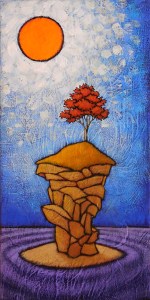
 We’re in the Fourth of July weekend here but I am pretty busy, with still much to do to finish up work on my show, Self Determination, for the West End Gallery that opens in less than two weeks, on July 14.
 I’m always intrigued by the paintings of Reginald Marsh, who painted scenes depicting the urban world of New York City throughout the early part of the 20th century until his death in 1954. His paintings always seemed densely packed with figures and constant movement, all rendered with easily recognizable line work and colors that were strong yet had a soft transparency. Striking.
 But it was great fun and over the few visits there I had many memories that burned indelibly into my memory bank. My parents, and my aunt and uncle who sometimes were with us, would, after a while stop at one of the bars that opened to the boardwalk to have a cold one and I would wander alone. It was a wonderland of colorful attractions and games, their facades faded by time and sun. I have sharp images of a burned in memory of standing at one bar’s doorway and watching a singer all dressed in cowboy regalia standing on the bar with his electric guitar singing out country songs in the middle of the afternoon.
  I remember seeing the crowds down on the beach and suddenly seeing everyone there pointing out to the water and yelling. Looking out, I saw two legs bobbing straight out of the water, almost comically so. The lifeguards rushed out and dragged the body in. Dead and, now that I think about it, had probably been so for a while.
 “Hold on!” he exclaimed in a thick accent that sounded Greek and a little angry to a terrified nine year old. He started chastising me.


 Redtree Times