Feeds:
Posts
Comments

**********************

“You must study the Masters but guard the original style that beats within your soul and put to sword those who would try to steal it.”

El Greco

**********************

These words from El Greco (1541-1614) certainly were reflected in the influence his work had down through the ages. Many artists through the ages have appropriated his compositions and rendered them in their own original styles. Picasso, for example, was influenced by the elongated figures of El Greco. His View of Toledo is considered one of the first paintings solely focused on landscape, as well as the first cityscape. Below, you might be able to see a connection between it and Van Gogh’s Starry Night.

For myself, in the painting here at the top, The Burial of the Count of Orgaz, a massive painting that is about fifteen foot tall, I was struck by the gold clad figures (St. Stephen and St. Augustine) at the bottom who are lowering the dead aristocrat into his tomb. The colors and positions of the figures had me seeing them as figures in a Gustav Klimt painting.

Looking at the detail below, I could see them as being influences on his The Kiss. I don’t know whether they were an influence, but it certainly jumped into my mind. If so, kudos to Klimt for translating it into his own original style that beats within his soul, as El Greco may have put it.

And that is what influence should be. It is not trying to replicate, to copy, another’s work. It is in taking it in and synthesizing it using one’s own unique voice. I think every artist does this in some form. You just may not immediately notice it in the very good ones.

Detail from “The Burial of the Count of Orgaz”
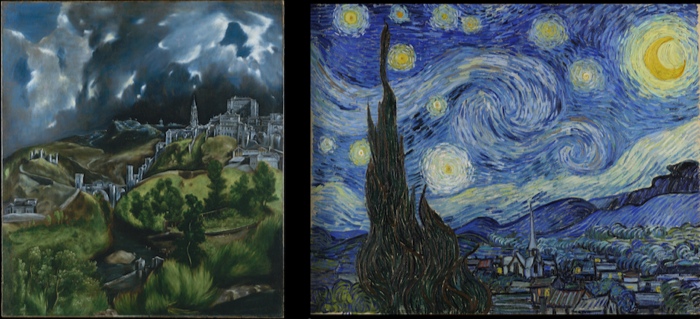
“View of Toledo” and “Starry Night”

I have a large painting on the easel I want to get to this morning. It’s at a point of transformation which is always exciting and just looking at it now, I am eager to see where it goes. But I wanted to share a post from back in 2012 about a painting done in 1997 or 1998 that has occupied an important place in my heart and mind for a long time. I think it’s a good example of the how an artist’s work often lives with the artist after it has found a new home.

****************************

I was going to write about something different but came across this older image and completely lost my train of thought, this piece replacing everything that I had been thinking. Some pieces have that effect. It’s a smaller painting, maybe 6″ square, that sold many years ago when I was first showing my work at the Principle Gallery in the mid-1990’s. Though not large, this painting has lived in a larger sense in my thoughts ever since.

It’s titled Beauty Scorned and is a relatively simple piece. But there’s something in the washed out quality of the colors and in the the bend of the twisting tree trunk that really speaks to me in a very poignant way, as though it is a pure physical expression of some deep emotion.

Beauty and sorrow.

For me, I see this as being about perceptions of beauty and acceptance. About how we often conform, like the other trees which are so much alike here, and step back from that which is different, seeing not the beauty in it but scorning it because it is unlike us.

The beauty is in its difference.

I remember when I did this piece, feeling that this was symbolic of my own work at that time. It was often quite different from the work of other painters with which I showed and I was still unsure of the validity of my own voice, often feeling that my work was somehow inferior because it wasn’t painted in the same manner, didn’t have the same look as these others. At the time, I felt like my work and my voice was truly tied to this twisting tree and those who dismissed it because it had a different look were missing the beauty and emotion that it may hold.

Just seeing it again summons all of these thoughts in a rush of feeling. It remains a potent piece for me for this reason. It also has a sad memory in it.  When I see this piece I am always reminded of the couple who purchased it and were avid and encouraging collectors that I always looked forward to seeing at shows. They had a knack for choosing work to which I was most keenly attached. This couple later divorced and the wife would still come to the shows, always so happy for and encouraging of my work. Tragically, she passed away in a plane crash this past year [2012] and now, instead of seeing the scorning of beauty in this piece as I once did, I now see the beauty of this young lady’s spirit.

It’s a different painting for me now but no less potent.

Walker Evans/Artist


Floyd and Lucille Burroughs; Walker Evans (American, 1903 – 1975); 1936


******************

Whether he is an artist or not, the photographer is a joyous sensualist, for the simple reason that the eye traffics in feelings, not in thoughts.

Walker Evans

******************

I am a big fan of the photos of Walker Evans. Some of my early Exiles paintings were inspired by his Depression era work, many of which were captured in a landmark book, Let Us Now Praise Famous Men,. Written by James Agee, the book is a document of the two men’s journey through the American south during that trying time.

I came across this quote from Evans and it made me appreciate his work even more. The idea that the eye traffics in feelings and not in thoughts is a simple one but it cuts right to the truth as any artist knows it to be. Art, whatever medium in which it takes place in, comes far before thought. It is that reaction, that feeling that hits you before your brain even begins to fully process what you are seeing that is the engine of art.

It is the feeling that bring on real thought afterwards. Allan artist can hope for their work.

I like seeing it put that way. And Mr. Evans certainly trafficked in feelings as the artist and joyous sensualist he was.

Here are just a tiny bit of his works.


Digital Photo File Name:DP264548.TIF
Online Publications Edited By Michelle Ma for TOAH 11_23_15


Three Farmers

*****************

I never made a person look bad. They do that themselves.

-August Sander

*****************


I came across a video this morning that I want to share. It is a PBS produced film called What This Photo Doesn’t Show and delves into the backstory and meaning of the photo shown here, Three Farmers on Their Way to a Dance, taken by the German photographer August Sander in 1914.

It’s an a provocative photo, one that provides plenty of material for one to create narratives in their imagination. So, to learn more about the young men and the story behind the photo adds an additional layer of interest.

August Sander (1876-1964) was considered the most important German photographer of the of the early 20th century. Sander was widely recognized for a collection of portfolios of his portraits taken over a couple of decades. Titled People of the 20th Century, it contained hundreds of his photos that documented a wide spectrum of the German people of that era, from the working classes to the more privileged classes to the homeless and forsaken.

He also produced a book in 1929, Face of Our Time, that contained a group of 60 of these portraits. Under the Nazi regime a few years later, this book was banned and the printing plates for it destroyed. He was allowed to continue working as a photographer but kept under the radar. His son, as a Socialist, was sentenced to ten years in a German prison, where he died in 1944, near the end of his sentence.

That same year, 1944, a bombing raid destroyed Sander’s studio, destroying many of his negatives. Two years later, an accidental fire destroyed the remaining archived negatives of his work. It was said there were around 40,000 negatives at that time. Sander basically stopped working as a photographer at that time until his death in 1964.

The August Sander Archive, even with the great loss of the fires, contains about 5000 photos and 11,000 negatives.

If you have about 9 minutes, take a look at this video. I think you’ll find it interesting and informative.


Watching the news and I can feel my blood pressure rising as I sense both my dread and rage. I am not going to vent here.

What’s the sense in that? You have eyes and ears. You’re witness to a new dark chapter being written in our history. If you read it as I do, you feel the same dread and anger. If you’re pleased with what is happening, then most likely you’re not reading this nor would my words mean anything to you as your version of what you believe is the truth no doubt diverges from my own.

Lately, I keep coming back to a passage from a 1995 book, The Demon-Haunted World: Science as a Candle in the Dark, from scientist Carl Sagan.  The book was a defense of science and rationality and an indictment of pseudo-science and religious extremism. He had a premonition for the future and it appears that the pattern he was seeing at that time is coming to bear now.

“Science is more than a body of knowledge; it is a way of thinking. I have a foreboding of an America in my children’s or grandchildren’s time — when the United States is a service and information economy; when nearly all the manufacturing industries have slipped away to other countries; when awesome technological powers are in the hands of a very few, and no one representing the public interest can even grasp the issues; when the people have lost the ability to set their own agendas or knowledgeably question those in authority; when, clutching our crystals and nervously consulting our horoscopes, our critical faculties in decline, unable to distinguish between what feels good and what’s true, we slide, almost without noticing, back into superstition and darkness.

The dumbing down of American is most evident in the slow decay of substantive content in the enormously influential media, the 30 second sound bites (now down to 10 seconds or less), lowest common denominator programming, credulous presentations on pseudoscience and superstition, but especially a kind of celebration of ignorance”

A celebration of ignorance.

That may be the defining term for this age.

I’m going to let you chew on that while I try to calm myself with a little music from a long time ago. It’s Itchycoo Park from the Small Faces in 1967. The frontman for the band at that time (pre-Rod Stewart) was Steve Marriott. Probably not a name many of you know but he was highly influential in the history of modern rock and roll. For example, Robert Plant was an ardent Marriott fan sometimes errand boy for the band. He and Led Zeppelin owe a lot to the stylings of Marriott, who died at the age of 44 in 1991.

Anyway, it’s a favorite song and one that eases my mind a bit on days like this. Give it a try for yourself.


**********************

A tree against the sky possesses the same interest, the same character, the same expression as the figure of a human.

Georges Rouault

**********************

Georges Rouault (1871- 1958) has been a favorite of mine for a long time and the quote above certainly falls in line with my own feelings about the image of a tree. I have used the tree, the Red Tree to be more exact, for the past twenty years as a surrogate for the human figure in my paintings. You could pretty much insert a human figure in place of the Red Tree in many paintings and not lose much of the emotional content of the painting.

It would be a different painting, that’s for sure. The presence of the figure would focus everything on the specific human aspects portrayed in it. Is it a man or a woman? A child? Tall or short? Thin or wide? The interpretation of the painting becomes much more narrowly defined.

Using the Red Tree, on the other hand, allows for a broader reading, allows the viewer to see it in whatever terms they desire. It can be their own surrogate in the landscape. Or it can take on the characteristics of someone with meaning for them or someone expressing feelings that they share.

Or it can simply be a tree.

So, while I like being able to give the viewer those choices,I see the trees in my work, as Rouault says, as having the same interest, the same character, the same expression as the figure of a human.

Wouldn’t have it any other way.

I’m On My Way

*************************

“The untold want, by life and land ne’er granted,

Now, Voyager, sail thou forth, to seek and find.”

Walt Whitman, Leaves of Grass

*************************

A little short on time this morning (what’s new?) but I wanted to share this new song from an upcoming album by a favorite of mine, Rhiannon Giddens. She has one of those voices that always seems absolute and powerful. A beautiful rarity. I felt that this particular song fit right in with the theme behind much of my work, especially in the line in its chorus :

Don’t know where I’m going but I know what to do

Does anyone really know what they’re looking for in this life? Just doing the right thing and being honest with ourselves is all we can do as we search.

So, give a listen and keep on seeking, folks. Have a great day.

*********
https://www.youtube.com/watch?v=a4Xlyi8Is98

***********************

Beauty is the only thing that time cannot harm. Philosophies fall away like sand, creeds follow one another, but what is beautiful is a joy for all seasons, a possession for all eternity.

Oscar Wilde

***********************

This is another new painting, a 24″ by 24″ canvas, slated to be part of my show, Redtree 20: New Growth, at the Principle Gallery, opening June 7.

I call this painting Meet Me in the Garden (At the End of the World). I know that sounds like an ominous title but I loved the way it came off the tongue with a rhythm that feels like it comes from a song. It works for me and I believe it aligns well with the painting and with the words above from Oscar Wilde.

Even though there might be nothing left to us but desolation and wilderness, even though our time here might seem at an end, beauty remains a constant.

It is a reminder of all that is meaningful in this world after everything else is stripped away.

It is our bond with both our humanity and whatever spiritual presence that might exist in the universe. To feel it, to be moved by beauty, is to be in communion with both.

Those who do not recognize or feel beauty, or deny beauty, live only partial lives, like half-filled glasses. I pity those people. They are missing the best part of this life.

Pontificating about something as subjective as beauty might be a lot to put out there before 7 AM and later in the day I may want to change these words in some way. But I believe, for the most part, that the greatest gift we receive as humans is to be emotionally moved by the beauty we witness in the world around us as well in the arts and literature we produce.

This painting reminds me that my time here is limited and being so, what better way should it end than when I am surrounded by the beautiful colors in a garden of flowers?

Got way too much stuff to get at it this morning to write. But I thought I’d share a post from back in 2010 that I like a lot. Take a look.

Southern Gardens- Paul Klee

I was asked yesterday if I talked to my paintings.

Interesting question.

I talk to animals. I talk to trees and plants. I talk to my car. I talk to my studio, which actually has a name. I talk to ghosts, present or not. Whether any of these things or beings listens is another matter.

But talk to my paintings?

It immediately brought to mind a section of a famous lecture that I had been reading recently and had really resonated with me. It was On Modern Art,  delivered in the 1920’s by Swiss artist and a personal favorite of mine Paul Klee:

May I use a simile, the simile of the tree? The artist has studied this world of variety and has, we may suppose, unobtrusively found his way in it. His sense of direction has brought order into the passing stream of image and experience. This sense of direction in nature and life, this branching and spreading array, I shall compare with the root of the tree.

From the root the sap flows to the artist, flows through him, flows to his eye. Thus he stands as the trunk of the tree. Battered and stirred by the strength of the flow, he guides the vision on into his work. As, in full view of the world, the crown of the tree unfolds and spreads in time and space, so with his work.

Nobody would affirm that the tree grows its crown in the image of its root. Between above and below can be no mirrored reflection. It is obvious that different functions expanding in different elements must produce divergences. But it is just the artist who at times is denied those departures from nature which his art demands. He has even been charged with incompetence and deliberate distortion.

And yet, standing at his appointed place, the trunk of the tree, he does nothing other than gather and pass on what comes to him from the depths. He neither serves nor rules–he transmits. His position is humble. And the beauty at the crown is not his own. He is merely a channel.

This very much sums up how I’ve always felt about art, especially my place as an artist– a mere channel or transmitter.  And when I look at my paintings, the crown of my tree, it is not in the form of a conversation so much as listening to what the paintings have to tell me. I paint because I question and, at best, the paintings provide some answers and insight that I might not find or see otherwise.

So, do I talk to my paintings? Not so much. But do they talk to me? Yes. And I do my best to listen…

.

***************************

“This is the most immediate fruit of exile, of uprooting: the prevalence of the unreal over the real. Everyone dreamed past and future dreams, of slavery and redemption, of improbable paradises, of equally mythical and improbable enemies; cosmic enemies, perverse and subtle, who pervade everything like the air.”

Primo Levi, If This Is a Man / The Truce

*****************************

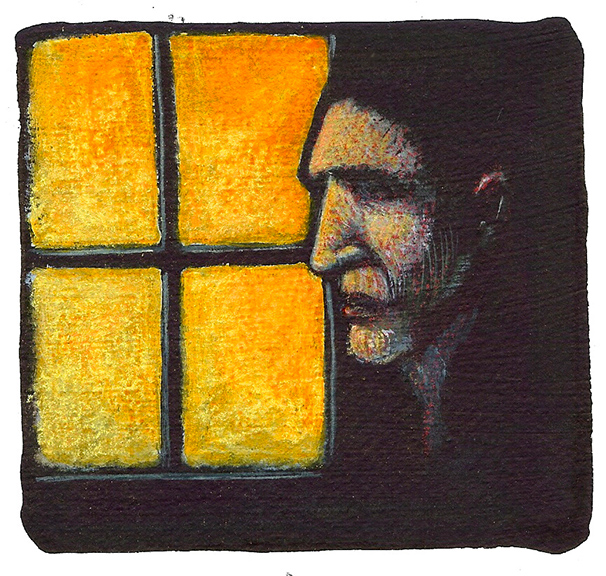
This small painting has been propped up on a bookshelf, unframed, here in the studio for over a decade. I have walked by it thousands of times, to the point that I barely even recognize that it is there. It was from the Outlaws series in 2008 and was one of the pieces that didn’t make it out of the studio. I just didn’t feel as strongly about it as the others in the series at the time, didn’t feel it carried the same emotional messaging.

But the other day I took it from the shelf and spent some time really looking at it and , all these years later, see much more in it now. It has its own story that I didn’t perceive before, maybe because it seems more like the characters from my Exiles series from 1995 than the Outlaws series of 2008. The Exiles were paintings that focused on loss and grief, of a looking back in time at what has been lost. The Outlaws, on the other hand, were about fear and vulnerability, the characters haunted by unseen pursuers.

The character in this painting seems like a hybrid of the two series, a person who has suffered loss and grief and is haunted by all that they have seen.

I originally saw this character as a male figure but looking at it now, I see it as being more female, one with close cropped dark hair, like it has been roughly shorn. I began seeing this as a survivor of atrocity, perhaps of a concentration camp. Someone who has seen horror and can never quite get far away from that memory.

The past for this person is like a ball that is thrown in the air, seemingly moving quickly away only to always coming rushing back down upon them.

The window here represents the past and the figure seems destined to always peer out at it.

It’s funny how the perception of a piece that I have basically ignored for a decade can change with one closer inspection. What seemed like a lesser piece at one point now seems much more powerful, more laden with meaning and emotion.

I think that when I painted this piece I was aiming for something other than what emerged and, as a result, I always viewed it from the perspective of my preconception. Now I am just viewing it as it is.

And my judgement of it is much different. I will never look at it with that indifference that existed for the past ten years. It now has meaning for me. I’ve even gave it a title: Window to the Past.

Glad I took the time to look again.