Feeds:
Posts
Comments

Midnight Rider

Been working on a few new small pieces for the upcoming Little Gems show at the West End Gallery, which opens February 8. As I’ve noted here before, the annual Little Gems show has special meaning for me. It was the first show in which I ever participated and served as a springboard to a career as an artist that I never anticipated. Without that first show, I have no idea what I might otherwise be doing at this time. Pretty sure it wouldn’t be writing this blog.

I usually try out some new things for this show or at least try to show some small oddities, pieces with themes or looks that may not find their way into my regular visual vocabulary. Such is the piece at the top, a 6″ by 6″ painting on panel that is called Midnight Rider, based on and using the lyrics from the classic Allman Brothers song from 1970. Little piece of trivia: This was the A side of a single with another classic, Whipping Post, as the B side.

I really enjoy working on these sort of pieces. It’s a different mindset from my normal painting and it has the effect of cleansing the palate. Or maybe it’s palette in this case. These pieces have been fun and freeing. How they fit into my regular body of work, I can’t say. Guess it doesn’t really matter because even though I will show these pieces, they are actually done mainly for myself.

For this Sunday morning music, the song is–surprise,surprise!- Midnight Rider. I am showing two versions. The first is from the late Sharon Jones and her Dap-Kings. It was produced for a Lincoln Mercury ad but that doesn’t take away from the strength of the performance. The second is from a performance from the also now-deceased Gregg Allman on the Cher variety TV show in 1975. It features a vintage dance performance from Cher, the kind of thing that was a regularly seen on the variety shows of that time. You don’t see much of this kind of stuff anymore– maybe for good reason. But it’s fun, in a weird kind of way.

Take a look and enjoy your Sunday.

***************

Common Ground

**************************

“Therefore, dear Sir, love your solitude and try to sing out with the pain it causes you. For those who are near you are far away… and this shows that the space around you is beginning to grow vast…. be happy about your growth, in which of course you can’t take anyone with you, and be gentle with those who stay behind; be confident and calm in front of them and don’t torment them with your doubts and don’t frighten them with your faith or joy, which they wouldn’t be able to comprehend. Seek out some simple and true feeling of what you have in common with them, which doesn’t necessarily have to alter when you yourself change again and again; when you see them, love life in a form that is not your own and be indulgent toward those who are growing old, who are afraid of the aloneness that you trust…. and don’t expect any understanding; but believe in a love that is being stored up for you like an inheritance, and have faith that in this love there is a strength and a blessing so large that you can travel as far as you wish without having to step outside it.”

― Rainer Maria Rilke, Letters to a Young Poet

**************************

I have always felt a companionship of sorts with the words of the Bohemian-Austrian poet Rainer Maria Rilke (1875-1926). I find the themes in his poetry and writings often echoing in the feelings and sensations of my own life.

Perhaps the piece of writing with which I feel the most connected is a series of letters he wrote between 1902 and 1908 to a young Army officer who was conflicted about the choice between pursuing a career either a military officer or a poet. The officer, Franz Xaver Kappus, released them as a book, Letters to a Young Poet, in 1929, three years after Rilke’s death from leukemia at the age of fifty one.

There is so much tremendous advice and guidance in his words that apply to anyone seeking a creative life. I have been mentoring a young artist as part of a program with a local arts organization and I only wish I could pass on a tiny fraction of Rilke’s advice to this artist. I had a very enjoyable talk with him the other day and while I believe there was some good advice given, it certainly didn’t approach the depth and breadth of that given by Rilke.

Take the bit at the top of the page, speaking of how to deal with the artist’s journey and growth. He describes the solitary nature of this journey, one that creates changes that sometimes take the artist mentally beyond and away from those people around him. That is the natural course for the artistic journey. In order to grow, the artist must be willing to seek and travel to places internally to which they cannot fully take or even properly describe to those around them.

This inner journey can be both a testing and a blessing. Finding common ground in which to live in this world with those around the artist is an important step in coping with this inner journey.

I didn’t mention that to the person I was mentoring. Maybe next time.

The painting at the top is from 2004 and is titled, appropriately, Common Ground. I definitely see the wise words from Rilke in this painting.

Beauty/ Rouault

**************************

In these gaudy times, we think we will shortly reach the point where everything is known, but the fact is we are ignoring the essential, which is love of all living things, of all beauty both visible and hidden.

–Georges Rouault (France, 1871- 1958)

**************************

Looking at the work of Georges Rouault, I am as excited by it now as when I first encountered it many years ago. It is fearlessly painted and brimming with the fervor with which he imbued all his work. It makes me want to do better, makes me want to make marks that are absolute expressions and proof of my being in this world.

Inspiring stuff, indeed.

Mo in the HOF

Yesterday one of my all-time favorite baseball players, Mariano Rivera, was elected to the the Baseball Hall of Fame in Cooperstown. He was the first player in the history of a hall of fame filled with legendary names to be elected unanimously. Every one of the voters recognized his ability and respected all that he contributed to the game. His stoic, respectful dominance is the ideal for lovers of the game. I know I sure miss seeing his number 42 running out of the outfield towards the mound. Here’s a post about Mo from back in 2011.

****************

I am a big fan of baseball. I classify myself as a Yankees fan currently but, though I revel in the rich history of the organization with names like Babe Ruth,Lou Gehrig, Joe Dimaggio, Yogi Berra, Mickey Mantle and on and on, it is the group of players that started their current run of success that made me fans of this team. Bernie Williams, Jose Posada, Andy Pettitte and, of course, Derek Jeter were constants over the last 15 years. All played significant roles in the restoring the Yankees to the top of the baseball heap.

But any fan who cares a lick about baseball knows that much of their success is due to one player, a rail thin man from Panama with the name Mariano Rivera, known to fans simply as Mo. Today he stands as the all-time leader in saves, meaning he is the pitcher who comes in at the ends of games when the outcome is in the balance and shuts down the threat from the other team. He is the closer, the most demanding position  in the game so far as absolute consistency is concerned. He either preserves the win or loses the game. No excuses accepted.

No one has been as consistent in protecting the lead for wins as Mo for the past 15 years, a remarkable time for a position where the strain and stress usually drains most closers after 7 or 8 years. Yankee fans have long felt the welcome comfort that comes with seeing number 42 come jogging through the outfield from the bullpen to enter the game. Even that number 42 is special.  Mariano will be the last player to wear the number since he is the last active player who was wearing number 42 at the time when Major League Baseball retired the number to honor Jackie Robinson.

Greener Pastures: 42

It’s hard to explain to non-baseball fans what Mo has meant to the Yankees and to baseball in general. He has carried himself for these years with great modesty and dignity, never showing up an opponent. On the mound, he has the appearance of the old gunfighter in the movie westerns of years gone by– wary but calm and collected, knowing that he must control his emotions to do what he must do. When the game is over, there are no histrionics, no yelling or posing or excessive fistpumps. He expects his success and usually flashes a small and sometimes sheepish grin as his teammates congratulate him.

It’s an attitude that has won him great respect around the game. Yesterday, when he broke the record, the Minnesota Twins, who came up short against Mo in this game, stayed after the game and gathered on the dugout steps to join the Yankee faithful in applauding the embarrassed star as he stood alone on the field. Even diehard Red Sox fans, who boo Jeter like he killed their mother, often give Mo a hearty cheer when he is announced at post-season or All Star games. [Note: When Mo retired in 2013, Red Sox fans gave him a long and loud standing ovation on his last appearance at Fenway]

He is a man of respect, both giving and receiving, a quality that hopefully will rub off on younger players.

Mo’s 41 years old and when he takes off his cap his scalp is bald now. He shows his age a bit but still performs at the highest level. As a fan I know there will not be many more times when number 42 calms the anxious Yankee fans as he jogs across the outfield toward the mound. I relish every appearance now, knowing that I am watching a legend, a player who will be talked about in the same breath with Ruth and Gehrig.

Deservedly so.

We live in a time of chaos and confusion, amidst a constant bombardment of information and misinformation, an indecipherable babble of yelled opinions and enough stupidity to fill all the oceans and flood every coastline of this planet.

And that’s on a good day.

This morning I found myself longing for something, some music or reading, that would take me away from this maelstrom of madness. I came to the music of the Estonian composer Arvo Pärt whose piece Tabula Rasa was a big influence on my early work.

His work is the antidote to the turbulence of our time. It is what I would call slow music. It is the sort of music that requires you to pause to hear it fully. Doing so slows down the elevated heartbeat, syncs it to a pace that seems to be a meditative drone that has long resided in us though we have long forgotten our ability to find it within ourselves.

For quite some time I have enjoyed Pärt’s adaptation of My Heart’s in the Highlands, which is a 1789 poem/song from the Scottish poet Robert Burns. Listening to it reminds me of the time spent alone wandering in the woods and fields in the hills around our home as a youth. Those times had that same pace, that same heartbeat and silence that made it so memorable in my mind.

Many times I have found my mind wandering back to those times and the spaces and silences that created a sense of home within me. Burns’ words speak a truth for me especially in these times so filled with sound and fury.

Allow yourself to pause for a moment and give a listen. Perhaps you will find your own heart in the highlands…

My heart’s in the Highlands, my heart is not here,

My heart’s in the Highlands a-chasing the deer –

A-chasing the wild deer, and following the roe;

My heart’s in the Highlands, wherever I go.

Farewell to the Highlands, farewell to the North

The birth place of Valour, the country of Worth;

Wherever I wander, wherever I rove,

The hills of the Highlands forever I love.

Farewell to the mountains high cover’d with snow;

 Farewell to the straths and green valleys below;  

Farewell to the forrests and wild-hanging woods;

Farwell to the torrents and loud-pouring floods.

My heart’s in the Highlands, my heart is not here,

My heart’s in the Highlands a-chasing the deer

Chasing the wild deer, and following the roe;

My heart’s in the Highlands, wherever I go.

Ben Shahn

Ben Shahn -Jersey Homesteads (Roosevelt NJ) Mural

********************

The artist must operate on the assumption that the public consists in the highest order of individual; that he is civilized, cultured, and highly sensitive both to emotional and intellectual contexts. And while the whole public most certainly does not consist in that sort of individual, still the tendency of art is to create such a public – to lift the level of perceptivity, to increase and enrich the average individual’s store of values… I believe that it is in a certain devotion to concepts of truth that we discover values.

–Ben Shahn

********************

Born in Lithuania in 1898, Ben Shahn emigrated to America with his family in 1906. Throughout his career, up until his death in 1969, Shahn’s early training as a lithographer and graphic designer played a large part in his work, giving it a symbolic visual impact that made him one of he leading lights of social realist artists. His work often dealt with the human condition, particularly that of the common man.

Ben Shahn- The Passion of Sacco and Vanzetti

While many of the themes in his work were labeled as leftist, his work championed civil rights and workers’ rights and stood against injustice and prejudice. He did a large series of works devoted to Sacco and Vanzetti. Designed to communicate a distinctly human point of view, his work always had a profound voice, one that called for the betterment of all people.

His was the work of the Everyman.

As he said: The natural reaction of the artist will be strongly towards bringing man back into focus as the center of importance.

I think that is a very important thing to keep in mind as is the quote at the top of the post, about how an artist must aspire to the highest human values of the public, even though they may not actually possess these qualities, with the hope that the artist’s work can lift them to a higher level. It’s a thought that should linger in the mind of any artist who hopes and desires to make a true difference in this world with their work.

I am not giving a lot of details here about the life and career of Shahn. But I hope the few that I have shared along with some of his images will inspire you to take a closer look at this interesting and important voice in modern art.

Ben Shahn- Father and Child 1946

Ben Shahn- The Burial Society

Ben Shahn- Nocturne

Ben Shahn- Four Piece Orchestra 1944

Ben Shahn- Self Portrait Among Churchgoers

Ben Shahn- Two Witnesses

Ben Shahn- Unemployment


Valley of Tears

Snowing like made still. Been out plowing for a couple of hours already this morning, just trying to keep the driveway open, and there is definitely a few more hours of plowing ahead. But I thought I’d take a break, drink some coffee and try to throw out some music for a snowy Sunday morning.

Came up with an old song, Valley of Tears, written and performed originally in 1957 by Fats Domino and covered by a number of other artists over the years. Buddy Holly did a version that charted in 1961 that had a skating rink/ magic organ quality to it but I really like this version from the late great Solomon Burke accompanied by one of my favorites, Gillian Welch, and her husband David Rawlings.

Solomon Burke was one of the early greats in the transition period between R&B and Soul. He was a real preacher and blended the spiritual and the physical aspects of soul– the sex and the salvation– into his music. He never got the acclaim as some of the other big names of 60’s Soul but he is is revered.

This is a great, heartfelt performance of the song. Give a listen while I get back to my own valley of tears. If you consider the falling snow tears, that is. Have a good day.


The American poet Mary Oliver died yesterday at the age of 83. I can’t claim to know much about poetry but I always found her work engaging and enlightening. There was a plain-spoken quality to her work that gave her musings the feel and clarity of newfound wisdom. She is gone but her voice will carry on. Here’s a post from a couple of years ago that was about the relationship of a painting of mine to one of her better known poems, Wild Geese.

**********************

GC Myers- The Singular HeartYou do not have to be good.
You do not have to walk on your knees
For a hundred miles through the desert, repenting.
You only have to let the soft animal of your body
love what it loves.
Tell me about your despair, yours, and I will tell you mine.
Meanwhile the world goes on.
Meanwhile the sun and the clear pebbles of the rain
are moving across the landscapes,
over the prairies and the deep trees,
the mountains and the rivers.
Meanwhile the wild geese, high in the clean blue air,
are heading home again.
Whoever you are, no matter how lonely,
the world offers itself to your imagination,
calls to you like the wild geese, harsh and exciting —
over and over announcing your place
in the family of things.

Mary Oliver

****************

A while back, a person interested in my work sent me the poem above, Wild Geese.  It was written by the esteemed Pulitzer Prize winning poet Mary Oliver. This person wanted to know if I would be interested in translating this poem into into one of my paintings for them. I replied that when I had some time I would gladly do that as I think the poem strikes a chord that very much resonates in my work.

After a short while, this person contacted me again and said they had been looking at my work and had found a painting that they felt captured the spirit of the poem. The painting is the one shown at the top, The Singular Heart.

I was thrilled by the choice. It had the feeling and message of the poem without being absolutely literal.  It’s exactly how I wanted to portray it. And the message and title of the painting fell perfectly in line with Oliver’s poem.  The Red Tree stands, singular and alone, with the realization that it has a unique place, as does every being, in the family of things.

I told this person a bit about this painting and an experience I had with it that stuck with me.  Once it hung in my home area gallery, the West End Gallery, and I met with a local college art class there. One of the questions was which of the pieces there was my favorite. I normally don’t answer that question because I have always felt that any painting that I decide to show has something unique to it, some quality that makes it special to me. Kind of like a parent with their kids.

But on this occasion I didn’t hesitate and pointed at this painting.  I told them if I were to try to describe in one painting what I wanted to say with the body of my work and what I hoped for myself as a person, that this piece would summarize it perfectly.

I told this person that I felt it was perfect choice and was pleased when they chose this painting to represent the poem in their home. It means a lot when any painting finds a home but is even more special when I know that it resonates on many levels with its owner, that it goes deeper than the surface.

Here’s a clip of Mary Oliver reading her poem, Wild Geese:

Emily Carr/ Essence

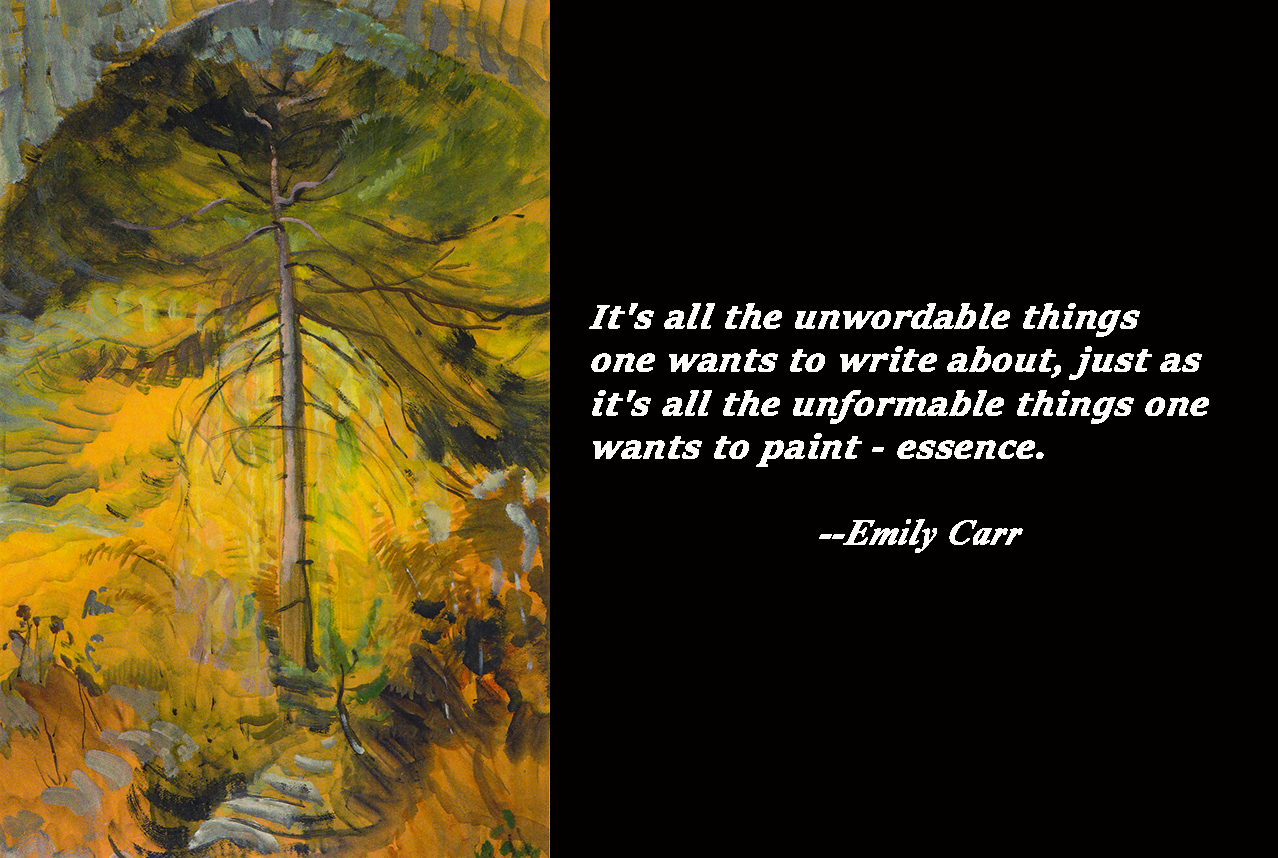
When I read the line above taken from the journal of the great Canadian artist Emily Carr (1871-1945), it really hit close to the bone for me. I thought about my early forays in my youth when I believed I wanted to be a writer.

I loved the words and their power, their ability to create emotion and reaction in the mind of the reader. But I cared little about creating narrative, about the details, the nuts and bolts, involved in storytelling. It was the essence of things that interested me, the atmospheres of silence and distance and empty space.

It was all too heady for an uneducated and inexperienced kid. I didn’t know what to do with writing that evolved into what seemed to be ethereal nothingness. More and more, it became a frustrating exercise.

And I think that is where painting came in for me, at a time when I truly needed it. I found that painting, especially landscape painting, was less about narrative and more about that essence, about capturing moments of atmosphere and perceived emotion and spirit.

The unwordable and the unformable, as Emily Carr put it.

I definitely see this evocation of essence in the work of Emily Carr and can only hope to find the same in my own.


Number 20

My annual show at the Principle Gallery in Alexandria, Virginia, opens on Friday, June 7th. This year is my 20th solo show there, something that seemed out of the realm of possibility when this run began with the first Redtree show back in 2000.

Nothing seemed guaranteed at that time.

I was still a fairly new artist at that point, showing my work publicly for barely five years with the last two years as a full-time artist. Still had that new artist smell. I understood that the Principle Gallery was taking a chance on me and that this show was a great opportunity for me as an artist. Solo shows in great galleries don’t just come to artists on an everyday basis and the success or failure of such a show could dictate how my career moved on from that point. I knew that all too well.

I remember my trepidation in the months before that first show as I prepared for it. I was operating in abject fear of my own failure was having trouble visualizing what success this show would even resemble. My final goal for the show ended up being that I simply hoped to not be embarrassed.

Fortunately, it turned out to be very successful. That led to the next year and the next and so forth. There have been varying degrees of success with the shows along the way but one thing that seldom changes is the absolute fear of failure that comes with each show. So, here I am, twenty years in, and still feeling that same ball of anxiety in my gut. If anything, it might even be worse because I see this as a personal landmark of sorts. I want it to be a show worthy of twenty years invested by the gallery.

I’ve been looking at some of he work from those earliest Principle Gallery shows, trying to see similarities and differences between the work then and now. To see how it has changed, to see what has been gained and lost. One that struck me this morning was the piece above from 2001 called Symphony to Joy. It’s a piece with what I would term great organic appeal. I mean that it in the sense given by the linework within the piece and the way the colors and forms play off one another. It just seems very natural.

Maybe I shouldn’t try to explain such things.

But what I am looking at is how I can regain that natural feel, that organic sense present in the painting. Twenty years of painting have straightened some lines, taken some spontaneity out of some color choices, and softened some rough edges. Experience and knowledge has taken the place of the urgency of the pure emotion found in these early pieces.

I sit here this morning anxiously wondering how to find a way to merge the experience with that emotional urgency. Hope I can figure it out before June 7th.