I think the best we can achieve is asking questions about the world in which we live because I think accepting the world as it is and so on is just impossible. Finding the right answer, maybe finding some directions towards some answers is the most we can dream of.
— Samuel Bak
++++++++++++
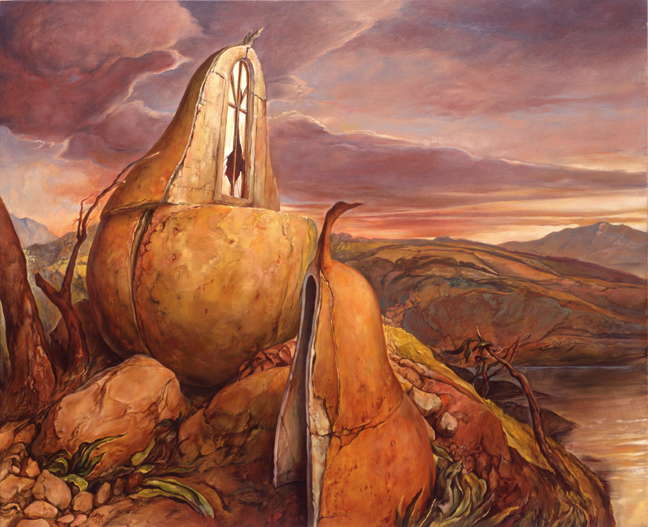
I came across the work of Samuel Bak about twenty years ago, at the Pucker Gallery in Boston. It was easy for me to be drawn into his work. It was strongly symbolic and densely painted with deep, dark colors. It was easy to see that there was nothing trivial about it.
It had weight.
I discovered that Samuel Bak, who has resided in the United States since 1993, was born in Poland in 1933. From an early age his artistic talent was obvious. His family was Jewish and spent much of World war II in the ghetto of Wilno (where he had his first exhibit of his work at the age of nine) before being sent with his mother to a labor camp. They were able to flee and take shelter in a convent where they remained until the end of the war. At that time, only he and his mother survived from an extensive family.
He and his mother spent three years in a Displaced Persons camp in Germany before moving to Israel in 1948. He lived there until his move to the US in 1993.
I have followed his work for the past couple of decades and it almost always has the weight that I first saw in it.
It feels like it is filled with the memory of all memories.
I thought today would be a good day to share his work.
We have become more and more numbed to the cascade of horrors that seem to take place on a regular basis here. But this week seemed worse than most, marked by dark and deadly deeds around this country. These acts were not done by 9 year old Honduran girls struggling on a highway 1000 miles away. Nor were they done by women who protested the Kavanaugh nomination nor blacks who demanded justice in the legal system. Nor was it football players kneeling on the sidelines during the National Anthem.
No, these were done by white men based on irrational prejudices and hatreds which allowed them to frame themselves as somehow being victims.
This week:
Two black adults were shot down in a Kentucky supermarket. The killer had attempted to enter a predominately black church just before he came to the supermarket. Fortunately, its doors were locked.
Early in the week, multiple pipe bombs were sent around the country to mainly political leaders who had spoken out against the actions of this administration. The man responsible was a fanatic follower of the president who attended his rallies and adorned his van with all sorts of right wing propaganda memes, including pictures of many of his targets with the cross-hairs of a gun superimposed over them. He was a rabid defender of the president* on social media.
Then yesterday, horror of horrors. Eleven Jewish congregants were killed by a gunman in The Tree of Life synagogue in the Pittsburgh neighborhood that Mr. Rogers called home. 6 other people, including 4 police officers, were also wounded by the man who had a history of hate speech in his social media accounts. In our long and bloody history, this was the deadliest shooting of Jews in America.
And in the midst of this horrible week, we had a president* who proudly proclaimed himself to be a nationalist at a rally. The term nationalist is most often associated with groups that believe in and demand a purely white racial identity for one’s country. They view all other races as being inferior, as being threats to their place in the social hierarchy. Undeserving takers.
They see themselves as victims and these others as scapegoats on which responsibility for most any problem can be heaped. While they believe that nationalism is a term of strength, it is actually a term of weakness, of a culture of seeing oneself as victim.
This is well known information, not obscure in any way. When he used that term, when he glorified that word, he knew what he was doing. He knew what triggers he was pulling among his base.
And if his ignorance is genuine, he is unfit to be in the office.
Regular readers know where I stand on that subject.
There is no coming together moment in sight nor do these nationalists desire that. This nationalist president* continues to shamelessly spew a steady stream of incitement and an ever increasing litany of lies even as these tragic events unfold. He continues to portray himself as a victim even as he falsely poses as a strongman. He simply does not have the ability or the desire to unite this country.
And those who helped him get to this point– the moneyed interests and congress– are too invested, too implicated, and too morally weak to stem this tide of division. They will offer thoughts and prayers but nothing more.
Nothing.
The events that took place this week feel as though they could be the starting point for a new period of even greater horrors to come. At this point, our only recourse is to vote for a sweeping change in the government. That is the only chance we have to change the course on which we have been set.
It might well be our last chance.
Vote for change. If we don’t, the blood will be on all our hands.
Okay, this Sunday morning music is The Weight from The Band and The Staples Singers taken from the film The Last Waltz, directed by Martin Scorsese. Have a quiet Sunday and take a few moments from your day to think about those lives lost in Kentucky and Pittsburgh. And remember, you still have the power to change this.
A few weeks ago I noticed a deer– a doe– laying down, tucked back in a group of mixed pines that are at the edge of the driveway in front of my studio. Something seemed amiss here. Too still and not looking back at me when I stopped walking to gaze in at it.
Moving closer I discovered that it was dead. There were no obvious wounds which was my first thought. Bow hunting season had opened recently and perhaps she had been hit and made it to this spot. But looking closer there were a couple of scrapes around her face and neck. Most likely she had been hit by a car and found her way to this quiet little glade to succumb.
There are worse places to die.
I’ve watched many groups of deer around my studio over the past decade and have witnessed many of them grow up in this comfortable safe space. I watch them playfully bounce around, often running crazily in circles around the studio. I watch them graze at the grass and undergrowth. Watch them sleep out in the lawn. Watch the males test their strength with their new antlers. One even sleeps up next to the foundation wall behind the scraggly hedges at the front of the studio.
I appreciate their struggle to live as a wild creature among humans. It’s hard enough for those of us who are somewhat human. And while I understand the place of death in the cycle of life, seeing this poor dead doe made me sad.
It also made me wonder if I should do anything with her body. It was pretty close to the studio and I worried that it might create an odor. I’ve been around enough of that stench of death to know I didn’t want to wallow in it for an extended period. Maybe I should get a bag of lime? Bury it?
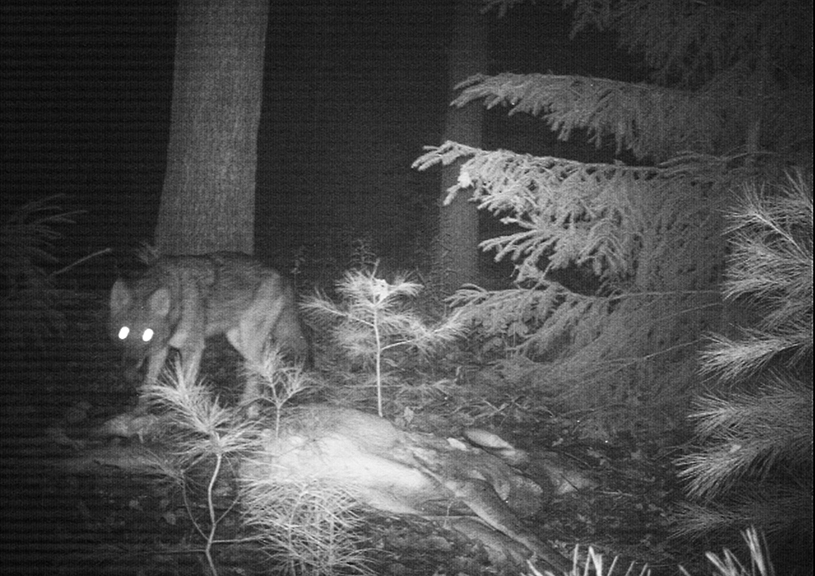
In the end I left it where it was. A day passed before I set up a trail cam to capture whatever came to visit.The carcass had been moved a bit and the rear haunch had been eaten at. The belly was open now and the organs exposed. The camera was setup and revealed a few visitors. But only a few. Less than I had anticipated.
The first two nights brought a single coyote who ate a bit at the rear haunch. Most likely it was the one who had moved the carcass.
The third day brought a couple of crows who worked at a spot behind the front leg. At this point, the open belly was writhing mass of maggots along with an army of beetles that ran to and from the body, grabbing bits of it disappearing under leaves with their precious cargo. I did not take pictures of the maggots or the beetles.
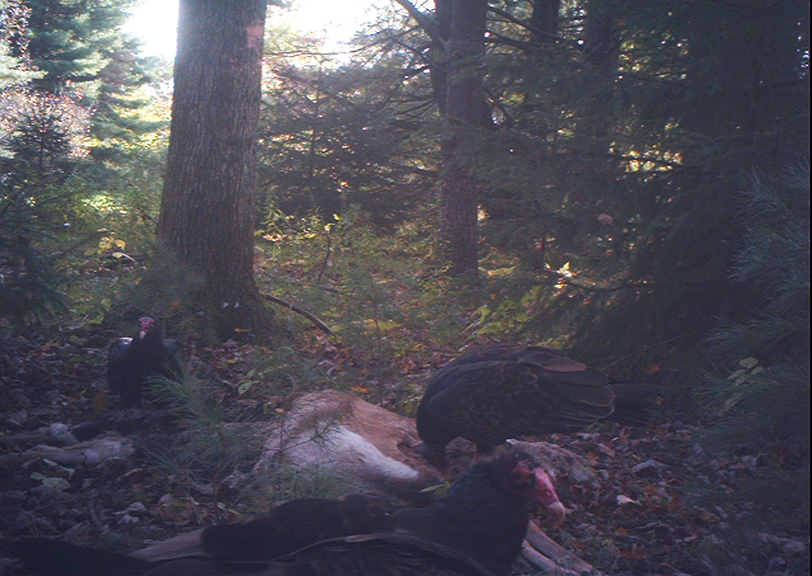
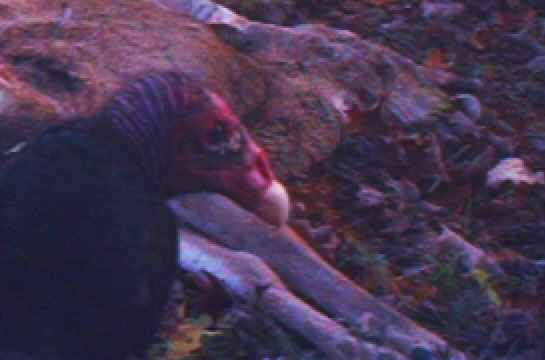
On the next two days the turkey buzzards came. If you have never seen buzzards up close, they are an impressive bird the size of an eagle with a huge wingspan. Walking down my driveway on one of these days, there were 7 or 8 of these guys in the trees around this spot. Watching them flee through the low pines, trying to avoid the many branches, with their majestic soaring way of flying was thing to behold. They did quite a job over the time they were there although nothing compared to the constant around the clock erosion caused by the maggots and beetles.
This guy below acted like the king, showing off his wingspan chasing off the others at times.
Below is the deer at the end of five days from when I first set up the camera.
Below is the next day. The turkey buzzards came for one last quick nosh. You can see how much work the maggots and beetles accomplished since the last photo above which was taken only 24 hours earlier. They are at it constantly.
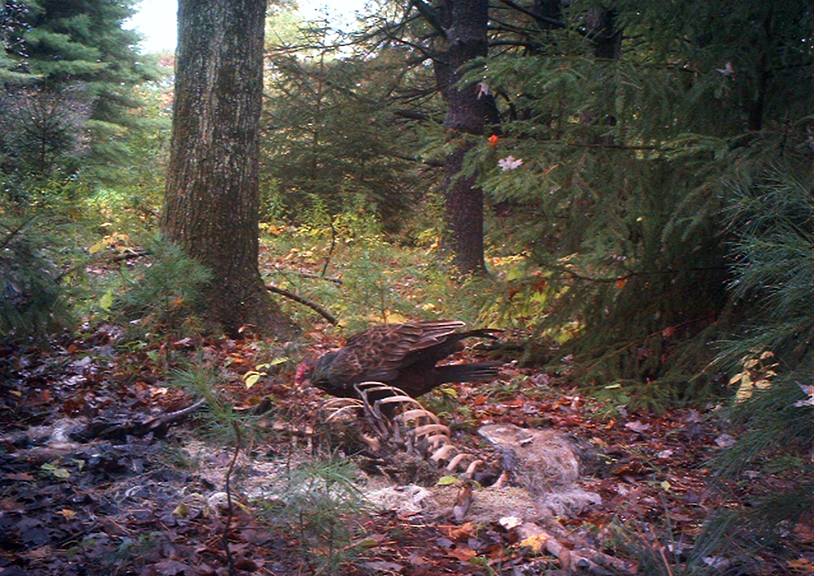
Below is at the end of seven days. Little remained but bones, a bit of hair and hardened skin around the skull. Thanks to scavengers, large and small, most of the deer had made its way back into the cycle of life. If this had been further up in the woods, the bones might even be gone by now.
The odor was surprisingly limited. It didn’t emanate in waves that went out in all directions. Rather came out in narrows bands that would move in whichever direction the air was moving at the moment. Sometimes I could walk up the carcass and barely smell a thing from it even as I stood mere feet away. But walking away around the corner from it, maybe a hundred feet away from it, I would cross through a band of pure stink that might be twenty feet wide. Once through, no more smell. After about five days the odor was nearly gone altogether.
As sad as it made me, it was an interesting thing to witness. It gave me a closer glimpse into the cycle of life, how the death of one creature can perpetrate the life of another. We don’t often get to see that firsthand so I feel lucky in an odd sort of way.
If a painting of mine suits me, it is right. If it does not please me, I care not if all the great masters should approve it or the dealers buy it. They would be wrong.
—Arshile Gorky
++++++++++++++++++
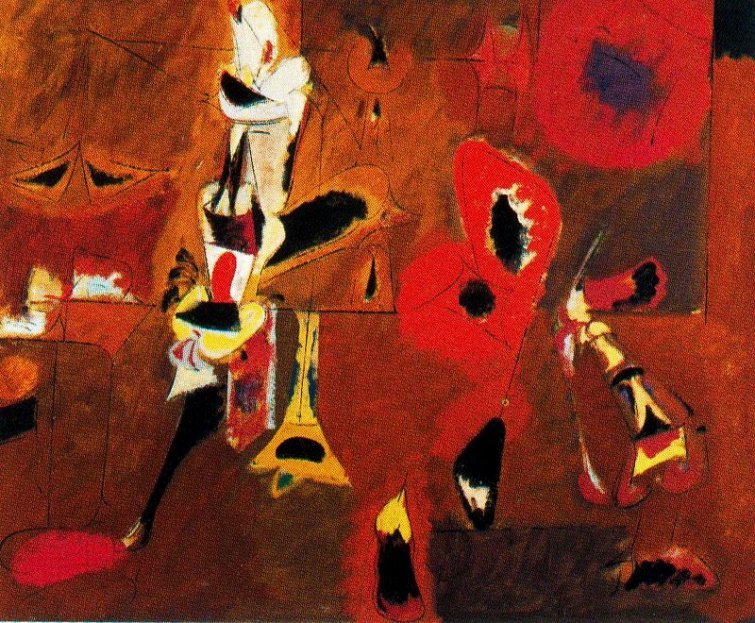
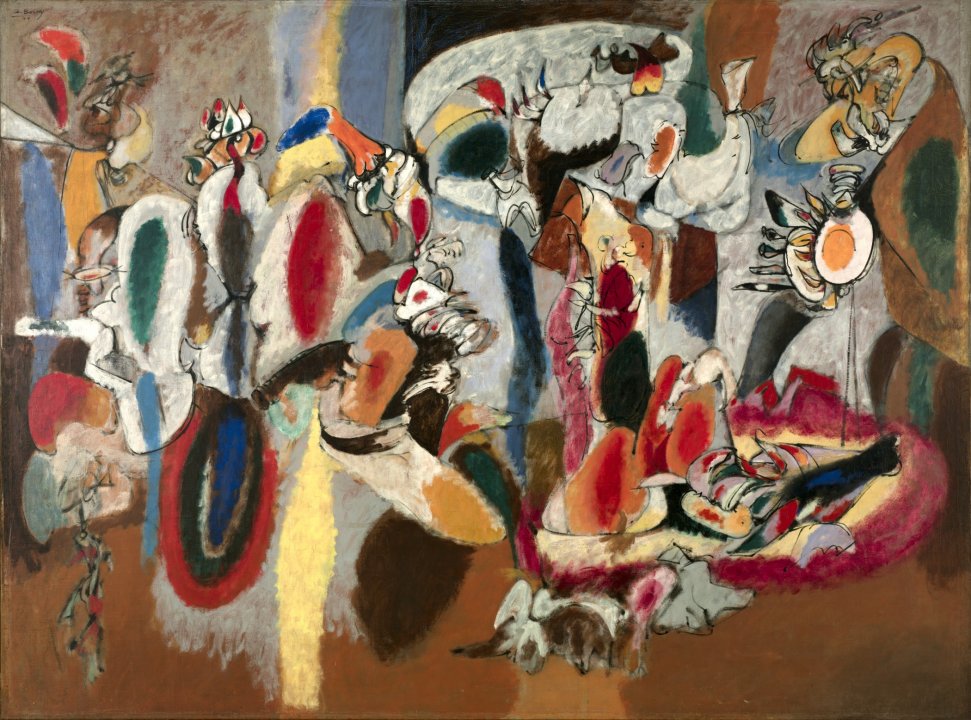
Arshile Gorky is one of those names that instantly stands out for me. But the reality is that I never knew much about his work. Just a unique name.
But of course there is more than the name. Gorky was born sometime around 1904 in Armenia and came to America in 1920 in the aftermath of the Armenian Genocide perpetrated by the Ottoman Empire on its own citizens of Armenian heritage. About 1.5 million Armenians died in this dark era including Gorky’s mother in 1919.
Fortunately for him, America was still a welcoming land to refugees fleeing hatred and danger.
He quickly integrated into the America of the 1920’s and spent the rest of his life here, gaining a sizable reputation as an important painter. He is considered one of the major influences on the Abstract Expressionist movement of the 1950’s, which he unfortunately didn’t live to see.
His candle burnt brightly but was short lived. He suffered several personal setbacks after 1946 including a car crash that broke his neck and temporarily paralyzed his painting arm. He hung himself in 1948, dying at around a young 44 years of age.
He hadn’t even come into his prime as a painter.
I like much of his work that I have seen. I am not a fan of abstraction for abstraction’s sake. For me, a work still has to have something to say and a sense of movement, rhythm and harmony of some sort. It has to talk, to communicate a meaning of some sort to me. It has to have have that sense ofrightness that I have referred to a number of times here.
Without that, the most beautifully crafted piece of work can be sterile and cold.
Dead.
So, I agree with Gorky’s words above about rightness in his own work. That is the quality I seek most in my own. His work is often described as Lyrical Abstraction which is where the work has many of the qualities that I described above, forming in itself a visual language of sorts that transcends the image.
These are ideas that spark my imagination, that make my time spent in the studio worthwhile.
….This is what you shall do: Love the earth and sun and the animals, despise riches, give alms to every one that asks, stand up for the stupid and crazy, devote your income and labor to others, hate tyrants, argue not concerning God, have patience and indulgence toward the people, take off your hat to nothing known or unknown or to any man or number of men, go freely with powerful uneducated persons and with the young and with the mothers of families, read these leaves in the open air every season of every year of your life, re-examine all you have been told at school or church or in any book, dismiss whatever insults your own soul, and your very flesh shall be a great poem and have the richest fluency not only in its words but in the silent lines of its lips and face and between the lashes of your eyes and in every motion and joint of your body….
—Walt Whitman, Preface to Leaves of Grass
+++++++++++++++++++++++
I have always been moved and inspired by the writings of the American poet Walt Whitman. I can find something that speaks directly to me in almost everything of his I come across. For me, he remains one of the most intriguing and unique characters in the American experience in so many ways.
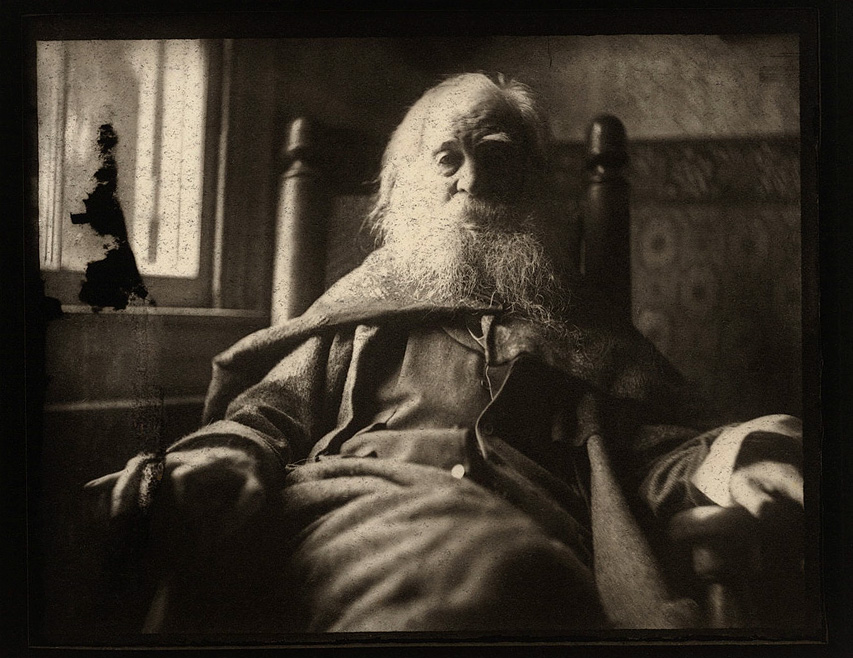
This comes across in the photos of him, including the remarkable portrait above that was taken by the great American painter Thomas Eakins in 1891, a year before Whitman’s death. It has a remarkable feeling of earned wisdom and understanding.
I had always felt a familial bond with him anyway, having called him Uncle Walt for as long as I can remember. He seemed like he was the wise old uncle I wanted growing up, someone who watched over me and imparted bits of wizened advice to me from time to time. So with this great reverence for the man, you can imagine how excited I was when my genealogy revealed that we were related.
Not an uncle.
Cousins.
Okay, 6th cousins. We share a grandparent going back to the early 1600’s, five generation before Whitman and nine generations before me. So, that makes us 6th cousins, 5 generations removed.
That’s like being in the furthest reaches of relationship in the game of 6 Degrees of Kevin Bacon. Sure, we’re related by these tenuous bonds but it is so far removed that it is academic at best. There are probably several hundred thousand, if not a million or more, people with this same bond. So it is certainly no big deal. Interesting but absolutely meaningless and without value.
But when I read a line from Whitman that makes my heart race a bit, that makes my brain and soul stir, I have to admit that it makes me happy that we share that silly, insignificant bond.
I have been going through my files lately, trying to find some misplaced or lost images and somewhat organize twenty plus years of chaos. I came across this video which I thought I had shared at some point but couldn’t find any evidence anywhere of having done that. So I guess today is a good time to do so.
This slideshow is a group of the images from my Exiles series set to one of my favorite pieces of music, Gymnopédie #1 from composer Erik Satie. I believe this was put together back in 2006.
I’ve written about the Exiles series a number of times here. It was created around the time of my mom’s death back in November of 1995 and focused on how I saw her suffering in the last several months of her life as lung cancer ravaged her body. It’s a personal series, one that was important to me in many ways.
This film is flawed and doesn’t contain all the series images but it captures the series perfectly, at least in how I saw it then and see it now.
Prejudice may be trusted to guard the outworks for a short space of time, while Reason slumbers in the citadel; but if the latter sink into a lethargy, the former will quickly erect a standard for herself. Philosophy, wisdom, and liberty support each other; he, who will not reason, is a bigot; he, who cannot, is a fool; and he, who dares not, is a slave.
—William Drummond, 1805
+++++++++++++++++++++
The last line of this quote [ he, who will not reason, is a bigot…] from Scottish philosopher William Drummond is often mistakenly attributed to Lord Byron. Whether it was Drummond or Lord Byron doesn’t really concern my use of it. But its words ring true in these times where those who know better refuse to reason sensibly, where those without an ability to reason follow those who play to their foolishness, and those that dare not to step forward to speak against fools and bigots is forever enslaved to these same fools and bigots.
Dare to reason. Dare to know. Dare to speak up.
+++++++++++++++
The painting at the top is a piece from last year that remains a favorite of mine. It is titled Dare to Know.
I have made a great discovery. I no longer believe in anything. Objects don’t exist for me except in so far as a rapport exists between them and myself. When one attains this harmony, one reaches a sort of intellectual non-existence, what I can only describe as a sense of peace, which makes everything possible and right. Life then becomes a perpetual revelation. That is true poetry.
—Georges Braque
+++++++++++++++++++
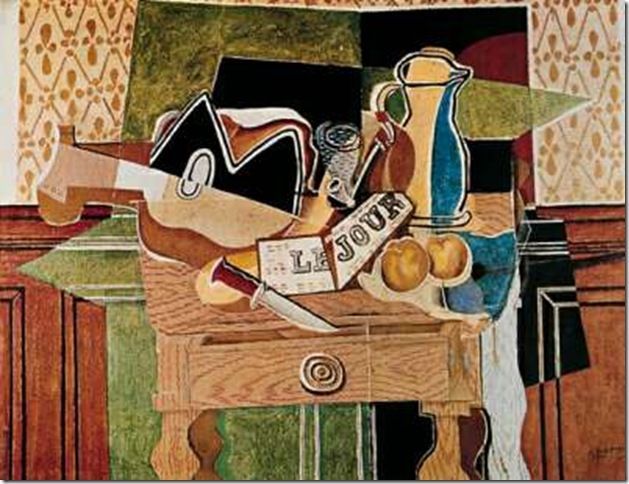
Just about anything I read from Georges Braque (1882-1963) makes me stop and think. I am still trying to digest this. In one moment it makes perfect sense and aligns with my own thoughts while the next it confounds me, like I’ve turned down a street that is totally unrecognizable. Not sure which way to turn.
But there is something in the pondering that makes me think it might be worthwhile.
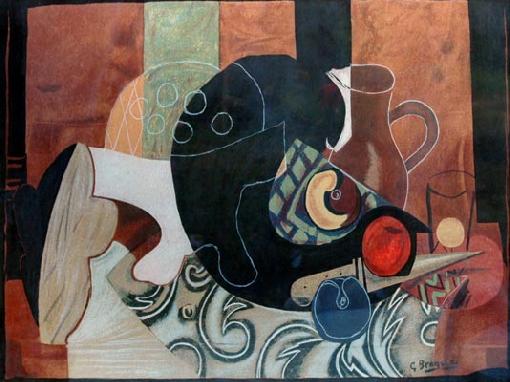
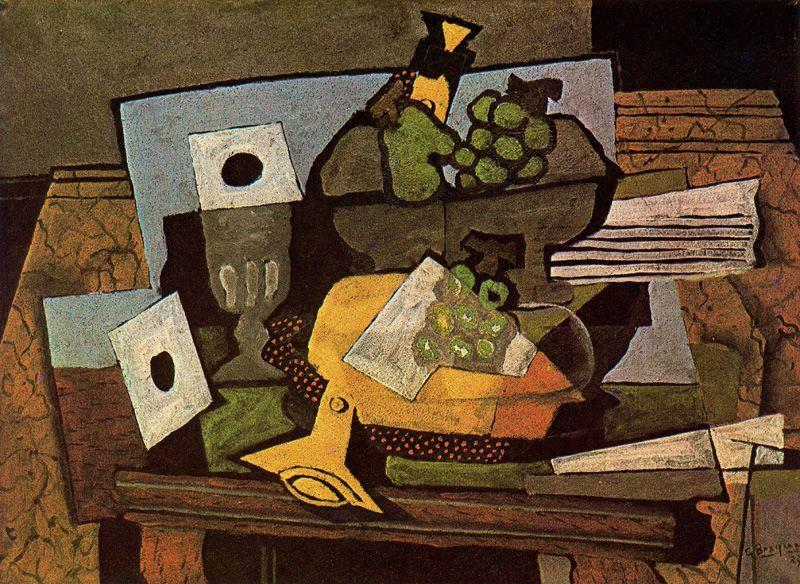
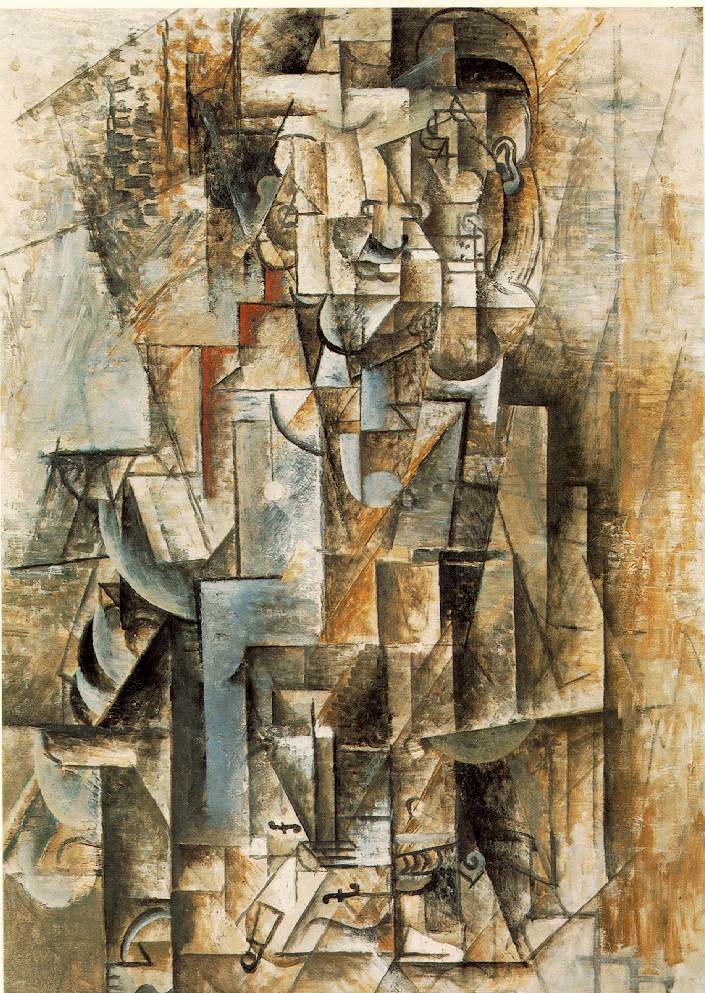
Braque had a pretty amazing career, moving from Impressionism to Cubism to Fauvism and Expressionism with his own unique voice. Here are some of my favorites.
Another gray, wet, cold Sunday morning here in paradise. The sun lately seems like a stranger who, on those rare occasions when it appears, I have a vague recollection of once seeing. It’s grim and has me gazing out my window, hoping that the ghost of Tom Joad, like he had somehow stepped right out of The Grapes Of Wrath, might emerge out of the darkness set against the distant pines. This weather puts me in that mood, that grim feeling of that we need somebody to stand against the darker forces of this world.
Tom Joad, as dark and ill-fated a character as he seems, still gives me hope that there are still people out there who won’t turn a blind eye to injustice and inequality. People who haven’t been numbed by their own self-interest and comfort. They don’t have to be heroes, just plain people with a sense of decency and an unwillingness to turn their back to the wrongs they witness.
We sure could use some more Tom Joads.
Here’s my Sunday morning music. It is, of course, The Ghost of Tom Joad, from Bruce Springsteen. Have yourself a day– good, bad or indifferent– and if you see Tom Joad, tell him I am looking for him.
I call this painting Let Us Now Praise Famous Men, a title I used for a few paintings from my early Exiles series, in which this piece is included. I seldom show this piece and am not sure if it has ever appeared here. While I like this piece for a variety of reasons– for instance, I love the sky and hill colors– I never felt it was up to the same level as the other work in the Exiles series. I felt that it was more flawed than the others and too forced, not as organically formed as much of the other Exiles.
But every time I pull this piece out I feel a small sense of satisfaction in it and maybe that it needed to be aired out. I want to play a song today and thought this would be a good opportunity to let this little guy get out a bit. We’ll see.
The song is Work Song. It was written by the brother of jazz great Cannonball Adderley, who originally performed the song as an upbeat jazz piece. But it has been interpreted by a number of artists over the years, some to great effect. Others, not so much to my taste. But one of my favorites is from one of my guilty pleasures, Tennessee Ernie Ford.
He certainly doesn’t seem like a “cool” choice if you remember his public persona in the 50’s and 60’s as the goofily naive but affable hick from Bristol, Tennessee. I enjoyed that caricature as kid but it was his music that hooked me. He had a deep and mellow voice and a knack for choosing songs and arrangements that fit him perfectly. His series of country boogies were great and his 16 Tons is a classic. His version of this song is a great interpretation, spare and deep felt.
I couldn’t find a decent video of this song so here is the track alone:
Here’s another version that is a different interpretation from a band called The Big Beats with vocalist Arlin Harmon. I don’t have a lot of info on either though from what I can glean Harmon was a highly esteemed singer out in the Northwest. It’s a solid rocking performance with a different flavor. Give a listen.
 ++++++++++++
 It had weight.













 Redtree Times