Feeds:
Posts
Comments

My Blue Heaven

I am just about done with painting for my solo show, Haven, that opens June 1 at the Principle Gallery. There are always mixed emotions at this point.

There’s a sense of relief at finishing a group of work if only for completing a large task. There’s also a little sadness that I have to put my brushes aside for a couple of weeks as I move into the part of the process where I physically get the paintings ready for showing. It is a time, sometimes tedious, spent photographing, varnishing, matting, staining and framing.

There’s also a air of excitement at both seeing the work come together as a group and in seeing each individual painting in its finished state, ready to present to the world. They have their own aura at that point, with their own sense of being and voice. It’s very gratifying in that moment.

One of the new paintings that gratifies in this way and has its own voice that speaks directly to me is shown above. It’s a 16″ by 40″ canvas piece that I call My Blue Heaven. The colors and the created depth that the eye follows into the picture really strikes a chord, giving it a sense of quiet awe for myself. Oh, to be deeply within that scene, blanketed in blues and greens with watchful stars and the warm nightlight of the moon to guide and comfort me.

Personally, I am going to miss this painting. But I do get to enjoy its company for the next week or so and that is a pleasure in itself.

I am sure may of you recognize the title of this painting as being the title of an old song. It was first recorded in the 1920’s and has been a standard ever since, recorded by hundreds of artists. The most notable was the version that was a hit for Fats Domino in the 1950’s. Today, I thought I’d play a nice version from Norah Jones.
Have a great day.


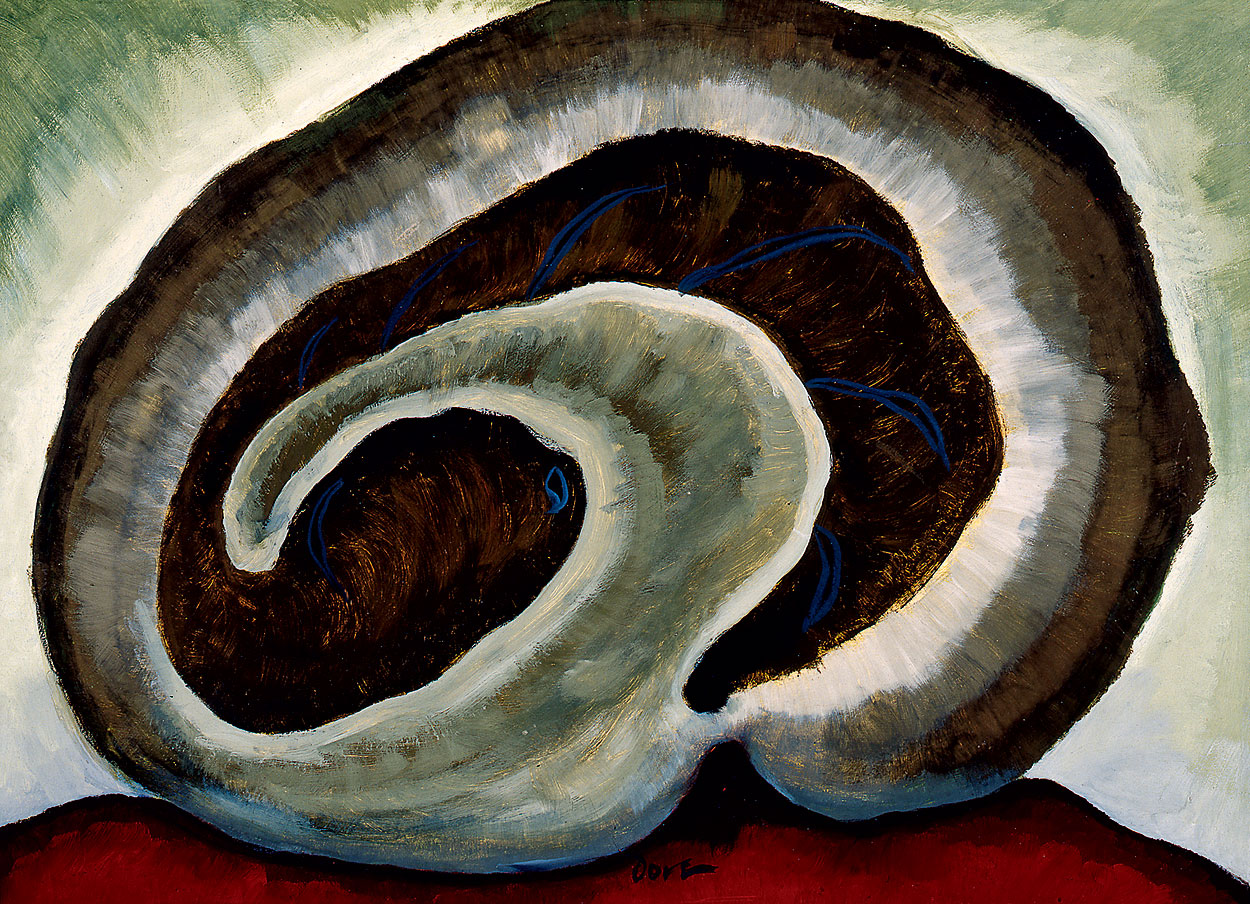
Arthur Dove- Me and the Moon 1937

******************

We cannot express the light in nature because we have not the sun. We can only express the light we have in ourselves.

–Arthur Dove

*******************

Really busy morning getting my upcoming Principle Gallery show ready. It seems there is just not enough time in the day and when there is, I don’t have the stamina to take advantage of it. Thought I’d share a few words from the Modernist painter Arthur Dove (1880-1846) who was someone I looked to when I was first beginning to paint. I liked the way he merged abstraction and representation in his work and how he used recurring elements in his work. The ball/circle shape that I use so often as my sun/moon always makes me think of Dove.

He was also from the Finger Lakes region of New York, born and raised in Canandaigua and educated up the road at Cornell. While that may hold no importance in his work, it interested me because it made me wonder how he saw the same things I have often seen in this area. How did this environment shape the way he saw and expressed the world?

Anyway, here are a few of my favorites along with a video of his work set to a nice Schubert piece.

Arthur Dove -River Bottom – 1923

Arthur Dove- Sunrise– 1924

Arthur Dove- Willow Tree — 1934


Natural High

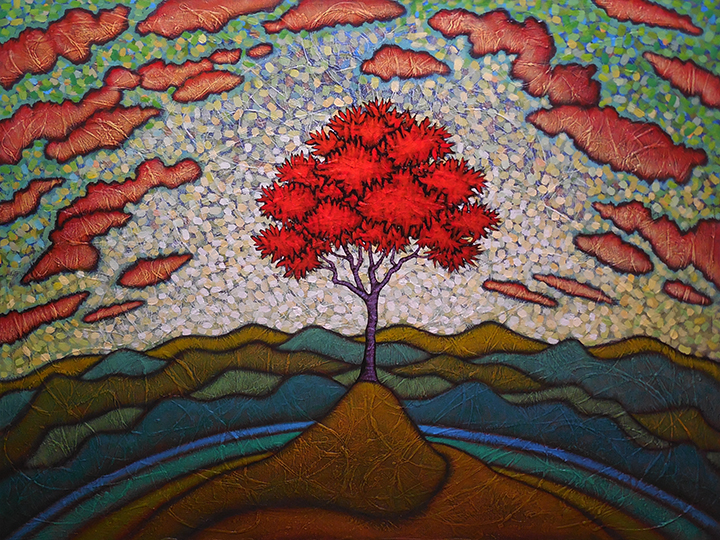
This new painting has been sitting in front of my desk here in the studio for several weeks now and it has began to feel like part of the place. It just feels right in that spot, even though it takes up a lot of space–it’s a big painting, 36″ high by 48″ wide— blocking a large part of the stone fireplace that I normally enjoy having in front of me. I wasn’t happy taking it down to photograph it. Like I said, it just felt right where it was.

Maybe there’s a sense of optimism or empowerment in it that I find attractive, both qualities that are sorely needed in these times. Maybe it’s the sense of unity with its surroundings that the Red Tree seems to possess. Or maybe it’s the symmetry in its composition or the rhythm in the bands of hills.

I can’t really say for sure but whatever it is, it makes me feel better in the time in the time it is front of me.

Hopefully, it will work that way for someone else when it goes to my show, Haven, at the Principle Gallery that opens on June 1.  If not, I will gladly welcome it back to brighten my outlook.

I am calling it Natural High.

I guess that makes a nice segue for this week’s Sunday morning music. The choice this week is, of course, the soul classic, Natural High, from the group Bloodstone recorded back in 1973. I hadn’t heard the song in a very long time and after hearing it recently, it became an earworm for me. It dug itself in and I found myself singing its chorus under my breath as I was walking through the woods to the studio at 6 AM. Maybe that’s why I chose to use its title for this painting. The song is an earworm for me like the painting is an eyeworm.

God, that sounds disgusting, doesn’t it? All these worms and ears and eyes. When, in fact, it’s actually all good. Take a look, give a listen and have a great Sunday.

Work Generator

Francis Bacon
Portrait of Michel Leiris 1976

++++++++++++

As you work, the mood grows on you. There are certain images which suddenly get hold of me and I really want to do them. But it’s true to say that the excitement and possibilities are in the working and obviously can only come in the working.

–Francis Bacon

++++++++++++

I am swamped in work today. I say that a lot and it might sound awful to many folks. But for me it is the best possible situation because being at work means that, like Bacon says above, I am amidst the excitement and possibilities that come with working. Thinking about ideas, mulling what you’re going to do has a place but they are worthless nothings until they go into process, become work. Then they usually become something altogether different because the work allows you to flesh out what the mind alone couldn’t imagine.

The process of working is the true generator of ideas.

There have been many artists through time who have expressed this same sentiment, that doing work generates new work, creates new possibilities. I know that it is true for myself.

Breakthroughs in the work always come while working, with hands in paint and eyes and mind straining to see where the piece before me ends and the next begins.

Here’s one of my favorite inspirational pieces from artist Chuck Close that very much says the same thing: Don’t wait on inspiration–make your own!

The advice I like to give young artists, or really anybody who’ll listen to me, is not to wait around for inspiration. Inspiration is for amateurs; the rest of us just show up and get to work. If you wait around for the clouds to part and a bolt of lightning to strike you in the brain, you are not going to make an awful lot of work. All the best ideas come out of the process; they come out of the… work itself. Things occur to you. If you’re sitting around trying to dream up a great art idea, you can sit there a long time before anything happens. But if you just get to work, something will occur to you and something else will occur to you and something else that you reject will push you in another direction. Inspiration is absolutely unnecessary and somehow deceptive. You feel like you need this great idea before you can get down to work, and I find that’s almost never the case.

I am taking that advice and just doing what I do. You do what you do, okay?

Bellows

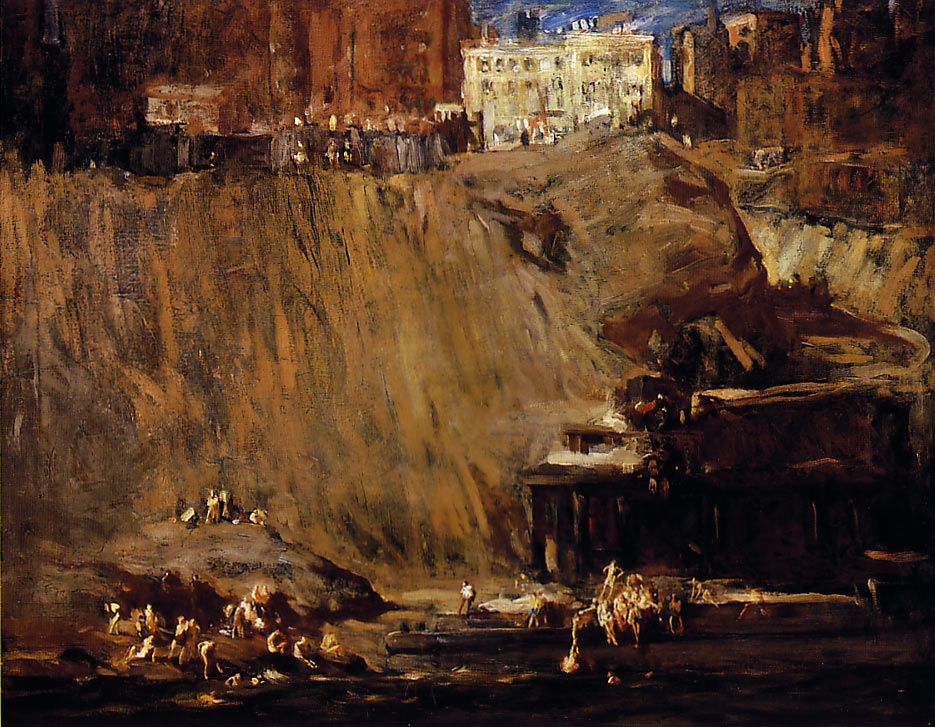
George Bellows painted everything like it was raw meat. Even his more pastoral pieces have this feeling, one of freshly ripped fiber and blood. One of the earliest blogposts I wrote here focused on his boxing scenes from the early part of the last century. I have included it below along with several more of his paintings and a video I came across that couples  Rhapsody in Blue from George Gershwin with the paintings of Bellows. Take a look: 

*****************

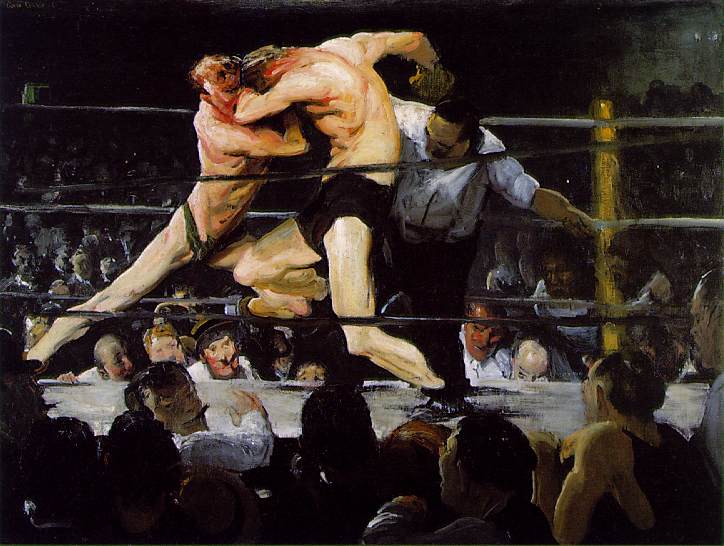
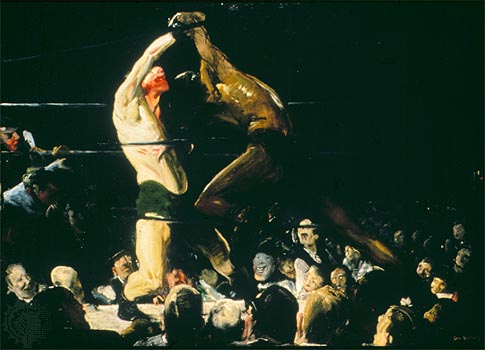
Bellows Stag at SharkeysThis is Stag at Sharkeys, painted by George Bellows in the early part of the 1900’s. Bellows was part of the Ashcan group of artists who depicted the reality of the time in their paintings, creating gritty scenes of city life and all that this entailed- street scenes, nightclubs, tenements, etc.Bellows Both Members of this Club

I’ve always been drawn to Bellows’ work, particularly his several scenes of club fights. There is such great movement and rawness in these pieces that you get the real sense of the fury of the violence taking place. This is enhanced even more by the high contrast between the brightness of the fighters’ skin and the great blackness of the open space above the ring. It all creates a great feeling of drama.

These paintings always bring to mind my grandfather, who was known as Shank. This was his time and this was his world. He had been a club wrestler which was the predecessor to professional wrestling except that it was real wrestling where one competitor might put a painful leg lock on the other and hold it for a long time until his opponent gave in. This ability to clamp on and not let go was how Shank came to his nickname.

The matches could last an several hours. I found an article in the local newspaper from that time, around 1907, documenting a match of his that went for four hours without either wrestler winning a fall. The match was suspended and they came back the next night to wrestle for another two and a half hours. Shank wrestled professionally for several years then later went on to be a stage manager at on of the many vaudeville theaters that once populated our city.

I remember as a kid, going to play bingo at the American Legion and this old city cop, Sailor Devlin, who was at the time the oldest active police officer in the country as recognized by Ripley’s Believe It or Not. Serving as security for the event in his late 80’s, Sailor would amble over to our table to talk with my dad.  He had known Shank, who was at this point dead for several years, and would always comment on him, calling him the toughest guy he ever met. That really resonated with me and I always valued toughness after that, putting high regard for those who could, as they say, take it.

Maybe that’s why I’m drawn to these images.  The guys in these paintings can take it.

Endless Becoming

I have about two more weeks to get ready for my solo show, Haven, that opens on June 1 at the Principle Gallery so I have little time to spare at the moment. So excuse me for doing a little shorthand here by using an older painting (No Way Home from 2009) and a thought-provoking quote from the late historian Lewis Mumford.

This idea of endless becoming transforming into being intrigues me, making me wonder if the work I am doing has made that jump.

And how does one know?

That might be both my breakfast and lunch because I’ll be chewing on it for quite some time today.

Time to get to work.

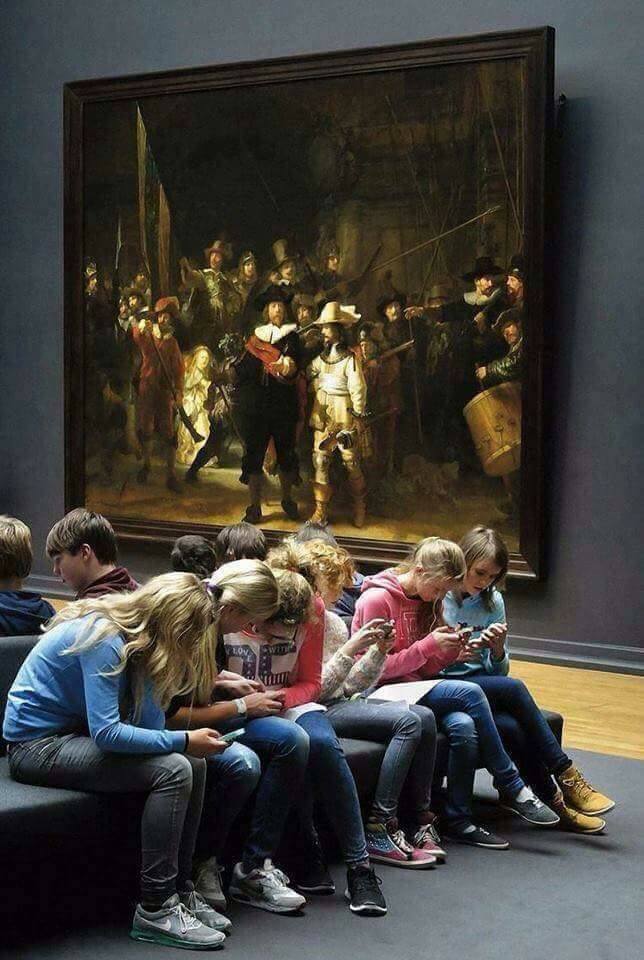
You’re not going to hear any snarky comments from me on this even though the photo is obviously begging for one. There’s no context here so it’s a bit unfair to for me to shake my fist and yell for these kids to put down their telephoney-machines and get off my lawn.

Maybe they were asked to do some quick research by their teacher about Rembrandt and his masterpiece, The Night Watch, the painting shown in this photo from the Rijksmuseum in Amsterdam. I don’t really know.

But it does provide a stark example of how we often forget to experience the here and now, how we fail to calmly sit back and just take in our surroundings. Often, our present moment and place holds something remarkable and real.

I can’t say that we are better or worse off for being so tethered to technology. A case can definitely be made for either. But we should not lose our ability to look and listen, to engage and absorb the world directly around us. Without that ability there will be no more epic paintings made for future generations to ignore.

++++++++++++++++

“A philosopher once asked, “Are we human because we gaze at the stars, or do we gaze at them because we are human?” Pointless, really…”Do the stars gaze back?” Now, that’s a question.” 

― Neil Gaiman, Stardust

+++++++++++++++

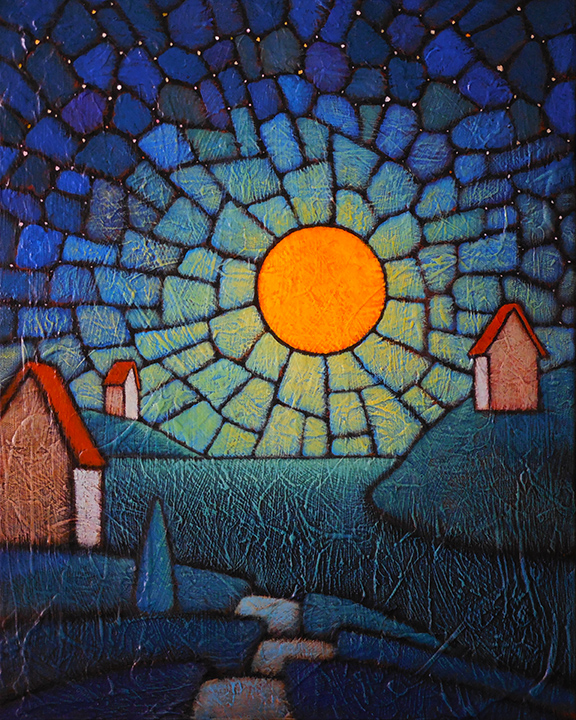
Above is a new painting that is going with me down to Alexandria for my show, Haven, at the Principle Gallery, opening June 1. I am calling this 20″ by 16″ canvas Stars and Satellites. It’s a continuation of a series of recent works that are primarily stark nightscapes with skies composed of shards of color in an almost stained-glass manner. At the junctures where shards meet are points of bright color— the light of the stars and the planets of the night sky.

I think I have written here about the meditative effect of painting these pieces, how there is a feeling of both intense concentration and non-thought that blocks out all other things. If the television is on or music is playing, I don’t really hear it. If delivery vans or cars come up my driveway, I am totally unaware even though they directly pass in front of the large windows before which I work.

It’s like I am in that space in that time, especially in the first stages of composing the picture. All is quiet and all that moves through my mind is the simple geometry of placing blocks of red oxide in a way that makes sense in that part of my brain that is scanning the whole of the composition. It’s one of my favorite parts of my process of painting, this state of being so mentally attached to the surface of the painting.

Another favorite part comes later as the painting evolves from its red oxide skeleton. This moment comes after layer after layer of color is added and the painting crosses a tipping point where it suddenly becomes a fully fleshed being, an entity with its own life force and its own voice.

That is a really gratifying moment, one that makes me think of Carl Sagan describing the Voyager space mission and how it would travel through time and space as a reminder of our existence as a people and a civilization long after our Sun had turned our planet into an ember, long after we had ceased to walk this earth.

And in a way many of those stars in the night sky serve that same purpose. Many are the final traces of light from stars that have been extinguished eons ago yet remind us of their existence.

This piece has, for me, a feeling of an interdependence between the moon, the stars and we here on earth. We each need the other in order to be seen, to serve as a reminder that we have existed in this universe, if only for short time.

Like John Lennon sang in Instant KarmaWell, we all shine on/Like the moon and the stars and the sun…

Rouault Monday

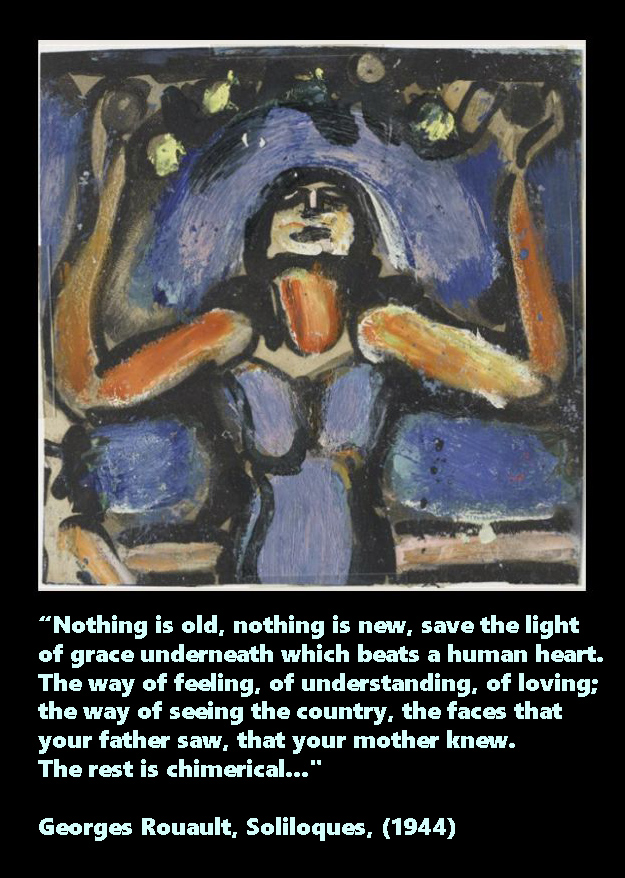
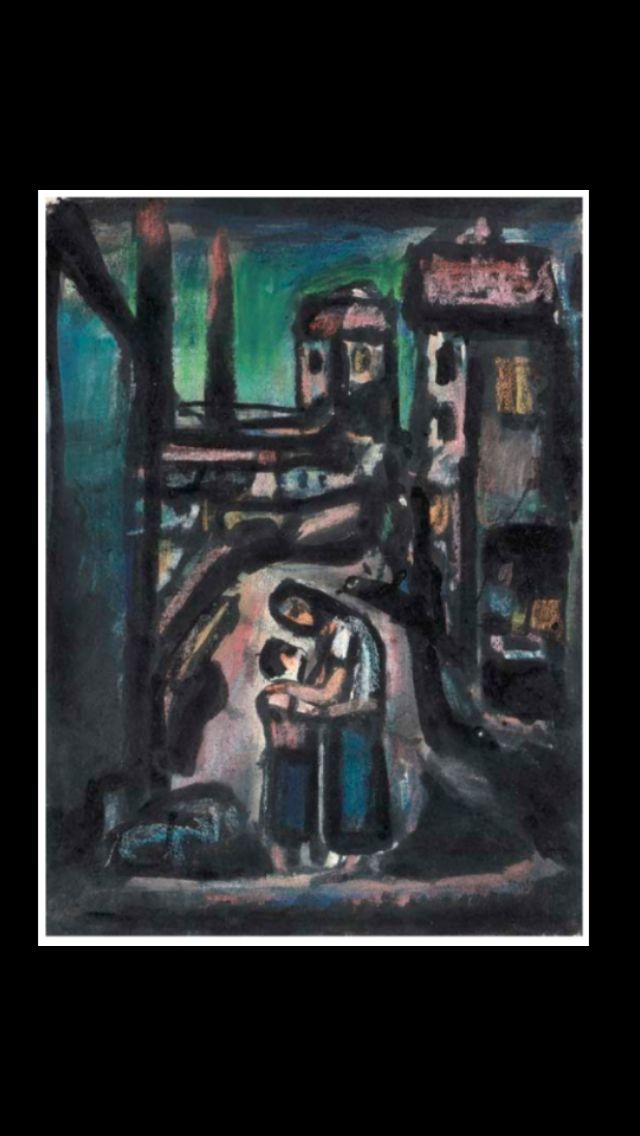
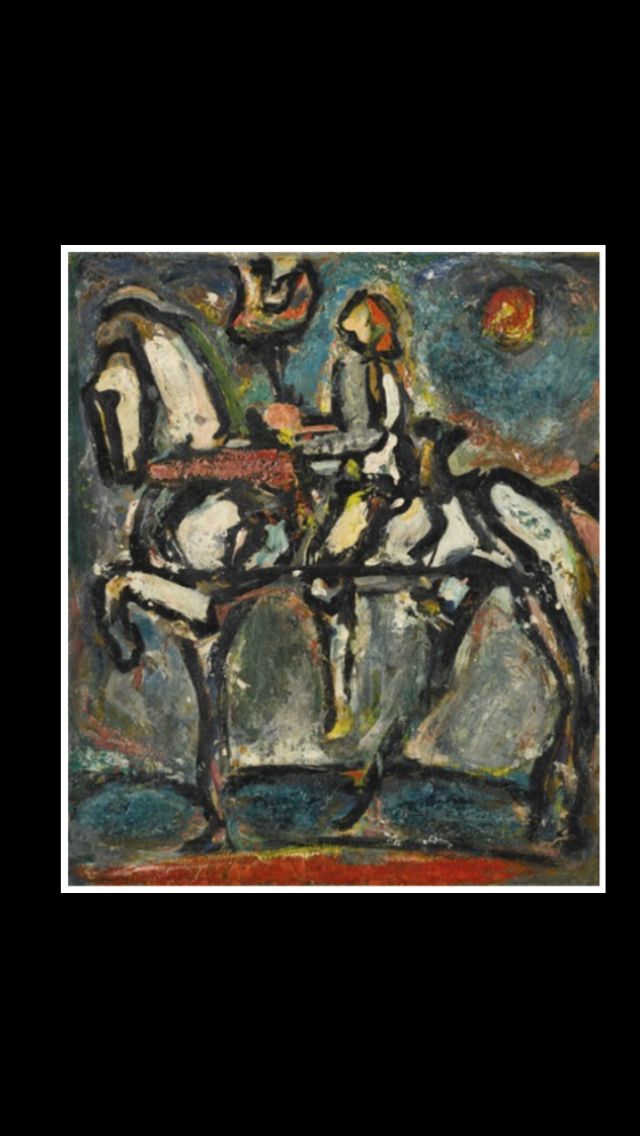
Too busy this morning but I can always find a few minutes to take in some work from Georges Rouault (1871-1958). His work has for me a real sense of rightness, a certitude that makes even his roughest brushstrokes seem both perfectly placed and necessary.

Murmuration

Watching the murmurations of starlings is a fascinating and hypnotic thing to see, indeed.  Murmuration is the word for the starling flock and for the intricate dance in the sky performed by these huge groups of birds which often number in the tens of thousands.

The murmurations move gracefully and quickly, creating constantly shifting forms that seem derived from some higher levels of geometry and quantum mechanics than my simple mind can comprehend. I get the feeling when I watch them that I am seeing some essential base element of our universe made visible.

We have never really fully understood the hows and whys of these complex movements. Researchers have found that these displays are almost always set off by a predator such as a falcon near the edge of the group. The group responds as a single unit without an actual leader in order to avoid and distance the group as a whole from the predator.

Researchers believe that this done with something called scale-free correlation which allows birds at any point in the group to instantaneously sense and react to what any other bird in the group, no matter how far away, might be experiencing. Any information moves through the group instantly and without any degradation of the message. It’s like an incredibly complex version of the telephone game. With people passing a simple message along in this game, the message is often garbled beyond recognition within a relatively short time. Here the message is passed tens of thousands of times without missing a word, a comma or inflection.

How they do it remains a mystery. Maybe that’s why they remain so fascinating, to remind us that we still know so little of the grand scheme of things.

For this Sunday morning music here’s a piece, On Reflection, from contemporary composer Max Richter. It is accompanied here by a video of the murmurations of starlings. The music and the flowing motions of the birds create a hypnotic and soothing effect. Give a listen and relax. Maybe you can imagine being part of that murmuration.