Feeds:
Posts
Comments

At the Cap Rep

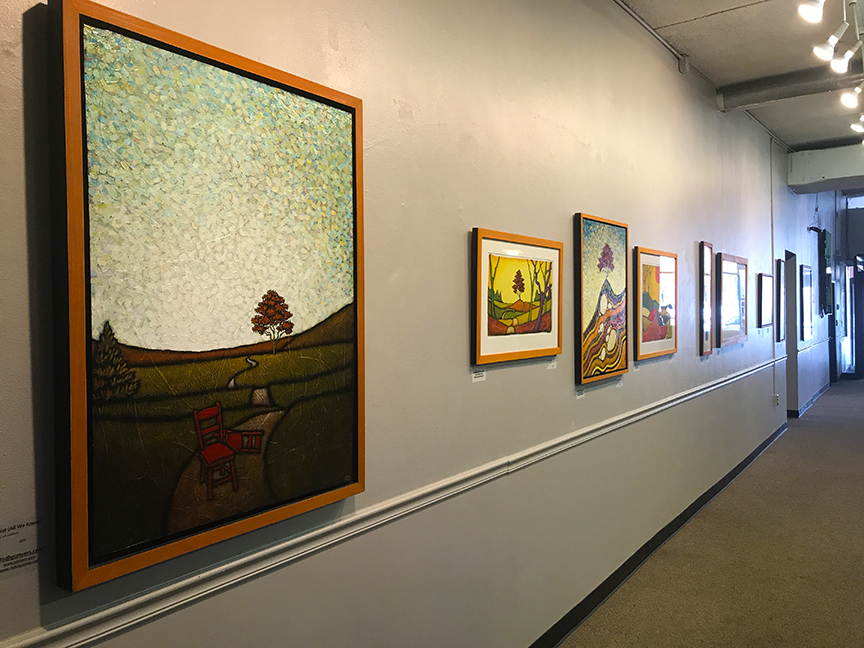
I currently have a small group of my work on display in the public gallery space at the Capital Repertory Theatre in downtown Albany, accompanying the current show Blithe Spirit, which opened last Friday. The demand for the show was so high that they added another week with its run ending May 6.  The Cap Rep is a highly respected repertory company with a resident cast of professional actors with impressive resumes so every show is performed at a very high level. They are in the midst of creating a new state of the art facility which should open in 2019.

I normally don’t do these kind of exhibits and, to be honest, didn’t have the time to dedicate to it. But a longtime friend, Jennifer Duke Anstey, who is the Head of Operations and House Manager at Cap Rep as well as a talented photographer with who I once shared an exhibit about 20 years back, convinced me that I could easily put together a group of work and she would take care of all the details. I trust Jennifer’s judgement and decided to put together the exhibit.

It turned out to be a mini-retrospective comprised of older work that are my personal paintings along with other pieces from several periods from the past two decades. There are paintings from that range from 1998 up to the present day. While an abridged show, it gives a representative glimpse of the progression of my work over the years.

So if you’re in the Capital District, stop in for a look — the space is open during the day– and stay for a great bit of theater.

There a new piece on the easel right now that is at a point in it’s progress that has me chomping at the bit to get to work this morning. I thought, in the name of expediency, I would share a post from a few years back about trusting yourself when it comes to something like art. I know a lot of people who won’t go into galleries or museums because they think they don’t know anything about art and feel intimidated. That’s a shame because you don’t need to know anything about art except how you react to it. Have a look:

*********************

He knows all about art, but he doesn’t know what he likes.

–James Thurber

******************

James Thurber Cartoon Art CriticThis may not technically qualify as a quote but who cares?  The message in this cartoon from the great James Thurber is so simply put and true and that’s what I am looking for in a good quote.

 And art.

That’s what I like.

In the past I’ve talked about how many people are intimidated by the idea of art, feeling that they don’t know anything about art.  This leaves them not trusting their own eyes and their own reactions to any given piece of art.

And that is a pity because art is mainly about the reaction to it.  Art is a reactive agent, reaching out and stirring something in the viewer.  All of the knowledge in the world about a piece of art cannot make you like that piece of work if it doesn’t first strike that chord that raises some sort of emotional response within you.

And I think most of us know within a few moments whether a work of art speaks to us or leaves us cold.  The trick comes in recognizing this realization and feeling okay with it.

I’ll admit that there are many celebrated works of art out there that do absolutely nothing for me.  They may have historical importance or elements of beauty or great craftsmanship in them but they simply don’t raise any emotional response within me.

I might be able to appreciate them but the bottom line is that I don’t like them, plain and simple.  That doesn’t mean I’m right or wrong.  It just means I know what I like.

And I accept that criteria from anybody, even with my own work.  While it would be nice to think that it speaks to everyone, I know this is an impossibility.  I’ve had people tell me that they didn’t like my work– in polite and respectful terms, thankfully– and I’m okay with that.

They know what they like.  And that’s good enough for me.

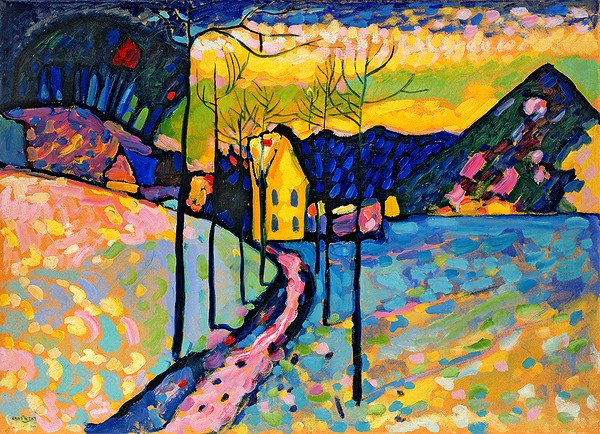
“… lend your ears to music, open your eyes to painting, and … stop thinking! Just ask yourself whether the work has enabled you to “walk about” into a hitherto unknown world. If the answer is yes, what more do you want?”

― Wassily Kandinsky

+++++++++++++++++++

A busy day but with enough time to consider this early Kandinsky painting and his words. Having learned to stop thinking some time ago, I do feel enabled to walk about in his created world. And, yes, I want and need no more this morning.

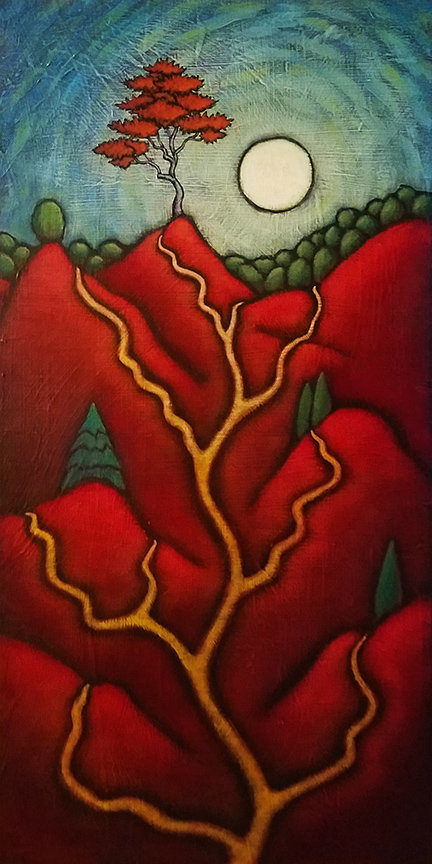
Etude No. 14

While searching for a piece of music to feature here this morning, I found myself looking over at this new painting shown here as I listened to the music. As usual, the search had me running down rabbit holes that sent me in all different directions, none that satisfied me enough to want to share it.

Then I somehow ended up on this modern classical piano piece from composer Phillip Glass, Etude No. 14, played by pianist Vikingur Olafsson. There’s a part in it, starting at about 1:15, that the sound and this painting just seemed to mesh for me, filling out the feeling that I was experiencing as I was taking it in.

It is a painting that is still on the easel, near completion or so I think. I am in that part of the process where I am still examining it, absorbing it to see what it has for me, what it’s trying to say to and for me. And here, the music created a narrative line that pulled me and the image together.

It’s hard to explain. Everybody sees art differently, having different expectations of what they hope to extract from it, if anything. I think a lot of folks don’t even think about those expectations and just react to what is before them. I do that as well and it is generally gives a true response.

But more often I see art as an existential puzzle with pieces that provide clues as to our meaning and purpose. There are works that attract me and I search them for these clues, trying to figure out if there are answers or where it will send me next in my search. In this painting, the Glass music helped me see what I had only sensed before.

As I said, it’s hard to explain.

Anyway, give a listen and have yourself a good Sunday. By the way, I am calling this painting Etude No. 14.

Final Portrait

Once the object has been constructed, I have a tendency to discover in it, transformed and displaced, images, impressions, facts which have deeply moved me.

–Alberto Giacometti

+++++++++++

There is a film out currently called Final Portrait which is about the writer James Lord, played in this film by Armie Hammer, sitting for a portrait with artist Alberto Giacometti, played in the film by Geoffrey Rush.

Taking place in 1964, a couple of years before Giacometti’s death, the sitting is initially supposed to last for a few hours but stretches for weeks as Giacometti agonizes and constantly alters the painting. The movie is based on Lord’s perspective, one that has him confused and frustrated until at last seeing how Giacometti has transformed his image into something beyond what he himself saw in it.

I haven’t seen it but imagine it to be a quiet but intense film. I’ve had some fascination for Giacometti’s work and writings for many years, intrigued by the singularity of his vision and his dedication to bringing it to light. I find myself often nodding in agreement, as I did with the quote here at the top, when reading his words from interviews and his writings.

Here’s a short film that the Christie’s auction house put together several years ago about the painting of this portrait when it came to auction, selling for nearly $21 million. It’s provides the basis for Final Portrait.


In the Stars

Look up at the stars and not down at your feet. Try to make sense of what you see, and wonder about what makes the universe exist. Be curious.

–Stephen Hawking

++++++++++++++

I’ve been working on a series of paintings recently for my June show at the Principle Gallery that feature fragmented skies with stars appearing at their junctures. Some are very geometric and angular while some– like the one, In the Stars, shown here–have more organic shapes with more randomness in their arrangement.

Both satisfy some part in me, in their creation and in the appreciation for them I feel once they reach a point of completion. Maybe it’s that there is a meditative stillness in both aspects. Painting them definitely creates a deep sense of quietude for me that I also find in studying them after they are done.

It is the kind of stillness that spurs wonder and curiosity, the kind that makes one look into the night sky with hopes that extend beyond our present time and place. Are we alone in this vast universe or are we the end-product– the flowers, perhaps — of one of those shining stars?

I don’t know and most likely will never know. But I will always have the need to wonder…


Ad Marginem C 1930 Painting by Paul Klee; Ad Marginem C 1930 Art Print for salePaul Klee On Modern Art 1924This excerpt from On Modern Art, the 1924 treatise from the great Swiss artist Paul Klee is a bit more than a quote but since this is about art we’ll be a little flexible in our definition. And that, I believe, would please Klee, whose works often defied definition.

I know for me, he was a big influence if only in his attitude and the distinctness of his work. I always think of his work in terms of the color– sometimes muted yet intense and always having a melodic harmony to it.

It always feels like music to me.

I like his idea that the world is in the process of creation, of Genesis, and that it is not a final form. It allows for visionary work, for imagining other present worlds that extend beyond our perception because, as he writes, In its present shape it is not the only possible world.

And to me, that is an exciting proposition.

Isles of the Dead

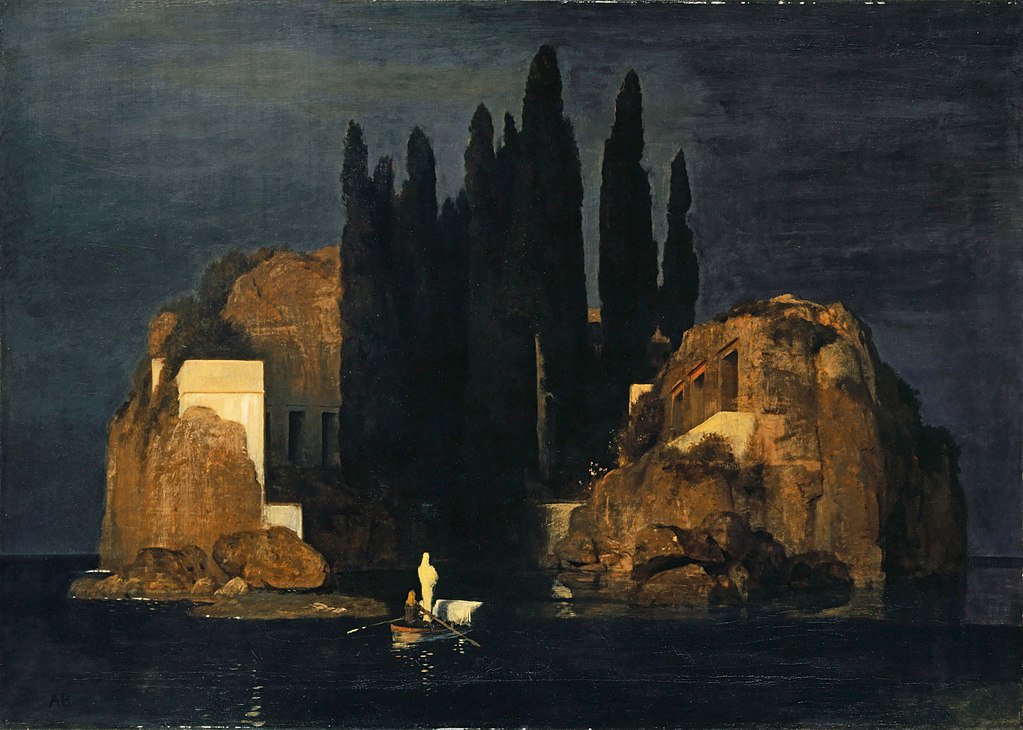
Isle of the Dead – Arnold Böcklin- First Version

I am a fan of the Symbolist painters from  around the end of the 19th century, artists like Edvard Munch, Gustav KlimtOdilon Redon. and many others created incredible works that were just a little beyond reality but beautiful and with a presence that lingered with the viewer. There are many great examples but one of those paintings with a lingering effect is the Isle of the Dead from  Swiss painter Arnold Böcklin (1827-1901).

Depicting an island where the bodies of the dead were interred, it is a powerful and somber image. Several locations are reputed to be the inspiration for this painting, including several tiny Mediterranean islands with similar cypress trees and chapels. Some believe it to be based on a cemetery in Florence, Italy near the artist’s studio where his infant daughter was buried.

Böcklin lost 8 of his 14 children to death, so the concept of death was something that was always near. This was not that uncommon in that time. Most families lost one or more children in early childhood and death was an accepted part of this world. During this time, at the end of the 19th century, it wasn’t unusual for a family to take portraits of their loved ones soon after they died.

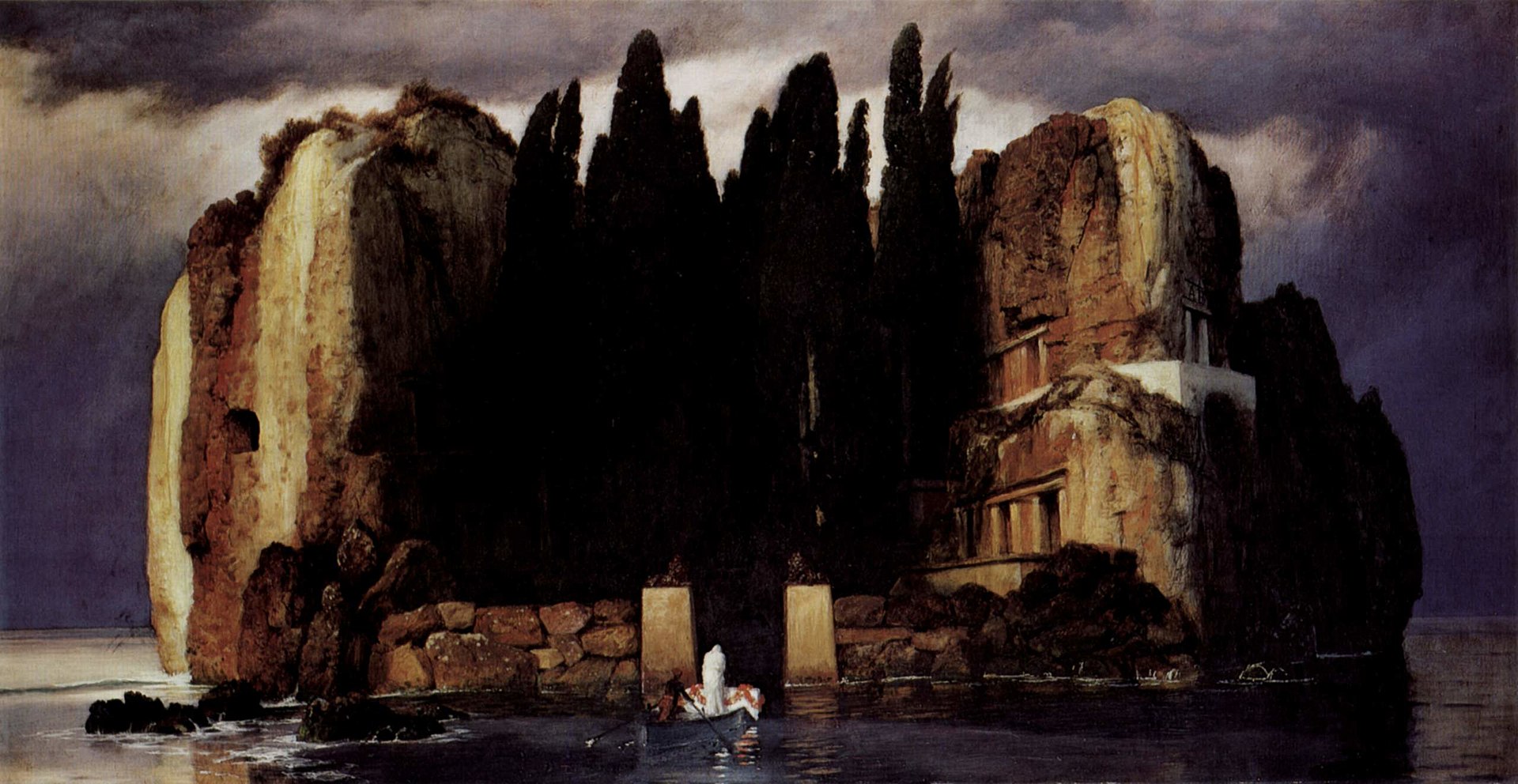
Böcklin painted five versions of this instantly popular work for collectors. One version, the third, was bought by Adolf Hitler in 1933 and now hangs in the National Gallery in Berlin. Another, the fourth, was destroyed by a bombing raid in World War II and only exists now as a black and white photograph.

This painting had something  with which people deeply identified and it was the new popularity of mass produced lithographic prints in the time that gave it staying power. It was said that one couldn’t enter a Berlin home at the turn of the century without coming across a print of the painting on the wall. This image has maintained quite a bit of its following through the years, even having websites dedicated to it.

As I said, it is a powerful image that lingers in your mind long after you see it. I know it does for me. It has definitely been a huge influence on a number of painters and other artists.

In 1888, Böcklin created a painting, Isle of Life (see below), that he considered the converse image to his now famous Isle of the Dead.  It has living people, animals, greenery and a generally more upbeat appearance. But it certainly doesn’t come close to the soul jolting impact of its antithesis.

But you be the judge…

Isle of the Dead – Arnold Böcklin- Fifth Version

Isle of the Dead – Arnold Böcklin-Second Version

Isle of the Dead – Arnold Böcklin-Fourth Version Destroyed

Isle of Life – Arnold Böcklin

Isle of the Dead – Arnold Böcklin- Third Version

Standing Naked

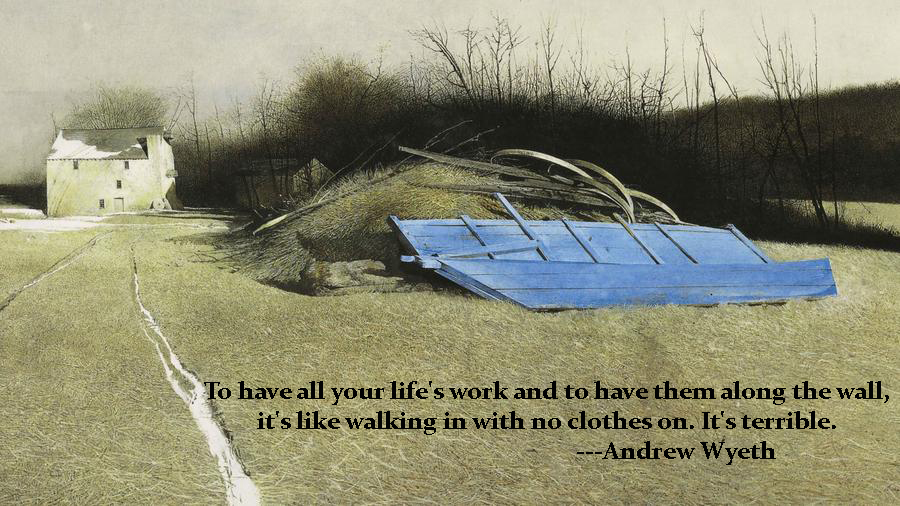
I was looking for something this morning and came across the above quote from Andrew Wyeth which really rang true for me.

I am in the midst of working feverishly towards my June 1 show at the Principle Gallery in Alexandria. my 19th solo show there. I’ve done over 50 solo exhibitions over the years so you would think that I would be over any uneasiness that comes with showing my work. But I still get that terrible queasy feeling in my gut whenever I first see each show hanging. It really is a feeling much like Wyeth describes, like standing there with no clothes on.

The worst of these feelings came at my first show at the Principle Gallery back in 2000. It was called Red Tree, which was the real introduction of the that signature tree that populates much of my work. I had only been working as a full-time artist for two years and had only two small solo shows at regional art centers under my belt at that point, so I had no expectations for such a show. But I had developed a solid base of collectors at the Principle since I began showing there in early 1997 and they felt I might do well with a show.

I understood at the time that this was a wonderful opportunity and put a lot of pressure on myself to put everything I could into that show. The rustic studio that was my home for the first ten years that I worked as an artist was much smaller than my current studio so when the show was done every space in it was filled with new work. I couldn’t get a real idea of how the show might look together, especially since this was pre-digital for me, all my work documented in slides rather than JPEGs.

I felt good about the work but maybe I was just being delusional. It happens.

So on the day of the opening we first walked into the gallery several hours before the reception and the then burnt orange walls of the gallery were filled with these paintings. There was a dizzying vibration to it that gave Cheri and I both an overwhelming feeling of nausea. It was like the inner self that I tried to keep hidden from the world was suddenly splashed through the gallery and I was trapped there amidst it, like someone standing naked in a dream with no way to escape and nothing with which to cover up.

Thankfully, that night exceeded all my expectations. If it had not, I don’t know that I might even be writing this blog now or where I would be in my career. If it had not done well, that horrible feeling would surely have stayed with me forever. As it is, it still visits me with every show but to a lesser degree and for shorter time span.

I suppose you get used to public nudity after a time.