Feeds:
Posts
Comments

With my annual Gallery Talk at the West End Gallery coming up tomorrow, I thought I’d share a blog  entry from back in 2009 about a talk that was approaching then. I still have some of the same anxieties but it has gotten easier and I think a lot smoother over the years:
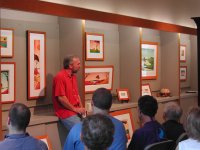
Gallery TalkWell, today’s my annual Gallery Talk at the West End Gallery in Corning in conjunction with my show, Dispatches, which is hanging there until the end of August.  I’ve done quite a few of these talks over the years, probably 14 or 15, so I know what to expect.  But there’s always a little anxiety anytime you have to speak in front of any group of people.

My gallery talks are always pretty much off the top of my head which, when it works and the audience is receptive and interacting, is good.  When it doesn’t work, it’s pretty ugly, especially for me.  A lot of blank stares and awkward silences as I try to find a hole in which I can hide.  Luckily, that’s only happened once or twice.

The first talk I did at the West End was back in 1997 and I had put everything I wanted to get across into a short speech that I wrote out and memorized.  Well, the talk began and I reeled off my little speech.  It was pretty good, everything moving along smoothly, until I came to the end of my prepared statement and glimpsed at the clock.

It had lasted about 4 minutes and my mind was a totally blank slate.

Tom Gardner, then co-owner of the gallery and a well known painter, had told me a little trick before the talk.  He told me to always have a glass of water and when I came to a spot where I was stuck with nothing to say to simply walk back and forth in front of the audience and take a very slow sip of the water.  Look thoughtful.  I thought it was pretty good advice until I realized I would be pacing back and forth, sipping water, for 56 minutes.

That much sipping would also demand a bathroom break.

Luckily, Tom rescued me with a question and from there it snowballed with the rest of the crowd asking questions, one subject leading to another. Phew!  Over the years I’ve gotten more comfortable with the whole thing and have an assortment of anecdotes to fall back on when things start to falter.

Another reason I don’t go in with a prepared speech is that each group of people is different.  Some groups are more interested in talking technique, wanting to know how each piece is painted.  What type of paint I use and how I achieve certain aspects in the paintings.  That kind of thing.  But others are not so interested in the how but in the why.  They prefer to hear what the stories are behind the paintings.  So, there’s a moment at the beginning of each talk  when I have to gauge what approach suits this particular group best.  I really try to stay away from the technical side for the most part because sometimes, when I’m droning on about such things, I can see the non-painters’ eyes glazing over.  I try to get off the subject as soon as possible when I spot this and try to engage their interest.

It usually goes pretty well and we all have a few laughs.  I’m hoping today is no different.  If you’re in the area today, the talk takes place at noon at the West End Gallery in Corning, NY.

**************

Win This Painting!

I think that last paragraph definitely applies to tomorrow’s talk. I am pretty sure it’s going to go well. I’ll tell some stories, we’ll have some laughs, maybe reveal a couple of things you didn’t know before and then I give away some stuff. That’s plural, as those who have come to these talks in the past will recognize. The painting shown here is the main prize but you never know what else will show up.  So tomorrow, Saturday, August 5, I encourage you to come out to the West End Gallery at 1 PM. Maybe come a little early to claim a seat. It should be fun.

An ASL Interpreter will be on hand

Unsurprisingly, one of the more popular features of my Gallery Talks is the drawing that is held at the end where one of my paintings is given away to one of the the folks in attendance. Who doesn’t want to win something?

But it’s also one of my favorite parts of the talks. It’s an opportunity to express my gratitude in a small but tangible way for this path as an artist that many of the people at these talks have allowed me to pursue. I never felt any sort of entitlement to walk this path, that I ever possessed any sort of extraordinary talent, training or knowledge that dictated that I follow this path. I knew that my only attribute was a desire to be heard, to stand as an individual voice. I knew that I was going to have to work hard and have a lot of good luck and help along the way if I were ever to move along it.

I believe that I have worked hard and I know that I have had more than my share of good fortune and help along the way, much of it given by those who have come to my shows and talks over the years. With their support and the encouragement that they and so many others like them have given, I continue down the path that I have enjoyed travelling for so long now.

So showing a little gratitude is not something I take lightly. It is a responsibility, a mandate.

As I have pointed out, I try to choose paintings to give away at the talks that have meaning for me, that give me a little twinge of regret in letting them go. And I think the piece I have chose for Saturday’s talk fills that bill very well.

It is titled Through Time and has been a personal favorite for a while now.  It’s a simple composition with some of my recognizable elements– the Red Tree , the Red Roofs and the winding path- set against clouds that travel diagonally across the sky. I think the thing about this piece that attaches it so strongly to me is that I see it as representing art’s ability to travel through time, to be always in the present regardless of when it is experienced. I know that my days on this planet are limited but my hope is that my work will somehow outlive me and connect the emotions and sensations I have felt in this life to someone in the future who sees those same things in their own life when they look upon the work.

While I will be gone and unaware of it, this lets me see my work as a time traveler of sorts. And that’s what I see in this painting and why I hold it in my own high esteem. I want someone else to have it so that it might start it’s own journey.

Maybe you could help it on its way.

The Gallery Talk takes place at the West End Gallery on beautiful Market Street in Corning this coming Saturday, August 5. It starts at 1 PM and runs about an hour with the drawing for Through Time taking place at the end.  Along with the drawing, there will be refreshments, some stories and what is usually a very good conversation.

Plus, this year we have the services of an American Sign Language interpreter for our deaf friends. Please RSVP the gallery at 607-936-2011 for seating near the interpreter.

So, try to come out Saturday to the West End Gallery. I will do my best to make it worth your while.


Drift Away

I am busy getting ready for this Saturday’s Gallery Talk at the West End Gallery.  You wouldn’t think it would take much preparation, would you? I show up and talk for a while. End of prep. And from a few of the many talks I’ve given over the years, that would appear to be the extent of my preparation.

But I really do try to have an idea of some ideas I want to get across in these talks. Sometimes, it focuses on an anecdote or two or a thought that has been floating around with me for some time. So, I try to collect these ideas and commit them to memory so that I can go to them when the time arises.

But the main preparation comes in continually telling myself to allow myself to be absolutely transparent and honest when I am up there in front of the group. That can mean admitting to my shortcomings and flaws to people that I’ve sometimes never seen before. I know that sounds awful when taken at face value, something no one really wants to face. Who wants to confess anything to strangers?

But, as an artist, there is great value in those moments. There is catharsis in the act of  confession, revelation in the exposing of one’s vulnerabilities. It’s like wiping off layers of dust from a mirror — what may have been obscured is now evident. And for me, that is a vital part of my creative process. Without it, I may as well be a chimp with fingerpaints.

So, my prep consists of readying my willingness to reveal vulnerability. Believe me when I say that it takes some doing.

Another part is choosing a painting to give away at the end of the talk. I spend a lot of time, going back and forth on what to give away. As I have said in the past, I want it to be a meaningful piece, something that actually hurts me a little bit to give away. I am really struggling to choose a piece for this talk. I have a couple in mind but keep changing my mind because part of me doesn’t want to give them away. And that little pang of regret makes me think I am close to choosing.

I will let you know in the next day or so.

So, to sum up: Gallery Talk this Saturday, August 5, at the West End Gallery in Corning. There will be refreshments, a drawing for one of my paintings, maybe a few other assorted giveaways and, if my preparations work out as planned, a darn good conversation.  

There is also a small group of new paintings that are coming with me including the little piece shown above. It’s petite in size only. I call it Drift Away. Here’s the song from Dobie Gray from many years back. If you are of a certain age, you have no doubt heard this song a thousand times and have the chorus permanently etched in your brain tissue. But it’s still a good listen.

Toward Home

“Mr. Fred shook hands with her, said he was glad to see her, drew out a wet Coke from the machine, wiped it on his apron, and gave it to her.

This is one good thing about life that never changes, she thought. As long as he lived, as long as she returned, Mr. Fred would be here with his…simple welcome. What was that? Alice? Brer Rabbit? It was Mole. Mole, when he returned from some long journey, desperately tired, had found the familiar waiting for him with its simple welcome.”

Harper Lee, Go Set a Watchman

************************

This is a new piece, a little painting just a bit over 2″ by 3″ that I call Toward Home. It’s going with me this coming Saturday for my Gallery Talk at 1 PM at the West End Gallery in Corning. I generally try to bring a few very new pieces to my talks to complement the works on hand.

I thought the words of Harper Lee above fit this piece. It has a sense of going home about it, about returning to the familiar. That’s something I understand.

I always look for the familiar and am attracted to those places and people that give me that feeling of having encountered them before. A natural sense of comfort that comes with knowing the landscape, instinctively sensing the rhythm of the place or person.

The Red Tree in this little piece reminds of those things that we set for ourselves as landmarks, those spots on our journey home that let us know we are in a place we call home. I know when I am returning from a road trip there are spots that, once I have passed them, I feel that I am home. Knowing that I am of that area, my mind and body eases as I finish the journey home.

It may be a small painting but it is full, at least for me.

********************

GALLERY TALK

SATURDAY, AUGUST 5, 2017 beginning at 1 PM

WEST END GALLERY, CORNING, NY

There will be a drawing for an original painting and other surprises, so try to make it to the West End Gallery this Saturday!


Reverie

Maybe it’s a morning for daydreaming. There’s a sharp crispness in the air this morning that reminds me of autumn mornings, gloriously cool and bright. But we’re lingering in July with the gauzy summer days of August still before us, so there is still a bit of time before those fall mornings arrive. So I’ll daydream of those days ahead.
I guess this leads me to today’s musical selection. I thought I’d carry on the daydreaming theme with a classical piece from Claude Debussy. It is titled Reverie which is just another way of saying daydream.  I chose this version from Eugene Ormandy and the Philadelphia Orchestra because it features a nice slideshow of Maxfield Parrish paintings, all of which easily fall into the category of daydreams.

Give a look and a listen. Let your mind float for a bit and have a good day.


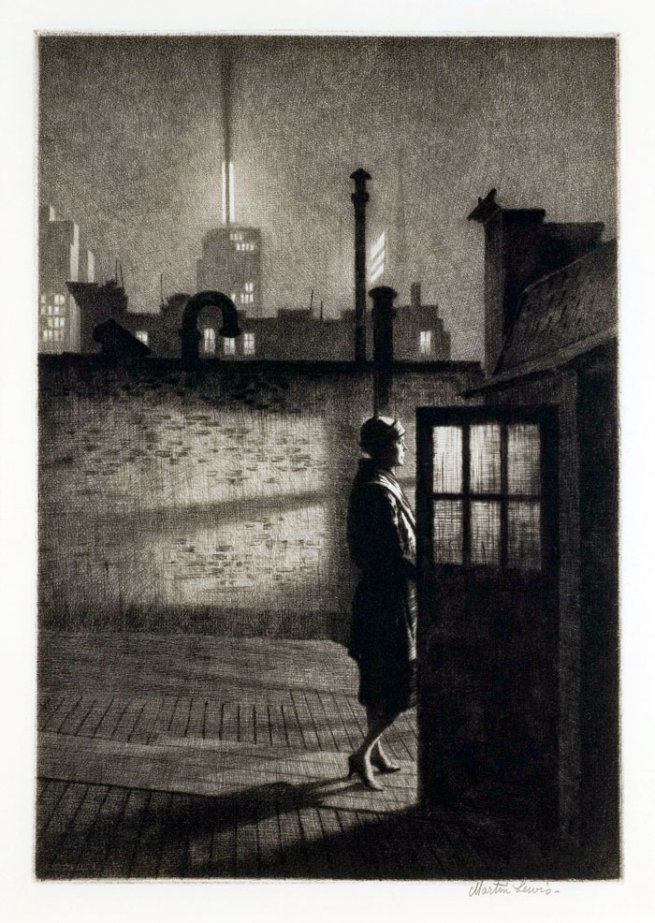
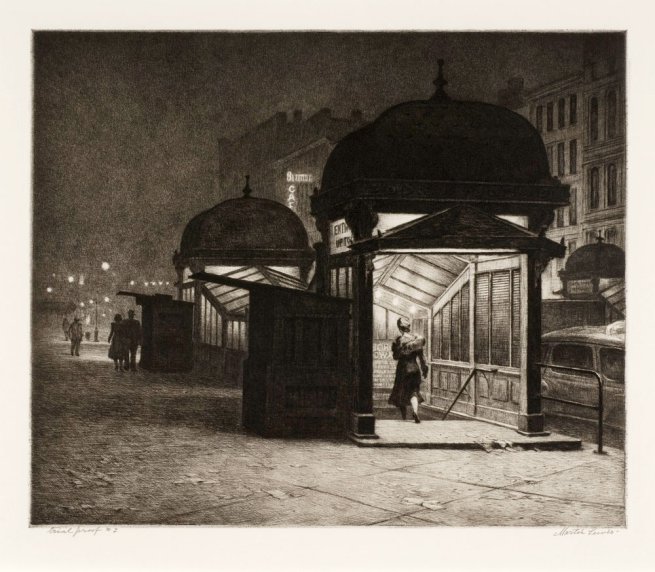
Martin Lewis - Late Traveler 1949I saw a Martin Lewis etching years ago and was transfixed by the crisp contrast of its darks and lights and the easy moodiness it gave off.  I knew nothing of the artist but it was obvious that he was masterful in his etching and in his artistic eye.  I had largely forgotten this artist until I came across a group of his etchings that are coming up for auction.  Seeing them rekindled that same feeling I felt years ago.  Mainly images from New York in the 20’s and 30’s, they often capture a feeling of urban anonymity and isolation, mining the same vein of emotion in which Edward Hopper worked in his paintings.  This is probably not a coincidence since Lewis and Hopper were friends, Lewis having taught Hopper the art of etching around 1915. Those people in the late-night diner of Hopper’s Nighthawks also inhabit Lewis’ world of dark streets and shadows.

Martin Lewis was born in Australia in 1881 and ran away from home at age 15, working rough jobs for a few years as he travelled and sketched his way through Australia and New Zealand.  He ended up in Sydney where he studied and did illustrations for a local newspaper.  He migrated to the US around 1900, arriving in San Francisco where he painted backdrops for the presidential campaign of William McKinley before finding his way to New York City.

Martin Lewis- Relics (Speakeasy Corner) 1928Inspired by the dynamism of the city at that time, Lewis worked as an illustrator and painter.  It was a 1910 trip to England, where he was introduced to the printwork of English artists such as James MacNeil Whistler, that inspired him to take up etching.  However, it was an 18 month stay in Japan in 1920 that set the groundwork for his signature work which captures light and air and mood so well.  He was active and increasingly successful from 1925 until about 1935.  However, the Great Depression brought a downturn to his popularity and by the 1940’s his work was out of favor.  His work never really took hold after that and he died in 1961,  largely unknown.  In fact, just finding some of the details on his life for this short blog post took some doing.

I think his work is wonderful and evocative and  find it amazing that his work ever fell out of favor.  But such is the nature of art.  But the etchings of Martin Lewis will persevere through the fickle cycles because they capture something elemental and personal.  And that is what real art does.

Martin Lewis- Shadow Dance 1930Martin Lewis-Tree ManhattanMartin Lewis- Little PenthouseMartin Lewis- Glow of the City 1928Martin Lewis - Which Way 1932Martin Lewis New York Nocturne

The Center Holds

I first read the poem The Second Coming by William Butler Yeats over forty years back and it left a mark. Cut and scarred me. Its first verse still resonates in my mind, especially that last line– the best lack all conviction, while the worst/ Are full of passionate intensity. It just reeks of the current political bog in which we are mired.

After putting the final touches on the piece above, a 12″ by 36″ canvas, I began examining the painting, trying to discern what it held for me. Immediately, the image from Yeats’ poem came to mind of a world in disarray,  spinning out of control in dark chaotic clouds and rising tide that overtakes and drowns all hopes.

But instead of Yeats’ forewarning that the center ( or centre, as is in his Irish version) cannot hold, I saw the Red Tree standing strong and resolute against the troubles swirling around it.  It holds tight to its core, not allowing the madness surrounding it to overtake it or alter those values of goodness that it holds dearly as definitions of its own humanity. It will die before it will succumb to becoming part of the blood-dimmed tide, as Yeats put it.

I am calling this painting The Center Holds.

I think this is a strong piece although I am not sure the photo above captures everything in it, its depth and contours. It’s coming with me to the West End Gallery for my Gallery Talk there next Saturday, August 5. Stop by and check it out for yourself.

Meanwhile, here’s Yeats’ The Second Coming:

Turning and turning in the widening gyre   
The falcon cannot hear the falconer; 
Things fall apart; the centre cannot hold; 
Mere anarchy is loosed upon the world, 
The blood-dimmed tide is loosed, and everywhere   
The ceremony of innocence is drowned; 
The best lack all conviction, while the worst   
Are full of passionate intensity.                                                                                                                                                                               .
Surely some revelation is at hand; 
Surely the Second Coming is at hand.   
The Second Coming! Hardly are those words out   
When a vast image out of Spiritus Mundi 
Troubles my sight: somewhere in sands of the desert   
A shape with lion body and the head of a man,   
A gaze blank and pitiless as the sun,   
Is moving its slow thighs, while all about it   
Reel shadows of the indignant desert birds.   
The darkness drops again; but now I know   
That twenty centuries of stony sleep 
Were vexed to nightmare by a rocking cradle,   
And what rough beast, its hour come round at last,   
Slouches towards Bethlehem to be born? 

Sunny Point from Keuka Lake

Have some details here for a two day painting workshop I will be leading at the Sunny Point location on the east side of Keuka Lake, located here in the beautiful Finger Lakes region of New York state. The workshop is being hosted by the Arts Center of Yates County and their Sunny Point location is a wonderful setting. We will be painting on the wonderful porch overlooking the lake and if the weather turns will move inside where they are in the process of updating their lighting with full spectrum LED’s.

The dates are September 28 and 29, Thursday and Friday. The workshop begins at 9 AM and runs to 4 PM each day. Enrollment is limited to 8-10 workshoppers with materials being provided. It is open to all levels of ability– from working artists to pure beginners. Even if you have never held a paintbrush, you can take part and create your own piece of art. You can go to this link to contact them about enrollment.

Looking out from the Sunny Point painting porch

This is my third year with this workshop and it is, surprisingly for me, something that I enjoy. Believe me, I was a little apprehensive in the beginning, as I am sure the folks who attended that first workshop can attest. But seeing how attentive and excited they were by the things they learned was invigorating to me. They made tremendous strides in a very short time and much of what they did was, simply put, exceptional. Plus, it was fun, with a lot of story-telling and good natured conversation.

In the past two workshops we focused on my wet process, one where a lot of liquid paint is put on the surface then taken off. It is fast paced and sloppy but the effects of the paint show themselves immediately. It can be exciting.

We will be painting in this style at this year’s workshop

This year we are switching gears, moving to a more controlled type of painting, one where we will be working a bit more upright on easels, applying multiple layers of paint. To put it simply, the wet process was about pulling paint off to reveal light and this process is about adding paint to build up light.

It’s a different thought process, one that is often a bit more meditative and slow forming. But, that being said, we will be moving at a fast pace. I want the artists there to try to see how it is to paint without thinking so much about painting a picture and focus on each stroke and its importance. My feeling is that every stroke is significant and the painting as a whole is a compilation of small paintings that come together to express something emotive.

Maybe that sounds ambitious for a two day workshop. But I have a feeling that the folks who end up at Sunny Point will be willing to have some fun and work hard to see that end. If it sounds like something that might interest you, I can guarantee you that I will work hard to make it worth your while.

Hope to see you on Keuka Lake in late September!


I wrote about late artist Dale Nichols (1910-1995) a few years back after being completely charmed by his paintings of snowy scenes from his home state of Nebraska. In that blog entry I mentioned that there wasn’t a huge amount of info on the artist. The only book was a book that accompanied a show of his work from back in 2011 at a small but not unimportant museum, the Bone Creek Museum of Agrarian Art, in his hometown of David City, Nebraska. I was shocked to find that this book was selling for $458 on Amazon which is a testament to the lack of literature on this wonderful artist. Happily, I found a copy at a normal price at the museum’s online gift shop.

I came across a nice short called The Forgotten Artist from Nebraska public television that features Nichols’ work and the Bone Creek Museum. It is a charming look at his work and the relationship he had with his niece. I thought I’d rerun the article I ran earlier along with the video. Maybe it will help make Dale Nichols a little less forgotten.

**************************

Dale Nichols- Company for SupperMost likely prompted by the recent weather here as well as a desire to try a slight change of palette, I have been doing a small group of snow paintings recently.  I thought I would look at several other artists, especially those with a distinct personal style,  to see how they handle snow in their work.  One of the artists whose snow works really stuck out  was Dale Nichols, who was born in Nebraska in 1904 and died in Sedona, AZ in 1995.  He is considered one of the American Regionalists,  that loosely defined group of painters whose work  for which I have long expressed my admiration.

Dale Nichols- After the Blizzard 1967His biography is a bit sparse with but Nichols lived a long and productive life, serving as an illustrator, a  college professor and the Art Editor of the Encyclopedia Brittanica.  He also spent a lot of time in Guatemala which resulted in a group of work with Meso-American forms that is quite different from his Regionalist work.

But Nichols is primarily known for his rural snow scenes and it’s easy to see why.  The colors are pure and vivid.  The snow, put on in multiple glazed layers with watercolor brushes has a luminous beauty.  The stylized treatment of the crowns of the bare trees adds a new geometry to the paintings.   There is a pleasant warmth, a nostalgic and slightly sentimental glow, to this work even though they are scenes that depict frigid winters on the plains of Nebraska.  Free of all angst, they’re just plain and simple gems.

You can see a bit more of Dale Nichols other work on a site  devoted to him by clicking here.

Dale Nichols- The SentinelDale Nichols- Silent Morning 1972Dale Nichols- Mail Delivery 1950Dale Nichols- Bringing Home the Tree


You have most likely seen the work of Piet Mondrian, the Dutch painter who lived from 1872 until 1944.

Like the painting shown here. Seems so simple. Mainly black lines creating squares and rectangles that are mainly white but periodically filled with bright primary colors. Critics claim it is too simple, that it is something a grade-schooler with a ruler and some paints could replicate easily.

Maybe. Maybe not. Who cares?

But putting that side aside, his work has always remained refresh and modern through most of the last century up to this very minute. Outside of time, like it represents a future moment that exists just beyond this very moment at all times. And that factor in itself makes his work appealing to me.

I will never list Mondrian as a true influence or even a real favorite of mine, there is much to be gained as an artist from studying his work. The elegance of his structures and the space created within, for example. Or how he transformed his work through the years from a style of impressionistic realism into cubism and then into the style of his that we know so well, stripping away all detail and content down to the bare essence of being.

The video below shows that evolution beautifully, with musical accompaniment from Phillip Glass. I hope you’ll find it interesting to see how the work makes that transformation. Take a look below.

Let us note that art – even on an abstract level – has never been confined to ‘idea’; art has always been the ‘realized’ expression of equilibrium.
-Piet Mondrian