I ran the post below a few years back but wanted to run it again just because Martin Lewis’ work hits the mark so well for me with their wonderful darkly evocative narratives. Plus , I found a video that uses his work along accompanied by dance band music from the time, the early 1930’s. The song is Blues In My Heart performed by Bert Lown and the Biltmore Hotel Orchestra featuring vocalist Elmer Feldkamp. Probably not names that ring a bell for most of us but they fit here.
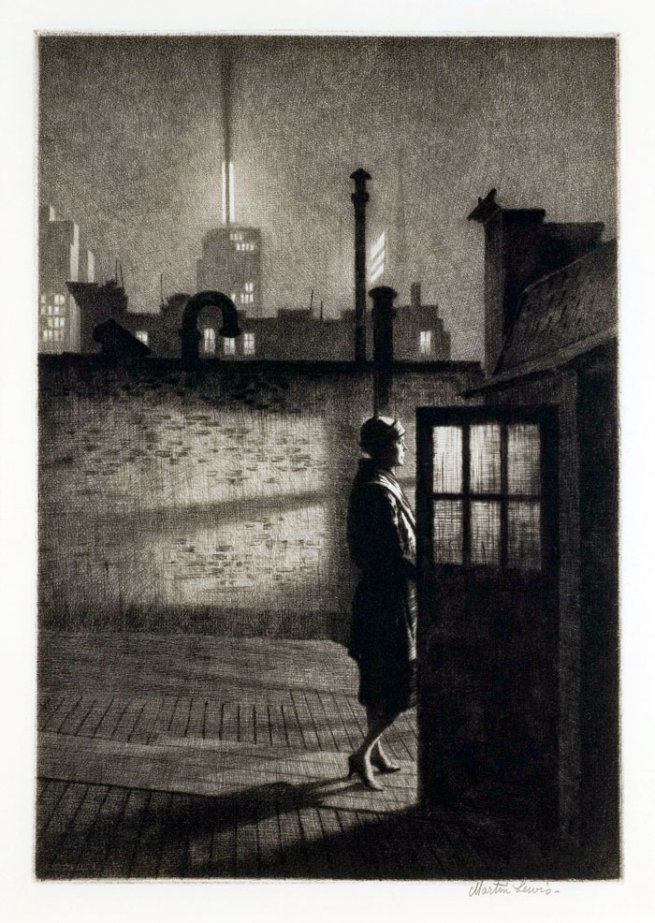
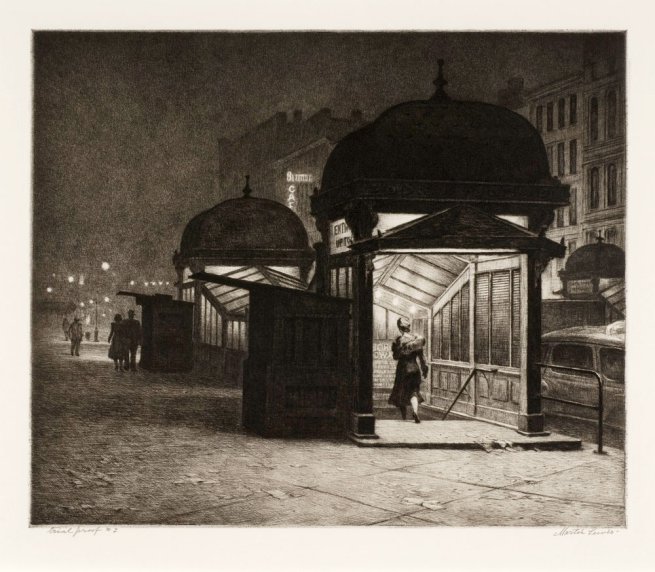 I saw a Martin Lewis etching years ago and was transfixed by the crisp contrast of its darks and lights and the easy moodiness it gave off. I knew nothing of the artist but it was obvious that he was masterful in his etching and in his artistic eye. I had largely forgotten this artist until I came across a group of his etchings that are coming up for auction. Seeing them rekindled that same feeling I felt years ago. Mainly images from New York in the 20’s and 30’s, they often capture a feeling of urban anonymity and isolation, mining the same vein of emotion in which Edward Hopper worked in his paintings. This is probably not a coincidence since Lewis and Hopper were friends, Lewis having taught Hopper the art of etching around 1915. Those people in the late-night diner of Hopper’s Nighthawks also inhabit Lewis’ world of dark streets and shadows.
Martin Lewis was born in Australia in 1881 and ran away from home at age 15, working rough jobs for a few years as he travelled and sketched his way through Australia and New Zealand. He ended up in Sydney where he studied and did illustrations for a local newspaper. He migrated to the US around 1900, arriving in San Francisco where he painted backdrops for the presidential campaign of William McKinley before finding his way to New York City.
 Inspired by the dynamism of the city at that time, Lewis worked as an illustrator and painter. It was a 1910 trip to England, where he was introduced to the printwork of English artists such as James MacNeil Whistler, that inspired him to take up etching. However, it was an 18 month stay in Japan in 1920 that set the groundwork for his signature work which captures light and air and mood so well. He was active and increasingly successful from 1925 until about 1935. However, the Great Depression brought a downturn to his popularity and by the 1940’s his work was out of favor. His work never really took hold after that and he died in 1961, largely unknown. In fact, just finding some of the details on his life for this short blog post took some doing.
I think his work is wonderful and evocative and find it amazing that his work ever fell out of favor. But such is the nature of art. But the etchings of Martin Lewis will persevere through the fickle cycles because they capture something elemental and personal. And that is what real art does.




 I first read the poem The Second Coming by William Butler Yeats over forty years back and it left a mark. Cut and scarred me. Its first verse still resonates in my mind, especially that last line– the best lack all conviction, while the worst/ Are full of passionate intensity. It just reeks of the current political bog in which we are mired.


 I wrote about late artist Dale Nichols (1910-1995) a few years back after being completely charmed by his paintings of snowy scenes from his home state of Nebraska. In that blog entry I mentioned that there wasn’t a huge amount of info on the artist. The only book was a book that accompanied a show of his work from back in 2011 at a small but not unimportant museum, the


 You have most likely seen the work of Piet Mondrian, the Dutch painter who lived from 1872 until 1944.
 Here’s an update for upcoming events on my schedule for the next couple of months:

 I’ve been going through some books on my shelves that I haven’t looked at for some time and came across a smallish book on the work of Richard Lindner, who was a German born (1901) painter who moved to New York during World War II. He taught at the Pratt Institute then later at Yale before his death in 1978.
 guided the hand of the film’s artist who most people think was Peter Max. However, the artist was Heinz Edelman . This misconception probably shows Lindner’s influence on Max as well. I also can see Lindner in some of Terry Gilliam‘s animations for Monty Python. The Beatles paid tribute to Lindner by inserting his image in the group of figures on the cover of their classic Sgt. Pepper’s Lonely Hearts Club Band album. He’s between Laurel and Hardy in the second row.
 One of my favorites is shown to the left here, FBI On East 69th Street. I have no idea whether he was influenced by Lindner’s work (although I wouldn’t be surprised), but when I look at this painting I can only think of David Bowie, especially in the early 70’s in the Glam era. Again, the strength of the color and shape,s as well as how his figures fill the picture frame, excite me. How I might take this excitement and make it work within my own work is something that remains to be seen. It may not be discernible but seeing work that makes your own internal wheels spin will show up in some manner. We’ll have to see if this comes through in the near future.


 Redtree Times