 I have written a number of times here about the events that are taking place in this country and my frustration at how little effect reasoning and factual evidence have on the followers of the current president. Their stubborn stupidity seems impenetrable to even the most glaring truths. I am sure that there are many of them out there who still, faced with an ever expanding list of acts of malfeasance, refuse to see anything other than a conspiracy against the leader of their cult.
It turns out that this phenomenon is nothing new. It can probably found in every major movement based on political power or religion. One of the most enlightening essays on the subject of the stupidity of the follower came to us in a letter written in a German prison during World War II by theologian and anti-Nazi dissident Dietrich Boenhoeffer. The first paragraph of the essay is shown above.
Dietrich Boenhoeffer was a pastor and theological writer who stood in direct opposition to the Nazi regime and spoke out against its programs of euthanasia and genocide. He had an opportunity to stay in the US in the late 1930’s, safe from the reach of the Nazis, but he insisted on returning, believing that if he were to rebuild the German church in the war’s aftermath he must endure it with its people.
He was imprisoned in a German prison in 1943 and later transferred to a concentration camp. He was implicated in a plot to assassinate Hitler and he was hanged in the waning days of the war, in April of 1945.
Dietrich Boenhoeffer’s story is most interesting and his writings live on and have great influence to this day. One of the terms he coined was cheap grace which also has great meaning today. I’ve included an apt description of this at the bottom of this page..
The following essay is taken from a letter written while in captivity. I urge you to read it. It may help you understand better your own frustration wit what you see today. And if you are one of those who fail to see what seems so clearly evident to most people, perhaps you should read it then ask yourself how you allowed yourself to be swept up in this grand wave of stupidity.
‘Stupidity is a more dangerous enemy of the good than malice. One may protest against evil; it can be exposed and, if need be, prevented by use of force. Evil always carries within itself the germ of its own subversion in that it leaves behind in human beings at least a sense of unease. Against stupidity we are defenseless. Neither protests nor the use of force accomplish anything here; reasons fall on deaf ears; facts that contradict one’s prejudgment simply need not be believed- in such moments the stupid person even becomes critical – and when facts are irrefutable they are just pushed aside as inconsequential, as incidental. In all this the stupid person, in contrast to the malicious one, is utterly self-satisfied and, being easily irritated, becomes dangerous by going on the attack. For that reason, greater caution is called for than with a malicious one. Never again will we try to persuade the stupid person with reasons, for it is senseless and dangerous.
‘If we want to know how to get the better of stupidity, we must seek to understand its nature. This much is certain, that it is in essence not an intellectual defect but a human one. There are human beings who are of remarkably agile intellect yet stupid, and others who are intellectually quite dull yet anything but stupid. We discover this to our surprise in particular situations. The impression one gains is not so much that stupidity is a congenital defect, but that, under certain circumstances, people are made stupid or that they allow this to happen to them. We note further that people who have isolated themselves from others or who lives in solitude manifest this defect less frequently than individuals or groups of people inclined or condemned to sociability. And so it would seem that stupidity is perhaps less a psychological than a sociological problem. It is a particular form of the impact of historical circumstances on human beings, a psychological concomitant of certain external conditions. Upon closer observation, it becomes apparent that every strong upsurge of power in the public sphere, be it of a political or of a religious nature, infects a large part of humankind with stupidity. It would even seem that this is virtually a sociological-psychological law. The power of the one needs the stupidity of the other.The process at work here is not that particular human capacities, for instance, the intellect, suddenly atrophy or fail. Instead, it seems that under the overwhelming impact of rising power, humans are deprived of their inner independence, and, more or less consciously, give up establishing an autonomous position toward the emerging circumstances. The fact that the stupid person is often stubborn must not blind us to the fact that he is not independent. In conversation with him, one virtually feels that one is dealing not at all with a person, but with slogans, catchwords and the like that have taken possession of him. He is under a spell, blinded, misused, and abused in his very being. Having thus become a mindless tool, the stupid person will also be capable of any evil and at the same time incapable of seeing that it is evil. This is where the danger of diabolical misuse lurks, for it is this that can once and for all destroy human beings.
‘Yet at this very point it becomes quite clear that only an act of liberation, not instruction, can overcome stupidity. Here we must come to terms with the fact that in must cases a genuine internal liberation becomes possible only when external liberation has preceded it. Until then we must abandon all attempts to convince the stupid person. This state of affairs explains why in such circumstances our attempts to know what ‘the people’ really think are in vain and why, under these circumstances, this question is so irrelevant for the person who is thinking and acting responsibly. The word of the Bible that the fear of God is the beginning of wisdom declares that the internal liberation of human beings to live the responsible life before God is the only genuine way to overcome stupidity.
‘But these thoughts about stupidity also offer consolation in that they utterly forbid us to consider the majority of people to be stupid in every circumstance. It really will depend on whether those in power expect more from peoples’ stupidity. than from their inner independence and wisdom.’
-Dietrich Bonhoeffer, from ‘After Ten Years’ in Letters and Papers from Prison (Dietrich Bonhoeffer Works/English, vol. 8) Minneapolis, MN: Fortress Press, 2010
Cheap Grace-
“But there is another, uniquely religious aspect that also comes into play: the predilection of fundamentalist denominations to believe in practice, even if not entirely in theory, in the doctrine of “cheap grace,” a derisive term coined by the theologian Dietrich Bonhoeffer. By that he meant the inclination of some religious adherents to believe that once they had been “saved,” not only would all past sins be wiped away, but future ones, too—so one could pretty much behave as before. Cheap grace is a divine get-out-of-jail-free card. Hence, the tendency of the religious base of the Republican Party to cut some slack for the peccadilloes of candidates who claim to have been washed in the blood of the Lamb and reborn to a new and more Christian life. The religious right is willing to overlook a politician’s individual foibles, no matter how poor an example he or she may make, if they publicly identify with fundamentalist values.”
— Mike Lofgren
 The other day I received the new Summer issue of Acrylic Artist magazine that hits the newsstands and bookstores on June 6. It contains an article featuring my work and how I arrived at my “signature style.”
 I have to say that I am pleased at the way it came out. Writer Zack Hatfield did a great job transforming our interview into a well written article covering ten pages along with numerous images. Many thanks to Zack and the editors at Acrylic Artist for being such pros and for a job well done.
 Truth and Belief, opening June 2 at the Principle Gallery, will be my 18th solo exhibit at the gallery. That’s a long enough time span to see the differences and changes in the work. Some of these come about because of technical changes and some come from conscious decisions. Some are evolutionary and I can see how a concept grows when I compare the shows from the different years.
 Sunday morning. It’s quiet which I like immensely. Early mornings are my favorite time, when there are fewer people stirring, fewer yahoos who feel it is their right and profound duty to create as much sound as they can in order that the universe might know they are alive. Those rare times when traveling, I like to get up early and prowl the streets of wherever we might be, taking in the landscape and buildings in a much quieter setting. The few people who are there are either early morning folks like myself who gladly soak in the quiet or they have somewhere to go and are still quietly dazed from being dragged from their bed.
 Really busy this morning as I try to wrap up everything for my Truth and Belief show that opens June 2 at the Principle Gallery. As it always is at this point, a week from delivering the show, there is still
  a lot to do including what seems like a million little, nit-picky details, those small touches that I find make a big difference.
 There is but one success– to be able to spend your life in your own way.
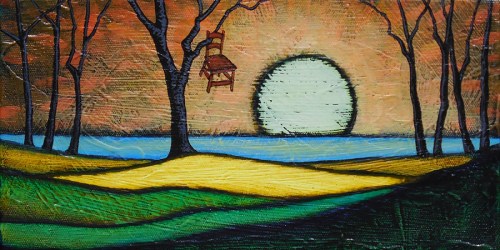
 This new painting is titled With Sanction of the Moon. It’s a 10″ by 20″ canvas that is part of my solo show, Truth and Belief, that opens in a little over two weeks on June 2 at the Principle Gallery. The show seems to be coming together really well with so many of the paintings pleasing me in surprising ways. This piece kind of symbolizes that aspect of the show.
 Every now and then a man’s mind is stretched by a new idea or sensation, and never shrinks back to its former dimensions.
 Well, it’s Mother’s Day. I am not going to wax sentimental here today except to say that I will think of my Mom today, just like I have nearly every day since she passed away nearly 22 years ago. I miss her in so many ways.
 Redtree Times