Feeds:
Posts
Comments

Purified Solitude

GC Myers- Purified Solitude smSolitude is the place of purification.

–Martin Buber

***************

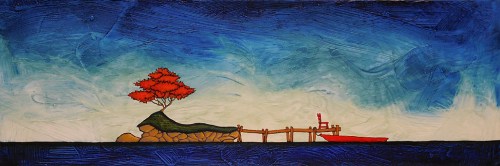
I have found myself painting quite a few islands lately, much like the one shown here in this new piece.  This small 12″ by 6″ painting on canvas is titled Purified Solitude and is part of my show, Contact, at the West End Gallery which opens on July 22.

Maybe the islands have come about because they are simply interesting compositional elements.  But part of me thinks it’s most likely an emotional response to the tensions of the world, an inner desire to pull away and find some peaceful solitude in a place where the bang and thrum of the outer world can’t reach me.

Of course, that is only possible on a short term basis.  We are formed in this world and are part of this world and can never fully break away.  The world is always with us.  But those moments when I find myself on that island of solitude do much to reinvigorate me, to make me feel strengthened to come back into the world once more.

That’s what I see in this little piece– a temporary refuge where the light can fully surround and cleanse me, purifying and washing away the confusion, the anger and the despair that builds up after time spent in this world.

Thankfully, I know that island is always there, waiting for me to arrive.

On the Dock

GC Myers-- On the Dock smWhat a time, what a time…

Watching the news it seems like we live in a time of chaos, in days and nights of division and anger.  To a certain extent I believe that’s true.  But for the majority of us– and I believe this includes people of every color, ethnicity and religion– we simply want to live a hassle-free life, one without rancor and hatred.  One where we can be ourselves as we wish ourselves to be and move through our days without fear.

One where chaos is a distant thing that doesn’t find its way to our guts.

Can we get to that point?  I believe we can.

How? That I don’t know.  Perhaps it to be found at first in small ways, in acts of kindness and tolerance towards others.  In not rushing to judgments and showing empathy.

It can’t hurt.

The painting at the top is in my upcoming show, Contact,  at the West End Gallery, opening July 22.  It’s an 8″ by 24″ canvas that is titled On the Dock.  There’s something very pacifying in this piece, something that definitely reminds me of the great Otis Redding classic, (Sittin’ on) The Dock of the Bay.  I have heard this song literally thousands of time and it never gets old for me.  It’s always calming and that is something I need these days.

It’s hard to believe that Otis Redding was only 26 when he cut this track not long before his death.  His life may have been short but he gave us so much to enjoy.  So, give a listen and have a peaceful Sunday.

There’s so much craziness taking place in this country at this point in time.  I wanted to write something that would plead for our patience and tolerance,  asking us to avoid the knee jerk reactions, finger-pointing and extreme behaviors that have brought us here.  To ask that we just breath and take a moment to consider the consequences of our words and actions.

I could do that.  But there has been so much said, so many words asking for calm  and some unfortunately, asking for retribution and more anger.  So instead I am going to focus on a different time and place.  Below is a piece from back in 2010 that focuses on the Coney Island paintings of Reginald Marsh, a favorite of mine, and some of my recollections of Coney Island.  Reginald Marsh

Reginald Marsh Coney Island Beach I’m always intrigued by the paintings of Reginald Marsh, who painted scenes depicting the urban world of New York City throughout the early part of the 20th century until his death in 1954.  His paintings always seemed densely packed with figures and constant movement, all rendered with easily recognizable line work and colors that were strong yet had a soft transparency.  Striking.

One of his favorite subjects was Coney Island, the famous part of Brooklyn with its beach, boardwalk and amusement park.  Whenever I see Marsh’s Coney Island paintings I am always reminded of the several trips I made there as a child in the late 1960’s.  My parents and I would go to NY to see Mets’ games, leaving my older, busier siblings at home, and would sometimes go to Coney Island on the day when the games were at night. 

It was always like entering an exotic, much different world than my country home.  It was dirty with  trash strewn everywhere.  I remember the first time we swung into the parking lot at Astroland, the amusement park there, and thinking we’d entered a landfill as there were literally piles of paper and bottles over nearly the whole lot.  If you spent much time in NY at that time, it was not an unusual sight.

Reginald Marsh The Lucky DaredevilsBut it was great fun and over the few visits there I had many memories that burned indelibly into my memory bank.  My parents, and my aunt and uncle who sometimes were with us, would, after a while stop at one of the bars that opened to the boardwalk to have a cold one and I would wander alone.  It was a wonderland of colorful attractions and games, their facades faded by time and sun. I have sharp memories of standing at one bar’s doorway and watching a singer all dressed in cowboy regalia standing on the bar with his electric guitar singing out country songs in the middle of the afternoon.  I sometimes wonder if it might have been country troubador Jerry Jeff Walker who had come out of Brooklyn. 

 Reginald Marsh Coney Island SceneI remember seeing the crowds down on the beach and suddenly seeing everyone there pointing out to the water and yelling.  Looking out, I saw two legs bobbing straight out of the water, almost comically so.  The lifeguards rushed out and dragged the body in.  Dead and, now that I think about it, had probably been so for a while.

I also remember going into a boardwalk arcade and approaching an older man with a gray moustache and a coin changer on his belt.  I asked for change and handed him my dollar bill.  He made a couple of clicks on the changer and poured a pile of nickels into my hands.  As I turned to go the machines, he put his hand on my shoulder.

Reginald MarshTunnel of Love“Hold on!” he exclaimed in a thick accent that sounded Greek and a little angry to a terrified nine year old.  He started chastising me.

“You don’t know me! Don’t ever trust anyone you don’t know.  I give you money and you trust me and don’t count.  You should not trust me.  Now, count!”

I stood there petrified and counted out loud.  It was the right change, of course, and the man’s gruff demeanor suddenly changed and he beamed a smile at me.  “You understand? Now go.  Have fun,” he said as he gave me a pat on the shoulder.

A little life lesson along with the change on the boardwalk in 1969.

That moment is clear as yesterday and it always reappears when I see images from Marsh or images of Coney Island.

Reginald Marsh Pip and Flip


The Old Man

GC Myers- The Old Man smNone are so old as those who have outlived enthusiasm.
Henry David Thoreau

*********************

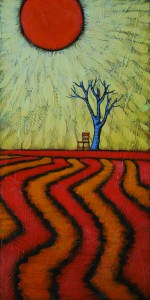
This is a new painting that measures 12″ by 6″ on panel and is part of my show at the West End Gallery that opens in about two weeks, on July 22.

I  call it The Old Man.

For me it symbolizes someone in their final years and days of life who has lost enthusiasm for this world, who sees it as a place that has changed beyond all recognition or comprehension.  It is no longer their world, which feels like an alien landscape in which they are stranded.

They feel detached from the lifeblood of the now and of the future, clinging to what remains of the past in their memories and connections, both which grow smaller and smaller with the passing of time.  After a time, even pulling from that field of memory brings no joy.

It becomes a painful waiting game beneath an unblinking sun.

That sounds sad, I know.  But there is something positive in it as well.  I see this as a cautionary piece, one that warns against disengaging from the world even as it changes from that which we have known and accepted.  The world keeps on moving and we must remain enthusiastic and find new joy in this ever changing world.

That’s my take on this painting, most likely formed from some personal observations. Perhaps you will see something other than this when you look at this image, something that jibes with your view of the world.

The Pause

GC Myers- The PauseThe right word may be effective, but no word was ever as effective as a rightly timed pause.
Mark Twain

*****************

The painting shown here is titled The Pause and is 16″ by 16″ on paper.  It is included in my upcoming show, Contact, at the West End Gallery which opens on July 22.

I am a big believer in the pause as a form of communication.  That brief moment of silence between words said and words not yet spoken, that small period of inaction between actions, is often filled with a great and ponderous anticipation of what might come next.  In that tiny span of emptiness there is both a look backward at all that has come before and ahead at all that the future might bring.  The pause allows for contemplation of both.

Okay, now that may be putting the importance of a pause in larger than life terms.  Not every pause holds all the past and all the future.  But every pause allows consideration and thought of the immediate past and future, giving that moment a certain degree of importance.

I learned the lesson of pausing from the many gallery talks I have given over the years.  Halting for just a moment to ponder the question asked or the statement made is far more effective than simply beginning to speak.  That was a difficult thing to do at first when it sometimes seemed like every moment needs to be filled with sound and content to cover my insecurity.  But I learned that that moment of silence was not a bad thing at all.  It showed an appreciation of the question or statement, showed that I heard what was being said and showed that I wanted really consider how I would answer.

Moving back to larger terms, the pause works in much the same way.  The pause takes the past and brings it into the present and makes it part of the decision for the future.  The pause consoles us as to what has failed us in the past and what has succeeded.  It cautions us against rash and impetuous actions.

The pause is a deep breath that freshens us, allowing us to take in the world around us and to refocus, to reconsider our words and actions.  The pause allows us to see other paths leading forward.

The pause can be a potent force, if only we choose to use it.

Woody Guthrie -This Machine Kills Fascists

Woody Guthrie -This Machine Kills Fascists

Since we’re in the midst of the Fourth of July weekend, I thought this Sunday’s musical selection should be something with a definite American flavor.   The song is This Land Is Your Land from the great Woody Guthrie.

You are no doubt familiar with this song, probably thinking of it as a cheery, upbeat song about the beauty and breadth of our democracy, sung often by smiling church and school choruses.  It’s become a kind of populist national anthem which is sort of ironic given its beginnings and the words of the song.  You see, there are verses that are seldom sung by the choruses and flag waving nationalists, verses that very much change the tone and meaning of the song.

Guthrie wrote the song in the late 1930’s in response to the immense popularity at that time of  the Kate Smith version of God Bless America, written by Irving Berlin.  Guthrie saw the world coming apart due to the nationalistic extremism that had spread through Europe, producing fascist leaders such as Hitler in Germany, Mussolini in Italy and Franco in Spain.

The original intro to God Bless America had the lines: While the storm clouds gather far across the sea / Let us swear allegiance to a land that’s free / Let us all be grateful that we’re far from there, / As we raise our voices in a solemn prayer.  That phrase that we’re far from there was later changed to for a land so fair.  Guthrie saw it as a call to an isolated form of nationalism, one that cast a blind eye to the perils lurking abroad that were beginning to spread here as well as our own problems at home.  Problems like poverty and inequality.

Guthrie wanted to address these problems in his retort to Berlin’s song.  At first, Guthrie sarcastically called his song God Blessed America For Me before naming it This Land Is Your Land.

Below are the two verses in the original version of This Land Is Your Land that are always omitted from those cheery civic versions speak to the ills of this country as Guthrie saw them, most noticeably  the greed which led to the great chasm of inequality between the wealthy and the poor of this land.  He questioned how a land with so much wealth and beauty, one based on the equality of man, could tolerate the extreme poverty and injustice he saw in his travels across this land.

There was a big high wall there that tried to stop me.
The sign was painted, said ‘Private Property.’
But on the backside, it didn’t say nothing.
This land was made for you and me.

One bright sunny morning in the shadow of the steeple,
by the relief office I saw my people.
As they stood hungry,
I stood there wondering if God blessed America for me.

It’s an interesting song that speaks to this crazy time in the world as blind nationalism rises abroad and here in the USA.  Give a listen to this wonderful version of the song from Sharon Jones and the Dap Kings and pay special attention to the words.  Have a great Sunday and a great 4th.
https://www.youtube.com/watch?v=XQ78uDio_ao

Mont Saint Michel-Jeremie Eloy-wanaiifilms-comI am really swamped in the studio getting work ready for my upcoming show at the West End Gallery.  Too much to d0 so I wasn’t going to write anything today except maybe mention the start this morning of this year’s Tour de France, one of the great spectacles of world sport.  This great bicycling event starts at Mont Saint Michel, an old abbey on a tidal island off the of coast Normandy, France.  As you can see in the photo above, it’s an amazing sight, one that always stirs some mysterious emotional response within me.
But since I am so busy I just want to share a video I stumbled across.  It’s from Moon Mullican, known as the King of the Hillbilly Piano Players in the 1940’s and 50’s and a huge influence on early rockers like Elvis and Jerry Lee Lewis.  This is Grandpa Stole My Baby with a video that features an early film, most likely from the time around the turn of the 20th century, well over a hundred years old.  I could not find any attribution for the film but it has two dancers, one a seemingly older gent, who show some pretty nice dance moves that fits well with the song.  I couldn’t look away.

Give a listen and take a look for yourself.  Have a great day and weekend!


GC Myers- Listener (The True Music)Mr. Twigley’s eyes glowed behind his spectacles as he thought of all the lovely things he would put in the musical box.

“But you can’t hear trees growing,” protested Michael. “There’s no music for that!”

“Tut!” said Mr. Twigley impatiently. “Of course there is! There’s a music for everything. Didn’t you ever hear the earth spinning? It makes a sound like a humming-top. Buckingham Palace plays ‘Rule Britannia’; the River Thames is a drowsy flute. Dear me, yes! Everything in the world — trees, rocks and stars and human beings — they all have their own true music.”

P.L. Travers, Mary Poppins Opens the Door

*****************************************

Think what you will but I love the Mary Poppins stories.  It seems like every chapter has a philosophical lesson or message, an urging to see the world in a different way.  There is usually a reminder that things are not always what they seem, that what we see and know is only a small part of the whole, that there are worlds and worlds around and beyond us.

Fittingly, it’s very much the theme of my recent work and upcoming show at the West End Gallery.  The painting, a 24″ by 12″ canvas, shown at the top is part of that show and is titled Listener (The True Music).  I  had Mr. Twigley‘s workshop, and that particular snippet from the book above, in mind when I was working on this piece.  The idea that everything has its own true music, its own truth, resonates with me.

I don’t exactly know what my own true music might be.  There have been songs and sounds that often bring me to tears so my guess is that my true music might reside in the chanter of a bagpipe, in the low vibrations of a cello or in the twang of a guitar string.

Or maybe it’s in the sounds of a lone voice singing Amazing Grace.

Or the voices of a large chorus united in Ode to Joy.

Or maybe it is simply in the sound of the wind as it moves the top of the grasses of the fields and in the leaves of trees.

Sometimes, as I walk through the woods to my studio, the trees moving in the wind rub and seem to make loud squawks and voice-like sounds that make me stop and try to hear what they might be saying.

Maybe that’s my true music.

I am not sure but I will continue listening.

What is your true music?

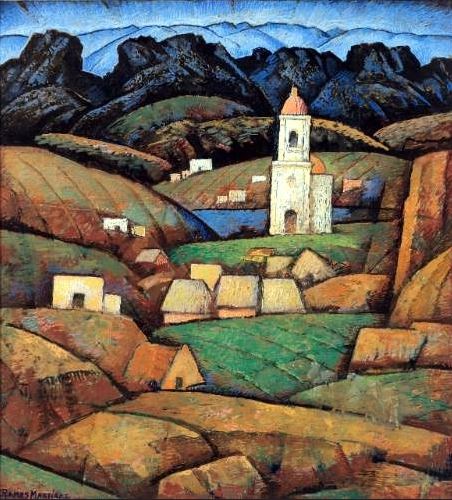
Alfredo Ramos Martinez- Mexican Landscape 1935We here in the States are often woefully ignorant of many of the artists from our neighbors in the other Americas, such as those in Canada and Mexico.  Maybe I shouldn’t say “we” because I really can only speak for myself.  My knowledge of Mexican artists was pretty much restricted to what I knew of Diego Rivera and Frida Kahlo, both of  which I admire very much.

Alfredo Ramos Martinez-El Mil de CumpresThis point was driven home recently by stumbling across the work of Alfredo Ramos Martinez, who lived from 1877 until 1946.  He was a painter/muralist who lived and worked in his native Mexico, Paris and California at different points in his life.  He is considered to be the Father of Mexican Modernism and much of his work focuses on the portrayal of traditional Mexican people and scenes.   He has been described as a painter who was able to capture the melancholy and sorrow of the people and places he painted.
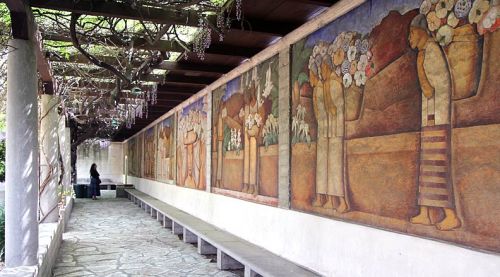
I am not going to go into great detail about his work or life today.  I am just throwing out some of his work so that if it interests you, you might look deeper into his life and work.  One thing I will mention is that at the time of his death Martinez was in the midst of a large mural, The Flower Vendors, shown directly below, at Scripps College in Claremont, California.  It remains unfinished but is still a striking and powerful piece of art even without its final details.

Alfredo Ramos Martinez-Unfinsihed Mural The Flower Vendors Scripps College 1946 Alfredo Ramos Martinez- The Chapel Alfredo Ramos Martinez- Head of a Nun

Point of Contact

GC Myers- sm


The world is full of magical things patiently waiting for our wits to grow sharper.

Eden Phillpotts, A Shadow Passes (1919)


These handful of words from the British author Eden Phillpotts succinctly sums up the idea behind my current show at the Principle Gallery as well as that of my next West End Gallery show, Contact, which opens July 22.  And that is that there is a world of wonder within our grasp if only we make the effort to recognize the patterns and forces of which they are comprised.

I have said before that we are part of a greater pattern.  I believe that it can be found in two simple ways– either looking inward or looking outward.  Since we are are formed from this pattern we can find parts of by examining our own inner world, our thoughts and dreams.  Or we can examine the world immediately around us for the hints of the pattern that are everywhere if only we can identify them.

Unfortunately, in this busy modern world we too often  find ourselves doing neither.  We live in a sort of limbo where we are mesmerized by the glossy lure of technologies that occupy our every moment.  It’s hard to look inward or outward when our eyes and thoughts are fixed on the screen in our hands.

Don’t get me wrong– I’m no technology-resisting Luddite.  I embrace the wonders of this technology when it serves a real purpose, when it expands our knowledge and sends it to the far corners of the world.  The possibilities for good things are seemingly endless.

But none of it matters if we lose contact with the greater powers and wonders that surround us every day, forces and patterns that patiently wait for us to unravel the magic that makes them invisible to us.

I know to some, this sounds like a bunch of mumbo jumbo.  Maybe the idea of great forces and patterns surrounding us seems a bit loony to some.  I get that.  But set that aside, if you must, and  simply consider the benefits of looking away from your smartphone or laptop for a short time each day to examine the inner and outer world outside of that screen.  Maybe if we do this on a regular basis our wits will sharpen to the point that we will better see that world of magical things as Bertrand Russell pointed out.

The painting above is 11″ by 16″ on paper and is called Point of Contact.  Part of the upcoming July show at the West End Gallery, I believe this piece very much mirrors the thoughts above.