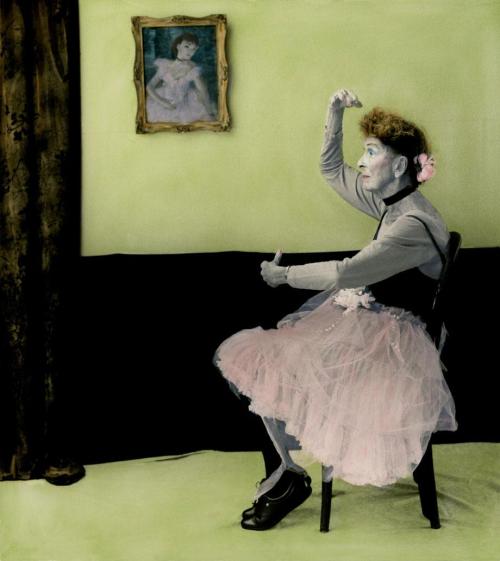
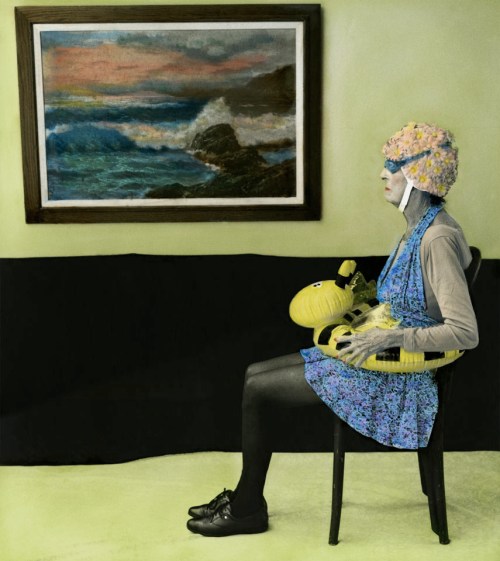
I have written here in the past about the composition from the iconic James McNeill Whistler painting Arrangement in Grey and Black— better known as Whistler’s Mother. It’s a beautiful, solidly structured composition that works as a wonderful template for creating a solid visual image of any subject.
Several years, ago, contemporary photographer Aline Smithson used Whistler’s image as the basis for a series of photos that she called Arrangement in Green and Black: Portraits of the Photographer’s Mother. Inspired by a print of Whistler’s painting that she found at a rummage sale and using her then 85 year-old mother (an obviously loving and patient woman who unfortunately passed away before seeing the finished series) as the subject, Smithson created 20 images with varied takes on the famous composition.
They are quietly comical individually and as a group. I just find them interesting. Below are some of my favorites.
For more on Aline Smithson’s work, please follow this link to her website where you will find many more portfolios featuring her distinct eye for observation. She also has a current exhibit, Aline Smithson: Self & Others, at the Griffin Museum of Photography in Winchester, Massacusetts. It closes May 1 so if you’re in the area, don’t waste any time in getting to the museum.
The morning wind forever blows, the poem of creation is uninterrupted; but few are the ears to hear it.
—Henry David Thoreau
********************
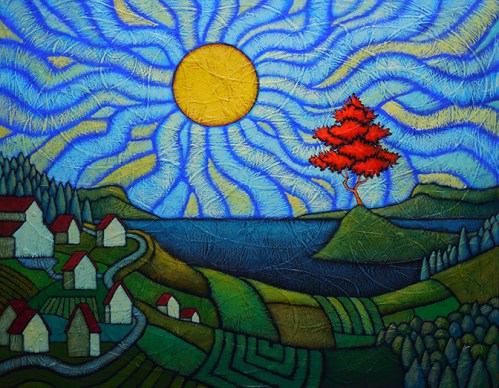
This new painting is 24″ by 30″ on canvas and is titled Contact. The words from Thoreau above speak pretty clearly to what I see in this piece, that we often ignore the beauty and wonder of the natural world that exists all around us. How many of us take the time to actually look at the sway of the trees in the breeze or the pattern of the stars in the night sky? Sadly, we’re more likely now to see these things on our phones or laptops.
We’re too busy, too distracted to have much interaction or contact with the wonder of the world that is often within our reach.
The buildings here seem closed in and eyeless, almost as though they are turned away from and oblivious to the world beyond their narrow line of sight. They are symbolically in the shadow of the hillside, rising in a pyramid-ish form toward the open fields and woods that open to the radiating sky. The sun has a warm and eye-like presence and the Red Tree seems to have reached a sort of tranquil communion with it.
Going to the Neue Galerie the other day rekindled my fascination with the work of Austrian artist Egon Schiele. There’s a lot of disturbing material in some of his work as well as in his bio that is hard to overlook even as I admire the work. But despite that, Schiele created, to my way of thinking, one of the most provocative and distinct bodies of work in modern art– all before an all too early death from the Spanish Flu in 1917.
He was 28 years old.
I think of that and then think of looking closely at the beauty and quality of his brushwork, I can only wonder what might have come in later years. What masterpieces he might have created. But as it is, he left us a rich and varied body of work, one that constantly both satisfies and provokes.
I particularly love his landscapes and cityscapes. Their abstract qualities and coloring just draw me in immediately. I always find myself inspired after looking at his work, like there’s something pushing out from it that runs into my own need for expression.
Took a day or two to shoot into NYC. We packed a lot into a very short time and quickly fled the throngs that packed the streets and parks of the city. Hit and run.
We first ran up through Central Park to the Neue Galerie, a small museum just above the Metroplitan Museum that features German and Austrian Modern art. It’s a beautiful collection situated in a beautiful 5th Avenue mansion which makes for intimate, if sometimes crowded, viewing of the art. If you’re in NYC, the Neue Galerie is worth a visit if only to see this piece even though there is much, much more to see there.
It has a memorable group of Germanic paintings and drawings from the likes of Klimt, Schiele, Kirchner, Beckman and many others. But undoubtedly, the crown jewel of their collection is the Portrait of Adele-Bloch Bauer by artist Gustav Klimt, the $135 million masterpiece with the fabled past that spawned last year’s film, Woman in Gold.
The lighting in the room with this painting is a flat and even light that dampens the gold’s glimmer, making it less shimmering than you may have seen it in photos. But even that can’t diminish this stunning piece which is evidenced by the flocks of people that surround it, a long with a docent who monopolized the piece for about 30 minutes.
That was all the time we had for museum hopping and it was on to the theater. We were meeting our neighbor and friend Bill’s English class from our local high school the next day for a matinee of the Eugene O’Neill landmark dramaLong Day’s Journey into Night so we figured that we needed something a bit less weighty and dark to counter the dose of O’Neill that was to come. We hit the musical Something Rotten which tells the story of two playwright brothers struggling to outdo William Shakespeare, who is wonderfully portrayed by Tony-winner Christian Borle as a rockstar who is idolized by the masses in Elizabethan England.
Very high energy, very funny and a really great cast.
The next day’s performance continued that theme, if you substitute the word dark for funny. The revival of O’Neill’s biographical masterpiece features a tremendous cast with Jessica Lange, Gabriel Byrne, Michael Shannon and John Gallagher, Jr. and they did not disappoint in any way. You could sense their total engagement with the material which is really needed for a production that runs over 3 1/2 hours and features very dark and probing dialogue between the small cast. In lesser hands, it could be a tortuous 3 1/2 hours but they made the time pass easily for the viewer. Great, great show.
Bill’s students seemed to understand the significance of what they were seeing which is a great thing to witness. Many kudos to Bill for exposing these kids to this part of the world. And if you get a chance and like the idea of seeing great actors doing great material, check out this show before it ends its short run at the end of June.
All in all, a good couple of days in the city. That being said, there is nothing better than that time approaching home when the traffic that snarls the city has fallen away and all you can see ahead of you is a single pair of taillights far in the distance and the outline of darkened hills set against the clear night sky. No crowds, no traffic, no noise– home is near.
Okay, for this Sunday’s music, here is a little sample from Something Rotten. It is the real theme of the whole show. It’s God,I Hate Shakespeare sung by Brain d’Arcy James.
Here are the dates for my scheduled events for the upcoming year:
JUNE 3– Opening reception for Part of the Pattern at the Principle Gallery in Alexandria, VA . This is my 17th solo show here and there will be a preview in the June issue of American Art Collector.
JULY 22– Opening reception for Contact at the West End Gallery in Corning, NY. This is my 14th solo show at the gallery wher I began my career.
AUGUST 6– Gallery Talk at the West End Gallery in Corning.
SEPTEMBER 17– Gallery Talk at the Principle Gallery in Alexandria. This marks the 14th consecutive year I have been doing gallery talks for both the Principle Gallery and the West End Gallery. Always a good time with a few surprises thrown into the mix.
SEPTEMBER 23 & 23– Two day Workshop, Puddle Splashing, at the in Penn Yan, NY, at theArts Center of Yates County. This year’s workshop will take place at their Sunny Point studio, located on the shore of beautiful Keuka Lake.
OCTOBER 22– Solo Show, not yet titled, at the Kada Gallery in Erie , PA. I’ve been showing at the Kada for 20 years and this is my 8th solo show there.
We are also still trying to put together an event at the Just Looking Gallery in San Luis Obispo, CA for late in the year. Stay tuned. Hope to see you at one of these events this year!!
Progress has not followed a straight ascending line, but a spiral
with rhythms of progress and retrogression, of evolution and dissolution.
– Johann Wolfgang von Goethe
********************
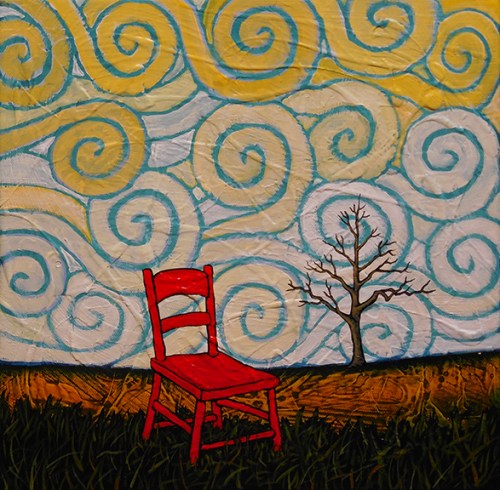
I was going through some older posts and came across this quote from Goethe. I immediately looked over at this new painting, a 12″ by 12″ canvas, that I had been working on yesterday. Something in it spoke to me from this quote, something that made me look at this piece differently.
It’s one of those pieces that don’t emerge smoothly from the hand or head. Everything about bringing some of these pieces to life seems tortured and messy. Pure struggle with nothing coming easy. The paint doesn’t seem right and the message seems unclear. Every move is tentative and probing, hoping that one stroke will send it down an easier path to completion.
Sometimes that happens. A touch here and there and suddenly it takes to flight like a young bird discovering what its wings can do for the first time. Pure joy in the newly found grace and rhythm.
But sometimes it doesn’t happen and that same bird that you think should fly flutters to the ground, unsteady and unsure. Not ready yet to take off.
At the end of the day, I felt as though this bird was somewhere in between.
But seeing these words changed my view of it. To me, its struggle was its narrative, its story. It is a representation of its own evolution, its own struggle to find its own form. The sky has that rhythm of progress and retrogression and the relationship between the chair and the bare tree is a representation of an evolution of a kind.
I am still taking it in, still looking at it but am no longer focusing on the struggle of its creation. It now has a meaning that moved past that.
Follow your bliss and the universe will open doors where there were only walls. –Joseph Campbell
*****************
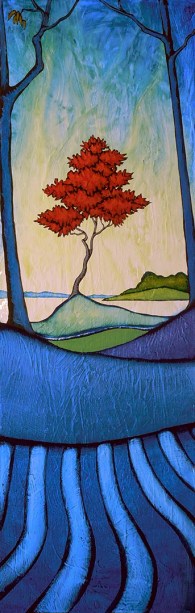
I call this new painting, which is 24″high by 8″ wide on canvas, Door to Bliss. The title refers to the well worn quote from the late mythologist Joseph Campbell, shown above, that advises us that if we work at that thing that we truly love, it will find a way to provide for us.
It will find the door that moves you forward and will open it once you have fully worked your way to it.
And from personal experience, I can attest to the truth behind the words.
I was going to write a whole spiel about setting goals and allowing and trusting your subconscious mind to make the decisions that will ultimately lead you to those doors. But I think that simple quote and the painting itself say enough without me muddying the waters.
I often use tree trunks in the foreground of either side of my paintings to act as a sort of stage curtain which further highlights the central figure. These trees also can be viewed as door frame through which the viewer is invited to pass. That’s how I saw these two trunks in this piece– as points that must be worked to and passed by before entering that desired location, that place of bliss.
I wanted to feature some music this morning that kind of jibed with the Henri Matisse Blue Nude cut-outs above that the artist produced in the early 1950’s. I wasn’t sure what I wanted but I settled on something from composer Burt Bacharach.
Bacharach, along with lyricist Hal David, collaborated with singer Dionne Warwick a number of times back in the 1960’s when they had an amazing string of hits that didn’t really sound like anything else on the radio at the time. It’s an unmistakable sound, light and breezy but complex and full.
When I was looking I came across this video that shows how beautifully Bacharach and Warwick worked together. It’s interesting to see how he communicates his vision for the song to Warwick and how she responds. It goes a long ways towards explaining why she was such a perfect vessel for his music. The clip ends with the full recording of the song.
So, have a great Sunday and here’s Burt Bacharach and Dionne Warwick with Loneliness Remembers What Happiness Forgets. I may steal that title at some point…
I was looking at this painting in the studio yesterday. It’s another orphan, one of those pieces that went out into the world and came back without being able to find a home. I normally try to figure out if there is an apparent flaw in these orphans and often there is something that is just not right. But sometimes I notice that these pieces are often pieces that I see as being more personal, more connected with my own life’s narrative. This painting, called No Mail, falls into this category. It evokes a certain time and feeling so vivid in my memory that it immediately emerges for me when I look at this painting.
I went back in the archives for the blog and found what I had written about this piece several years back. I’d like to share it just to show the connections that some paintings make even though they may not reach out to everyone.
This is a piece that’s been bouncing around my studio for a month or so, one that I call No Mail. It’s a smallish painting on paper, measuring about 8″ by 14″. I haven’t decided whether I will show this one or simply hold on to it. It’s a matter of whether I believe others will see anything in it rather than me wanting to keep it for myself. Maybe it’s that I see a very personal meaning in the piece that is reflected in the title and I can’t decide if it will translate to others.
For me, this painting reminds me of my childhood and the house I consider my childhood home, an old farmhouse that sat by itself with no neighbors in sight. Specifically, this painting reminds me of exact memories I have of trudging to the mailbox as an 8 or 9 year-old in the hot summer sun. There’s a certain dry dustiness from the driveway and the heat is just building in the late morning. It was a lazy time for a child in the country. Late July and many weeks to go before school resumes. The excitement of school ending has faded and the child finds himself spending his days trying to find ways to not be bored into submission.
The trip to the mail box is always a highlight of the day, filled with the possibility that there might be something in it for me. Something that is addressed only to and for me, a validation that I exist in the outside world and am not stranded on this dry summer island. Usually, the tinge of excitement fades quickly as I open the old metal mailbox and find nothing there for me. But occasionally there is something different, so much so that I recognize it without even seeing the name on the label or envelope.
It’s mine, for me, directed to me. Perhaps it’s my Boy’s Life or the Summer Weekly Reader. I would spend the day then reading them from front to back , reading the stories and checking out the ads in Boy’s Life for new Schwinn bikes. Oh, those days were so good. The smell of the newly printed pages mingling with the heat and dust of the day to create a cocktail whose aroma I can still recall.
But most days, it was nothing. Just the normal family things– bills, advertisements and magazines. Or nothing at all. The short walk back to the house seemed duller and hotter on those days.
That’s what I see in this piece, even though it doesn’t depict everything I’ve described in any detail. There’s a mood in it that vividly recalls those feelings from an 8 or 9 year-old, one of eager anticipation and one of disappointment.
I dream a lot. I do more painting when I’m not painting. It’s in the subconscious.
–Andrew Wyeth
**************
Andrew Wyeth- Trodden Weed
I love this short quote from the great Andrew Wyeth. That second sentence speaks to how I view my own relationship with what I do– I do more painting when I’m not painting. The mind is always clicked on, seemingly always seeking that something, that one inside thing that is crying out to be expressed.
It’s a built-in thing, one that can hardly ever be turned off. You would think it would be a maddening quality but it has become a normal way of functioning and I would probably panic if I found my mind not churning in some way.
Sometimes it is in the form of day-dreaming, just letting the imagination run free. Other times it takes place in the words or sounds or images of others. Like pulling a new thread from an existing fabric.
Inspiration comes in many different forms and the mind is always looking for them.
Here’s a neat short film from artist/filmmaker Andrew Zuckerman that shows Wyeth describing how he sometimes find inspiration.

 I have written here in the past about the composition from the iconic James McNeill Whistler painting Arrangement in Grey and Black— better known as Whistler’s Mother. It’s a beautiful, solidly structured composition that works as a wonderful template for creating a solid visual image of any subject.



 The morning wind forever blows, the poem of creation is uninterrupted; but few are the ears to hear it.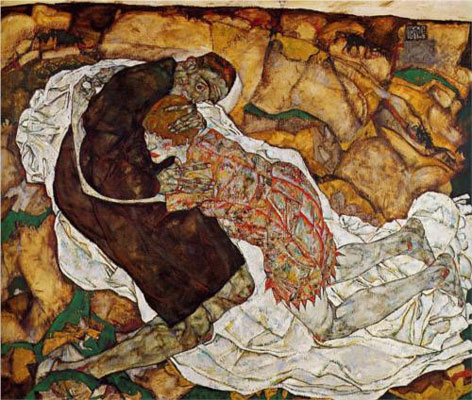
 despite that, Schiele created, to my way of thinking, one of the most provocative and distinct bodies of work in modern art– all before an all too early death from the Spanish Flu in 1917.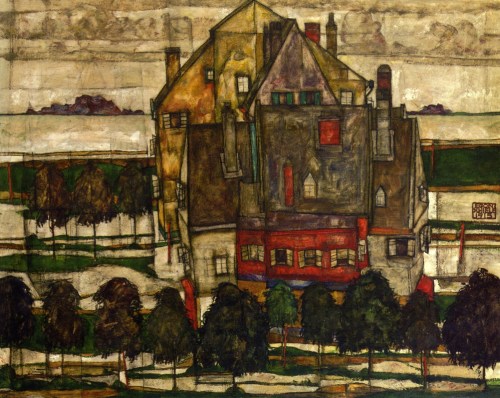


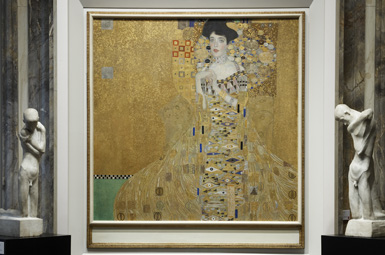 We first ran up through Central Park to the Neue Galerie, a small museum just above the Metroplitan Museum that features German and Austrian Modern art. It’s a beautiful collection situated in a beautiful 5th Avenue mansion which makes for intimate, if sometimes crowded, viewing of the art. If you’re in NYC, the Neue Galerie is worth a visit if only to see this piece even though there is much, much more to see there.
 Here are the dates for my scheduled events for the upcoming year:
 Progress has not followed a straight ascending line, but a spiral
 Follow your bliss and the universe will open doors where there were only walls.
 I wanted to feature some music this morning that kind of jibed with the Henri Matisse Blue Nude cut-outs above that the artist produced in the early 1950’s. I wasn’t sure what I wanted but I settled on something from composer Burt Bacharach.
  I was looking at this painting in the studio yesterday. It’s another orphan, one of those pieces that went out into the world and came back without being able to find a home. I normally try to figure out if there is an apparent flaw in these orphans and often there is something that is just not right. But sometimes I notice that these pieces are often pieces that I see as being more personal, more connected with my own life’s narrative. This painting, called No Mail, falls into this category. It evokes a certain time and feeling so vivid in my memory that it immediately emerges for me when I look at this painting.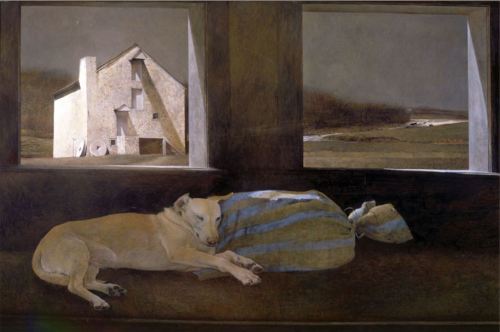

 Redtree Times