Feeds:
Posts
Comments

First Flame

GC Myers- First FlameLight thinks it travels faster than anything but it is wrong. No matter how fast light travels, it finds the darkness has always got there first, and is waiting for it.

Terry Pratchett

*************

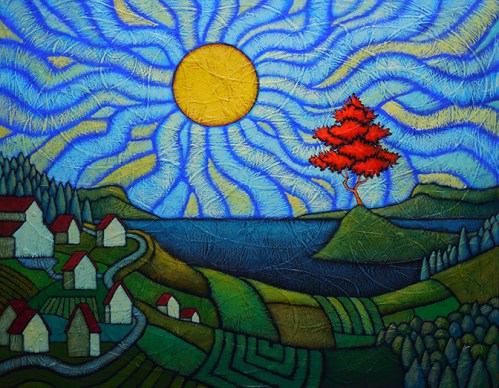
Last week, I featured a painting called Early Riser and spoke a bit about being just that– an early riser.  This is another new piece in that same vein, a 30″ by 30″ canvas that deals with the Red Tree greeting the first light of morning as it sweeps away the darkness of night.  I call this painting First Flame.

I’ve been thinking about this relationship with light, about the need to not waste the light of the day.  It reminds me of the rarity of light in this universe and how much darkness there is throughout its vastness, punctuated by the light of distant stars.

Light means life in this universe, so far as we know.  Everything we depend on for our continued survival is itself dependent on light and perhaps we ourselves are comprised of  and animated by light.

We are beings of light.

And perhaps there is a type reverence shown here in this painting with that knowledge at hand.

Looking now at this painting after writing these words, I can see many things in it which confirm this interpretation.  The cemetery in the shadow of the church, for example– an implication of death being devoid of light.  The orchard at the bottom right that waits for the feeding light of the sunlight. And the fruit stands that are dark and closed.

So long as the sun rises each morning, life goes on– for us as a group and for personally for myself.

To use my all-time favorite Kurt Vonnegut-ism: So it goes

Sunset Song

GC Myers The Anticipation  2003Sunday morning quiet…

It’s always one of my favorite times, bringing back memories as a kid when I would get up before everybody else and have the house basically to myself.  Nothing expected and nothing to be said.  Go out to the road to get the paper and read the comics.  Maybe have some hot chocolate to dunk my toast in. Safe in my home with my parents sleeping nearby…

A child’s tranquility, seemingly so easy and natural.  We add and absorb so many things that change us from that easy and natural state.  You can spend your whole life trying to recapture that feeling, that momentary bliss, but unfortunately it is as elusive as the fog.  But every so often we experience a flash of moments that seem reminiscent of those times before everything didn’t seem like old news, before everything had been seen or heard–that feeling of newness and wonder that only a kid can truly feel.

Man, is that a good feeling.  It can sustain you for days and days until the memory of it dissolves and is forever lost.

Hope to find it again soon.

This Sunday I thought I’d share a performance from one of my favorites, Richard Thompson.  This is him performing his Sunset Song at the Goldmark Gallery, an art gallery in Uppingham, England, that often hosts musical performances for small groups. It’s a great version of a lovely song.  I chose the painting at the top, a piece called The Anticipation from back in 2003, to go with this song.  It’s a painting that always catches my eye.

Enjoy and have a great Sunday…

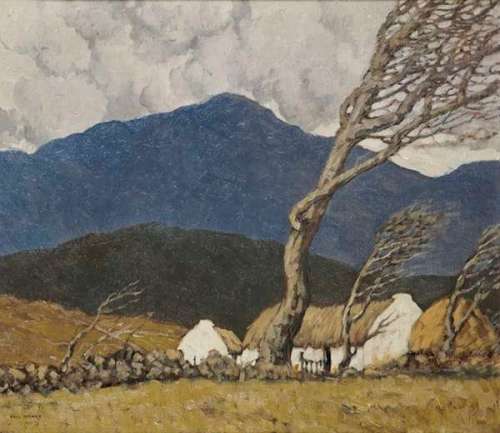
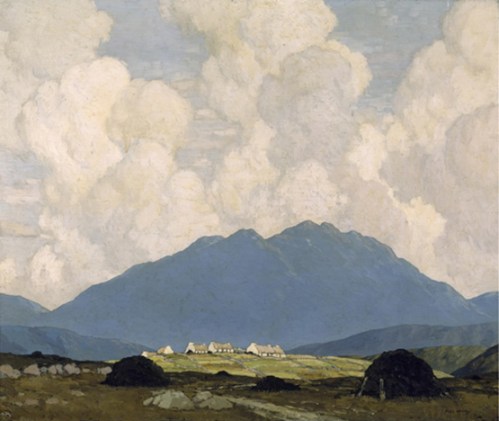
Paul Henry - The Fairy ThornI thought since this was St. Patrick’s Day that  I would feature an Irish painter.  There are a couple of obvious choices– Francis Bacon and Jack Butler Yeats, for example– but I chose Paul Henry, who spent his life painting his native Ireland from 1877 until 1958.  He was perhaps the best known painter in Ireland through the first half of the 20th century though many of us here in the States may not recognize the name.

You will however recognize the familiarity of his landscapes, most set in the west of Ireland in the Connemara district, an area described by Oscar Wilde as “ a savage beauty.”   For many, Henry’s landscapes represent the idealized image of the Irish countryside with simple white cottages set among stark, barren hills and rolling green fields.  But his greens are not that bright Kelly green so often used in depicting Ireland.  No, Henry often chose blue and brown tints in his work.  He used a very distinct and deceptively cool palette in his painting which enhances the coolness and solitary nature of the landscapes.

So, even if you haven’t an ounce of Irish blood, I hope you will enjoy these images of Eire.  Have a good St. Paddy’s Day.

Paul Henry Paul Henry The Fishing Fleet Galway

(c) Queen's University, Belfast; Supplied by The Public Catalogue Foundation

Paul Henry Killary Bay Paul Henry A Farm in County Down Paul Henry A Connemara Village 1933-34 Paul Henry - Connemara Landscape

Dr. Seuss-  Gosh Do I Look As Old As All ThatSay what you mean and act how you feel,

because those who matter don’t mind,

and those who mind don’t matter.

Dr. Seuss

*************

I think these words about sincerity from the wonderful and wise Dr. Seuss are good advice for just about anybody.  For myself, I pass this advice on to young artists.  Your own meaning and feeling– make that the focus of your work…

GC Myers- The Veil and the HeartToday we are searching for things in nature that are hidden behind the veil of appearance… We look for and paint this inner, spiritual side of nature.
-Franz Marc

************

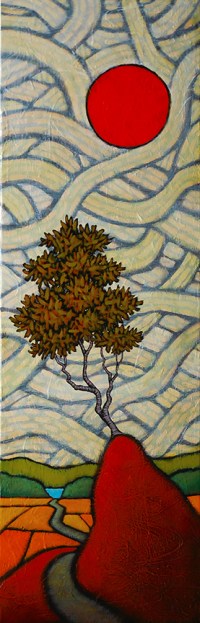
This is a new painting, a 36″ by 12″ canvas piece that I am calling The Veil and the Heart.  It is a continuation of the patterned sky series that has been occupying me as of late, a group which will no doubt play a large part in my annual June show at the Principle Gallery in Alexandria.

I see the red sun here as a symbol for the type of truth that can’t be veiled, can’t be covered.  While there are forces and powers beyond our perception, as I have written about concerning the thought behind this series of patterns and veils, there are also certainties and truths that cannot be obscured in any way.

It may be our own truth, who we really are as a person and how that forms the way in which we maintain a relationship with the world in which we exist.  It may be how we come to accept our place as a tiny piece in the puzzle of a universe that seems vast and largely unaware of us.

Maybe that red sun represents the universe, for a brief  moment, being aware of us.

I don’t really know.

I’ve said those words so many times over the years, especially in regard to my work.  You would think after all this time that I would be able to say definitively what is contained in my work.  But I can’t.  Just about every piece has a mystery in it, a veiled thought or meaning that shows just enough of itself to let me know it is there but remains elusive.  Even this painting has a meaning that seems easily within my grasp one moment and has another in the next.

 Like that red sun, you see it and understand it but you’re not sure why.  And maybe that is the way it should be, the way it is meant to be.

I don’t really know…

I’m Coming Home

GC Myers- In the Window- Worlds Beckon smLast week, we watched the HBO documentary  Mavis! which is, of course, about the career of singer Mavis Staple.  Ever since I have been going to YouTube to listen to her early gospel work with her family, the Staple Singers, in the 1950’s.  It’s just great stuff, a little gritty and blues-edged beneath with her vocals soaring above it all.  It seemed so ahead of the time, especially given what was being played on pop radio at that point.

I thought for this Sunday morning music I would keep this simple and play one of my favorites, I’m Coming Home from 1959.  I think it’s a great example of what they were doing then.

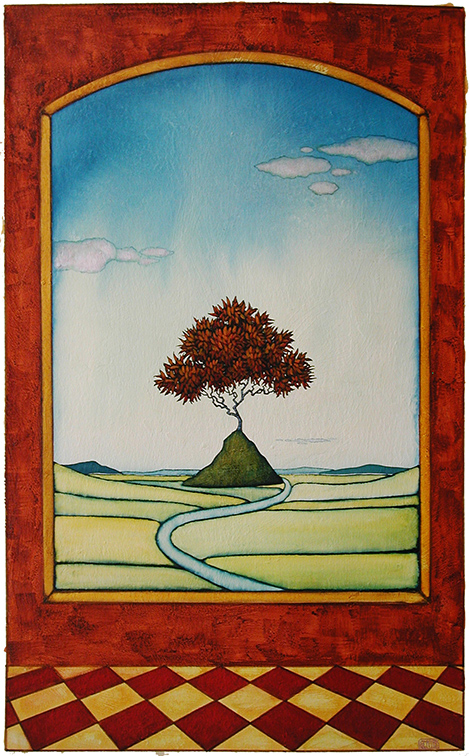
I picked the painting above for this song.The painting at the top is from my In the Window series from back in 2005 and is titled In the Window: Worlds Beckon.  I chose it for this post because it reminded me of the thought of going home in the way of this song, that there is another world beyond this one.  We may exist in this room, this life,  now but there’s a whole different one just outside the window.  That’s how this painting always struck me and it jibes with the song, at least for me.

Anyway, enjoy and have a great Sunday.

Icon: Martin P.

GC Myers- Icon-MartinI thought I had put the Icon series on hold for a bit as I moved more heavily into the work for my upcoming shows in June and July.  But the other day I just had an itch to jump quickly into one of the ancestors who remains prominent but a bit of a mystery for me.  It was painted quickly without hardly any dawdling over it and by the time it was blocked out in the red oxide paint that I use for my underpainting it felt like it was coming to life.

The painting is a 12″ by 12″ canvas that is titled Icon: Martin P.  It is my depiction of my 3rd great-grandfather, a man born in Canada sometime around 1800.  I have seen his birth year listed as 1798, 1800 and 1802.  His name is also somewhat up for debate.  It has come down through time as the anglicized Martin Perry but I have seen the last name listed  as the French-based Paré, Parent and Poirer.  He was of French-Canadian descent, that is without dispute.  Outside of this and a few other facts, there is little else to go on besides assumptions that can be gleaned from what little is known and rumors from the family that remains in the far north of New York state, near the Canadian border.

For instance, there is no known record of the name of his wife, my 3rd great-grandmother.  I have heard rumors from the family there that she was a maiden from the Mohawk tribe that occupied a reservation in the area where Martin came to live but there is no evidence of this, either in records or in DNA.  I have heard from a professional genealogist who ran into this dead-end and was unsuccessful in uncovering anything.

Martin was not known to be a farmer though his children all ended up as such.  He was rumored to have been a coureur des bois, literally a wood’s runner or woodsman,  which was basically a frontier figure who lived as a hunter and sometime guide.  In the few records I can find from his later life, he is listed simply as a laborer, no doubt at a time when the idea of being a woodsy, especially an old one, was on the decline in the quickly settling areas of the east.

But one thing I do know is that he must have been a tough old man.  At the outbreak of the Civil War, he enlisted in late 1861, along with son of the same name, at the age of 60 years old.  He served in the 98th New York Infantry and in the following year, saw action at the Battle of Williamsburg and the the Battle of Seven Pines. which was at that time, early in the Civil War, the largest conflict of the campaign.

I don’t know how he came through it all except to note that he was mustered out later that year, 1862, due to disability.  The idea of a 60 year old man marching a thousand or so miles and fighting in battles that were often at close range seems pretty wild in these times but I don’t think it was such for a man raised in the northern wilds.  He would have been used to tough conditions, to wet and cold and a spartan lifestyle.  For him to have been pulled from the conflict points to a real injury, illness or wound of some sort.

I have yet to find the date of his death.  Records in that time and place are often iffy at best but I continue to search.

So, in my depiction of Martin Perry I see him as that coureur des bois, bearded and dressed in buckskin.  From what I can tell, he lived on the fringes of the civilized world  with a foot always in the wild.

Early Riser

GC Myers- Early RiserThe early morning has gold in its mouth.

Benjamin Franklin

*******************

I am an early riser.

I guess that I’m here in the studio at 5:30 in the morning is a testament to that fact.  It’s always been that way for me even as a child.  The prospect of what the new day might bring has always been exciting enough to rouse me in the early morning.  On those days when I have a less than thrilling or an even dreaded task before me, the thought of getting started on that task so that it will just get done and out of the way does the same.

At times in my life when I worked the  overnight third shift at other jobs, the idea of going to bed when the day was breaking seemed awful and the day always felt already spent  when I eventually woke up only a few hours later, as though all possibility was drained from it while I slept.  I could never get used to that.

As an early riser, you get used to seeing the day unfold and the light changing as the sun rises.  Each morning is teeming with the potential of the new.  Even when things aren’t going well, there seems to be the possibility that this next new day will bring that change that alters one’s course in a better way.

I think that’s what I see in this new painting, a 24″ by 30″ canvas that I am calling Early Riser, of course.  The sun and its rays seem new and different but filled with a potency of possibility for the eagerly waiting Red Tree.  Meanwhile, the neighboring community slumbers, not witnessing the breaking wonder that is the new day.

This was  a difficult painting.  By that I mean it took several attempts to achieve a sky that served what I felt as I laid out the initial underpainting or bones of the piece.  Twice I got quite a ways into the sky, spending many hours each time, before painting it over and restarting.  They were patterned skies but never captured a rhythm that synced with my own emotions in the piece.  As soon as I set out the first rays of this last attempt, it felt right for this painting and everything fell into place.

And early this morning, I feel this captures my eagerness to greet the day.  Now, I have to go– there are things to be done.

Hilma af Klint - Painting the UnseenJust a few days ago, a new exhibit opened at the Serpentine Galleries in London.  It features a group of abstract and symbolic paintings from a Swedish painter by the name of Hilma af Klint who lived from 1862 until 1944.  The images of her work on display are quite captivating and intrigued me enough to look further into her work.  It’s an interesting case.

She was trained in the 1880’s in Sweden as a traditional artist and for most of her life supported herself with naturalistic landscapes and portraits.  This work is well done and attractive but unremarkable.  She considered this conventional work as a means of supporting her “life’s work” which were the many spiritually inspired abstract pieces produced from the 1890’s up to the time of her death in 1944.

Hilma af Klint YouthInterested in spirituality and theosophy, Hilma formed a group of women who met on a regular basis to hold seances to attempt to contact and channel the spirits from other dimensions.  She claimed to have been “commissioned” by one of these spirits to create a series of large paintings which occupied her for a number of years.  These paintings consisted of geometric and organic forms and a distinct visual vocabulary expressing a deeply spiritual element.
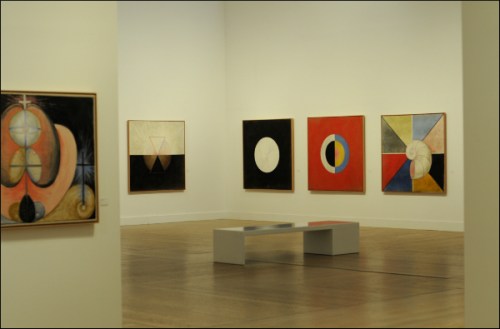
At the time of her death, there was a huge group of work, over 1200 paintings of varying.  Some are epic in their size, measuring over 10′ in height.  However, none were ever displayed publicly in her lifetime and she stipulated that it not be allowed to be exhibited until twenty years after her death. for fear that it would not be understood in that present time.  Little did she know that it would actually be more than forty years before it came to light in an exhibit in 1986.  In recent years there have been two major exhibits of her work, including this current show at the Serpentine Galleries, which have really pushed her work into the spotlight.

Her recent discovery and the depth of her work has created a quandary fo art historians who struggle to place her in the timeline of art history.   Her work was formed independently of and, in most cases, before the abstract movement pioneered by Kandinsky, Malevich and Mondrian.  They don’t know how to categorize her: Is she a pioneer or simply an outsider?

I don’t think this categorization matters.  Just take a look at some of these works on display and most likely you won’t care either.  The work definitely is in the present and alive. And that is all that matters.

Hilma af Klint - A Pioneer of Abstraction3 Hilma af Klint - A Pioneer of Abstraction 2 Hilma af Klint - Painting the Unseen2 Hilma af Klint - A Pioneer of Abstraction

Steeple

GC Myers-- SteepleI have stretched ropes from steeple to steeple; garlands from window to window; golden chains from star to star, and I dance.

Arthur Rimbaud

*****************

I was looking for a title for this new painting which is a 24″ by 12″ canvas.  I was seeing joy and exhilaration in it as well as the Red Tree being at the pinnacle or highest point.  Looking at a list of synonyms for the word pinnacle, I spotted the word steeple.  At first I thought it a bit odd, thinking of a steeple only in the context of a church’s architecture.

But then I realized that a steeple is built to be the highest point, reaching upward toward the heavens.  I began to think of the many times I had painted my Red Tree on sharp sided mounds that attempted to push it further upward, above the surrounding earth.  Was that mound not a steeple of some sort? Were not many of these paintings ultimately about reaching out to unknown forces as well as seeking inner peace?

Looking at this painting, I began to see it clearly as a steeple.  A steeple for a place of joy.  I guess that’s why the line from poet Arthur Rimbaud at the top fit so well,  Though most of the poetry from his very short career is dark and brooding in its imagery, I found the image put forth in this line bright and joyous.  It is  filled with the energy of self-realization, of the awareness of one’s connection to the cosmos.

Perhaps those swirls in the sky are ropes waiting to be stretched from this steeple to the next…