Feeds:
Posts
Comments

Exceptionalism/ Redux

GC Myers- Reaching to Time sm

I was checking the stats for my blog this morning.  One of them is a list of most viewed posts from the prior day.  I saw the title for one and it didn’t ring a bell so I checked it out, finding that it related in a way to a post from earlier in the week when I wrote about an unusual character in my wife’s ancestry.  As I said, it’s wonderful running across great stories from one’s family history.  But on the flip side, when you come across a story that is tragic or just sad it sticks with you in a different way.  I thought I’d rerun this post from back in 2010 because in the last few paragraphs the story relates to how I view my Red Tree:

I woke up much too early this morning.  Deep darkness and quiet but my mind racing.  Oddly enough I found myself thinking of a person I had come across in my explorations in my personal genealogy.  It was a cousin  several generations back, someone who lived in the late 1800’s in rural northern Pennsylvania.  The name was one of those you often come across in genealogy, one with few hints as to the life they led.  Few traces of their existence at all. 

 At the time, it piqued my curiosity for some reason I couldn’t identify.  He was simply a son of  the brother of one of my great-great grandparents.  As I said, you run across these people by the droves in genealogy, people who show up then disappear in the mist of history, many dying at a young age.  But this one had something that made me want to look further.  I could find nothing but a mention in an early census record then nothing.  No family of any sort.  No military service.  No land or property.  No listings in the cemeteries around where he lived.  I searched all the local records available to me and finally came across one lone record.  One mention of this name at the right time in the right place, a decade or so from when I lost sight of them.

It was a census record and this person was now in their late 30’s.  It was one line with no other family members, one of many in a long list that stretched over two pages.  I had seen this before.  Maybe this was a jail or a prison.  I had other family members in my tree who, when the census rolled around, were incarcerated and showed up for those years as prisoners.  So I went to the beginning of the list and there was my answer.

It wasn’t a prison.  Well, not in name.  It was the County Home.  This person was either insane or mentally or physically handicapped and was living out their life in a home when they could or would no longer be cared for by family.  It struck me at the time that this was someone who lived and experienced as we all do and who has probably not been thought of in many, many decades.  If ever.

This all came back to me in a flash as I laid there in the dark this morning.  I began to think of what I do and, as is often the case when I find myself wide awake  in the dark at 3:30 AM, began to question why I do it and what purpose it serves in this world.  Is there any value other than pretty pictures to hang on a wall?  How does my work pertain to someone like my relative who lived and died in obscurity? 

In my work, the red tree is the most prominent symbol used.   I see myself as the red tree when I look at these paintings and see it as a way of calling attention to the simple fact that I exist in this world.  I think that may be what others see as well– a symbol of their own existence and uniqueness in the world. 

If I am a red tree, isn’t everyone a red tree in some way?  Isn’t my distant cousin living in a rural county home, alone and apart from family, a red tree as well?  What was his uniqueness, his exceptionalism?  He had something, I’m sure.  We all do.

And it came to me then, as I laid in the blackness.  Maybe the red tree isn’t about my own uniqueness.  Maybe it was about recognizing the uniqueness of others and seeing ourselves in them, recognizing that we all have special qualities to celebrate.  Maybe that is the real purpose in what I do.  Perhaps this realization that everyone has an exceptionalism that deserves recognition and celebration is why I find it so hard to shake the red tree from my vocabulary of imagery. 

 Don’t we all deserve to be a red tree, in someone’s eyes?

Odilon Redon- The Cyclops 1914I am certain about what I will never do – but not about what my art will render.

–Odilon Redon

***************

When I came across this quote from the great French Symbolist painter/printmaker Odilon Redon, I found myself nodding in agreement.  There are many things I know that I will never do with my work mainly because these things don’t inspire me to take the time to make the effort.  But about those things where I do make the the effort,  I am never quite sure where they will take me or how they will surprise me or how they will reach out to others in ways I never imagined.

And that is the thing, the driving force, that keeps me coming back to this studio each morning: the hope that this will be the day that brings that next surprise, that next thing that remains a wonder to myself.

By the way, you should really take a few moments and check out the work of Odilon Redilon.  He was one of the most influential painters around the turn of the 20th century and set the groundwork for a lot of modern movements.  Plus, his prints and paintings are just plain interesting to take in, with a mysterious twist and symbolism that feels both psychological and spiritual.  The eye in the sky is a recurring form in his work as you see in the painting at the top, The Cyclops.  His one-eyed creature has a different feel than that of the more terrifying one in Homer’s Odyssey.  Redon’s has an almost protective, paternal feel.  It feels odd but inviting.

Here is a site ( click here)with most of his known paintings although not much if any  of his print work.  It’s worth a look.

Odilon Redon - Eye  Balloon-1898 Odilon Redon Flower Clouds 1903

Crazy Quilts

Fraser Smith -The Lake

Fraser Smith -The Lake

These quilts will keep you warm on a cold night– if you burn them in your fireplace.

You see, they are elaborate trompe l’oeil  ( it means fool the eye) sculptures from artist Fraser Smith.  Starting with large glued slabs of basswood, Smith carves quilts, coats, shirts, robes and other textile items, finishing them off with paints that add a layer of reality that completes the transition from a block of wood to something that convinces your mind that it is soft and cuddly.

I am amazed at the detail work and can only conclude that Smith has an amazing obsession for this.  Check out the examples below as well the short film that shows how the piece at the top metamorphosizes.  Interesting stuff.   Also check out his website by clicking here.

Fraser Smith Improv 7 2009 Carved Wood and Silk Dyes Fraser Smith Finding Beauty in Bad Things 2013 Carved Wood and Silk Dyes Fraser Smith American Jacket 2010 Carved Wood and Silk Dyes

The Flying Angel

flying-angel-3This is basically a rerun of a story that I first posted back in 2009.  I’ve mentioned before that I enjoy doing genealogical research, digging back through layers of history, trying to put together a sometimes very complicated puzzle to reveal certain connections.  Sometimes it can be relatively boring, going through generations without finding a visible compelling story.  But once in a while you stumble on an ancestor with heroic traits and an exciting story to tell.  Or one who is a scoundrel who makes you wish you hadn’t found out so much about them.  But one of the great pleasures I take in doing this is coming across the life stories of ancestors that are just plain good tales.

One such is from my wife’s family, the story of the lady they called the Flying Angel.  Her maiden name was Magdalena Dircksen Volckertsen and she was born in New Amsterdam (now Manhattan) in the 1630’s, her father a builder of the earliest homes there for the Dutch West Indies Company.

Her first husband ( not in my wife’s family line) was a privateer for the Dutch West Indies Company.  That is to say, he was a pirate hired by the company to attack foreign ships and competitors in the area.  Called “Captain Caper” for his daring, he was killed in an Indian attack that was the beginning of the Indian Wars of 1655.  Magadalena was left a young widow with an infant child.

Two years later she married Herman Hendricksen Rosenkrance, called “Herman the Portuguese.”  The name came not from his nationality ( he was from Norway) but from his service as a mercenary for the Dutch company in Brazil where they forced their way into sugar growing areas controlled by the Portuguese.  Finally forcibly repelled from Brazil, Herman and his cohorts were sent to New Amsterdam to engage the Indians there.  Herman stayed on as a settler, supposedly running a tavern of low repute called the Flying Angel, the origin of Magdalena’s nickname.

Magdalena had quite the temper.  On her wedding day to Herman, after downing multiple beers, she was walking with her sister just above what is now Wall Street in NYC when she passed and insulted the fire warden.  What was termed a street riot broke out and several weeks later  she was yellow-carded by Peter Stuyvesant, meaning she was expelled from the settlement, sent back to Holland where she and Herman bided their time for two years until they were finally allowed to come back, provided they did not open a tavern or sell spirits.

The following years were a series of adventures involving Indian Wars  (one that had Herman being captured and staked out in the sun before he was able to escape), various  legal troubles, some involving Magadalena throwing beer in the faces of a number of  men, stabbings and accusations of selling liquor to the native Indian population.  They ended up living up the Hudson, near Kingston, where Magdalena lived into her 90’s.

It’s rumored that in her later years, she would chase Indians from her property by running out at them, yelling and shaking a large goiter on her neck at them.  How could she not live past 90?

It’s just an interesting footnote in our history and the early settlement of NY, one that you don’t hear much about.  I’m always excited when I come across such stories, especially when there is a small personal connection.  Magadalena and Herman would be my wive’s 8th generation grandparents.

I’m not sure how proud she is…

Homecoming

1999 GC Myers TangoI was recently alerted that three of older pieces, pre-2000 and pre-Red Tree, were available at an antique shop in western Virginia, part of a recently acquired estate.  Looking into this, I found that they were indeed my paintings, including one, Tango (above), that was a favorite of mine from that time.

They were also mistakenly identified as prints, probably due to the numbering on the back that identifies the year and sequence of the painting.  Also, I was  painting on a smooth surface so there wasn’t a lot of evident surface texture.  To the the casual observer they might appear to be prints.  I used to have people ask about that a lot in those days.

As a result of mistaking them for prints they were priced at a very low price, far below what they were worth.  I was torn between the idea of contacting the shop to alert them that these were not prints and my desire to have these pieces back with me as I don’t have much work from this time, almost all of it having found new homes long ago.  Plus, the idea of having Tango return was exciting to me.  It’s one of those pieces that really stand out in my mind from that time and I wanted to see how it had aged over the past 16 years or so.

I decided that we would buy them back without notifying the seller of their mistake.  I don’t know if that was wrong but the shop had failed to do any research and were devaluing the work by their omission.   I looked at this as a way of taking them off the market at the devalued price that they asked.

They arrived last week and it was such a thrill to see them again.  The framing for Tango was in an older style, stained a deep green that I stopped using not too long after this time.  But it was tight and clean and the painting was just as I remembered it, actually a bit sharper and brighter than my memory.  It held up as well as I had hoped it might and that was satisfying.

A pleasant homecoming.  I don’t think I will let this one go again…


mark_rothkoIt is a widely accepted notion among painters that it does not matter what one paints as long as it is well painted […] There is no such thing as good painting about nothing.

Mark Rothko

**************

I have often said, often without much grace, that the subject for a painting is secondary, not really that important so long as the painting says something, expresses feeling and evokes emotion within the viewer.  I think the work of Mark Rothko is a good example of this sentiment. They are simple of blocks of opposing colors set one over the other or, as in the case of the piece above, one alongside another.

Seemingly without subject.

Seemingly about nothing.

But as Rothko states, there is no such thing as a good painting about nothing.  And this is a good painting.  It allows the viewer’s own emotions into its space, lets their own story become the story and subject of this work.  That space is the subject and purpose of this work.

So, every picture does tell a story.  Some dictate the story, forcing the viewer to follow a set storyline through the picture as though they were the plot of a murder-mystery novel.  Others do so like a song or poetry, evoking feeling with a suggestion or a gentle nudge.  The viewer here is complicit in the fulfillment of the art.

For myself, I prefer the latter but have enjoyed works with more obvious subjects.  Perhaps not as deeply felt but enjoyable nonetheless.  I still question where my work falls on this scale.  I am sure it has been both and I know I am much more satisfied when it appears more poetic.  But being able to dictate the nature of the work is often beyond me.  It sometimes appears in the poetic form seemingly on its own, without my direction.

And that is most satisfying.  And elusive.

All this being said is mere pretense for this week’s Sunday Morning Music.  It’s a cover of Rod Stewart‘s classic song, Every Picture Tells a Story, done by the Georgia Satellites back in 1986.  I always liked their version of this song and hope it’ll kick off your Sunday on a high note.  Have a great day!

It Is What It Is

GC Myers Dominion smI have been away for a few days, taking in a couple of plays at the Shaw Festival in Canada.  I will write more about that later.  For this morning, I wanted to rerun a post that I first ran back in 2009 and again 2012.  It’s a post that always helps me find personal clarity.

Sometimes, usually at certain points of my year, there are times when I begin to question what I do and who I am as an artist.  It’s a time when my normal self-confidence falls aside and I fret about the future of my work.  It’s an internal struggle that usually resolves itself in the paint itself.  I paint and the doubts fade away, replaced by new revelations found in the spaces of my work.  Here’s what I wrote a few years back: 

There was an episode of Mystery! on PBS starring Kenneth Branagh as Swedish detective Wallander.  It was okay, a nice production but certainly nothing remarkable in the story.  But there was a part at the end that struck home with me and related very much to my life as a painter.  Wallander’s father, played by the great character actor David Warner, was, like me, a landscape painter.  Now aged and in the beginning stages of Alzheimer’s, his son comes to him and intimates that he can’t go on as a detective, that he can’t take the stress.  The painter then recalls how  when Wallander  was a boy he would ask his father about his painting, asking, “Why are they always the same, Dad?  Why don’t you do something different”

He said he could never explain.  Each morning when he began to paint, he would tell himself that maybe today he would do a seascape or a still life or maybe an abstract, just splash on the paint and see where it takes him.  But then he would start and each day he would paint the same thing- a landscape.  Whatever he did,  that was what came out.  He then said to his son, ” What you have is your painting- I may not like it, you may not like it but it’s yours.”

That may not translate as well on paper without the atmospheric camera shots and the underscored music but for me  it said a lot in how I think about my body of work.  Like the father, I used to worry that I would have to do other things- still lifes, portraits, etc.- to prove my worth as a painter but at the end of each day I found myself  looking at a landscape, most often with a red tree.  As time has passed, I have shed away those worries.  I don’t paint portraits.  Don’t paint still life.  I paint what comes out and most often it is the landscape.  And that red tree that I once damned when I first realized it had became a part of who I am.

I realized you have to stop damning who you are…

Here is that clip:

Dorothea Lange Next Time Try the TrainTo know ahead of time what you’re looking for means you’re then only photographing your own preconceptions, which is very limiting, and often false.

Dorothea Lange

*****************

As a fan of Dorothea Lange’s photography, I was very open to her take on what an artist–  in her case, a photographer– is seeking.  I’ve written a lot here over the years about searching for something  in my work but what that thing is, quite honestly, I do not know.  I know that it is not something I can find without releasing a lot of myself including my fears and preconceptions.

Lange’s idea of preconceptions being limiting is one that rings very true to me, coinciding with my constant chorus that  painting is best done without thought, without having an idea of where it might end up.  Preconceptions create expectations and these too are limiting.  The best work often comes when there are no expectations and no idea of what I am trying to accomplish.  Well, it holds true for my painting, at least.

Her idea ( and mine, I suppose) of searching is so devoid of planning or purpose that it actually reminds me of Picasso‘s thoughts on searching:  I have never had time for the idea of searching. Whenever I wanted to express something, I did so without thinking of the past or the future.

They both very much say the same thing but in differing ways.

And I agree with both.

dorothea-lange-depression-inspiration-tractored-out-childress-county-texas

Girls In The Windows

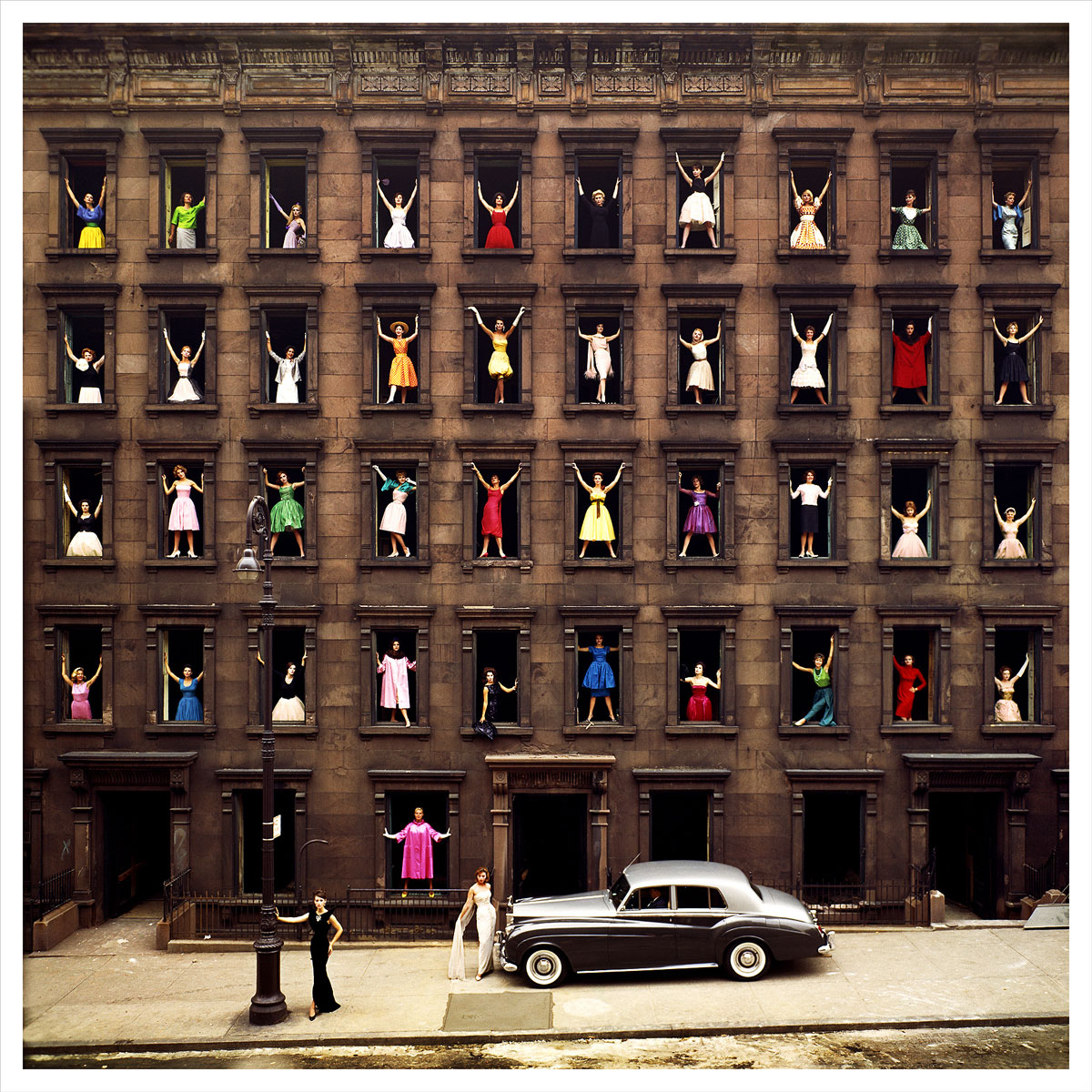
Ormond Gigli  Girls InTh Windows New York 1960 --Stanley-Wise Gallery NYCOrmond Gigli is an American photographer born in 1925 who is famous for his photos of celebrities from the worlds of stage, screen and fashion.  I recently came across his most famous photo (above) which is called Girls In the Windows.  It is considered to be one of the great fashion shots of the 1960’s and just a great photo in any category.

The photo came about in 1960 when a group of brownstones in Manhattan were being demolished across the street from Gigli’s  East 58th Street studio.  Gigli wanted to capture those brownstones on film and had a vision of 43 fashion-clad women adorning the windows.  Working quickly, arrangements were made to get permissions, models and the Rolls-Royce in place so that the photo could be taken during the workmen’s lunch break before the buildings hit the ground.  Some of the models couldn’t stand on the windowsills as they were so crumbly.

It’s a stunning visual.  You never know what will inspire something new in your own work and looking at a photo like this triggers all sorts of reactions within my mind.  I am sure this was the same for others who sort of borrowed from this photo in the years after it was taken.  For instance, I am pretty sure the artist who did the cover for Led Zeppelin‘s 1975 album, Physical Graffiti was inspired in some way by Gigli’s photo to place iconic images in the windows of a crumbling apartment building.

Ormond Gigli has a website devoted to his work and the stories behind some of his more famous shots that you can visit by clicking here.

Led Zeppelin Physical Graffiti Album Cover 1975

Hogback Heaven/ Redux

I am a little busy this Monday morning but I wanted to run something to replace yesterday’s post at the top of this blog.  Something a little lighter in feel  I came across this entry from back in 2011 and it made me stop.  It’s about an old experiment from my formative years along with a great little piece pf music.  Enjoy!

GC Myers- Hogback Heaven 1994Looking through some old work, most of which was done early on while I was still forming my technique and style and before I showed my work publicly, I came across this oddity that I noted as Hogback Heaven. It’s a goofy little scene of a rough hewn home and yard somewhere out on a back country road, the kind of place that I often passed years ago in my treks on the backroads around my home area. All that is missing here from my memories of those places are a barking hound and a toddler in a sagging diaper playing in the gravel of the driveway.

Whenever I come across this piece, I have to smile. I don’t know if it’s the subject or the crazy electric feel of the cobalt blue sky and hills and the red neon outlines of the house and ground. I’m still trying to figure out where that color came from. Maybe it’s a smile of embarassment that this little painting is hovering in my past. But there’s something in it that makes me not want to destroy it.

I wanted to set this post to some fitting music and in my search came across this other sort of oddity. Called Yiddish Hillbillies, it’s a vintage 40’s era cartoon that has had the soundtrack replaced ( in a very clever and coordinated way) with a song from Mickey Katz.  Katz was a comedian who specialized in Jewish humor, with Yiddish-tinged song parodies of contemporary songs of the time being his specialty. Think Borscht Riders in the Sky or Sixteen Tons (of Latkes). While much of the Yiddish-tinged wording goes over my head I do enjoy the klezmer feel here. A note on Mickey Katz: His son is actor Joel Grey which makes him the grandfather of actress Jennifer Grey.