Feeds:
Posts
Comments

Posts Tagged ‘Archaeology’

Archaeology: All We Leave Behind

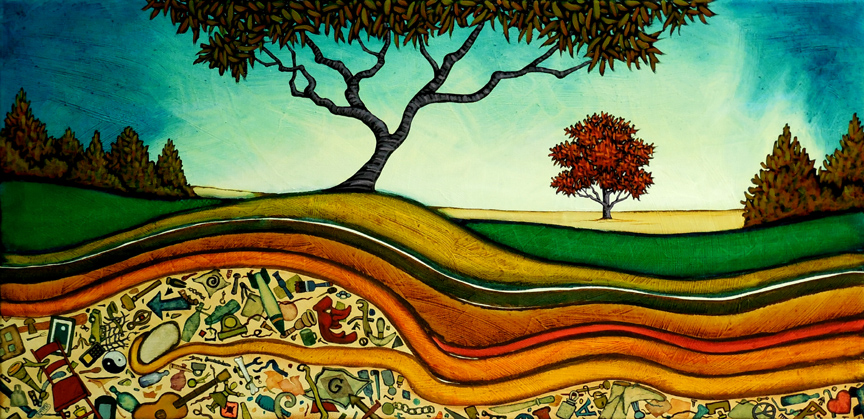
Archaeology: All We Leave Behind

As the title suggests, there are a few paintings from my Strata and Archaeology series in the Layers show that opens Friday at the West End Gallery.  The piece above, Archaeology: All We Leave Behind, is a 12″ by 24″ canvas is the latest and perhaps last entry in the Archaeology series.

I am considering retiring this series that started back in 2008 although I can’t say I won’t revisit it at some distant point in the future.  It has been a series of paintings that has been among my favorites, both in painting and in delving deeper into them, as well as being important to my development as an artist.  When I first started the series, it came at point when I was in need of inspiration and was questioning my future as an artist.  These paintings gave me footing, a firm base to rest on while I gathered what I needed to move on.

Looking at these pieces, I am almost always surprised when I get to inspect the underground artifacts.  So many of the items  were painted  without any forethought or afterthought so once they were done and I had moved on to the next item in the debris field, they sometimes escaped my notice of their singularity.  They just became part of a larger pattern of forms and color.  But going back and looking at the items later gives me little surprises that sometimes make me smile and sometimes scratch my head, wondering what the hell some not quite recognizable thing is or what I might have meant by its inclusion.

But all things must come to an end, which is actually the theme of this series.  And this piece, which took over a year to complete as I worked on it a bit at a time,  seems like a fitting end.  And if it does end up being the last in its line, what better place to show it than where my little journey as a painter began back in 1995, the West End Gallery.

Here’s another Archaeology piece in the show, Archaeology: Formed in the Past,  one from a few years back that has a favorite of mine from the minute it was completed:
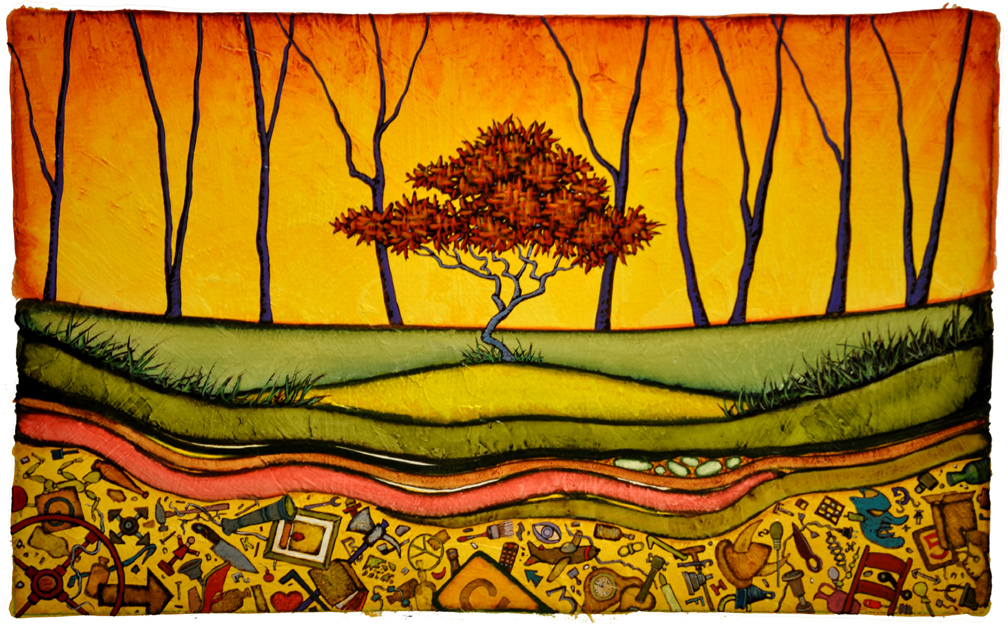
Archaeology: Formed in the Past

Archaeology: Formed in the Past

Read Full Post »

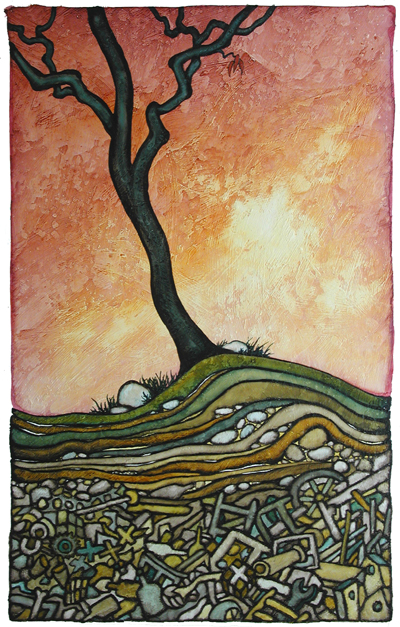
GC Myers- Time TravelerI finished this new painting, 18″ by 26″  on paper, a few days ago and have been regularly taking it in as it sits in my studio, waiting to be framed for my upcoming show, Traveler, at the Principle Gallery.  I think I am calling this piece Time Traveler but it’s still up in the air as I ponder it for a few more days.

It’s one of a few pieces that will be in this show that are from the Strata series, which are similar to my Archaeology pieces but more focused on the patterns and colors of the underground layers and boulders rather than on artifacts.  I like this mix of the straight representation of the Red Tree in the top half  set against the organic and almost abstract forms of the lower half, giving it a striking visual contrast while still maintaining  harmony.

I normally don’t like to dwell on technique here but  this is also a little technically different from my typical work.  I normally work in one of two ways–in a  reductive manner, where the paint is applied very wet, in puddles,  then removed leaving a transparent and luminous surface or in a more traditional additive manner in which paint is applied in layers building from dark to light.  Usually one one process is used in a piece but the Strata series allows me to easily mix the methods which adds to the visual contrast between the upper and lowers segments.

As I continue to consider this piece, I thought I would play a song this Sunday morning that mentions time.  I thought I would play Time Is On My Side which was a big hit for the Rolling Stones in 1964.  I always assumed it was written by Jagger and Richards but it was actually a cover.  The song was written my Jerry Ragavoy under the pseudonym Norman Meade.  It was first recorded by jazz trombonist Kai Winding in 1963 with the only lyrics being Time is on my side sung by back-up singers Dionne Warwick and Cissy Houston.  It’s an interesting version that I am including below but I really wanted to focus on the version from the Soul Queen of New Orleans, Irma Thomas, which was released around the same time as the Stones’ version.  It has the added lyrics that most of us know and is just a dynamite performance.

Enjoy and have a great Sunday!

Read Full Post »

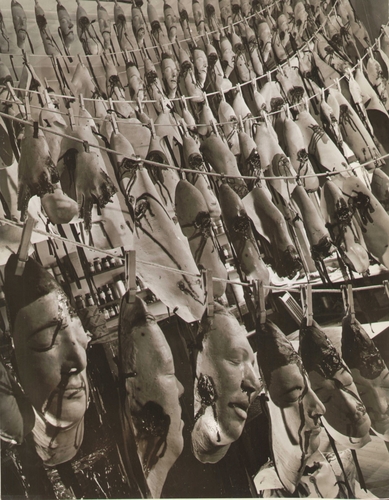
Carol Eyerman-  A Surreal Study of Latex Masks 1950There is something about a mask that captures the imagination.  Hiding our true selves behind a shield often allows us to act in ways that are often in direct opposition to who we really are or to, at least for a short time, take on a persona we would never dare exhibit as our own.  I think we all often wear masks of a sort in our dealings with people, showing only the face we choose to show at any given moment.  We seldom fully take off our masks and show our full and true self.  I think that is a reason I often feature masks in the artifacts of my Archaeology series.

So when I came across this photo it  immediately caught my attention.  It is a wonderful abstraction of latex masks hanging from lines as they dry.  I can find no story behind this 1950 photo or even much about the photographer,  Carol Eyerman , who died in 1996 at the age of 85 and was a Life and Sunset magazine photographer best known for landscape photos.  To me, it is either a shop that makes masks for Halloween or theatrical or movie productions.  I’m thinking Halloween just by the sheer number.

But beyond the facts behind the photo, it’s a terrific image with the looping lines that hold the gruesome faces and  bloodied hands rising up and away.  Like a factory of pain and torture, an image torn from a nightmare. Just a great shot.

Cherry and Richard Kearton - Wildlife Photography Pioneers 1900As an aside, while I was jumping around online trying to find more about Carol Eyerman, I came across this photo of a man standing on another man’s shoulders while taking a photo on a camera atop an extraordinarily tall tripod.  It was such a neat image that I had to stop to discover that the two men were Cherry and Richard Kearton who were brothers and pioneers in wildlife photography.  This photo was taken in 1900.  I always seem to find the most interesting things while searching for other things, as thought the initial search is actually only a starting point.  In this case, it may not be as interesting as the masks but it’s a great image in itself.

Read Full Post »

GC Myers Archaeology-sketch

I did a presentation last night for a local arts group, the Elmira Regional Art Society.  I’m not sure how well I did in meeting their expectations, or my own for that matter, but I stumbled through.  Not my smoothest talk but they were a very gracious group and I thank them for having me in to speak with them.  One of the stories that I related was about how the Archaeology series evolved, one that I related here back in April of 2010.  I thought that I would revisit it today:

There’s new exhibit that opens at the West End Gallery in Corning next week [May, 2010]. It’s titled The Process- Start to Finish and features the gallery’s roster of artists showing sketches and studies for finished pieces of work. The idea is to give the viewer a better understanding of how a piece of art evolves through the process.

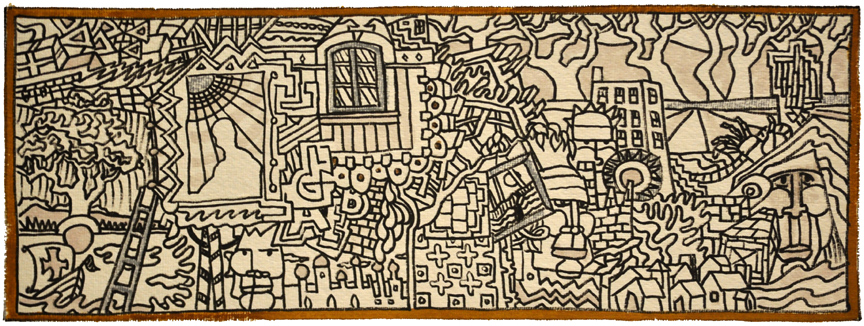
Now, I never really do studies and very little sketching for my paintings so this didn’t really seem like a show fitted to my process. But I remembered that a couple of years ago, at a point when I was floundering a bit and somewhat lost direction, I did a series of sketches (actually, I call them doodles) that eventually evolved into my Archaeology series.

GC Myers Archaeology-new-day

Archaeology: New Day

These were done on 12″ by 24″ sheets of watercolor paper with a finepoint Sharpie marker, which I liked to use because it forced bold lines and better simulated the way I used a brush as a drawing device when I painted. They were basically exercises where I would start at any given point on the sheet with a mark and simply fill the space with shapes and lines. Kind of a stream of consciousness thing. There was no intent . I was just trying to find something that would fire my then faltering imagination.

I did this for about a week, filling a number of these sheets until I began to realize that this sketching process could lend itself well to a different type of painting for me. One that combined my typical landscapes and iconography with areas of this intuitive doodling. Thus came the Archaeology series.

So I guess I do have a sketch of sorts for this show. The piece shown here, Archaeology: New Day, was one of the first in the series. You can see this by way the underground elements are formed in the same marker-like manner as the sketches as opposed to later pieces in the series where each element is painted as though it is almost floating in an underground basin. This piece, which remains a personal favorite, will be at the West End for the show.

Read Full Post »

I am in the final days of preparations for my show, A Place to Stand, which opens next Friday, June 8th, at the Principle Gallery in Alexandria.  This always seems to be  the most tedious part of my job, at least while I’m in the midst of it.  The painting is set aside and long days are spent staining and sanding frames, cutting  mats and putting it all together to make what I hope is a great show. 

 But near the end of the tedium and  the angst which comes as the deadline appoaches, it begins to become exciting again as the paintings, which have been strewn around the studio in various stages of completion and without any sort of framing or final finish, begin to come to life for me.  It’s like the final presentation suddenly clicks some deeply hidden switch and what seemed like only potential before now becomes a separate entity before my eyes, complete and self-contained in its message and meaning.  

It’s at this point that I get to really look with focus for what may be the last time at much of this work.  During the process a painting may be completed and set aside, only to get an occasional glimpse or passing glance.  But now I get to take a last long look and see what is really there.  I am seldom disappointed at this stage.  Paintings that would do that don’t make it this far.  But sometimes I am simply satisfied,  the painting being just as I had expected.  But once in a while it all comes together and a piece meets every aspiration I have for it, making it feel like more than the sum of its parts.

That is how I feel about this new painting.  It is titled Archaeology: Future Past and is a 12″ by 24″ canvas.  It does just what I wanted the Archaeology pieces to do which is to to have an immediate and strong look, an instant identity  that the viewer takes it in and gets a sense of   from a distance.  The subterranean deris field reveals itself as the viewer nears and has its own rhythm and narrative, contained in yet separate from the strong presence  of the scene above.  Even the ribbons of strata that separate the two parts here have a strong rhythmic presence that adds greatly to the whole. 

That may be the operable word here– whole.  It has a feeling of completeness that I am always excited by in any piece of art .  It doesn’t need any explanation including my words here. Simply strong and unmistakable. 

All I could hope for…


Read Full Post »

Archaeology is the peeping Tom of the sciences. It is the sandbox of men who care not where they are going; they merely want to know where everyone else has been.

Jim Bishop
 
*************************************************************
 
   Maybe I fit into the quote above from the  late journalist Jim Bishop and maybe that’s why the idea of incorporating archaeology into my work, as I have done with my Archaeology series over the last few years, has been so appealing to me.  The idea of diverting our eyes from where we are headed to instead see where we have been, to examine those things which have shaped us as we stand now, is indeed intriguing to me.  We are the products of our past and where we are headed is often determined in the how and the why of the past.  Unfortunately, and to our detriment I fear, we often fail to look back and, as a result, are continually reliving  pasts that could and should  have been avoided.
 
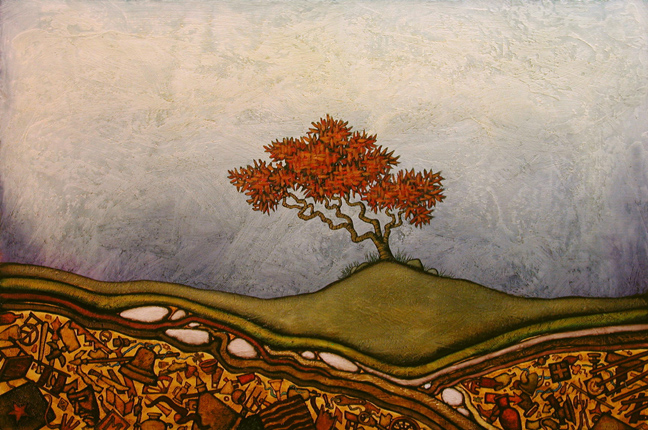
This thought is definitely behind the title of this new piece, Archaeology: Formed in the Past, a 10″ by 16″ painting on paper.  I see the central Red Tree here as being formed and twisted by the artifacts below the surface, remnants of the past.  The trees in line behind stand  like stoic witnesses to this history.  The artifacts contain tools and toys, books and bottles, shoes and other items of the everyday– the things that make up a life and a world.  There is also evidence of the creative side of life here– a painting, paint brush, a drama mask, a ukulele and an artist’s mannequin. 
 
It’s always interesting to look at these pieces after finishing them and to see how they come together to offer up some sort of narrative in the collection of artifacts.  Interesting because I don’t really think about how the items will interact as I am painting.  No forethought at all really.   They’re just painted in rhythm as they come to mind, often just because a shape or form fits at the moment.  So when I see the commonality of thought and narrative  running through them, I wonder what the source might be. 
 
Is it just a reflection of my own psyche and interests? 
 
Perhaps.  Probably.  But even so, there’s something somehow compelling in sifting through the debris, even the debris of one person’s mind.

Read Full Post »

Lascaux.   The name immediately brings to mind the famed cave in France containing the extraordinary Paleolithic paintings.  Preserved for over 17,000 years, they represent the profound need for the artist to record what is in his world.  It also serves as an intimate glimpse into an age that is massively far removed from our modern world.  Yet, for as distant as that world and time might seem,  the imagery in these caves still brings us back to our primal connections to those ancestors.  We are still moved by the image and the story.  We may have changed less than we would like to believe.

I mention this today because there is a new online literary/art magazine called The Lascaux Review.  The first edition premiered yesterday and features one of my Archaeology ( Archaeology: Rainbow’s End, seen below)  paintings as accompaniment to a poem, Creation, by the distinguished American poet, Philip Appleman.  The poem is dedicated to Marcel Ravidat, the discovered of the Lascaux caves.  It is a lovelyand powerful poem and I am honored to have my image associated with it.

Please take a moment and check out The Lascaux Review.  It won’t be time wasted.

Read Full Post »

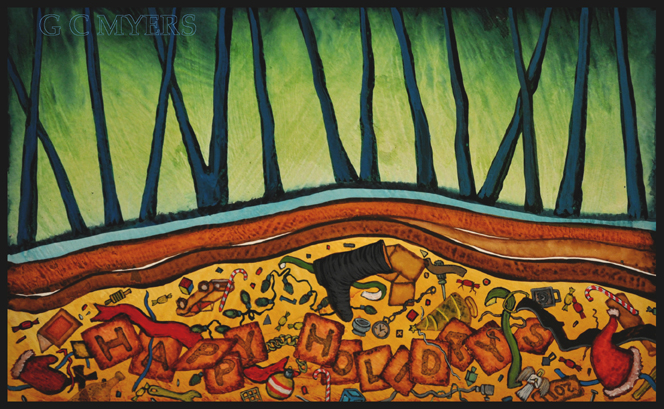
Happy, happy Christmas, that can win us back to the delusions of our childhood days, recall to the old man the pleasures of his youth, and transport the traveler back to his own fireside and quiet home.

—Charles Dickens

Wishing a very Merry Christmas to everyone everywhere.  May the season find us all at peace.

—-GC Myers, 2011


Read Full Post »

I’ve been reviewing past work over the last few weeks for a variety of reasons.  Sometimes I am looking for an idea or motif that has not been in use for some time.  A new lead to re-examine and follow anew.  Sometimes, it’s pure nostalgia, looking at the work as group with a small bit of pride, like a parent looking at photos of their kids. And I sometimes go back through my files because they serve as a form of memory for me.  While I may have the details of most of my work stored somewhere in the folds of my brain, I can’t always pull them forward.  Seeing the images brings back everything in a torrent.

The painting above is a good example of this rush of detail.  Titled Archaeology: The Story Told, it’s a 20″ by 30″ canvas from  the 2008 Archaeology series.  Although I don’t like to publucly state that there are pieces that are favorites, this painting was one of my favorites from this group. 

There is so much I like about this painting from the moody duskiness of the sky with its purples that grade downward to the way the underground boulders create a visually rhythmic counterpoint.  But the thing that always stuck out for me was how the underground debris came together to form a narrative, which is where the title originated.  There was no intent in painting this.  All of the debris was painted in a freestyle manner, with each piece being painted independently from one another outside of possible relationships in size and shape.  It wasn’t until it was done that I began to see a stroyline running through the heap of items.

For me, it was the story of this country starting with  the obvious prompting of what looks to be an American flag at the center of the bottom.  There was a bell that reminded me instantly of the Liberty Bell to represent our Revolution and a Viking helmet that told of the earliest European explorers here.  There was a cowboy boot that symbolized our westward movement and what appeared to be a lance for the weapons that the native Americans used in their defense of their land.  There is a pitchfork for the agriculture that sustained and help the nation expand.  There  is an electric light to represent the inventors like Edison who transformed our country and machine parts for the industrialization.  There is a baseball bat for our national pasttime.  A peace symbol for both its inherent meaning as well as for its use as symbol of protest and our right to speak freely.

It’s all loosely associated and many may not even see them in a unified way but for me it all came together in a single glance and that was how I immediately read the painting.  It’s unlike any of the other paintings in this series in that way and that makes it special for me. 

Gary T., I hope you don’t mind me showing your painting!

Read Full Post »

I recently finished this new painting, an 18″ by 26″ piece on paper, that is the newest addition to my Archaeology series.  Titled Archaeology: Rainbow’s End,  this painting features the subterranean debris field that marks this series including some of the recurring icons that show up in most,  or at least many, of the pieces in this series.  There’s a shoe, a peace symbol, a red chair, a self-referential painting and a mask, amon many other little bits and pieces.

I don’t know if there’s something in my psychology that is at risk here , some flaw that I’ve managed to hide from the world that might be exposed in this field of trash.  If so, I guess that’s risk I’m willing to make.  I really like the feel of this group and the way it creates a rhtymic pattern in the underground that feels like faded wallpaper in an old house, which is pretty fitting.  There’s a sense of the nostalgic here perhaps enhanced by the warmth of the sky above, aglow in reds and gold.

The Rainbow’s End part of the title comes from the colors of the strata above the artifacts.  Whenver I loooked at this piece that immediately struck me and I began to think of this as the rainbow painting over the long time that I worked on this piece.  I worked on this in bits and pieces for several months, never quite wanting to finish this particular painting.  Even now, after it is done and headed out to what will certainly be a new home, I have regrets about finishing it, as though it represents a personal piece.  Maybe there is something in that trash heap that I haven’t recognized yet.  I don’t know.

Maybe this hesitation to let a piece like this go is the reason I do so few of the Archaeology paintings lately.  As well as the longer time it takes to finsih these paintings, there also does seem to be a different type of mental investment in these pieces.  Like pouring out all the detritus that has accumulated in my mind over time for all the world to see.  There is less control in this than in the painting of a landscape, at least in how the pieces are read by the viewer. 

Maybe that’s it.  Again, I don’t know.  I never do.  So, I keep painting in the hope that I will find something that finally does let me know.  Maybe there’s something in this debris that I’ve missed.  I better look again…

Read Full Post »

« Newer Posts - Older Posts »