
First Peace— At West End Gallery
The great quality of true art is that it rediscovers, grasps and reveals to us that reality far from where we live, from which we get farther and farther away as the conventional knowledge we substitute for it becomes thicker and more impermeable.
–Marcel Proust, The Maxims of Marcel Proust (ed. 1948)
Proust certainly knew what he was talking about when it comes to the reality of one’s inner landscape. In his case, it is a place populated with layers of memory. The memories described in his monumental seven-volume Remembrance of Things Past are both voluntary and involuntary, those triggered and animated in his inner world by a sensory prompt– a taste, smell, sight, or sound– occurring in the outer real world.
His maxim above clearly states what I have been trying to say with my work for years now. And that is that art reveals realities that we often fail to observe. As he points out, it is a reality that has been barricaded from us by the common perceptions of what makes up reality that have been built up over the years. We have become so entrenched in only dwelling in that reality that we have lost the ability to sense and appreciate the other, that being one’s inner reality and its connection to an even greater outer reality.
My hope as an artist is that my work serves as a device or a prompt for the viewer to find their way to their own inner world, to see things from a viewpoint inside themselves rather than from their usual position in the outer world. And maybe that is what true art is, a device or tool that exists beyond its surface.
Proust mentioned this in the final volume of Remembrance of Things Past, writing how the reader (or in my case, the viewer) uses the work as instrument in which they can better see themselves.:
In reality every reader is, while he is reading, the reader of his own self. The writer’s work is merely a kind of optical instrument which he offers to the reader to enable him to discern what, without this book, he would perhaps never have perceived in himself.
In that way, a piece of art becomes something more than mere wall coverings or ear or mind candy. It becomes a portal to another reality, another dimension, in which we are inhabitants whether we know it or not. It’s kind of miraculous to see this in action, to see someone engage with a piece of art that instantly reveals something of themselves of which they were either unaware or were blindly seeking.
I’ve been fortunate to witness this several times over the years and it may well be the primary motivator for my work now.
Well, that was not expected when I started this post this morning. Hope it makes sense in an hour or a day from now. Maybe we will talk about this on Saturday at the Gallery Talk at the West End Gallery.
Maybe not. Who knows which way the wind will blow on Saturday?
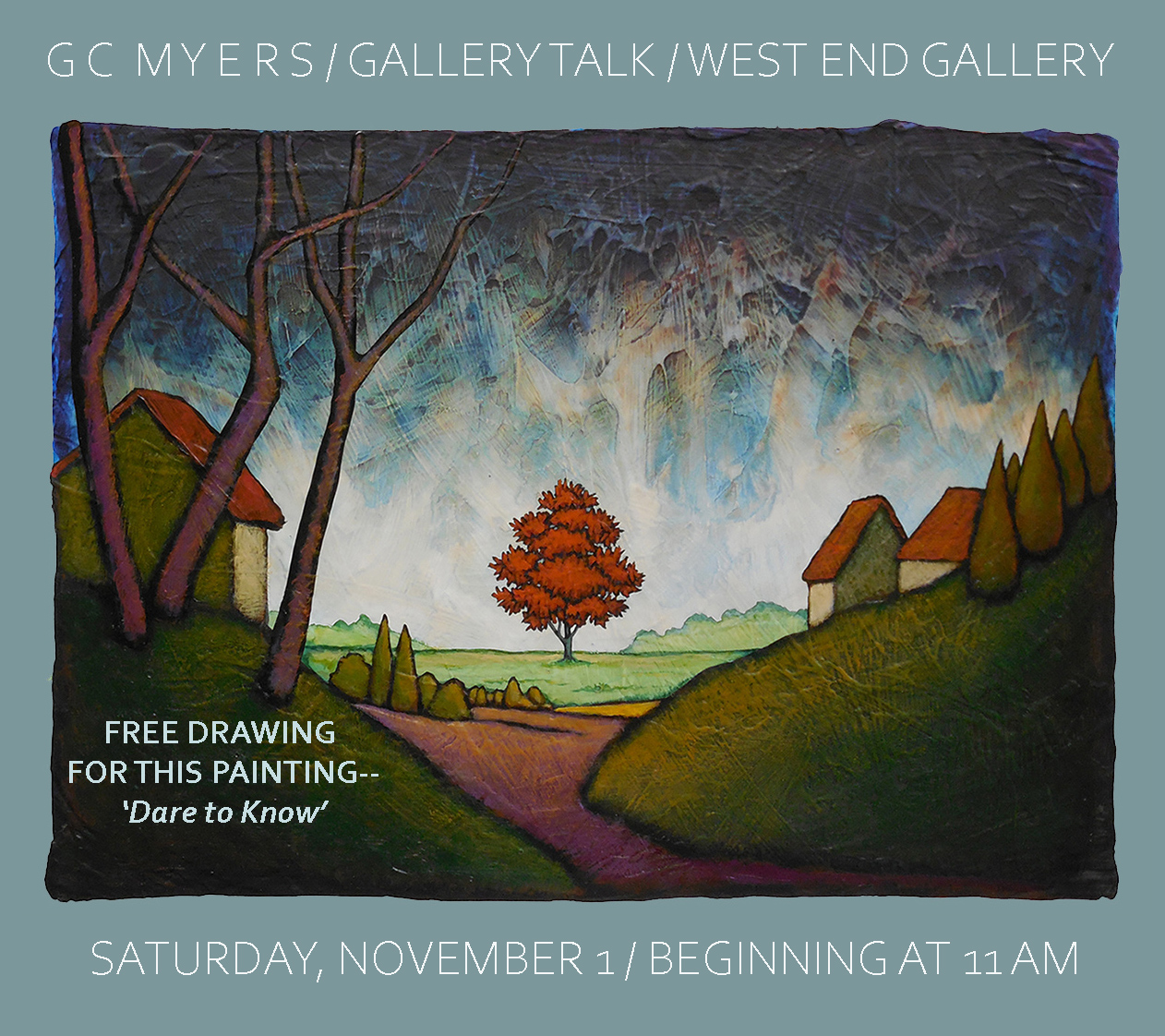
The Gallery Talk at the West End Gallery begins at 11 AM and lasts about an hour, ending with the drawing for the painting, Dare to Know, shown at the bottom of this page. The Gallery Talk and the drawing for the painting are free and open to all. You must be in attendance to win prize. Seating is limited so I would suggest you arrive early to claim your seat and settle in. We can chat or you can take in the exhibit. Doors Open at 10:30 AM.
Here’s a favorite song, Killing the Blues. It is best known as performed by John Prine which to me is the gold standard. I hesitated in playing this version that I like very much from Alison Krauss and Robert Plant since I have played it here before. I thought it was recently but, after checking, discovered that I had shared it last in 2011. I guess a 14-year gap between plays is acceptable.


 Redtree Times