Feeds:
Posts
Comments

Posts Tagged ‘Henry Miller’

Wherever the Wind Takes Me – At Principle Gallery


The worst sin that can be committed against the artist is to take him at his word, to see in his work a fulfillment instead of a horizon.

–Henry Miller, The Cosmological Eye (1939)


Love these words from Henry Miller. I think most people, artists included, look at a piece of art and see it as an endpoint rather than a jumping off point. I would like to think that my work serves both as an invitation and starting point for the viewer. My hope is that my little world as I present it is welcoming enough that they easily enter and feel comfortable. Once there, my wish is that they begin to explore both the space in which they are and the self they see in it. To start an inner journey of some sort, one that might last only for a few moments or for a lifetime.

That’s asking a lot, I know. And it’s not fully in my mind when I am at work because at that point I am fully engaged in my own inner journey. It’s only after I step back and try to view a piece with a more dispassionate eye that I begin to recognize if a piece has that potential in it.

A horizon to pursue.

A starting point of a journey.

Some do. Some don’t. And maybe some that I think do, don’t. And vice versa.

One never knows for sure. And that is the beauty of art. Some see totality and some see endless potentiality.

That’s all the time I have this morning. I see a horizon forming and need to get moving towards it.

Here’s a song from Michael Nesmith, best known as one of the Monkees. This is his take on Beyond the Blue Horizon, a song that was first performed by Jeanette MacDonald in 1930. It’s quirky but still works for me this morning.


Read Full Post »

Soloist– At West End Gallery


We’re creators by permission, by grace as it were. No one creates alone, of and by himself. An artist is an instrument that registers something already existent, something which belongs to the whole world, and which, if he is an artist, he is compelled to give back to the world.

Henry Miller, The Rosy Crucifixion Book I: Sexus (1949)


The words above from Henry Miller very much echo in several things I have written here in the past. An artist recreates in their own manner that which already exists, the seen and the unseen. It is created from a multitude of influences, experiences, and observations from this world.

As he says, this creation, being comprised of this world, belongs to the whole world. Art, though its message often feels targeted to us as individuals, is at its heart communal, meant to be shared.

I am not going anywhere with this statement this morning. I simply like the thought and thought it needed to be shared.

Now, here’s a song from a favorite of mine, guitarist Martin Simpson. It fits well with the painting at the top but most likely has nothing to do with Miller’s words. As it was with the Miller passage, I simply like it and wanted to share it. This is Granuaile from his 1991 album When I Was on Horseback. I believe it refers to Grace O’Malley, the head of the Irish O’Malley dynasty in the 16th century. She is often referred to as the Pirate Queen. and is known for a meeting she had late in her life with Queen Elizabeth to ask for the release of her sons who were being held captive by the English governor of Connacht.


Read Full Post »

The Wakening Light— At Principle Gallery


Strange as it may seem today to say, the aim of life is to live, and to live means to be aware, joyously, drunkenly, serenely, divinely aware. In this state of god-like awareness one sings; in this realm the world exists as poem. No why or wherefore, no direction, no goal, no striving, no evolving. Like the enigmatic Chinaman, one is rapt by the everchanging spectacle of passing phenomena. This is the sublime, the a-moral state of the artist, he who lives only in the moment, the visionary moment of utter, far-seeing lucidity. Such clear icy sanity that it seems like madness. By the force and power of the artist’s vision the static, synthetic whole which is called the world is destroyed. The artist gives back to us a vital, singing universe, alive in all is parts.

In a way the artist is always acting against the time-destiny movement. He is always a-historical. He accepts Time absolutely, as Whitman says, in the sense that any way he rolls (with tail in mouth) is direction; in the sense that any moment, every moment, may be the all; for the artist there is nothing but the present, the eternal here and now, the expanding infinite moment which is flame and song. And when he succeeds in establishing this criterion of passionate experience (which is what Lawrence meant by ‘obeying the Holy Ghost’) then, and only then, is he asserting his humanness. Then only does he live out his pattern as Man. Obedient to every urge — without distinction of morality, ethics, law, custom, etc.

— Henry Miller, The Wisdom of the Heart, 1941


I’ve had this passage from Henry Miller sitting in a draft file for a long time now. Maybe it was his use of the dated stereotype of the enigmatic Chinaman that kept me from using it. It sounds cringey, yes. Definitely not the preferred nomenclature today, as Walter from The Big Lebowski would be quick to point out.

But I understand that his reference is not a slur as he was referring to the wise and stoic sages such as Confucius and Lao Tzu. It was about artists acquiring a similar Zenlike state in their work one that transports them to the eternal here and now, as Miller put it.

The expanding infinite moment which is flame and song…

That is what struck me about this passage. It is something I understand and maybe the main reason I am a painter today. More so than any reasons based on practicality or talent.

It is that moment that comes while working on a painting when I am no longer in the studio on that particular day but instead find myself in the place and time of the painting on which I am working–the eternal here and now

 A different reality has taken hold then and its feeling is palpable. It is both liberating from and unifying with the world in which I live. Liberating in that the world outside my studio with its lies, hatred, corruption, and stupidity seems like a distant planet in that time and place. Unifying in that this act of creation, this other time and place, allows me to express a connection with humanity that I sometimes struggle to find on the outer world. Asserting my humanness, as Miller wrote.

Of course, this does not happen here in the studio every time I stand before my easel. No, it is a rare gem that is buried deep and has to be excavated. The world impinges further into the studio on some days and in recent weeks I have lacked the energy and mental clarity to be transported fully to that other place and time– the eternal here and now— for any extended visits.

But it’s getting better every day. Yesterday I was able to once again find that place and time for a spell and it was like a trip to a spa for me. As free and easy a day in the studio as I have had in well over a month. It didn’t last long but it felt good for the time I was there and not here.

I hope to find that place and time again today. And to stay a little longer. 

Read Full Post »
Inertia


“Nothing is more obscene than inertia. More blasphemous than the bloodiest oath is paralysis.”

Henry Miller, Tropic of Cancer


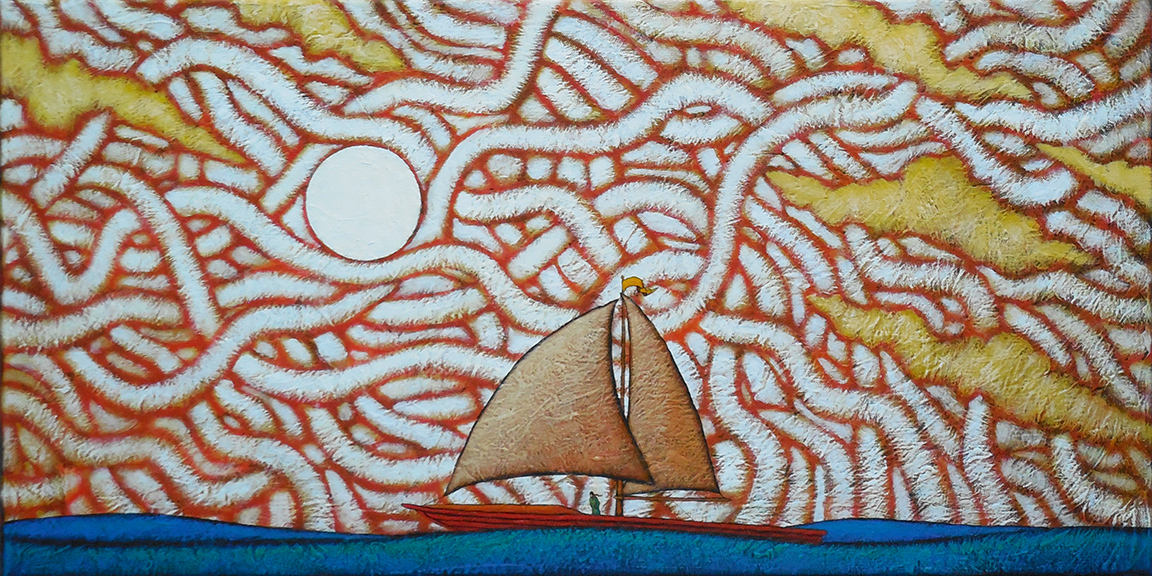
The painting at the top hangs in my studio and has been a favorite of mine since it was painted five years back. Every day, I find myself often looking over at it. There’s something in it that satisfies or completes something in me. It’s 24″ by 24″, so it’s not a small piece, but I think it’s not large enough to fully transmit what is has to offer. I often wonder how it would feel as a much larger painting, say 6′ by 6′ or even larger.

These thoughts went through my head this morning before 6 AM as I found myself, coffee in hand, turning to gaze at this piece. I realized then that I couldn’t remember the title of this painting that I look at with intention each and every day. I don’t think of it in terms of its title given to it years ago.

Now, it just is. It exists free of words for me. It is defined by the moment and the circumstance in which I am seeing it.

But I had to get up this morning and go over to it and peek at the back of the painting to see its given name: October Sky.

How fitting, I thought. It’s what I might have called it this morning. That mood that produced it back in 2015 was here in 2020, as odd as it is to think that anything could be similar in any way in this most unusual year. 

I went back to my desk and continued to stare at October Sky, thinking that I should be working on a larger version, if only for myself. I could start it today.

But I probably won’t.

I’ve been ensnared in a state of inertia for a while. Been hard to get started and even harder to finish things. I have personal projects around the studio and home to still finish, commissions to work on, new work to begin and a plethora of other things in the hopper. But getting up a head of steam to simply take that first step seems so difficult right now. It feels like paralysis of some sort, one that paralyzes the mind and not the muscles.

I can’t fully pinpoint the cause behind this though there are certainly a lot of possible contributing factors. Just opening your eyes these days is an existential threat to one’s peace of mind. I don’t even think I need to find the cause.

I just need to take that first step forward and I know from past experience that the dullness of mind and body will quickly fade. It’s just getting to the point of taking that step. It’s like I am waiting for something to happen right now and am afraid to be distracted even if that distraction is my own wellbeing.

Now, that sounds more ominous than it is, I am sure. I know I will soon be past this and the work will be flowing, that the synapses will be snapping and shooting off like fireworks. In fact, I think just writing this indicates that I am nearing the end of this malaise, this paralysis of the soul.

I am signing off now. I want to look again at October Sky. Maybe today’s the day I start a larger version. Or just take a first step toward something, anything else. I think there’s something pretty damn good in there just waiting to come out so maybe it’s time to get moving.

Sounds like a plan. Let’s get to the day and make it count.

Read Full Post »

Well, the work for my upcoming show, Moments and Color, is out of the studio and at the West End Gallery. The show will be completely hung sometime today well in advance of next Friday’s July 12 opening.

It always feels a little weird the first morning back in the studio after delivering a large group of work for a solo show. While it’s a relief to have the work gone and the task met, it is a bittersweet sensation. The paintings that have surrounded me, that have called out at me, that have occupied my mind for months are suddenly gone. It feels hollow here even though the place is far from empty and the work that is gone seems to have left behind an echoing presence.

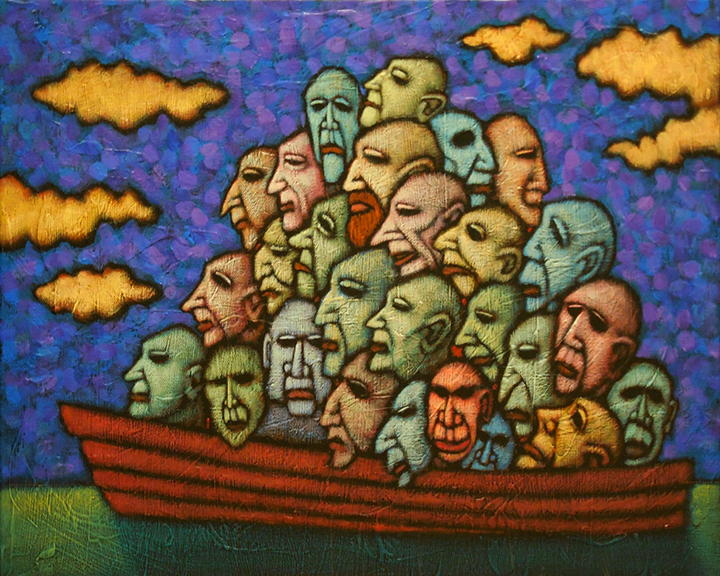
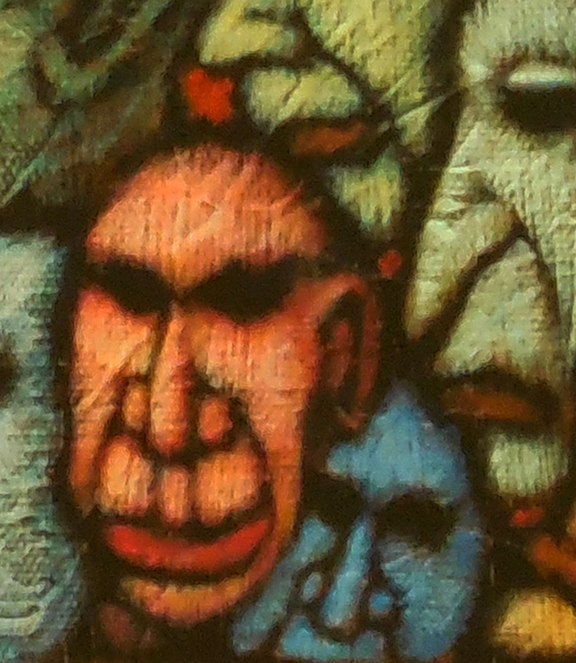
Some pieces definitely leave behind reverberating waves. Like the one above, a 16″ by 20″ painting from the Multitudes series that I call Soul Boat. It’s a piece that I miss now when I scan around the studio. There are faces in it that I had gotten used to locating and focusing on, like the one here on the right that reminds me of Henry Miller. Maybe he’s sailing out on the Tropic of Cancer or Capricorn.

Don’t know but I kind of miss having him staring out at me.

If you want to have this Henry Miller stare at you for a bit, Soul Boat is now at the West End Gallery for next week’s opening on Friday, July 12. Please stop in and get a sneak peek at the show.

Anyway, here’s an oldie from Grand Funk Railroad that might kind of line up with this piece– if you squint your eyes and try real hard. It’s I’m Your Captain/Closer to Home.

Read Full Post »

Was looking through some images of work from around 2006 and 2007 and came across this painting, The Middle Way. It really jumped out at me so thought I’d share it along with a blogpost from back in 2009 about a Henry Miller essay. The painting and the essay seem to fit together well.

*****************

 ***************************

    From the very beginning almost I was deeply aware that there is no goal. I never hope to embrace the whole, but merely to give in each separate fragment, each work, the feeling of the whole as I go on, because I am digging deeper and deeper into life, digging deeper and deeper into past and future. With the endless burrowing a certitude develops which is greater than faith or belief. I become more and more indifferent to my fate, as a writer, and more and more certain of my destiny as man.

      – Henry Miller, Reflections on Writing

****************************

This is a fragment of an essay, Reflections on Writing, from a book of essays, The Wisdom of the Heart, by Henry Miller, the great and controversial author. When I was young his books such as Tropic of Cancer and Tropic of Capricorn were still being characterized as “smut” and many libraries didn’t have them on their shelves for fear the morality police would swoop in and raise a fuss. Probably many only know the existence and influence of his books from their use in a memorable Seinfeld episode, the one with Bookman the library cop whose hard-boiled dialogue still makes me hoot.

For me, I wasn’t so much attracted to his books by the raciness of the stories but rather by his way of speaking through his words and expressing views that I found at once to be compatible with my own. He observed and said the things that I  wished I could say with a voice and power I wished I possessed. I can pick up one of his books and open to a page anywhere in the book and read and be fascinated without knowing the context of what I’m reading, just from the sheer strength of his writing’s voice.

I see a lot of things in this particular essay that translate as well for painting or any other form of creation. It opens:

Writing, like life itself, is a voyage of discovery. The adventure is a metaphysical one: it is a way of approaching life indirectly, of acquiring a total rather than a partial view of the universe. The writer lives between the upper and lower worlds: he takes the path in order to eventually become that path himself.

Substituting artist for writer, I was immediately pulled in. The path he refers to is the path I often refer to in my paintings, the path we all walk and struggle along on, trying to find the middle way between these upper and lower worlds.

It’s a good essay and one I recommend for anyone who creates in any form and struggles with the meaning of their work beyond its surface. For anyone seeking that path…

_________________________________________________________

Read Full Post »

Writing, like life itself, is a voyage of discovery. The adventure is a metaphysical one: it is a way of approaching life indirectly, of acquiring a total rather than a partial view of the universe. The writer lives between the upper and lower worlds: he takes the path in order to eventually become that path himself.

Henry Miller, Reflections on Writing

********************************

This is one of my favorite passages from an essay in the Henry Miller book, The Wisdom of the Heart. I think you can easily insert any creative endeavor in place of the word writer and still be correct. The idea that the path of art concerns itself with acquiring a total view of the universe rings like absolute truth to my ears.

It’s a good thing to keep in mind on those days when you question the path you’re on and can’t recognize your purpose. Knowing that you are your own path somehow eases that anxiety.

Read Full Post »

If we are always arriving and departing, it is also true that we are eternally anchored. One’s destination is never a place but rather a new way of looking at things.
Henry Miller
**************

We often search and search, moving from place to place, trying to find that certain something that we can’t quite name. We have it in our minds that it is a physical place, a tangible object, that will satisfy our need to wander.

New people to meet.

New streets to explore.

New landscapes to surround us. New hills to climb.

But maybe what we seek is just a new way of seeing ourselves, of a new opportunity to unleash the person we desire ourselves to be. Or, more likely, a chance to see ourselves as we really are, something that becomes obscured in the familiar. Being anchored, as Miller infers above, in the repetition of  day to day life has us showing ourselves always in the same light. We lose touch with aspects of who we are that are never allowed to come to light.

The search allows us that new perspective. While we remain the same we see ourselves from new angles, new vantage points, allowing us to feel new. Different.

Sometimes it is good and sometimes it is not, exposing perspectives on ourselves we would rather not see and may have hidden for a long time. But hopefully unveiling the truth of all that we are will somehow  make us feel comfortable in our wholeness.  Knowing our shortcomings as well as our strengths make us more real, more human.

What we seek is always with us.

You might not view it the same way but that’s what I am seeing in this new painting, an 8″ by 16″ canvas, that I call Destination Seen. It is headed to the West End Gallery for my upcoming show, Self Determination, which opens July 14.


Read Full Post »

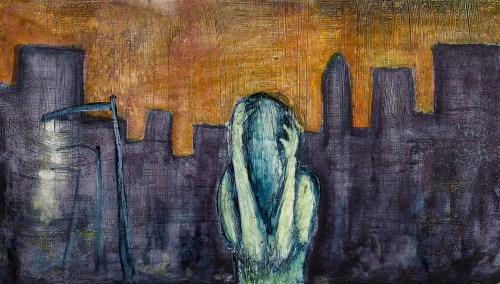
gc-myers-the-angst (1)Each man has his own way of being himself and of saying it so ultimately that he can’t be denied.
Henry Miller

*******************

I ran the entry below back in 2009 and again back in 2013.  It is a favorite of mine and one of my more popular posts,  regularly drawing a number of readers who find it via web searches.  I like it because it describes the internal transition that took place over the years on my path to becoming and accepting my place as an artist.  I say path because it took a long time before I found the  confidence to call myself an artist.  For many years, even as I was working full time as a painter, I was hesitant to say those words, to say that I was an artist.

I periodically pull this entry up and read it just to remind myself to trust my inner voice and the work that comes from it.  I think it is worth running yet again.  Oh, and excuse Henry Miller for the sexist sounding nature of his words above– it would read better if it went Each person has their own way...

********************

When I used to enter a gallery or museum, even up until several years ago, I would be filled with a severe sense of dread and anxiety.  Angst. The knot in the stomach. The racing pulse. The whole thing. 

I would go from painting to painting and would feel lessened in some way because in each piece I would see something that I could not do, some technique that was not in my toolbag. There were colors and forms that I could not replicate and all I could think was that I was somehow inferior. 

I didn’t belong. 

The resulting feelings would leave me reeling and sometimes angry, making me even more determined to create something that would validate my work. 

While this was a motivating force for many years, helping me actually find my voice, it gradually subsided over the years as I became more and more aware that I had been focusing on things I could not control and on being something I was not. 

I began to see what I was. My perceptions and feelings were only mine.  To express these, I had an individual voice and vocabulary that was mine and no one else’s.  I began to see that other artists felt about my work as I had felt about their work. I saw that while they were doing things that I could not, the reverse was true as well. I recognized that my voice, my technique and style, was finally mine and mine alone. I saw that my form of expression was every bit as valid as any other artist hanging in any gallery or museum. 

This was a liberating feeling. It allowed me to go into galleries and museums and , instead of seeing what I was not, recognize the beauty of expression that was there and be excited and inspired by things other artists were doing.

Instead of coming out saying ” I’ll show them ” I was saying “I can use that”. 

Instead of asking “Why am I not good enough?” I was asking “Why not me?” 

It was merely a matter of trusting that what I saw in my own work was a true and real expression and would be visible to others. I think this a lesson from which any viewer of art can benefit. They must learn to trust their own instincts and reactions when looking at art. Like my self-expression, their reaction to a work is theirs and theirs alone. Their reaction is as valid as anyone else and no critic or gallery-owner can make a person like a piece that doesn’t move them. When the viewer realizes that there is no right or wrong, that their own opinion is truly valid, their viewing pleasure will increase dramatically. 

By the way, the piece at the top is an old experiment from around 1994. I always enjoy pulling it out even though it doesn’t fit neatly into my normal body of work. No more angst. 

Well, a different kind of angst…

Read Full Post »

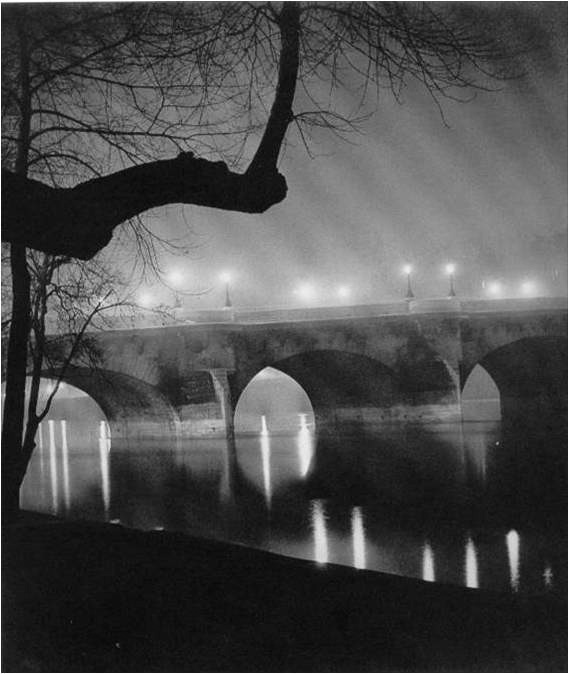
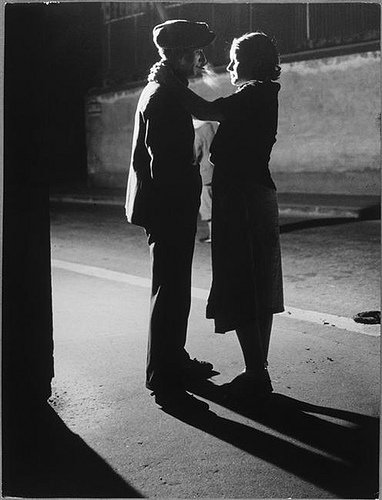
Brassai_1899_1984__ Paris 6I realized after publishing yesterday’s post that, while I had shown the work of many great phtographers,  I had never before shown any of the photos of Brassai here.  That was an oversight on my part.  Called the Eye of Paris by his friend Henry Miller, Brassai’s work is iconic and defines the perception that many people have of Paris in the first half of the last century.

Born in Hungary with the name Gyula Halasz  in 1899, he studied art and served with the Austro-Humgarian army in World War I.  After the war, he found his way to vibrant Paris, filled with the great artists, writers and musicians of the time.  He adopted the pseudonym Brassai  from the name of his hometown and soon was photographing the city that he so loved  and was his home for the rest of his life, until his death in 1984.  His photos of Paris captured its high life and its low life, with photos of the great artists and thinkers that made their way there alongside the photos of decadent parties and photos of the brothels and the prostitutes along the city’s avenues.  For me, when I think of Brassai I think of his night scenes that capture the shadows and mist of the city as well as the lovers who embrace on the darkened boulevards.

It’s powerful work, work that evokes both a time and a place as well as a feeling.  Brassai was indeed the Eye Of Paris and I’m pleased to have taken care of my oversight here.  Most of these photos are from the early 1930’s.

Brassai_1899_1984__ Paris 11 Brassai_1899_1984__Paris 8 Brassai_1899_1984__Paris 5 Brassai_1899_1984__Paris 10 Brassai_1899_1984__Paris 9 Brassai_1899_1984_Paris 2 brassai_Couple_d_amoureux_sous_un_r_verb_re_1933 Brassai_1899_1984__Paris 7 Brassai_1899_1984__Paris 3 Brassai_1899_1984__Paris 4Brassai Notre Damebrassai_theeiffeltowerattwilight

Read Full Post »

Older Posts »