“I have no right to call myself one who knows. I was one who seeks, and I still am, but I no longer seek in the stars or in books; I’m beginning to hear the teachings of my blood pulsing within me. My story isn’t pleasant, it’s not sweet and harmonious like the invented stories; it tastes of folly and bewilderment, of madness and dream, like the life of all people who no longer want to lie to themselves.”
― Hermann Hesse, Demian
I have a new painting on the easel waiting for me this morning. I thought it was complete when I finished up yesterday but just as I was leaving, I saw that it needed a small but critical adjustment. I didn’t have the time then to complete it, so it’s been nagging at me all night. Therefore, I will be short this morning even though the subject deserves much more time and effort than I can give it at the moment.
Today is a triad of word, image, and song centering around the seeker. By that I mean the seeker of inner discovery, of the self. I am including a passage from a Hermann Hesse book, Demian, that was very influential in my life. It came to me at a time when I was struggling mightily and it helped me rethink what my life was and could be. It allowed me to recognize that I was exhausted from the lies I told not only to others but mainly to myself.
Without coming across this book, I doubt I would be painting or writing at this moment. God only knows what, if anything, I might be doing.
I am accompanying the passage with a painting that is very much about seeking, Under the Compass. For me, I see it as being about the inner search though it might also apply to the seeker who still looks for outer validation of their existence. I a also sharing a performance from The Who of their song The Seeker. It first came out in 1970 and this is how Pete Townshend described it in a Rolling Stone interview at the time:
Quite loosely, “The Seeker” was just a thing about what I call Divine Desperation, or just Desperation. And what it does to people. It just kind of covers a whole area where the guy’s being fantastically tough and ruthlessly nasty and he’s being incredibly selfish and he’s hurting people, wrecking people’s homes, abusing his heroes, he’s accusing everyone of doing nothing for him and yet at the same time he’s making a fairly valid statement, he’s getting nowhere, he’s doing nothing and the only thing he really can’t be sure of is his death, and that at least dead, he’s going to get what he wants. He thinks!.
Divine desperation. Maybe that is the unifying bond here, the driving force behind the Seeker.
All birth means separation from the All, the confinement within limitation, the separation from God, the pangs of being born ever anew. The return into the All, the dissolution of painful individuation, the reunion with God means the expansion of the soul until it is able once more to embrace the All.
–Hermann Hesse, Steppenwolf (1927)
The expansion of the soul until it is able once more to embrace the All…
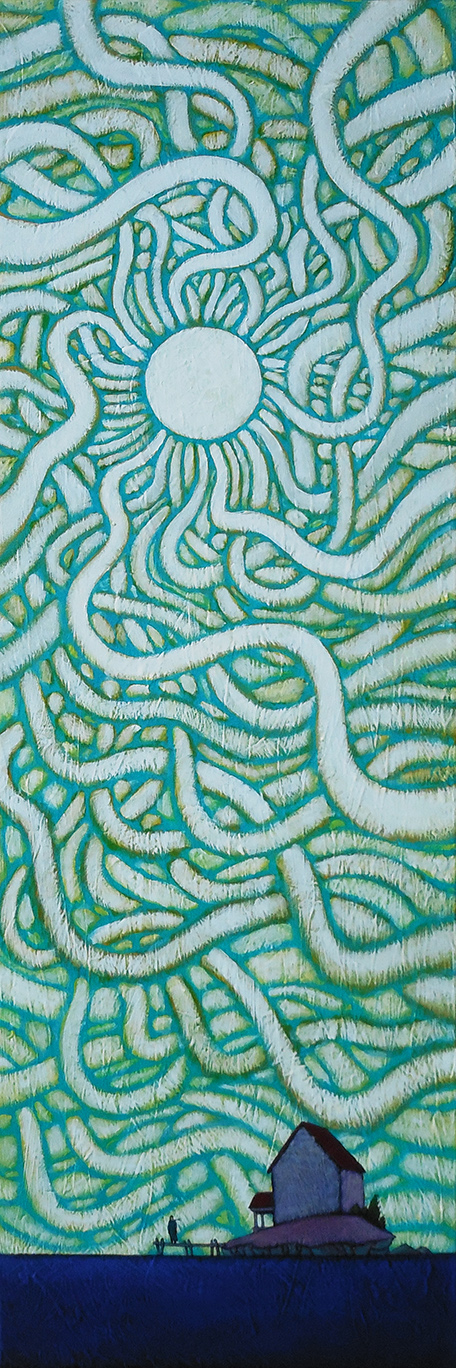
The title, Reunion, for this new 36″ x 12″ painting from my June show at the Principle Gallery came long before I was reminded of the passage above from Hesse’s Steppenwolf. But the message comes pretty close to that of both this painting and the Entanglement exhibit as a whole, as I have attempted to describe in recent posts here.
I say attempted because I really don’t know, so my words are often lacking. It is still a mystery to me, one that will remain so until the energy that animates the physical form I temporarily inhabit reunites with the all-encompassing energy of the universe, the Alldescribed by Hesse.
It is the mystery of this whole thing that I am trying to capture with much of the work from this upcoming show. The landscapes in these paintings are spare, often small islands or sailboats on the seas or lone trees or houses on wide plains. As in this piece, they are set low in the picture plane in a way that, for me, symbolizes the smallness or insignificance of the ephemeral nature of our existence in relation to the vast and seemingly eternal energy represented by the sky.
My desire was to have the skies, with the rhythm of their patterns and twists and turns, be the focus of these paintings. The idea is to represent a form of energy that seems chaotic from afar yet has motion and rhythm that hopefully becomes apparent to the viewer who takes the time to dwell in these pictures.
I know I have found this work most rewarding. It is a theme that has shown itself in my work over the past decade. In 2016 I did a group of similar work that remains close to my heart. I moved away from it but every time I reviewed that particular work, I found myself asking why. It moves me as much now as when it first emerged. I think these new takes on that theme takes it further and deepens the meaning of it.
Being a mysterious thing, there are certainly questions raised. That’s a good thing, in my opinion. Are there answers to be found? That’s not for me to say. As with most things, the answer is in the individual and where they are in their way through this temporary bit of time and space.
That is, if there are answers at all. Maybe just asking the question is all we need. Maybe it’s the first step in aligning our energy to that great Entanglement with which we will one day be reunited.
Until that time, it shall remain a mystery.
Entanglement opens Friday, June 13 at the Principle Gallery with an Opening Reception from 6-8:30 PM. I will also be giving a Painting Demonstration at the gallery on the following day, Saturday, June 14, from 11 AM until 1 PM.
I wasn’t going to add a song to this post but as I was finishing up a song came to mind that made me laugh. It felt a little goofy and out of place for a fairly serious post but then I thought, why not? The title alone works for me with this painting. Plus, I haven’t shared a lot of Elvis here in recent times. This is Return to Sender.
Archaeology: The Golden Age Beyond — At Principle Gallery
At Saturday’s Gallery Talk at the Principle Gallery, I started by speaking about how my painting came about as a result of a lifelong search to identify my own belief system. I feel that everyone has some sort of belief system– even atheism is a belief system– and had always wanted to understand why we were here and what our purpose truly was.
Eventually, the talk turned to the Red Tree. That was fortuitous since it has become an icon for me of some sort of the sort of cobbled together belief system I have come to hold. I went on to read a passage from Hermann Hesse on his own feelings on the meaning and importance of trees.
Hesse holds a place in the formulation of my belief system, something I didn’t mention this during the talk. At a dark low point in my life, I had come across a book, Demian, by Hermann Hesse that I believe saved my life. I have read many of his other works and have gleaned bits here and there but that one resonated most with me and the turmoil I was experiencing at the time.
But I was equally affected when I came across the passage from Hesse below on what we can learn from listening to trees from Hermann Hesse. The late Nobel Prize winning writer included this in his 1920 book, Wandering: Notes andSketches. It well describes much of what I have received from the Red Tree, things that have contributed to my belief system.
There is a lot to like here but I was most struck by the line: Home is neither here nor there. Home is within you, or home is nowhere at all.
That line would be included in the Proverbs section of my belief system.
I thought it would be fitting to include his essay here once again. I have also included a reading of this selection at the bottom. I have listened to several and they often miss the mark for me. This one is fairly good, in my opinion. But perhaps you should just read it in your own voice. Here it is, if you choose that route:
For me, trees have always been the most penetrating preachers. I revere them when they live in tribes and families, in forests and groves. And even more I revere them when they stand alone. They are like lonely persons. Not like hermits who have stolen away out of some weakness, but like great, solitary men, like Beethoven and Nietzsche. In their highest boughs the world rustles, their roots rest in infinity; but they do not lose themselves there, they struggle with all the force of their lives for one thing only: to fulfill themselves according to their own laws, to build up their own form, to represent themselves. Nothing is holier, nothing is more exemplary than a beautiful, strong tree. When a tree is cut down and reveals its naked death-wound to the sun, one can read its whole history in the luminous, inscribed disk of its trunk: in the rings of its years, its scars, all the struggle, all the suffering, all the sickness, all the happiness and prosperity stand truly written, the narrow years and the luxurious years, the attacks withstood, the storms endured. And every young farmboy knows that the hardest and noblest wood has the narrowest rings, that high on the mountains and in continuing danger the most indestructible, the strongest, the ideal trees grow.
Trees are sanctuaries. Whoever knows how to speak to them, whoever knows how to listen to them, can learn the truth. They do not preach learning and precepts, they preach, undeterred by particulars, the ancient law of life.
A tree says: A kernel is hidden in me, a spark, a thought, I am life from eternal life. The attempt and the risk that the eternal mother took with me is unique, unique the form and veins of my skin, unique the smallest play of leaves in my branches and the smallest scar on my bark. I was made to form and reveal the eternal in my smallest special detail.
A tree says: My strength is trust. I know nothing about my fathers, I know nothing about the thousand children that every year spring out of me. I live out the secret of my seed to the very end, and I care for nothing else. I trust that God is in me. I trust that my labor is holy. Out of this trust I live.
When we are stricken and cannot bear our lives any longer, then a tree has something to say to us: Be still! Be still! Look at me! Life is not easy, life is not difficult. Those are childish thoughts. . . . Home is neither here nor there. Home is within you, or home is nowhere at all.
A longing to wander tears my heart when I hear trees rustling in the wind at evening. If one listens to them silently for a long time, this longing reveals its kernel, its meaning. It is not so much a matter of escaping from one’s suffering, though it may seem to be so. It is a longing for home, for a memory of the mother, for new metaphors for life. It leads home. Every path leads homeward, every step is birth, every step is death, every grave is mother.
So the tree rustles in the evening, when we stand uneasy before our own childish thoughts: Trees have long thoughts, long-breathing and restful, just as they have longer lives than ours. They are wiser than we are, as long as we do not listen to them. But when we have learned how to listen to trees, then the brevity and the quickness and the childlike hastiness of our thoughts achieve an incomparable joy. Whoever has learned how to listen to trees no longer wants to be a tree. He wants to be nothing except what he is. That is home. That is happiness.
“The Admiring Pause”- At the Principle Gallery, Alexandria VA
It may be important to great thinkers to examine the world, to explain and despise it. But I think it is only important to love the world, not to despise it, not for us to hate each other, but to be able to regard the world and ourselves and all beings with love, admiration and respect.
― Hermann Hesse, Siddhartha
Even though I am writing this on Saturday morning, this is Sunday and for the first time since last year I am back on the road, delivering my new show, Between Here and There, to the Principle Gallery. The show, my 22nd solo effort there, open June 4.
Maybe because I have become so used to being ensconced in the studio, the idea of any sort of trip, even a daytrip like this, feels unusual. Strange, like I have somehow forgot how to move among people or talk or act around them. In a way, I feel like a convict who has been in solitary for the past year and is suddenly back among the general population.
Just hope I don’t have to shank anybody.
Just kidding, of course. Wink, wink, nudge, nudge.
Okay, time is fleeting and I still have much to do today (yesterday for those of you reading) before I am ready to do anything tomorrow (today) so let me point out the new painting at the top, The Admiring Pause, which is part of the show. There’s a lot I like about this piece. There is a sense of stillness and fullness that I find very satisfying. Makes me want to sit back and admire it for just a brief moment.
The pause that refreshes, as the old Coca Cola slogan goes.
For this Sunday morning music I thought a piece from Dave Brubeck would go well with this painting. I am going with Koto Song. A koto is a Japanese zither-like instrument and this song was from Brubeck’s 1964 album Impressions of Japan. It’s a nice piece of music that has that elemental stillness that marks much Japanese art. Something I have long admired and desired for my own work. You judge for yourself.
Nothing whets the intelligence more than a passionate suspicion, nothing develops all the faculties of an immature mind more than a trail running away into the dark.
― Stefan Zweig, The Burning Secret
The new painting above is part of my June solo show, Between Here and There, at the Principle Gallery in Alexandria. Its title, The Burning Secret, is borrowed from a Stefan Zweig short story. The Austrian Zweig (1881-1942) was a giant of literature in the 1920s and 30’s, his books among the biggest best-sellers and most translated of the time. But he has not come forward in history with the same impact as some of his contemporaries such as Hermann Hesse and Thomas Mann, though there was new interest in his work after director Wes Anderson made Zweig’s The Grand Budapest Hotel into a wonderful film.
I am not going to get into Zweig here but the short excerpt form the story at the top seemed to fit so well with what I was seeing in this new painting. The forest of Red Trees has a feeling of danger and menace yet also beckons. I know that, as one possessed of an immature mind despite my quickly advancing age, that the danger possessed in mystery is an attractive thing for this unnurtured sort of mind.
You know you stay out of that place but there is something in there that needs to be found, some mystery to be exposed.
The fractured sky above appears to shed light and clues and the house seems to almost stare into the dark of the forest. Though it is apparently night the light on the fields is surreally mysterious and shadowy.
Yet, even with its evident potential for peril, there is something in this that tells me that the core of this mystery, the secret waiting to be uncovered, is not to be feared. The fear only comes in not knowing which allows the immature mind to run wild.
The more mature part of the mind feels that behind the mystery there may be answers. Perhaps even answers to the larger questions that have plagued one’s mind.
It makes me want to follow that path, that trail running away into the dark.
Who knows what lies beyond?
The Burning Secret is 13″ by 19″ on paper and is matted and framed in an 18″ by 24″ frame. It is included in my solo show, Between Here and There, which opens June 4, 2021 at the Principle Gallery in Alexandria, VA.
As the peculiar faculty of the eye is to see form and colour, and of the ear to hear sweet tones and voices, so is aspiration peculiar to the soul.
–Meister Johann Eckhart
Don’t have a lot of time this morning but wanted to just share a few lines from Meister Johann Eckhart who was a German theologian/philosopher that lived in the second half of the the 13th century, dying around 1328 while waiting to hear the verdict on charges of heresy set against him. In more modern times Meister Eckhart has undergone a revival, being hailed in some circles as a mystic.
I don’t know about that but I do find his observations are often quite insightful and sometimes align closely with my own thoughts on certain subjects, especially on artistic expression– though I believe he is describing religious expression but let’s not split hairs, okay?– and the creative process.
For example:
To be properly expressed a thing must proceed from within, moved by its form: it must come, not in from without but out from within.
This pretty much sums up what I have been saying for some time, that our real artistic voice takes in influences from without but synthesizes and adds to them inside ourselves to create a unique expression of self.
Or there’s this:
Only the hand that erases can write the true thing.
That sounds very much like a line from Hermann Hesse’s Demian — Hesse probably pinched the idea from the old Meister– that has hung with me for a long time: Whoever wants to be born, must first destroy a world. Real change in this world and in one’s singular life demands a willingness to leave the past behind completely.
Then there’s this one:
When the soul wishes to experience something, she throws an image of the experience out before her and enters into her own image.
This couples well with the line at the top about the aspiration of the soul. I have always held on the belief that if we truly want something of great significance in our lives, we internally and externally create the conditions for us to reach some form of that desire. I believe this actually a popular concept among modern self-help gurus but, of course, it’s not so quick or easy as they make it sound. The real proof is often decades in coming to fruition and even then it may appear in a form that you didn’t realize was your desire at the beginning.
But the soul knows better what the soul wants and needs.
Okay, there are a lot more examples from Meister Eckhart — for example, a relevant fave: Form is a revelation of essence –but I have to get to work, to express my peculiar faculty of the eye and attempt to reveal my essence. His words, not mine.
You go do what you do and try to have a good day in the process.
“One never reaches home,’ she said. ‘But where paths that have an affinity for each other intersect, the whole world looks like home, for a time.”
-Hermann Hesse, Demian: The Story of Emil Sinclair’s Youth
The painting at the top, Home in Sight, is a new small piece that is headed to the West End Gallery for their annual Little Gemsshow which opens in February. The words above are from a Hermann Hesse book that holds a special place in my heart, a book that served a very important purpose for me when I was struggling at my lowest point.
It helped me find my way home.
Often, when I employ the concept of home in my work, that book comes to mind. And I am always so grateful then for what it did for me then. And now because without it there may well not have been a now.
This quote came from Hermann Hesse‘s most famous book, Steppenwolf. A great book but my favorite Hesse book is Demian, which I have referenced here a couple of times in the past. It was a book that I read at a time when I was at a crossroads in my life and it was very influential in my heading in the direction which led to this point. I think this quote very much jibes with my perception of the world portrayed in my work, that being that it is a real entity, a real place.
It has as much substance as the outer world to me. It has depth and layers. It has breath and light. It has emotion and its truth comes the fact that it is a precise portrayal of itself– not a replication of the outer world.
It just is.
That may sound nutty or perhaps egotistical to some. I get that. But without this belief in the reality of this inner world, the validity of the work to myself comes undone. It fades to nothingness and certainly doesn’t move across the void to the viewer. It loses all meaning for everyone, myself included, without this certainty in its being real.
I’m going to stop at this point. I may have said too much already, maybe too much for the outer world. In here, in my little inner world of colors and shapes, it sounds right…
*************
This post was from about five years back. I reread it for the first time again this morning and thought it deserved another run.
Below is a wonderful essay on what we can learn from listening to trees from Hermann Hesse. The late Nobel Prize winning writer included this in his 1920 book, Wandering: Notes and Sketches. There is a lot to like here but I was most struck by the line: Home is neither here nor there. Home is within you, or home is nowhere at all.
Give it a read for yourself:
For me, trees have always been the most penetrating preachers. I revere them when they live in tribes and families, in forests and groves. And even more I revere them when they stand alone. They are like lonely persons. Not like hermits who have stolen away out of some weakness, but like great, solitary men, like Beethoven and Nietzsche. In their highest boughs the world rustles, their roots rest in infinity; but they do not lose themselves there, they struggle with all the force of their lives for one thing only: to fulfill themselves according to their own laws, to build up their own form, to represent themselves. Nothing is holier, nothing is more exemplary than a beautiful, strong tree. When a tree is cut down and reveals its naked death-wound to the sun, one can read its whole history in the luminous, inscribed disk of its trunk: in the rings of its years, its scars, all the struggle, all the suffering, all the sickness, all the happiness and prosperity stand truly written, the narrow years and the luxurious years, the attacks withstood, the storms endured. And every young farmboy knows that the hardest and noblest wood has the narrowest rings, that high on the mountains and in continuing danger the most indestructible, the strongest, the ideal trees grow.
Trees are sanctuaries. Whoever knows how to speak to them, whoever knows how to listen to them, can learn the truth. They do not preach learning and precepts, they preach, undeterred by particulars, the ancient law of life.
A tree says: A kernel is hidden in me, a spark, a thought, I am life from eternal life. The attempt and the risk that the eternal mother took with me is unique, unique the form and veins of my skin, unique the smallest play of leaves in my branches and the smallest scar on my bark. I was made to form and reveal the eternal in my smallest special detail.
A tree says: My strength is trust. I know nothing about my fathers, I know nothing about the thousand children that every year spring out of me. I live out the secret of my seed to the very end, and I care for nothing else. I trust that God is in me. I trust that my labor is holy. Out of this trust I live.
When we are stricken and cannot bear our lives any longer, then a tree has something to say to us: Be still! Be still! Look at me! Life is not easy, life is not difficult. Those are childish thoughts. . . . Home is neither here nor there. Home is within you, or home is nowhere at all.
A longing to wander tears my heart when I hear trees rustling in the wind at evening. If one listens to them silently for a long time, this longing reveals its kernel, its meaning. It is not so much a matter of escaping from one’s suffering, though it may seem to be so. It is a longing for home, for a memory of the mother, for new metaphors for life. It leads home. Every path leads homeward, every step is birth, every step is death, every grave is mother.
So the tree rustles in the evening, when we stand uneasy before our own childish thoughts: Trees have long thoughts, long-breathing and restful, just as they have longer lives than ours. They are wiser than we are, as long as we do not listen to them. But when we have learned how to listen to trees, then the brevity and the quickness and the childlike hastiness of our thoughts achieve an incomparable joy. Whoever has learned how to listen to trees no longer wants to be a tree. He wants to be nothing except what he is. That is home. That is happiness.
This another new painting, coming in at 24″ by 24″ on canvas, that is headed to the Principle Gallery for my annual solo show there. The show,my 20th solo effort at the Alexandria gallery, is titled Redtree: New Growth and opens on June 7. This painting is titled Solitude’s Rapture.
I don’t know if solitude is for everybody. Some people might look at this painting with a little discomfort, seeing in it isolation and loneliness. But for myself, it represents a total freedom of the self, one that allows one’s absolute truth to emerge. A freedom that allows one to experience clear glimpses of our connection with all being.
The lines above from Byron’s Childe Harold’s Pilgrimage express this feeling well. Alone on a shore, one can begin to hear and converse with nature. The lap and roar of the sea becomes language as does the light of the sun and moon as it sifts through clouds above. It is in these conversations that we come to better understand that we are both small and large, insignificant yet integral.
Of course, this is not a practical matter for most of us. I have my own little island of solitude here in my studio but I am not isolated. My regular life has me out in the world, interacting with people on a regular basis. But knowing that I will soon be back on my island where the only conversation taking place is in myself.
Hermann Hesse put it well in the excerpt below from his book, Reflections. He mentions it as being a way of bitter suffering. I suppose initially, for those who have been always in the society of others and seldom alone, this may be the case when faced with solitude. But, as he points out, when you get past that discomfort, the rewards of solitude are rapturous.
*********************
“We must become so alone, so utterly alone, that we withdraw into our innermost self. It is a way of bitter suffering. But then our solitude is overcome, we are no longer alone, for we find that our innermost self is the spirit, that it is God, the indivisible. And suddenly we find ourselves in the midst of the world, yet undisturbed by its multiplicity, for our innermost soul we know ourselves to be one with all being.”



 Redtree Times