Feeds:
Posts
Comments

Posts Tagged ‘Kahlil Gibran’


Pity the nation whose people are sheep
And whose shepherds mislead them

Pity the nation whose leaders are liars
Whose sages are silenced
And whose bigots haunt the airwaves

Pity the nation that raises not its voice
Except to praise conquerors
And acclaim the bully as hero
And aims to rule the world
By force and by torture

Pity the nation that knows
No other language but its own
And no other culture but its own

Pity the nation whose breath is money
And sleeps the sleep of the too well fed

Pity the nation oh pity the people
who allow their rights to erode
and their freedoms to be washed away

My country, tears of thee
Sweet land of liberty!

–Pity the Nation, Lawrence Ferlinghetti (after Khalil Gibran) 2007


I leave this here today without image, comment, or music, except to point out that Ferlinghetti took inspiration in 2007 from the Kahlil Gibran poem of the same title, published posthumously after his death in 1931. Both poems clearly speak to their own times as well as this present moment. Here is the Gibran poem:


Pity the nation that is full of beliefs and empty of religion.
Pity the nation that wears a cloth it does not weave
and eats a bread it does not harvest.

Pity the nation that acclaims the bully as hero,
and that deems the glittering conqueror bountiful.

Pity a nation that despises a passion in its dream,
yet submits in its awakening.

Pity the nation that raises not its voice
save when it walks in a funeral,
boasts not except among its ruins,
and will rebel not save when its neck is laid
between the sword and the block.

Pity the nation whose statesman is a fox,
whose philosopher is a juggler,
and whose art is the art of patching and mimicking

Pity the nation that welcomes its new ruler with trumpeting,
and farewells him with hooting,
only to welcome another with trumpeting again.

Pity the nation whose sages are dumb with years
and whose strongmen are yet in the cradle.

Pity the nation divided into fragments,
each fragment deeming itself a nation.

–Kahlil Gibran, from The Garden of The Prophet (1933)


Read Full Post »

The Calming Flow— Coming to Principle Gallery, June 2025


In my youth the heart of dawn was in my heart, and the songs of April were in my ears.
But my soul was sad unto death, and I knew not why. Even unto this day I know not why I was sad.
But now, though I am with eventide, my heart is still veiling dawn,
And though I am with autumn, my ears still echo the songs of spring.
But my sadness has turned into awe, and I stand in the presence of life and life’s daily miracles.

Youth and Age, Kahlil Gibran (1926)


I recently came across the opening portion above from the poem Youth and Age from poet/philosopher Kahlil Gibran (1883 –1931) and felt that it spoke deeply to both what I have been feeling in my recent work and in my own life. I suppose that makes sense since my work very much reflects the experience and feeling of my life. I 

I think that anyone who is into the autumn or winter of their life can identify with the message of these lines. The face in the mirror shows the wear of the years and the body often aches and groans but the heart and spirit still feel youthful. As Gibran puts it, my ears still echo the songs of spring.

But it is a youthfulness that comes with much more understanding and acceptance than when one was actually the age felt. I think this is put best in a passage from later in this poem:

And in my youth I would gaze upon the sun of the day and the stars of the night, saying in my secret, “How small am I, and how small a circle my dream makes.”
But today when I stand before the sun or the stars I cry, “The sun is close to me, and the stars are upon me;” for all the distances of my youth have turned into the nearness of age;
And the great aloneness which knows not what is far and what is near, nor what is small nor great, has turned into a vision that weighs not nor does it measure.

The extremes of smallness and largeness of self that one sometimes felt in their youth has mellowed with the knowledge that while we are but small and seemingly insignificant bits of whatever you want to call this swirling, chaotic mass that is our existence and the universe, we occupy a place in it.

Born of a singularity, we are of it. 

And with that knowledge, as Gibran puts it so well, my sadness has turned into awe, and I stand in the presence of life and life’s daily miracles.

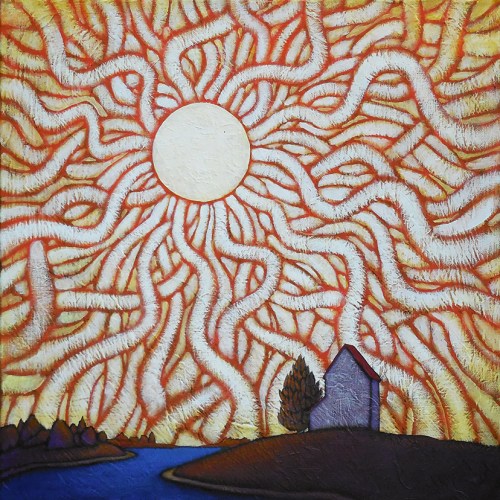
I think this thought is an apt description for what I see in this new painting, The Calming Flow, an 18″ by 18″ canvas that is part of my upcoming solo exhibit, Entanglement, at the Principle Gallery. I recognize that same sense of acceptance and realization that I read in Gibran’s verse. It is one of the calmness and patience that comes with age for some.

The complete poem Youth and Age is below.


Entanglement opens Friday, June 13 at the Principle Gallery with an Opening Reception from 6-8:30 PM. I will also be giving a Painting Demonstration at the gallery on the following day, Saturday, June 14, from 11 AM until 1 PM.


In my youth the heart of dawn was in my heart, and the songs of April were in my ears.
But my soul was sad unto death, and I knew not why. Even unto this day I know not why I was sad.
But now, though I am with eventide, my heart is still veiling dawn,
And though I am with autumn, my ears still echo the songs of spring.
But my sadness has turned into awe, and I stand in the presence of life and life’s daily miracles.
The difference between my youth which was my spring, and these forty years, and they are my autumn, is the very difference that exists between flower and fruit.
A flower is forever swayed with the wind and knows not why and wherefore.
But the fruit overladen with the honey of summer, knows that it is one of life’s home-comings, as a poet when his song is sung knows sweet content,
Though life has been bitter upon his lips.
In my youth I longed for the unknown, and for the unknown I am still longing.
But in the days of my youth longing embraced necessity that knows naught of patience.
Today I long not less, but my longing is friendly with patience, and even waiting.
And I know that all this desire that moves within me is one of those laws that turns universes around one another in quiet ecstasy, in swift passion which your eyes deem stillness, and your mind a mystery.
And in my youth I loved beauty and abhorred ugliness, for beauty was to me a world separated from all other worlds.
But now that the gracious years have lifted the veil of picking-and-choosing from over my eyes, I know that all I have deemed ugly in what I see and hear, is but a blinder upon my eyes, and wool in my ears;
And that our senses, like our neighbors, hate what they do not understand.
And in my youth I loved the fragrance of flowers and their color.
Now I know that their thorns are their innocent protection, and if it were not for that innocence they would disappear forevermore.
And in my youth, of all seasons I hated winter, for I said in my aloneness, “Winter is a thief who robs the earth of her sun-woven garment, and suffers her to stand naked in the wind.”
But now I know that in winter there is re-birth and renewal, and that the wind tears the old raiment to cloak her with a new raiment woven by the spring.
And in my youth I would gaze upon the sun of the day and the stars of the night, saying in my secret, “How small am I, and how small a circle my dream makes.”
But today when I stand before the sun or the stars I cry, “The sun is close to me, and the stars are upon me;” for all the distances of my youth have turned into the nearness of age;
And the great aloneness which knows not what is far and what is near, nor what is small nor great, has turned into a vision that weighs not nor does it measure.
In my youth I was but the slave of the high tide and the ebb tide of the sea, and the prisoner of half moons and full moons.
Today I stand at this shore and I rise not nor do I go down.
Even my roots once every twenty-eight days would seek the heart of the earth.
And on the twenty-ninth day they would rise toward the throne of the sky.
And on that very day the rivers in my veins would stop for a moment, and then would run again to the sea.
Yes, in my youth I was a thing, sad and yielding, and all the seasons played with me and laughed in their hearts.
And life took a fancy to me and kissed my young lips, and slapped my cheeks.
Today I play with the seasons. And I steal a kiss from life’s lips ere she kisses my lips.
And I even hold her hands playfully that she may not strike my cheek.
In my youth I was sad indeed, and all things seemed dark and distant.
Today, all is radiant and near, and for this I would live my youth and the pain of my youth, again and yet again.

–Youth and Age, Kahlil Gibran 


Read Full Post »

Icon: Peter the Scoundrel


HOW I BECAME A MADMAN

You ask me how I became a madman. It happened thus: One day, long before many gods were born, I woke from a deep sleep and found all my masks were stolen,–the seven masks I have fashioned and worn in seven lives,–I ran maskless through the crowded streets shouting, “Thieves, thieves, the cursed thieves.”

Men and women laughed at me and some ran to their houses in fear of me.

And when I reached the market place, a youth standing on a house-top cried, “He is a madman.” I looked up to behold him; the sun kissed my own naked face for the first time. For the first time the sun kissed my own naked face and my soul was inflamed with love for the sun, and I wanted my masks no more. And as if in a trance I cried, “Blessed, blessed are the thieves who stole my masks.”

Thus I became a madman.

And I have found both freedom of loneliness and the safety from being understood, for those who understand us enslave something in us.

But let me not be too proud of my safety. Even a Thief in a jail is safe from another thief.

–Kahlil Gibran, The Madman: His Parables and Poems (1918)


I was recently looking at some paintings from 8 or 9 years back from a series I call Icons. The subjects are people pulled from my ancestry that were done in a rough way like religious icon paintings. I stopped over this one at the top, Peter the Scoundrel. This one has been one of my least favorites from the series for a variety of reasons, some aesthetic, but mainly because the character it portrays, my 3rd great-grandfather, was such an enigma.

His name was Peter Bundy though it’s hard to tell if that was his real name or just one of the several aliases he assumed in his lifetime. I shared his story here back in 2016 and what a convoluted and confusing one it was. It had an abandoned family, two stints in the Union Army in our Civil War under different names one of which ended in desertion, capture and imprisonment in Andersonville, and a couple of other aliases that hid who-knows-what. My investigation into left me with the realization that the only thing I knew of him for sure was that he was buried in a small country cemetery in Caton. His stone there lists the unit of his second stint as a soldier and that he was born in Scotland. While I think he served in this unit under the name Peter Bundy, I have my doubts as to whether he was actually born in Scotland or born with the name Peter Bundy.

It was a frustrating look into his life, like trying to reveal the identity of someone behind a mask. Just when you thought you were going to see the truth of that person, you pull off the mask you see only to discover there is yet another mask beneath. And another beneath that one and maybe another beyond that. 

It made me think of the masks many of us wear throughout our lives. Peter Bundy might be an extreme case but many of us have multiple faces we wear for different situations and people, often to the point where it becomes difficult to discern which face is real and which is a mask.

It is equally difficult to fully understand the reason for the mask we wear. Sometimes it is to deceive, plain and simple. Peter Bundy, for example. Sometimes we wear masks for protection against things we fear or to fit into situations where we feel uncomfortable. Sometimes we wear a mask simply because we don’t want to be who we are or to show our real self. There are many reasons and situations, some honest and some not, that cause us to don our masks.

I often wonder if there are those who never wear a mask and think that it must be a wonderful thing to be so comfortable in your own skin. I am sure they are out there, those people who feel so self-assured and real. But then I wonder if one would even be able to know for sure if that was not just a mask in itself.

That brings me to the parable at the top from Kahlil Gibran. I came across it the other day after sharing another short piece on a scarecrow that was from the same book of Gibran’s parables. It made me think of Peter Bundy’s masks as well as the many masks I have worn. But more than that, it made me think about the liberating feeling of shedding all your masks, to live with your naked face.

To live a life of transparency.

I realized that it’s something I aspire to through my work and this blog. I also realized that shedding every mask is not an easy thing. Some fit so well, feel so comfortable and protective, that they naturally just go back into place at certain times. 

I have also found that trying to resist the temptation to wear these masks often leads one to a need for solitude and caring less, if at all, how others see you. This would be the freedom of loneliness and the safety from being understood as Gibran put it. I would quibble a bit with the use of loneliness in this translation as I seldom, if ever, feel lonely in my solitude. In fact, I often feel lonelier out in the public. That’s when I most want to pull on my mask.

I don’t know that I’ll ever be fully without a mask or two. Can any of us really make that claim? Is it even possible?

Who really knows?

Let’s finish up with a song that’s not really about masks. Well, the more I think about it, maybe it is. It is about madness of a sort. It’s some great early Rolling Stones–19th Nervous Breakdown.

Here it comes, here it comes….


Read Full Post »

Not a Crow in Sight– At West End Gallery


THE SCARECROW

Once I said to a scarecrow, “You must be tired of standing in this lonely field.”

And he said, “The joy of scaring is a deep and lasting one, and I never tire of it.”

Said I, after a minute of thought, “It is true; for I too have known that joy.”

Said he, “Only those who are stuffed with straw can know it.”

Then I left him, not knowing whether he had complimented or belittled me.

A year passed, during which the scarecrow turned philosopher.

And when I passed by him again I saw two crows building a nest under his hat.

–Kahlil Gibran, The Madman, His Parables and Poems (1918)


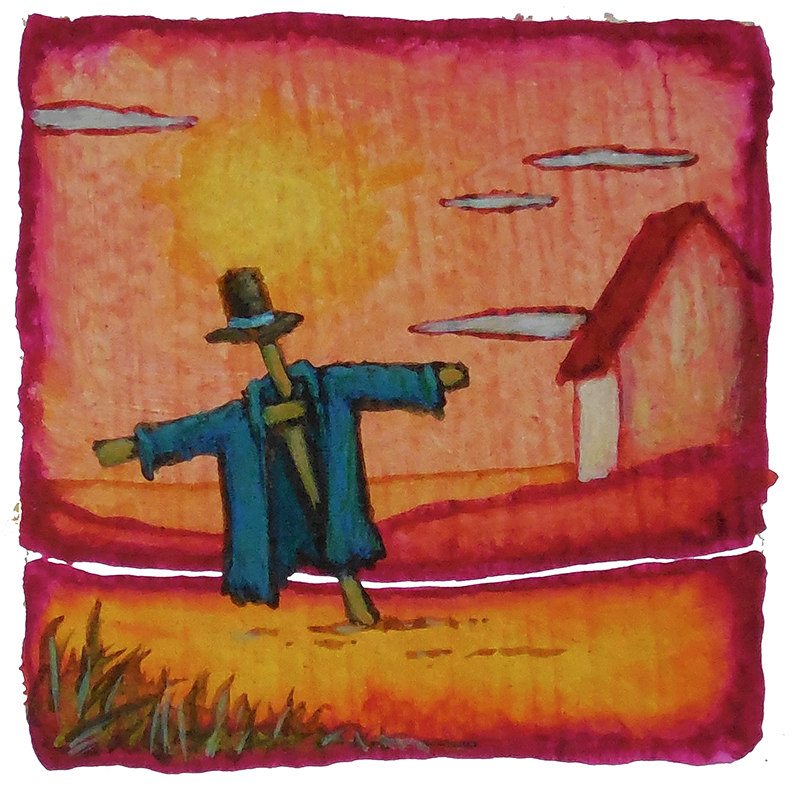
Looks like the theme for today is the scarecrow even though I have already spent too much time attempting to write something altogether different.  The other and now discarded subject was just not coming together in any kind of cohesive way. But in a roundabout way it did lead me to the short parable above from Kahlil Gibran.

The answer from the scarecrow– “The joy of scaring is a deep and lasting one, and I never tire of it.” — struck my fancy.

I just stopped for a few moments after writing that to ponder what a strange phrase struck my fancy is. There may be a blog post in that phrase. Or not, which is probably for the better. Whatever strikes my fancy.

But the idea of that there can be joy in scaring is intriguing. I am not sure I ever felt scaring people was part of who or what I am. But taking joy in scaring those who richly deserve it might be within me. It probably should be within all of us just so that we keep the deserving aware of our presence and the power we possess over them.

That last sentence probably seems like pretty cryptic. Well, it probably is. Scarecrows are seldom what they seem so take it any way you wish.

Here’s a song, Scarecrow, from Beck just to round out today’s triad. Got to run– two crows are pecking around my hat…


Read Full Post »

9921088 The Center Found sm

The Center Found“- Now at the West End Gallery


Imagination sees the complete reality, – it is where past, present and future meet… Imagination is limited neither to the reality which is apparent – nor to one place. It lives everywhere. It is at a centre and feels the vibrations of all the circles within which east and west are virtually included. Imagination is the life of mental freedom. It realizes what everything is in its many aspects… Imagination does not uplift: we don’t want to be uplifted, we want to be more completely aware.

― Kahlil Gibran


I came across the passage above from writer Kahlil Gibran (1883-1931) and felt it matched up well with my interpretation of the new painting at the top, The Center Found. I see it as it being about the Red Tree’s awareness of the many worlds surrounding it and its place and purpose within those intersecting worlds.

As Gibran points, out, that comes with the mental freedom of imagination which allows the Red Tree here to see the possibility of these worlds existing.

So perhaps the Red Tree in some of its many iterations could be a symbol for ones imagination. I can see that being true in this piece and in many others and could easily live with that interpretation since it links imagination with awareness.

Gibran is certainly right that we want to be more completely aware. I am not sure that I completely agree that we don’t want to be uplifted in a spiritual sense. I might be taking liberties here but I think he means we don’t want to be uplifted by others, that our uplifting is dependent on our own actions and understandings.

But I understand his point that without awareness, there is little possibility of being truly uplifted. And I would like to think that in this painting the Red Tree has found that center of awareness, that it feels the intersections of all the worlds around it.

And is then uplifted.


The Center Found is part of my new annual exhibit, Through the Trees, which opens Friday, July 16, at the West End Gallery in Corning, NY. There is an opening reception from 4-7 PM Friday. The show is currently hanging and available for previews. Thank you!


Read Full Post »


GC Myers- Canyon of Doubts


Creativity requires introspection, self-examination, and a willingness to take risks. Because of this, artists are perhaps more susceptible to self-doubt and despair than those who do not court the creative muses.

Eric Maisel


This painting below sits on a shelf directly in front of my desk. I was looking at it early this morning and wondered if I had put anything about it here on the blog. I came across the entry below from about four years ago which really spoke to the doubts I endure every year at this time as I begin to gear up for my annual shows.

This year is no different. Maybe even more pronounced, given the stress from the events of this past year. But I take some comfort in knowing that I have navigated through these canyons before and that takes off the edge. The doubts are still there but can’t box me in.

There is always a way through. 

Here’s what I put down about this four years back:

This new painting, 8″ by 10″ on panel, is called Canyon of Doubts. For me, it represents the navigation that takes place in the creative process as the artist tries to get past the formidable obstacles of self doubt. Doubt often throws up barriers that has the artist asking if they are good enough, if they have the talent, training, and drive to create true art that speaks for them to the world. Doubt makes them fear that they are out of place, that they don’t belong, that every other artist has more right to create than them.

Doubt keeps the artist seemingly boxed in with no apparent way forward.


Doubt is a pain too lonely to know that faith is his twin brother.

Kahlil Gibran


I’ve been trapped in that canyon many times. I’ve thought many times that there was no way out, that the fears posed by my doubts were the realities of who and what I was.

I have always felt alone with my doubts. Words of encouragement from others often felt hollow when I was lost in those canyons. They didn’t know how steep the walls of doubts seemed to me or how inadequate, how ill-prepared I felt in that moment.

The only option that seemed available to me was to trust that I could somehow fight my way out of those daunting canyons. It would mean mustering every bit of talent, every ounce of energy, and a sustained belief that I deserved to have my voice rise from out of  those canyons. It was matter of  either having the faith in my own value as human to find my way free or withering away in a canyon of doubts.


Your doubt can become a good quality if you train it. It must become knowing, it must become criticism.

Rainer Maria Rilke


I still find myself in those canyons. I still find myself periodically looking up at the walls that surround me and wonder if I am talented enough, strong enough, or even entitled to escape them.

But I now know that there is a path through them, one that is well worn with my own footprints from my past journeys in that shadowed place. I know that, even though it is lonely and seemingly unbearable in that moment, I don’t have to be trapped in that place of doubt.

I’ve traveled this path and there is indeed a way out.

It takes time and effort and devotion. It takes the belief in yourself, forged from past experience, that you will make the right decisions and not be trapped in those walls. It’s in having the faith that when take a wrong turn, when you make a mistake, that you will recognize it and get quickly back to the path that sets you free.

At the moment, I may well be in that canyon still but I have the moon guiding me and its light shows me where the canyon ends.

And then I will be free once more.


Have a good day.

Read Full Post »

********************

“The hidden well-spring of your soul must needs rise and run murmuring to the sea;
And the treasure of your infinite depths would be revealed to your eyes.
But let there be no scales to weigh your unknown treasure;
And seek not the depths of your knowledge with staff or sounding line.
For self is a sea boundless and measureless.
Say not, “I have found the truth,” but rather, “I have found a truth.”
Say not, “I have found the path of the soul.” Say rather, “I have met the soul walking upon my path.”
For the soul walks upon all paths.
The soul walks not upon a line, neither does it grow like a reed.
The soul unfolds itself, like a lotus of countless petals.”

― Kahlil Gibran, The Prophet

**********************

A new painting, a 24″ by 24″ piece on canvas that I call Seeking Depths.

I am starting to make progress on  work for my two main annual shows, the first at the Principle Gallery in June and the second at the West End Gallery in July. I am working on several different modes for these shows, ranging from a series of cityscapes such as the one featured in progress here last week  to revisiting the sparse ink landscapes on paper of my early work along with new paintings that are at the current end of  my painting continuum. The overlying theme for these shows is that the work will be mainly seeking to find inward depth in the picture plane and a deeper atmospheric presence.

This piece is a pretty good example of what I am looking for in the current work. There is optical depth into the canvas. The colors are darkly deep and rich. The atmosphere that moves across the depths of the painting, from the sky to the foreground, is an essential element of the painting here with  its own weight and dimension, not just a background on which everything rests.

I am looking forward to how these groups of work progress together. Having determined a direction, I now feel refreshed and eager to move ahead at a reckless pace– my favorite way to work.

We shall see what it brings…


Read Full Post »

GC Myers- Canyon of DoubtsCreativity requires introspection, self-examination, and a willingness to take risks. Because of this, artists are perhaps more susceptible to self-doubt and despair than those who do not court the creative muses.

Eric Maisel

*************

This new painting, 8″ by 10″ on panel, is called Canyon of Doubts. For me, it represents the navigation that takes place in the creative process as the artist tries to get past the formidable obstacles of self doubt.  Doubt often throws up barriers that has the artist asking if they are good enough, if they have the talent, training, and drive to create true art that speaks for them to the world. Doubt makes them fear that they are out of place, that they don’t belong, that every other artist has more right to create than them.

Doubt keeps the artist seemingly boxed in with no apparent way forward.

__

Doubt is a pain too lonely to know that faith is his twin brother.

Kahlil Gibran

*************

I’ve been trapped in that canyon many times. I’ve thought many times that there was no way out, that the fears posed by my doubts were the realities of who and what I was.

I have always felt alone with my doubts.  Words of encouragement from others often felt hollow when I was lost in those canyons.  They didn’t know how steep the walls of doubts seemed to me or how inadequate, how ill-prepared I felt in that moment.

The only option that seemed available to me was to trust that I could somehow fight my way out of those daunting canyons. It would mean mustering every bit of talent, every ounce of energy, and a sustained belief that I deserved to have my voice rise from out of  those canyons. It was matter of  either having the faith in my own value as human to find my way free or withering away in a canyon of doubts.

__

Your doubt can become a good quality if you train it. It must become knowing, it must become criticism.

Rainer Maria Rilke

*************

I still find myself in those canyons. I still find myself periodically looking up at the walls that surround me and wonder if I am talented enough, strong enough, or even entitled to escape them.

But I now know that there is a path through them, one that is well worn with my own footprints from my past journeys in that shadowed place.  I know that, even though it is lonely and seemingly unbearable in that moment, I don’t have to be trapped in that place of doubt.

I’ve traveled this path and there is indeed a way out.

It takes time and effort and devotion.  It takes the belief in yourself, forged from past experience, that you will make the right decisions and not be trapped in those walls.  It’s in having the faith that when take a wrong turn, when you make a mistake, that you will recognize it and get quickly back to the path that sets you free.

At the moment, I may well be in that canyon still but I have the moon guiding me and its light shows me where the canyon ends.

And then I will be free once more.

__

Read Full Post »