Feeds:
Posts
Comments

Posts Tagged ‘New Painting’

GC Myers- All We Do Not KnowMan can learn nothing except by going from the known to the unknown.

Claude Bernard

******************

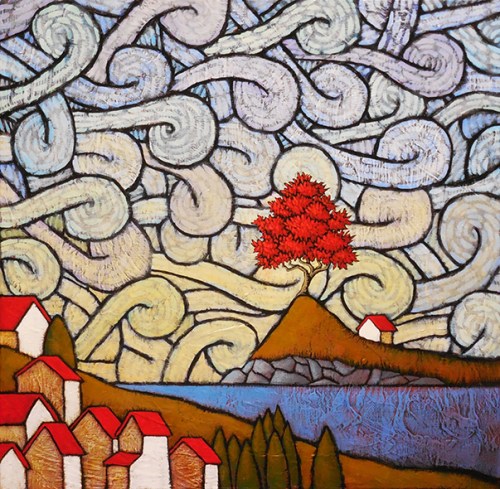
I call this new painting, a 24″ by 24″ canvas, All We Do Not Know.  It’s a continuation of my recent work incorporating a patterned background or sky.  One of the things that draws me is that the strength of the patterns allow for simpler, sparser compositions.  A single tree set in a simple landscape set against this pattern sends out its message clearly, without the veil of superfluous detail.

For me, I see this painting as being about the need to continue our search for knowledge and wisdom.  We know so little even though at this point in time we have perhaps more knowledge than at any time that came before.  Every age has a certain hubris about its place at the pinnacle of what is known and we certainly are no different.

Yet one only has to look into the sky and know that there are forces and powers beyond our comprehension.  There are things that we sense but cannot see and perhaps may never know.  But, as the great 19th century physiologist Claude Bernard points out above, we can only learn by moving toward that great unknown.

Look for that thing we don know.  It is as much a seeking of the spiritual and existential as it is a scientific search.

There is always more to learn, a new horizon to which we can aspire.  And perhaps that is where this path  is taking us.

Read Full Post »

GC Myers- Into the PatternMy latest works have been focusing on the use of pattern within my landscapes.  Well, I guess you could call it pattern.  There is often a motif of shape and sometimes a direction of movement but for the most part it is fairly chaotic and seemingly without order.  Maybe that is what art is –trying to see pattern within chaos, trying to impose some sense of order so that we might better understand what we are seeing.

And maybe it is our reaction to seeing an emerging pattern that defines what we consider as beautiful.  I am sure many of you have once seen an image that struck you immediately and remained in your mind even if it was only seen in a glimpse.  I know I have.  I am often mystified as to why this occurs.  My only explanation is that its form and pattern somehow jibe with some innate sense of form and pattern, something inborn and with us since the beginning of our time as a species.

Perhaps even the patterns of those things of which we are made.  Maybe the pattern is us.

And that could be expressed through religion.  Or spirituality.  Or physics. Or art…

That being said, this new painting is an 18″ by 36″ canvas that I am calling Into the Pattern.  For me, it represents what I have written above– that we are  part of the pattern  and the pattern is part of who we are.  The Red Tree here is understanding of this and begins to meld into the strong pattern of motion seen in the sky, as expressed by the leaves coming from its limbs.

This is a pretty simple image but it has a nice tension between chaotic motion and calm stillness of understanding.  At one point, I had painted in a figure near the tree.  For me, it absolutely destroyed the impact of the whole piece, distracting focus from what the painting was trying to send out.  The figure just plain bothered me and it didn’t take much thought for me to decide to paint it over.

It was amazing how this changed the painting and my perception of it.  Now, it is one of those pieces that I look at quite often throughout the day here in the studio, pondering what it is saying to me and trying to decide if we are part of the pattern or if it is part of us.  Or both…


Read Full Post »

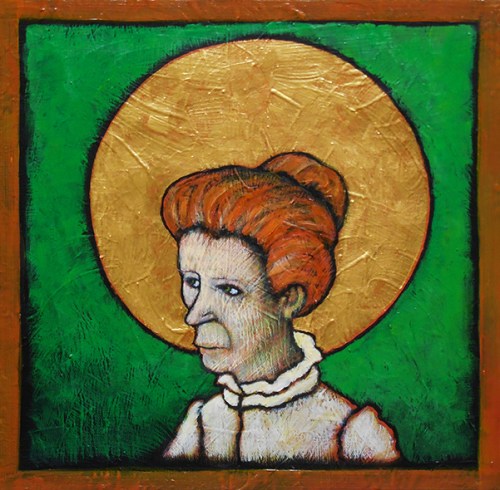
GC Myers- Icon- Tacy CooperThe more I read about this ancestor,the latest entry in my Icon series,  the more interesting I find her.  Her maiden name was Tacy Cooper and she is my 10th great-grandmother, born around 1609 in England.  Little is known of her parentage or when exactly  she came to America but she is known to have lived in Dorchester, near Boston in the Massachusetts Bay Colony in the early 1630’s.

At the time, the Colony was strictly ruled by the Congregational Church and its precepts.  Very puritanical, of course.  Many of the settlers who were coming into the colony sought more religious freedom than was being offered and under the influence of Roger Williams, set out  in 1634 to leave the Colony and establish a new community outside its boundaries.  They sent out a party of scouts who chose a site on the Connecticut River below present day Hartford.  Soon after, a group of about 100 people set out by foot for this location.  Among them was Tacy Cooper and her future husband, Samuel Hubbard.  They met during this journey and Samuel later wrote that Tacy was the lone bright spot in the whole undertaking.

Although the heavy goods for the community had been shipped by boats from Boston up the river, it was a harsh trek.  Many of their provisions had also been shipped and their trip was ill-timed.  By the time of their arrival, a bitter winter had set in on them and the boats had not arrived nor would they arrive in the future. Without those provisions,  a number of this group died that winter and those who remained survived on acorns, malt and grain that had brought along as seed for future crops.  To make things worse, the Pequot Indians were attacking as they tried to stem the spread of the settlers into their territory.

But they persevered  and in 1636, Tacy and Samuel were married.  However, the religious freedom they sought did not come to bear in this new community.  Samuel spoke up in protest to the role of the Church Elders in the local government and was driven from the community along with several other families who were in agreement with him.  They fled south, settling in the area now known as Springfield, Massachusetts.  They thought they were outside  the boundaries of the Massachusetts Colony but in subsequent years,  the provisions of the settlement of the Pequot Wars brought that location back into its realm.  In protest, Samuel and Tacy became Baptists.

In the following years, Baptists were banished from the Colony and, after many threats, they fled once more, this time to Rhode Island where they were reunited with Roger Williams.  They lived peacefully there for many years as members of the Baptist Church but it didn’t end there.

In the mid 1600’s, a movement had began in England– the  Seventh Day Baptists.  While they were almost exactly the same in their beliefs as traditonal Baptists, they observed their sabbath on the seventh day, Saturday.  In 1665, Stephen Mumford moved from England to Rhode Island, bringing this new sect with him.  He spoke of this beliefs to Tacy and Samuel  and a few other members of the First Baptist Church of Newport.

It was Tacy alone who first chose to join with Mumford in observing a seventh day sabbath.  Soon after Samuel and four other joined them and they formed the first Seventh Day Baptist church in America.  Tacy is considered the first American founder of the church.  The Seventh Day Baptists exist to this day and were a big part of my mother’s line for almost two hundred years and six generation, although I am pretty sure she would have not been aware of this fact.

While I am not a religious person in any organized sense of the word, I still find it fascinating in the way religion has shaped much of my( and just about everybody else’s) past.  I am pleased that Tacy was such a strong woman.  She was the one who stood and answered the Church Elders when she and the others were made to account for their desire to break from the Baptist Church.  She went before the congregation and  with “great clearness and force” outlined their reasons for departing.  I can’t help but think that this must have been a rare moment in early America– a woman speaking to power.

This may not be the best painting of the Icons but it moves me in the same way.  I always hope to find something in these stories that I can take for my own life and I can only hope to one day have Tacy’s strength and conviction.


Read Full Post »

GC Myers- Jumping Off PointBetween two worlds life hovers like a star,
‘Twixt night and morn, upon the horizon’s verge.
How little do we know that which we are!
How less what we may be! The eternal surge
Of time and tide rolls on, and bears afar
Our bubbles; as the old burst, new emerge,
Lash’d from the foam of ages; while the graves
Of Empires heave but like some passing waves.

Lord Byron, Don Juan

***************

I chose the stanza above from Lord Byron’s Don Juan to kind of describe this new painting because it seemed to fit so well what I was seeing in this piece.

When I look at it the Red Tree seems to be an intermediary between differing worlds–  between the solid ground of earth and the airiness of the heavens, between the closer living of the settlement of houses and the wide open spaces of the fields and hills beyond, between the now and eternity, between the visible and the invisible.

Standing with one foot in either world, it becomes a moment of contemplation on the temporary nature of our existence.  Standing there before the suddenly visible and unrelenting power of nature and the universe– the eternal surge of tide and time— the Red Tree recognizes its own smallness and insignificance–How less what we may be!

This idea of  insignificant beings living but for a short time may seem like a dismal prospect to some.  But I don’t see it that way.  If anything, I see this as a celebration of just having the opportunity to bear witness to the grand spectacle of life set before us each day, to have a chance to play a part, albeit small, in the machinations of the universe.

Maybe this is too much for a simple painting such as this to bear.  Maybe you will not see it in the same way, only seeing a tree on a mound overlooking a group of houses with a patterned sky.  That’s fine because in its simplest terms that is what it is.

But even the simplest moments and images can have greater depth and meaning if we only choose to look more closely, to choose to perceive our place in the world in a different manner.

Well. that’s what I think anyway…

—Oh, this painting is 18″ by 18″ on canvas and I am calling it Jumping Off Point.

Read Full Post »

Sustenance

GC Myers- SustenancePainting is the pattern of one’s own nervous system being projected on canvas.

Francis Bacon

********************

I am still in the midst of processing this new painting for myself, trying to determine what it is saying to me.  For now, I am calling this 16″ by 20″ canvas Sustenance.  There is something about the pattern of the sky filled with rays containing smaller strokes that remind me of surging atoms.  Maybe it’s my own nervous system being projected as Bacon says above or maybe it is an energy that feeds everything.  The ubiquitous energy  that transforms into vibrant, richly colored life.

I am still not sure.

You might notice that this is not a Red Tree.  Yes, this is the rare Green Tree.  Coming to the end  of this painting, I decided on green as a contrast to the reds and oranges I had used for the land around the tree.  It just felt right from a design standpoint and I think it works here.

It has emerged better than I had originally thought it might when I was working on it.  But, as I said, I am still taking this in. There are a lot of things in this simple painting that speak to me but I still can’t exactly put them into words.

And I kind of like that it doesn’t have an obvious read for me, that it leaves me without words.  So, I will stop now and just try to figure out what those words are…

Read Full Post »

GC Myers= In DelightThere is delight in singing, though none hear beside the singer.

Walter Savage Landor

*********************

The British poet, Walter Savage Landor, who wrote those words above knew what he was talking about: Sometimes you do something that is filled with pleasure for yourself yet it might not stir the soul of a single other person.  The delight comes in simply doing it.

Not that Landor, who lived from 1775 to 1864,  was without accolades.  He had an incredibly long career–almost 70 years— and was held in the highest esteem by his peers. But he never gained widespread public popularity or love for his work in his life or after.

His poetry was his singing and sometimes only he and perhaps a few others could appreciate that voice.

I chose these words from Landor for this painting not only because I felt that he was writing about his own work in a way.  I used it because of the great pleasure I took in painting the painting above, an 18″ by 18″ canvas that I am fittingly calling In Delight.  It was one of those paintings that gave me a lot of joy at every step of its growth, each stroke making it come more and more to life for me.

It’s that fulfillment of joy that makes me not worry about how it is received.  If not a single person sees a thing in it, I do not care.  It pleased me to simply make it and even now it makes me smile when I look at it from my chair in the studio.

For me, I felt like I was singing with a rich and full voice.  But again, that’s just my ear.  You might hear fingernails on a chalkboard when you look at it.  And that’s okay– the delight was in the singing.

Read Full Post »

GC Myers- Icon: Mary TOne of the things I am trying to emphasize with this current Icon series is the fact that we are all flawed in some way, that we all have deficiencies and stumbles along the way.  Yet, uncovering these faults in my research, I find myself holding affection for many of these ancestors that dot my family tree.  Perhaps it is the simple fact that without them I would not be here or perhaps I see some of my own flaws in them.

I’m still working on that bit of psychology.

The 12″ by 12″ canvas shown here is titled Icon: Mary T.  She is my great-great grandmother.  Born Mary Anne Ryan  of Irish immigrant parents in the Utica area she married Michael Tobin, an Irishman ( I believe he was from County Kerry but the research is still up in the air on this) who came to the States around 1850, right in the midst of the Great Irish Immigration.

Michael worked on the railroads being built throughout central New York in the late 1800’s.  Following the progress of the railroads, the couple and their growing family worked their way down through the state towards Binghamton, NY where they eventually settled.  Mary Anne eventually ended up as a housekeeper in a prominent home in the area.  Michael died around 1890 although records are sketchy on this and Mary died at my great-grandmother’s home in Elmira in 1914.

All told, they had seven daughters and three sons.  Most worked in the then booming tobacco industry of that time and place.  Most of her daughters worked as tobacco strippers  and some worked as cigar rollers, as did her sons.

That’s the simple telling of the story.  Looking into the back stories provide a little more depth which can sometimes change all perceptions.

None of her sons ever married and all were had desperate problems with alcohol.  One son was listed in a newspaper report from some years later as having been arrested for public drunkenness around 40 times over the years, seven times in one year.  He was also arrested for running a still more than once during the prohibition years.  Two of her sons died in institutions where they had been placed for their alcoholism.

A Silk Spencer

A Silk Spencer

I came across a story in the local Binghamton newspapers about Mary and two of her daughters, who were also working as domestics with here in the prominent Binghamton home owned by a local attorney and nephew of the founder of Binghamton .  In 1874, the story reports that a number  of items came up missing, including a “forty dollar silk spencer,” which is a sort of short garment like the one shown here at the right.  Neighbors informed the owner of the spencer that Mary had a number of the stolen items in her possession and a search warrant was sworn out.

Detectives came to the Tobin home and made a thorough search but turned up nothing.  They then tore up the carpets which revealed a trap door that led to a small basement.  There they found many of the stolen items but no spencer.  But they did find a silk collar that had been attached to it.  Mary and her two daughters were arrested.

Mary did finally claim to be the sole thief and her daughters were released.  I have yet to find how this particular story ends and how Mary was punished but based on the futures of some of her children I can’t see it being a happy ending.

Doing this painting, I was tempted to make my Mary a bit harsher, a lit more worn.  But as I said, there’s some sort of strange ancestral affection at play even though I know she was obviously a flawed human.  She’s smaller and more delicate looking in the painting than I imagine she was in reality. But maybe that’s little payback for the information her story reveals about the future of my family.

This is a simple painting because, as I pointed out, this is a simple story at its surface.  It’s the story of many, many families.


Read Full Post »

GC Myers- Icon-EleazerWhen you delve back into your ancestry you often uncover surprises, some pleasantly exciting and some a bit disappointing.  In some cases, it’s a bit of both.  Such is the case of the person behind this latest painting from my current Icons series.  This piece is 24″ by 12″ on masonite and is titled Icon: Eleazer.

The person represented here is a fellow named Eleazer Lindsley.  He was born in Morristown, New Jersey in 1737, a member of the family that founded much of that area.  He did well in the years before the American Revolution, owning a grist mill and several other businesses.  He was a man of status that was increased with his participation in the war.  He served as a Colonel and acted as an aide-de-camp to both General George Washington and General Lafayette.  Both were guests in his home at various time and Lafayette personally gifted and placed a signet ring on Eleazer’s hand in appreciation. It was never to come off and was buried with him when he died in 1794.

After the war, for some reason Eleazer chose to leave the comforts of his home state and set out with his extended family to settle in the newly acquired frontier territory.  After the war, the government took much of the land in what is now central and western NY and divided it into parcels that were given to those who served in the war as a form of payment for their services rendered.  Under these Land Patents, a private might receive 200 acres, moving up through the ranks to a general who might receive 2000.   When Eleazer and his family arrived in this area they collectively held 6000 acres.

They settled just south of what is now Corning, NY, occupying a fertile river valley.  Today, much of the area probably still looks relatively unchanged from that time with most of the land still in fields and forests. This area is now the town of Lindley— they dropped the “s” from the name in the 1840’s for some reason.  Eleazer became the first state assemblyman from the area.  He was also active in a plan to secede from NY and from a new state consisting of the area that is now central and western NY.  When he died in 1794, this plan died as well, although it has periodically been thrown out there by upstaters over the years.

There’s a lot more to tell about Eleazer, much to be proud of,especially for someone like me who grew up near the area and never knew of my connection with the founders.  But there was also one dark fact that taints the whole story.

You see, when Eleazer arrived in their new home their party consisted of about 40 members, most of them my ancestors.  But among the group were also seven slaves.  The family story, much of which is contained in family papers and documents held now at the University of  Michigan, claim that the slaves were treated as family members, one being called Uncle Pap, and that they were eventually emancipated in the very early 1800’s.  A story written in the late 1800’s says that many of the slaves settled and raised families in the area.

Now, part of me wants to believe that part of the story or to write it off as simply being an accepted thing at the time–after all, Washington, Jefferson and so many other Founding Fathers had slaves.  But the fact remains that Eleazer owned slaves and it bothers me that he somehow justified that in his mind, especially given that he so heartily participated in a war of independence.

When painting this piece, I found it hard to not make him a bit harsher in his gaze.  Though there is no evidence of mistreatment,  he holds a pair of shackles in his hands as a symbol of slavery.

When you do genealogy you often find yourself hoping for and attributing high ideals to your ancestors.  You want to see them in the very best light and tend to set aside negatives.  But as you dig more and more, you find that they are simply the same flawed humans that we encounter every day, possessing good and bad qualities. I often find myself wondering if I would personally like these ancestors.  But, like him or not, Eleazer is part of my family tree. But I do like this painting, if only for the narrative behind it.  I think the dichotomy of light and dark elements in the story are exactly what I hope for in this series.

Read Full Post »

GC Myers- Until the Sea Shall Free Them


All the Men will be sailors then, until the sea shall free them…

Leonard Cohen, Suzanne


I call this new painting, a 7″ by 5″ piece on paper, Until the Sea Shall Free Them, which is taken from the lines of the Leonard Cohen song Suzanne.  The song’s sound, pace and feeling really jibe well with what I see in this piece so I felt taking the title from one of its lines was very fitting.

This is one of those pieces that has a composition that I connect with on an emotional level before it actually says anything to me on an conscious or intellectual level.  In other words, I like it before I can figure out why.  And there is something very satisfying in that.

And mystifying.  I generally want to know the why behind something.  But sometimes it is just better to enjoy the now and forget the why.  And that is what I am doing with this painting.

Here’s Suzanne from Cohen.


Read Full Post »

GC Myers- BetweenA man’s work is nothing but this slow trek to rediscover through the detours of art those two or three great and simple images in whose presence his heart first opened.

-Albert Camus

*******************

These lines above are from an essay, Between Yes and No,  written by the French Nobel Prize-winning writer Albert Camus.  It basically states, in sometimes grim detail, his belief that art “exalts and denies simultaneously.”  In short, truth is generally somewhere in the middle, never absolutely in yes or no.  Yes or no is generally an oversimplified view.

While I may not fully understand all the subtleties of Camus’ essay, I do fully agree with the premise as I see it in my own simplified way.  I think that art communicates best when it contains both the yes and the no— those polar oppositions that create a tension to which we react on an emotional level.  For example, I think my best work has come when it contains opposing elements such as optimism tinged with with the darkness of fear or remorse.

Yes and no.

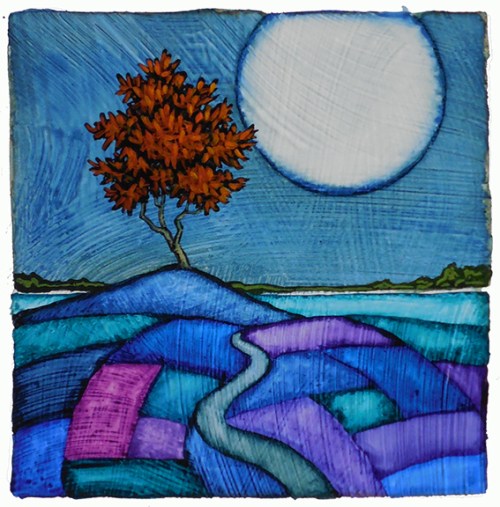
I guess it’s this thought that brought the title for the new piece ( 4″ by 4″ on paper)  at the top which I call Between. Simply put,  I see it as the Red Tree being torn between the nebulous  desire of the Moon’s promise set against the security of its earthly home, represented by the patchwork quilt-like look of the surrounding landscape.  Between the unknown and known.

Somewhere in between the yes and the no…

Read Full Post »

« Newer Posts - Older Posts »