Feeds:
Posts
Comments

Posts Tagged ‘Quote of the Week’

Caspar David Frederich- Abbey Among Oak Trees

Caspar David Frederich- Abbey Among Oak Trees

A picture must not be devised but perceived. Close your bodily eye, that you may see your picture first with the eye of the spirit. Then bring to light what you have seen in the darkness, that its effect may work back,  from without to within.

–Caspar David Frederich

***********************

I find myself identifying strongly with the words and work of the 19th century German painter Caspar David Frederich (1774-1840).  His work often takes a symbolic stance with expansive landscapes that overwhelm the human presence in them and much of it moves toward the metaphysical.  He , along with his British contemporary JMW Turner, were at the forefront of the movement from Classicism  to  work that reflected the inner emotional reaction of the individual to the world around them.

It was said of Frederich that he was “a man who has discovered the tragedy of Landscape.”  I see this in his often moody and contemplative work.  It is not painting of only a place or scene– it is more a painting of emotion, of some inner vibration triggered by what is before the painter.  His brilliance is in capturing that inner element and revealing it to the viewer.  It’s a rare thing, one that I think most painters aspire to obtain in their own work.  I know that I do.
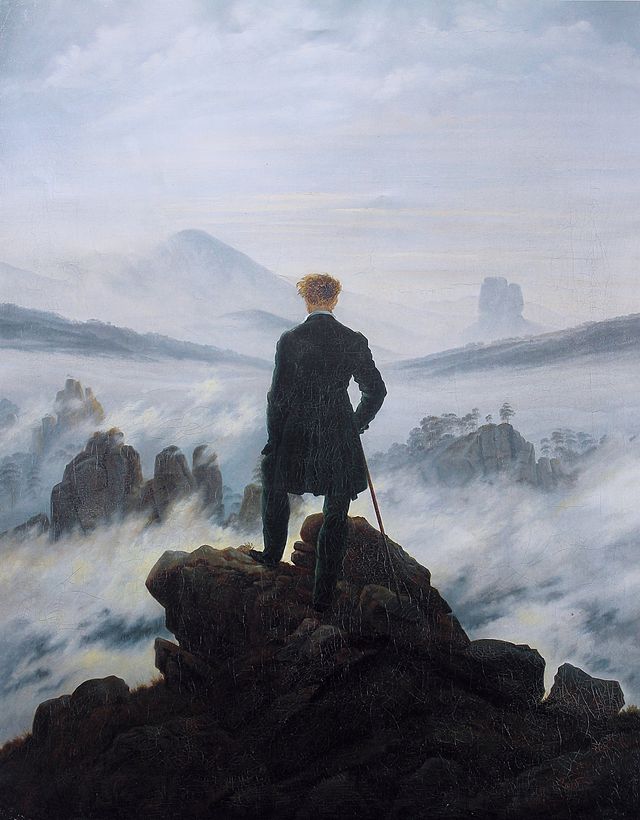
Caspar_David_Friedrich_-_Wanderer_above_the_sea_of_fogFrederich’s work fell from favor in the latter stages of his life but the coming of modern art movement whose many painters were greatly influenced by Frederich,  brought him back to great recognition through the first few decades of the 20th century.   Unfortunately for Frederich, in the 1930’s, his work was associated with the Nazis who mistakenly saw his work as being nationalistic in its symbolism. I know that the piece shown here on the right, Wanderer Above the Sea of Fog,  is often associated with Friedrich Nietzsche‘s idea of the Übermensch or Superman.  Even though Frederich died years before Nietzsche was born and almost a century  before the Nazis usurped his art, it took several decades before his work regained the stature it lost due to this association.

But the inner message of his landscapes persevered and his paintings still resonate with their timeless qualities today.  As they should.
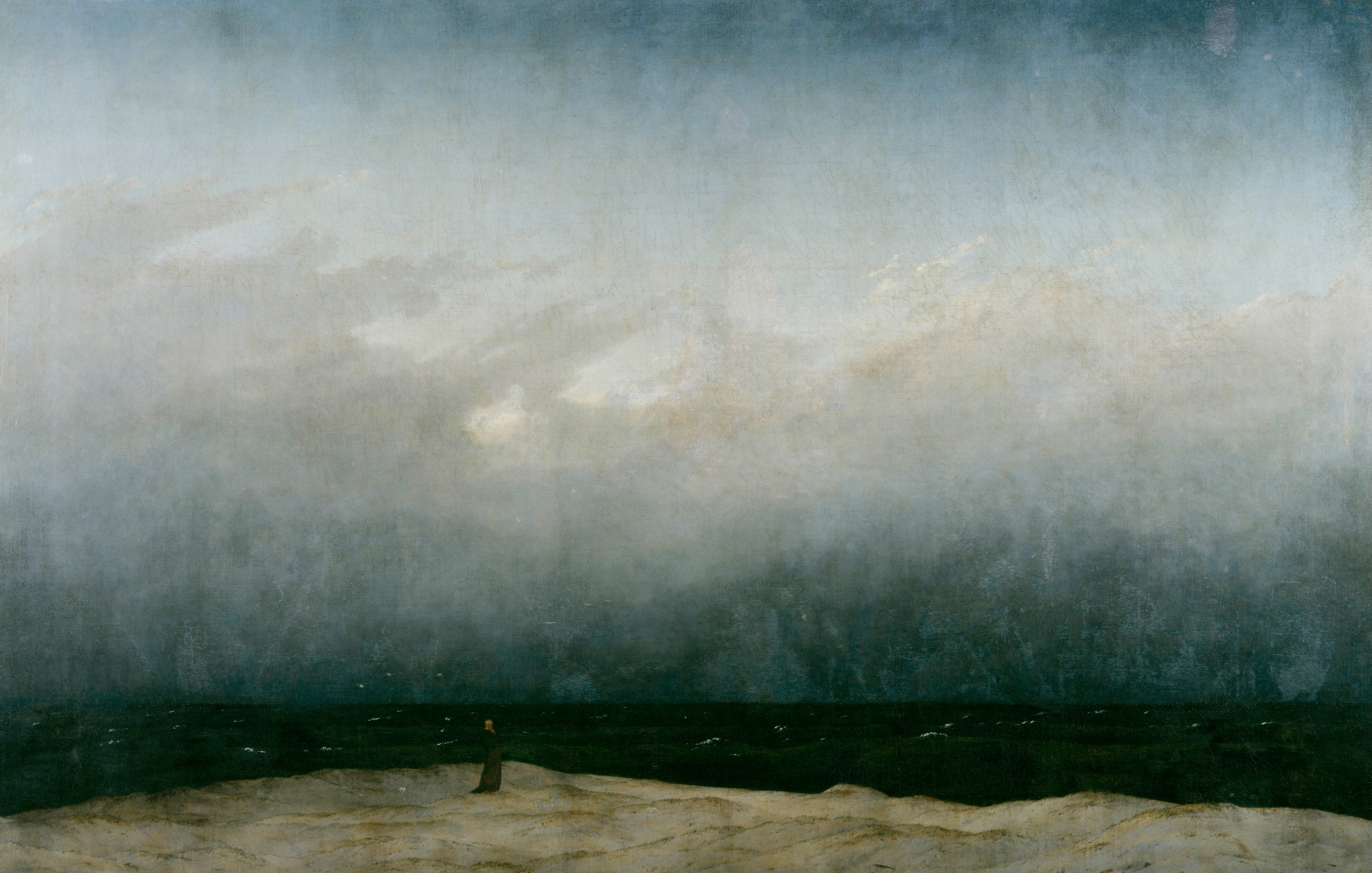
Caspar David Friedrich- Monk by the Sea

Caspar David Friedrich- Monk by the Sea
Read Full Post »

Theodore Rousseau- Under The Birches  1842

Theodore Rousseau- Under The Birches 1842

It is better in art to be honest than clever.

–Theodore Rousseau

*************************

Theodore Rousseau (1812-1867) was part of the Barbizon school of painters, an art movement in 19th century France that was instrumental in moving away from from formalism and towards naturalism and artistic expression of emotion.  It was very influential on many of the painters who later created the Impressionist movement.

Rousseau and Jean-Francois Millet, best known for his peasant scenes, were the two artists from this school whose work really spoke to me, seeming to have honest emotional content in them.  Perhaps that is why his short quote resonated so strongly with me.  That and the fact that I have found myself less impressed with cleverness than honest expression through the years.  I have always believed that art comes from tapping into the subconscious, something other than the part of our brain that produces conscious thought.

I guess I just don’t think we are that smart.  Or clever.

I know I am not.  My work is at its best when it comes from a place of honesty and real emotion, when it is made with more intuition than forethought.  When it is too thought out and directed it begins to feel stilted and contrived, losing its naturalness and rhythm and becoming heavy-handed.

That is probably the reason I tell young or beginning painters to focus not so much on the actual idea of a painting but more on things like paint handling and color quality, those things that make up the surface of a painting and convey the real meaning of the painting. And I think that is what Rousseau was probably getting at in his terse quote.

But maybe not.  Like I said, I am not that clever.

Read Full Post »

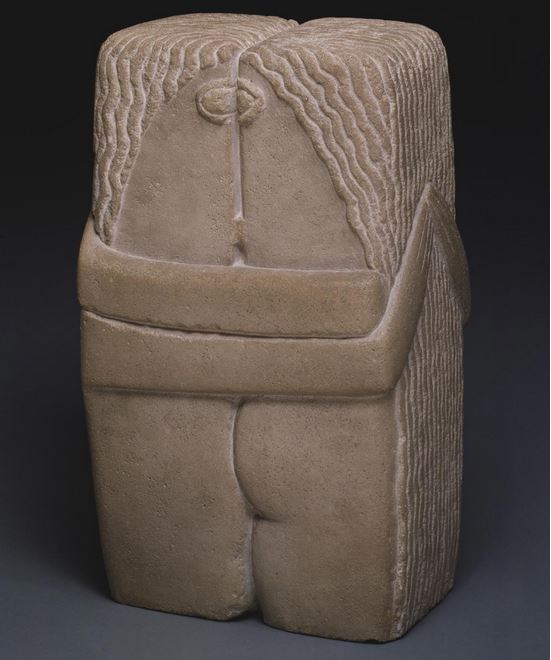
Brancusi The Kiss Phila Museum of ArtOne day in Switzerland, in front of a beautiful mountain there was the most beautiful of cows, and she was contemplating me in ecstasy.  I said to myself, ” I must be someone if even this cow admires me.”   I came closer; she wasn’t looking at me, and she was relieving herself.  That tells you what you need to know about fame.

–Constantin Brancusi

*************************

This was a favorite anecdote of famed sculptor Constantin Brancusi (1876-1957) concerning an incident as he took the long trek on foot from Bucharest to Paris as a poor young man seeking fame and fortune.  He found both but the influence of his peasant roots in Romania remained with him.

His story of the unimpressed Swiss cow is a pretty good reflection on the nature of fame, even the type acquired through great deeds,  Fame is something created by other people, not something that is displayed on oneself. When all is said and done, we’re all pretty much the same– famous or not– in the eyes of that peeing cow.

It reminds me of when I first began showing my work in a gallery while I was still working as a waiter in a pancake house.  I would go to openings and people would praise my work, telling me how great I was.  I could barely get in my car to drive home because my head was so big by the end of the evening.  But at 6 the next morning, there I was, pouring coffee for truckers and families who were less than impressed by the praise lavished on me the night before.

A big pin prick that brought my head quickly back to a more normal size.

Those folks at the restaurant were my peeing cows.

It’s a lesson that I try to remember when things are going too well and I find myself beginning to believe that I am something more than what I really am– a simple schlub watching a cow pee.

Read Full Post »

Ad Marginem C 1930 Painting by Paul Klee; Ad Marginem C 1930 Art Print for salePaul Klee On Modern Art 1924This excerpt from On Modern Art, the 1924 treatise from the great Swiss artist Paul Klee is a bit more than a quote but since this is about art we’ll be a little flexible in our definition.  And that, I believe, would please Klee, whose works often defied definition.

I know for me, he was a big influence if only in his attitude and the distinctness of his work.  I always think of his work in terms of the color– sometimes muted yet intense and always having a melodic harmony to it.

It always feels like music to me.

I like his idea that the world is in the process of creation, of Genesis, and that it is not a final form. It allows for visionary work, for imagining other present worlds that extend beyond our perception because, as he writes, “In its present shape it is not the only possible world.

And to me, that is an exciting proposition.

Read Full Post »

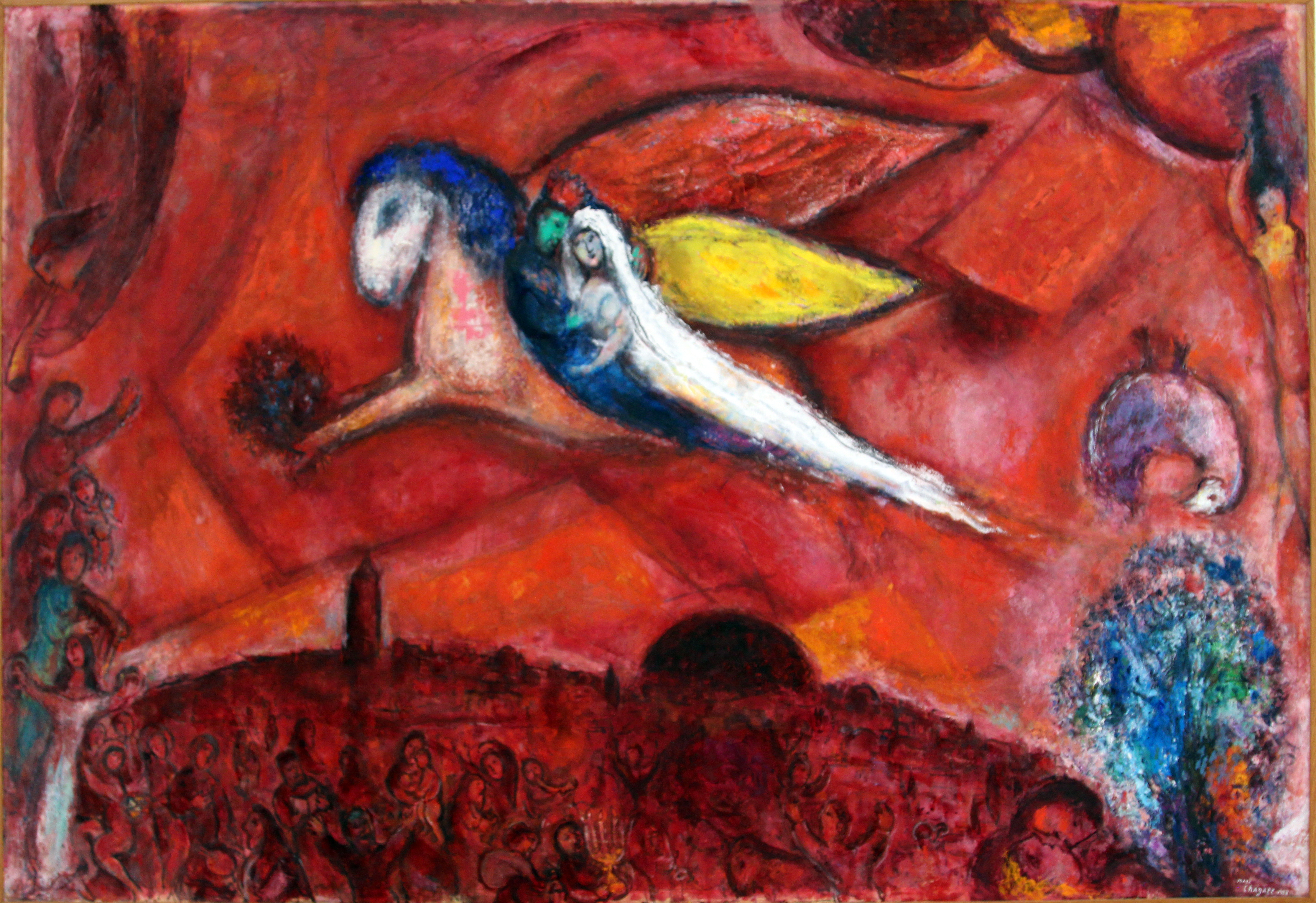
Marc Chagall Sun of ParisWhen I am finishing a picture I hold some God-made object up to it / a rock, a flower, the branch of a tree or my hand / as a kind of final test. If the painting stands up beside a thing man cannot make, the painting is authentic. If there’s a clash between the two, it is bad art.

–Marc Chagall

**************

I haven’t mentioned Marc Chagall  here but once over the 6+ years I have been doing this blog and I very seldom list him as one of my influences or even one of my favorite artists.   But somehow he always seems to be sitting prominently there at the end of the day, both as a favorite and an influence.

One way in which his influence takes  form is in the way in which he created a unique visual vocabulary of symbology within his work.  His soaring people, his goats and horses and angels all seem at once mythic yet vaguely reminiscent of our own dreams, part of each of us but hidden deeply within.

They are mysterious but familiar.

marc-chagall-fishermans-family-1968And that’s a quality– mysterious and familiar– that I sought for my own symbols: the Red Chair, the Red Tree and the anonymous houses, for examples.  That need to paint familiar objects that could take on other aspects of meaning very much came from Chagall’s paintings.

He also exerted his influence in the way in which he painted, distinct and as free-flowing as a signature.  It was very much what I would call his Native Voice.  Not affected or trying to adhere to any standards, just coming off his brush freely and naturally.

An organic expression of himself.  And that is something I have sought since I first began painting– my own native voice, one in which I painted as easily and without thought as I would write my signature.

  So to read how Chagall judged his work for authenticity makes me consider how I validate my own work.  It’s not that different.  I use the term a sense of rightness to describe what I am seeking in the work which is the same sense one gets when you pick up a stone and consider it.  Worn through the ages, untouched for the most part by man, it is precisely what it is.  It’s form and feel are natural and organic. There is just an inherent  rightness to it.  I hope for that same sense when I look at my work and I am sure that it is not far from the feeling Chagall sought when he compared his own work to a rock or a flower or his own hand.

Marc Chagall Song of Songs

Read Full Post »

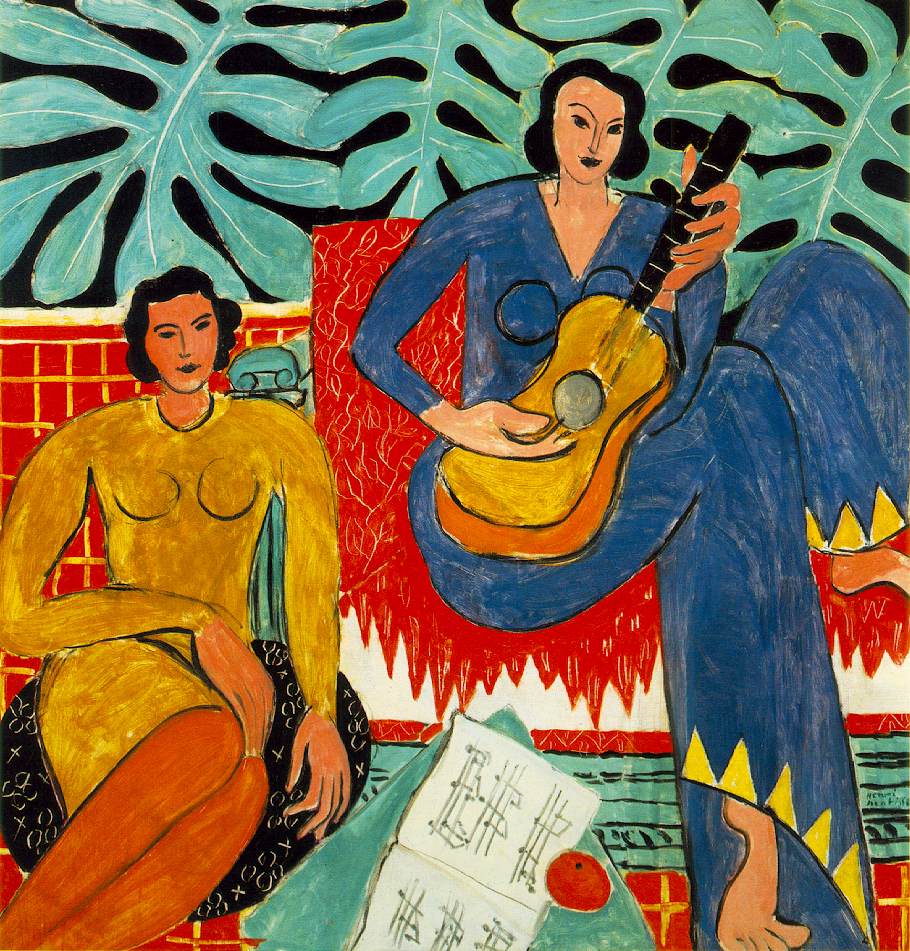
matisse.la musiqueI want to reach the state of condensation of sensations which constitutes a picture. Perhaps I might be satisfied momentarily with a work finished at one sitting, but I would soon get bored looking at it; therefore, I prefer to continue working on it so that later I may recognize it as a work of my mind…Nowadays, I try to infuse some calm into my pictures and I keep working at them until I have succeeded in doing so.

-Henri Matisse, 1908

*********************

 It seems like every artist has a different answer for the question of  when a painting is done.  Whistler and several others said it was when all traces of its creation have been concealed on the surface.   Some say it is when the artist achieves his aim and others say they are never finished.  Edward Munch ( The Scream) said that a piece is done after it has had time to mature, weathered a few showers and endured the elements, including nail scratches.

I tend to go with the never finished group although Munch’s definition is appealing to my love of weathering and patina.  My goal is to have the work complete enough that they can exist on their own,to  be alive in the outer world.  In that respect, because they are human creations, I view them  very much as I view other humans– never quite complete and always imperfect.  That’s just how we are and I am certainly no different.

 I am a collage of imperfections that is still a work-in-progress.  If I saw me hanging on the wall I might want to take a brush and soften an edge here or there and add color in certain parts of my composition.  But I probably would not do it because those imperfections actually become part of the composition, create the contrasts that give us, as a painting, life.  And that , even with the flaws and weathering exposed, pleases me.

None of us is perfectly painted.  Nor should we be.


Read Full Post »

GC Myers- Archaeology-Rainbows EndThe thing I am most aware of is my limits. And this is natural; for I never, or almost never, occupy the middle of my cage; my whole being surges toward the bars.

–Andre Gide

******************

I chose this week’s  quote from the late French author Andre Gide, who won the Nobel Prize for Literature in 1947, because as an artist I find myself sometimes wondering about my limits, questioning whether I am pushing myself enough into new territory.  Gide uses a cage in his metaphor with his limitations being the bars that keep him from moving forward.  He is not content to simply accept these limits sitting contentedly in the center of his cage. No, he is always pushing and pulling at the bars, seeking to get past them.

In the past, I have expressed this same desire to press past my limits with a metaphor where the artist climbs ever upward until they come to a plateau where they are comfortable and safe.  It is a place where they could easily live out the remainder of their days with little worry, living an easy life by retelling stories that made up the journey up to this point.  Many might not even notice there is still a mountain hovering above them to climb, if they just dare leave the comfort of the easy plateau.

Gide’s cage is my plateau and while he is trying to break through his bars, I find myself still questioning if I have the nerve to start climbing.  Oh, there are first steps, tentative meanders up the path but only far enough that I am within sight and  can return easily to my safe haven on the plateau.

When does the real trek upward begin?  When does one begin to thrash at their bars?

Where are you in your own cage?

******************************

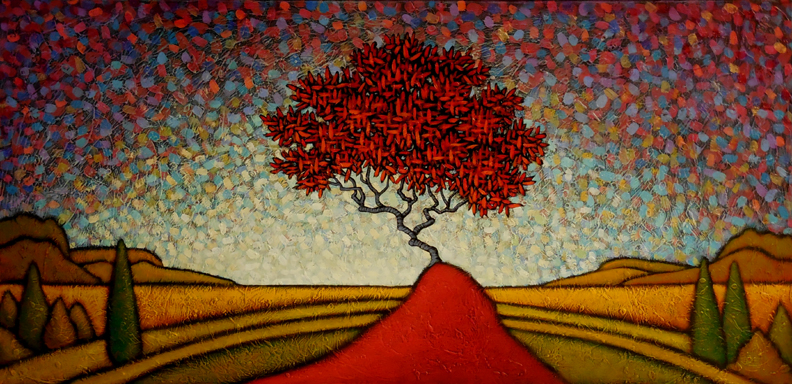
I used a painting from several years,  Archaeology: Rainbow’s End, to illustrate this post.  For one thing, I just like this image.  But more importantly, looking at it seemed to remind me that one’s creative past is often buried and gone from sight.  Or at least, should be if one is going to continue growing.  Like the tree in the painting, you grow from that past existence  being nourished by it.  But you don’t live only in that past.  You must move upward like the Red Tree in this painting to find clear air.

Read Full Post »

GC Myers The Singular Heart smAll the knowledge I possess everyone else can acquire, but my heart is all my own.

–Goethe, The Sorrows of Young Werther  1774

**************************

One of the primary factors in my finding my way to art was the fact that whatever I created would be all my own, a reflection of what I felt was my own truth.  Art, painting in my particular case, was the one place in this world where I could have total control, the one place where I could set the rules and chose what criteria would satisfy my own needs.

I would be using materials and knowledge available to everyone else, just like the knowledge referenced in Goethe’s quote above.  But what made art so appealing was that there was the opportunity to take these materials and knowledge and transform them into something quite different than the person sitting next to you equipped with the same materials and knowledge.  For some, it is an academic exercise that uses the materials and knowledge by the book with little of their own self invested.  For others, it is a battleground in an existential struggle to be heard, to have their voice have meaning of some kind.

The real difference between these two comes from how much one is willing to totally reveal their self in this work, how they interpret the materials and knowledge they are given, and how much of their heart and soul they are willing to put on display.  For me, having my own heart evident in my art was always an existential effort– if I couldn’t make something that was uniquely my own then I would not be pursuing it for long.

You know, this is a pretty simple quote on the surface but it is one that makes me struggle in discussing my own relationship to it.  Perhaps I should just let Goethe’s few words stand as they are and let the new painting at the top of the page, a 24″ by 48″ canvas that I call The Singular Heart, speak for me.  After all, that is what the whole thing is about– a heart that is all one’s own.


Read Full Post »

GC Myers A Consideration of Grace  2002The greatest happiness you can have is knowing that you do not necessarily require happiness.

–William Saroyan

****************

This quote from William Saroyan caught me off guard when I came across it, mainly because it captured in a few words the lesson I had finally gleaned from years of  seeking this elusive beast called happiness.  And  a beast it was, a creature from mythology.  I had made it into a thing that had special powers and was like the Abominable Snowman— rumored to exist but seldom seen.

I discovered over time that this was a mistake.

I was picturing happiness as a once in a life thing, some sort of peak moment, when it was, in fact, just a small part of our being human.  The key in Saroyan’s short quote is the word knowing.  Once we begin to know who and what we are and are not, the need for peak moments subsides as we understand that there is a sort of happiness in the smaller moments of simply being.  It is not a gleeful, heart-pounding joy but a comfortable warm glow and an inner sense of satisfaction that often comes to you at what seems to be the most mundane of moments.

Stopping just now and looking out my studio window, for example.  A light snow is falling almost in time to Paul Desmond’s sax that is mingling with Dave Brubeck’s piano and I sip my coffee.  It is gray and almost gloomy but I feel this glow, this satisfaction in the moment.  It is not happiness as most might define the word .  It is just a moment of knowing that  I exist in the world,  that I am here to bear witness to the small wonders that take place around me in my small corner of the universe.

And that’s good enough.

************************

I chose the painting at the top, A Consideration of Grace from back in 2002, because there is something like the feeling I am describing today in it for me.  Maybe it can be described as grace.  I don’t know…

Read Full Post »

Traditions are lovely things- to create traditions, that is, not to live off of them… the great shapers do not search for their form in the fogs of the past.

–Franz Marc

******************

Franz Marc- The Yellow Cow 1911

Franz Marc- The Yellow Cow 1911

I chose today’s quote from German painter Franz Marc because he was an influence for me early on.  Not so much in the style or subject matter that he employed but simply in the fact that he created work that stood out and was identifiable as his from across a gallery space.  This is basically what he is pointing towards in this aphorism–to not toil in the fields planted by earlier artists but to carve out your own space and work it in the way that suits and  best expresses you.

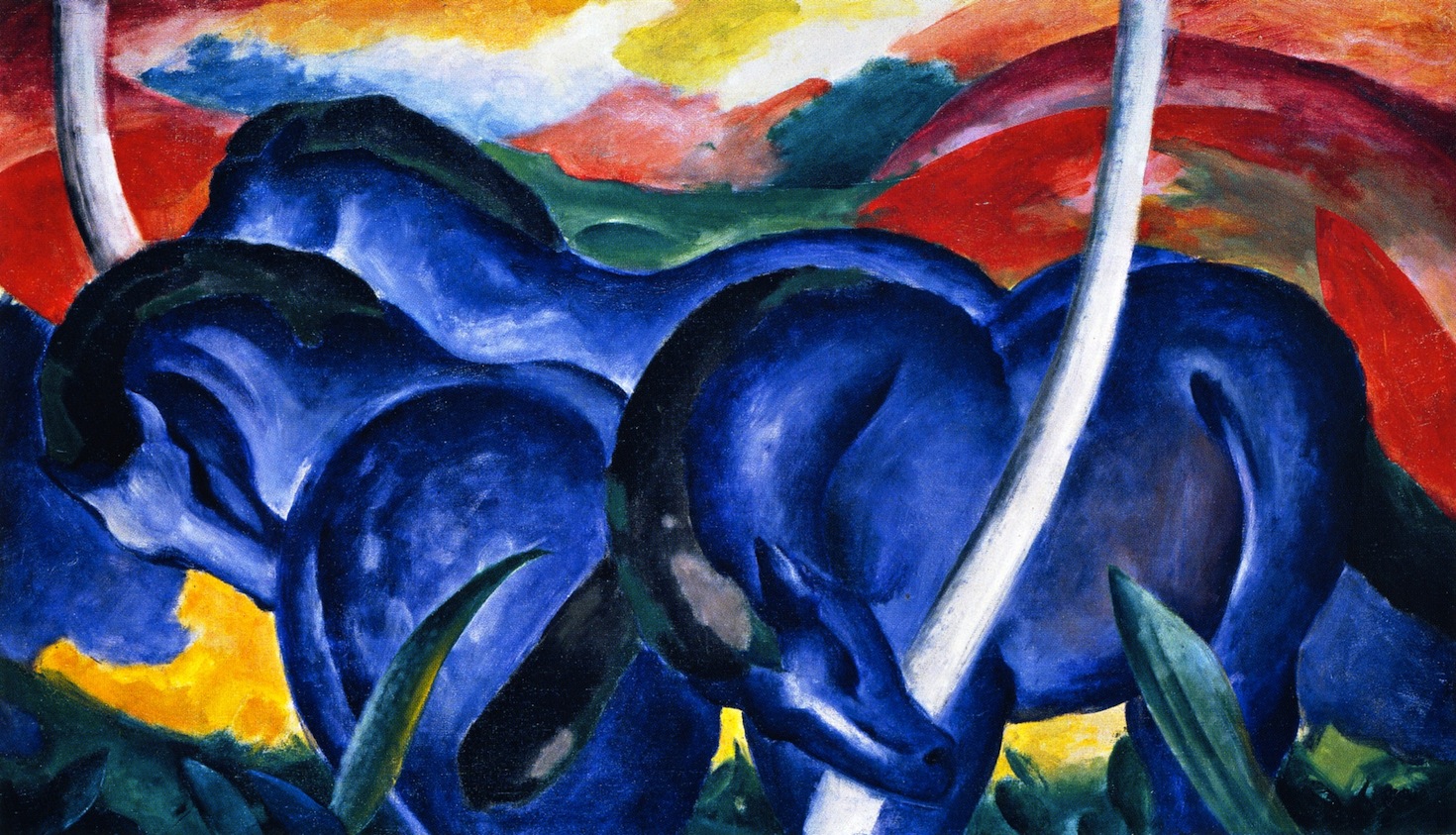
Franz Marc- Large Blue Horses

Franz Marc- Large Blue Horses

He is not downplaying the influences of the past.  Early in his career  Marc copied the works of other artists from before and contemporary to him, using it as a way in which to find an avenue of expression that meshed with his vision.  He did not want to remain a replicator but wanted instead to be a creator.  And that was the attraction for me.

There was safety and security in remaining in this symbolic field with others but it would often be as an anonymous member of a larger group, your furrow always directly compared to the furrow of those alongside you, your harvest compared to their’s.

Breaking away and heading out was risky.   You had to believe that in taking this leap of faith that you would be able to work your little spot in your own way away from others and produce a harvest that is uniquely appetizing to others in some manner.   But you might end up toiling in barren soil, creating crops that appealed to no one but yourself.  It was scary to think that your field might never expand but you were at least nourishing yourself.

This was the type of thinking that drove my work early on, fueled by looking at the work of Marc and others who veered from the traditions of the past in their times.

Unfortunately, Franz Marc only worked his fields for a relatively short time, dying in WW I at the Battle of Verdun.  He was 36 years old.  But his crop still lives on, surviving being labeled as degenerate art in the 1930’s by Hitler and the Nazi regime.

It is unique and his own tradition.

Franz Marc- The Waterfall 1912

Franz Marc- The Waterfall 1912

Read Full Post »

« Newer Posts - Older Posts »