Feeds:
Posts
Comments

Posts Tagged ‘Quote’

**********************

Art has no other purpose than to brush aside… the conventional and accepted generalities, in short everything that veils reality from us, in order to bring us face to face with reality itself.

–Henri Bergson

**********************

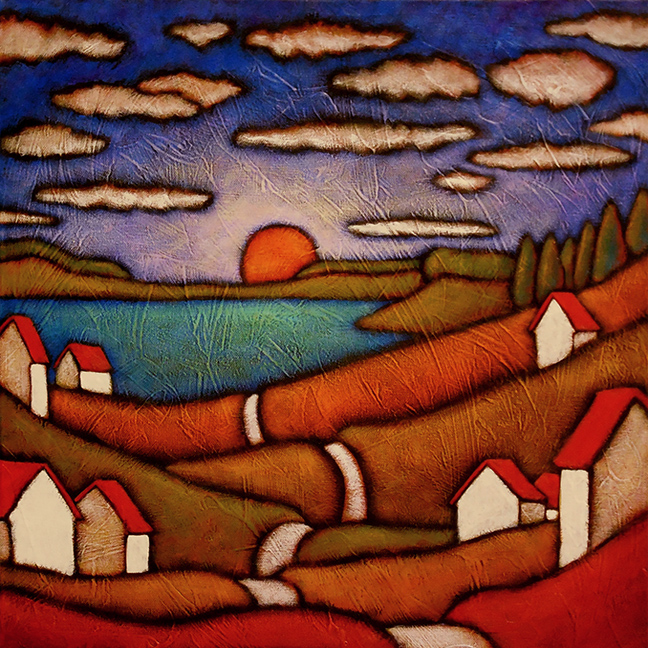
This is another new painting, 16″ by 20″ on canvas, that is part of the group of work going with me to Alexandria on Saturday for my Gallery Talk (begins at 1 PM!) at the Principle Gallery. I call it The Moon’s Revelation and I have spent a lot of time over the past few weeks looking at it, both taking pleasure in it and questioning what I was seeing in it.

What purpose, if any, does it hold?

The question of purpose is a big theme for me lately. My own purpose and that of my work. The purpose of truth. Of institutions and laws. I can’t say if I have found answers any of these questions. But I still believe that there are clues leading to my own purpose somewhere in this piece and others.

They just have to be revealed, in the way the moon brings the colors of the fields to light in this painting.

Time , as always, shall be the revelator.


Read Full Post »

Baziotes

+++++++++++++++++++

.

.Each painting has its own way of evolving. When the painting is finished, the subject reveals itself.

–William Baziotes
.
+++++++++++++++++++
William Baziotes is another painter you probably don’t know. He had a relatively short life, dying at age 51 in 1963 from lung cancer. His work has garnered a following over the years with some of his work approaching the million dollar pricetag at auction yet his name most likely is not known to but a few.
.
He was born in Pittsburgh and worked throughout his career in NYC. He started as an abstract expressionist but transitioned into primitivism and automatism, which is attempting to paint completely detached from conscious thought. I like that idea but don’t think one can ever fully separate the mind and the work.
.
There’s a lot I like in his work, especially the quality and complexity of his color. As for the quote above, it’s a thought that I firmly believe. Sometimes, even when starting with a goal in mind, you have no idea what a painting is truly about until the final stroke has been placed and you step back. Only then does it reveal what it has to say. Sometimes it is quite different than you thought it might be while working on it.
.
And that is sometimes a welcome revelation.
+++++++++++

Read Full Post »

I have finally chose the painting that will be given away at this coming Saturday’s Gallery Talk at the Principle Gallery. It is called Deep Focus and is 18″ by 18″ on canvas. It has been around for several years now and each time it returns from a gallery I am surprised because it is a real favorite of mine, hitting the mark for me on so many points. I think you can see my feelings for this painting in the post below that I wrote when it was first painted.

So, if you would like to have a chance ( decent odds, too!) at taking this favorite of mine home with you, come on out to the Principle Gallery  in historic and beautiful Alexandria, VA this coming Saturday, September 15, for my annual Gallery Talk that begins at 1 PM. There will be some other surprises as well.

Hope to see you there!

Meditation brings wisdom; lack of mediation leaves ignorance. Know well what leads you forward and what hold you back, and choose the path that leads to wisdom.

–Buddha

***********

This new piece, 18″ by 18″ on canvas, is titled Deep Focus. This was one of those pieces that just seemed to fall out with very little inner wrangling or consternation. Once I started, it was off and running with what seemed very little assistance from me.

It was immediately clear that this painting was going to be about focus, about looking deeper and deeper into the canvas. Built from the bottom, each layer pushed the eye further inward. About halfway into this I began to think of the title for this as being AutoFocus, just for the ease with which it was emerging. But I finally opted for Deep Focus because of the depth I was seeing in the picture and the way everything seemed to gravitate toward the central point of the sun that is peeking over the distant hill.

This piece seems to have a very meditative quality, a placid feeling that goes well with the ease of the piece. Or at least, the ease that I felt in its creation. Sitting here now, taking it in, its construction seems simple, almost naive. Yet there is a feeling of opulence that I think comes from the colors and curves of the landscape that sheds this naivete and gives it a feeling of deeper knowledge. Or a way to deeper knowledge. Far from naive.

Years ago, I had a hard time trusting the validity of pieces that fell so easily from my hand, believing that  struggle must be part of making a painting come alive. I was almost embarrassed by the ease with which some pieces came. But over time, I have come to believe that it is this effortless work that is the goal, the work that is true and has the authenticity that I seek. This piece is a testament to the trust in my intuition that has come with time.

Read Full Post »

+++++++++++++++++

To desire and strive to be of some service to the world, to aim at doing something which shall really increase the happiness and welfare and virtue of mankind – this is a choice which is possible for all of us; and surely it is a good haven to sail for.

-Henry Van Dyke

+++++++++++++++++

This is a new painting that is part of a group of new work that will be going down to Alexandria with me next Saturday for my annual Gallery Talk at the Principle Gallery. I call this 16″ by 20″ painting Striving on the Wind.

I really enjoy painting these pieces with sailboats even though I must confess that I know practically nothing about sailing or boats in general. But the nature of the compositions with the bands of horizontal color  and the lure of the wide open sky along with the captured movement of the boats on the waves and in the sails makes it a tremendously appealing subject. Billowing sails on the waves under a big sky is a thing of beauty, even to this landlubber.

Plus, these pieces come with the inherent concept of the journey, the idea that there is an intended goal toward which the boat is headed. They have a built in sense of purpose. I can only imagine that sailing to a far destination is an act of total purpose, requiring the sailor’s complete focus and unwavering attention to keep the boat on course and afloat.

A sinking boat has lost its purpose.

And that sense of purpose is important to me, something I have always wanted to recognize in my own life. I think it must be equally important to many other folks out there. And I think that symbolism comes through in these pieces. Hopefully, the words at the top from author Henry Van Dyke align with that sense of purpose.

As he said: surely it is a good haven to sail for.

++++++++++++++++

Striving on the Wind, along with a number of other new paintings, will be at the Principle Gallery next Saturday, September 15,  where I will be giving a Gallery Talk beginning at 1 PM. As is now tradition, there will be a drawing where one of my paintings will be awarded to someone in attendance along with some other neat prizes and plenty of good conversation. Hope to see you there!


Read Full Post »

+++++++++++++++++++++

Truth has no continuity. It is the mind that wants to make the experience which it calls truth continuous, and such a mind shall not know truth. Truth is always new; it is to see the same smile, and see that smile newly, to see the same person, and see that person anew, to see the waving palms anew, to meet life anew. 

― Jiddu Krishnamurti, The Book of Life: Daily Meditations with Krishnamurti

+++++++++++++++++++++

I was looking for some words to put with this new painting that is part of a group of work that is going with me to my Gallery Talk at the Principle Gallery next Saturday, September 15. I came across the words above from the late Indian philosopher Jiddu Krishnamurti and at first kind of scoffed at the idea that truth has no continuity. I immediately thought that truth, above all things, has continuity. It’s this idea that truth is some sort of nebulous form, always changing and never set, that has us in the situation we now face as a nation.

I believed that truth- especially objective, fact-based truth- was a straight unwavering line running from its inception until the end of time.

But the truth he describes is a different sort of truth. It’s a subjective truth based on our perceptions. How we see the world around us. To see truth, especially these subjective truths, as something set in concrete closes off the mind. We begin to look at the world with blind eyes and a mind filled with the truths of yesterday. We fail to see the beauty and freshness of the renewed truth that is before us in every present moment.

We may have seen yesterday’s sunrise and that has its own truth, its own set of conditions. Today’s may seem to have the same truth but it is always different, slightly changed. The same goes for each of us. We were one person yesterday but in some small and almost imperceptible way  we have changed. We may feel a bit older. A bit wiser. A bit happier or sadder or any number of different things. But we are not the same today as we were yesterday.

Our truth has changed.

And there is something wonderful in that. Oh, I know we would often like things, our truths of the past, to remain the same as we remember them. There’s reassurance in those static touchstones that clutter our memories. But today is a new truth under a new sky and a newly changed sun. The world is freshened and made new. It has a new truth of its own and it is our task, our hope and our joy to discover it anew.

I find that thought to be a fine basis for this painting, an 18″ by 36″ canvas that I call The Freshening. Winter is a perfect example of this idea of constant renewal. The falling snow creates a new truth, alters our perceptions of the world we see. It creates a new truth. And its melting creates yet another revelation of truth. As does the rising of the new day’s sun.

Maybe that seems a naive way of looking at the world in these complex times where truth means something different to so many different people. But there are simple truths  that make up our existence and looking at them in a simplified manner might not be such a bad thing.

Like looking at the world in the first light of day after a snowfall– freshened and new.

++++++++++++++++++++

My Gallery Talk at the Principle Gallery in Alexandria takes place on Saturday, September 15, beginning at 1 PM. There will be a painting giveaway, some other prizes, surprises, good conversation and puppets. Lots of puppets. Okay, that last part isn’t true. But you won’t know for sure unless you come.

Read Full Post »

++++++++++++++++++

I love color. It must submit to me. And I love art. I kneel before it, and it must become mine. Everything around me glows with passion. Every day reveals a new red flower, glowing, scarlet red. Everyone around me carries them. Some wear them quietly hidden in their hearts. And they are like poppies just opening, of which one can see only here and there a hint of red petal peeking out from the green bud.

–Paula Modersohn-Becker
++++++++++++++++++
.
Paula Modersohn-Becker (1876-1907) is yet another artist that is unknown to most of us. I know she was not known to me and as I was going through the images of her paintings from her tragically short career, I feel selfishly saddened for the loss of what more she might have had in store for us.
.
Born in Germany, her actual artistic career lasted less than a decade but her work had great influence in the European art world of the early 20th century. Perhaps a leading edge of the Modernist movement to come, she worked only in tempera with a limited palette of colors and worked with simplified forms, sometimes scratching the painted surface to create her distinct textures.
.
She died at the age of 31 from a post partum embolism.
.
I love her quote at the top, how we all carry colorful red flowers with us. Some of us hide our flowers and others wear them for all to see. The artist’s chore – or gift- is to discover and express that red flower.
.
Take a look below at some of the paintings from Paula Modersohn-Becker.
.
+++++++++++++

Read Full Post »

There’s a tombstone in a local cemetery that we walk by nearly every day. I look at it nearly every time we pass and it always makes me smile. Below the name and the dates of his lifespan are the words Grade A Milkman. All I can think is what great pride this man took in his job before he passed away at an early age. It reminds me of a post from several years back that I ran for the Labor Day weekend. It fits here for this Grade A Milkman.

A little postscript: After years of walking by this grave, a bit of research revealed that this fellow was my mother’s 3rd cousin. Makes me smile even a little more.

Here’s the post from back in 2013:

***********************

If a man is called to be a street sweeper, he should sweep streets even as Michelangelo painted, or Beethoven composed music, or Shakespeare wrote poetry. He should sweep streets so well that all the hosts of heaven and earth will pause to say, here lived a great street sweeper who did his job well.

–Martin Luther King, Jr.

**********************

Another Labor Day weekend is here. On this blog in the past I have bemoaned how the general public has forgot how much it owes to the labor movement, how the middle class that was the pride of this country during the middle of the last century was a direct result of hard fought gains from workers who banded together and stood against social injustice. But today I just want to speak briefly about taking pride in one’s job, the same sentiment reflected in the quote above from Martin Luther King, Jr.

When I was a waiter in a pancake house, even after I had started showing my work in several galleries, I was always a waiter first when I was at my job. Never a painter-slash-waiter, a title which served no purpose. Circumstances had put me in this place at this time and I had determined that if I had to be there I would give it my complete attention and effort. I would make it my own. If I disliked it so much that it made me miserable, I would do something about changing my job when my day there was done and the task before me was complete.

But while I was there, I treated it as though it were my destiny because, who knew, maybe it was. I took great pride in being good at that job and some other jobs that I’ve done that could be classified as menial. What was the cost in doing this? If I had to be there then I would rather be recognized for my excellence than for my displayed misery.

Simply put, take pride in the task before you, however menial you see it. Find pride in the toil and treat it as your destiny because, in that very moment, it is.

Have a great Labor Day weekend and remember what the day stands for.

Read Full Post »

_________________________

Art is not a handicraft, it is the transmission of feeling the artist has experienced.

-Leo Tolstoy

_________________________

I don’t know about the accuracy of this quote. Tolstoy did write about art and the transmission of emotion through it but I can’t vouch for the precision of the wording in the widely accepted quote.

But I do heartily agree.

Craftsmanship– handicraft– definitely has a part to play but that alone cannot transport the viewer to that inner spring from which their emotions flow. Something might be beautifully crafted but unless it is constructed from the empathy, the love, the awe, the wonder and the wide assortment of feelings that define tour humanity, it remains just a lovely object.  Beautiful but coolly devoid of feeling.

And there is nothing wrong with that.

But the aim of the artist, at least to my mind, should be to engage the the emotions of the viewer ( or listener or reader, whatever their medium might be) with their own. To create a sort of communion of feeling between the artist and the recipient.

Can this be taught? I don’t know. I try to tell students to read, to look, to listen, to practice a sense of empathy in their daily lives. Widen their view and become a fuller person. I think art comes from an equal blend of one’s handicraft and their sense of humanity.

That’s just my opinion and it may be as flawed an idea as the mind that thinks it. But I can stand behind that thought and hope, in some small way, to achieve that blend in my own work.


The painting at the top is Find Your Light, a 36″ by 36″ canvas, that is a central part of my show, The Rising, at the West End Gallery that ends tomorrow.

Read Full Post »

+++++++++++++++++

Life is very short… but I would like to live four times and if I could, I would set out to do no other things than I am seeking now to do.

William Merritt Chase
+++++++++++++++++
+
I find this to be a very interesting quote from the American master William Merritt Chase (1849-1916). I don’t think about it very often but given a choice of doing what I am doing with my life and being able to freely pursue any other life, I would continue, like Chase, on the path I am currently on.
.
I know there could be greater adventures, greater importance, greater rewards, wider travels and so on in other pursuits. But this life meshes with my character and my preferences so well that the thought of doing anything else seems almost absurd at this point. It never even enters my mind.
.
And there is something calming in the certainty of this. It’s one less thing that might gnaw at me, to make me question my own decisions. One less thing in which to find uncertainty in a world overflowing with it. When I enter my studio, I know I am in my proper place. Oh, I might question my decisions, my actions, in that space but I can no longer imagine myself being in any other place. And like Chase, I find myself wishing I could live four more of these lives.
.
And that’s a good thing.
.
Here are some more painting from William Merritt Chase. Hope his words somehow apply to you. Have a great day.
+

Read Full Post »

+++++++++++++++++++

.

It is my dream to create an art which is filled with balance, purity and calmness, freed from a subject matter that is disconcerting or too attention-seeking. In my paintings, I wish to create a spiritual remedy, similar to a comfortable armchair which provides rest from physical expectation for the spiritually working, the businessman as well as the artist.

.

–Henri Matisse

.
+++++++++++++++++
.
I have read (and shared) a different translation of the quote above from the great Henri Matisse. It aligns perfectly with my own hopes for my work and stands almost as a credo. At the end of the day, I am trying to create work that allows any viewer, no matter how much or how little they know about art, to withdraw into their own inner space while at the same time feel a sense of communion with a greater whole. To move into a place that feels safe and comforting.
.
A spiritual remedy, as he calls it.
.
It’s not something you can have in mind, however. It only comes in the process, as the thoughts that may have been pressing on my mind are set aside and my own emotions are leveled off to a state of calm. It has to be my own spiritual remedy before it becomes that of anyone else.
.
When it happens, it is a lovely thing and the world seems somewhat right.

Read Full Post »

« Newer Posts - Older Posts »