Feeds:
Posts
Comments

Posts Tagged ‘Quote’

GC Myers- Absorbed in the MomentIt is through gratitude for the present moment that the spiritual dimension of life opens up.
-Eckhart Tolle

************

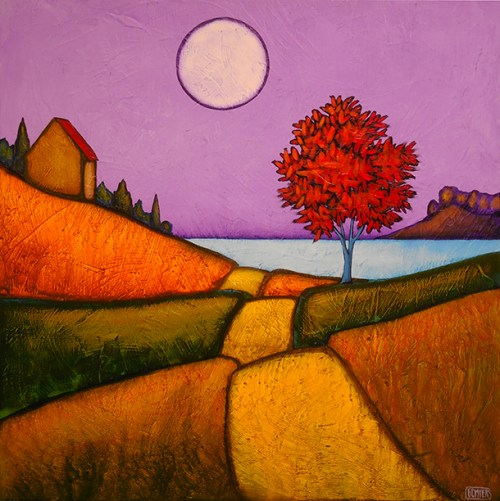
This new painting is a 20″ by 20″ canvas titled Absorbed in the Moment.  This was one of those rare pieces that felt strong from its very beginning all the way through to its completion.  It felt very directed and each piece seemed to fit easily into the painting, adding its own strength.

The progress of this piece very much kept me in the moment as I worked and maybe that is where that sense of awe in the moment that I get from this piece originates.  I know as I worked, I stayed only in the moment.  Setting aside the past and the future, I relished being in that place at that time.  The scene, the colors and the way everything fell together created an inviting and restful –even invigorating — place for my mind to linger.

And that held true even long after its completion.  Every time I look in its direction I sense a feeling of comfort, a great calming effect, in that moment.  The moment taking place on the surface becomes the moment I am living in the present.

It is always in the present moment and the present moment is always in it–that is all I can ask of anything I paint.

This painting will be included at my upcoming show, Part of the Plan, which opens October 29 at the Kada Gallery in Erie, PA.

Read Full Post »

GC Myers- In GratitudeTrue happiness is to enjoy the present, without anxious dependence upon the future, not to amuse ourselves with either hopes or fears but to rest satisfied with what we have, which is sufficient, for he that is so wants nothing. The greatest blessings of mankind are within us and within our reach. A wise man is content with his lot, whatever it may be, without wishing for what he has not.

Seneca

************

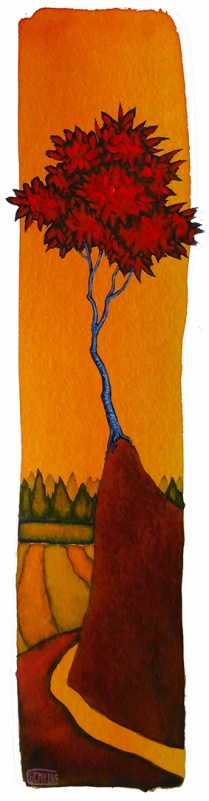
This new painting, which is about 4″ by 15″ is a bit of a rarity.  It is done on plain watercolor paper without the benefit of the texture from the gessoed surfaces that I typically use, much like my very earliest works.  It was a nice change, reverting to working on the smooth surface of untreated paper.  There’s a sense of purity in the way the colors flow on and set to the paper’s surface.

Very clean.  Crisp.

I call this piece In Gratitude.  The words at the top from the Roman philosopher Seneca very much capture the spirit of what I see in this painting and aspire to in my own life– to be always conscious of and grateful for that which I do have in my life.

I talk and think a lot about gratitude.  Gratitude for where I am in the present moment sets me free from dwelling on the past or fretting about the future, both things out of my hands.  Gratitude also makes me recognize the importance of those who have played key roles in my life.

 Recognizing that one depends on the help, the love and the recognition of others in their life is a key element in finding a level of contentment in one’s life.

We do nothing totally alone.

I may claim that my work is my creation alone but it is, in fact, a compilation of the interactions of my life with those who I have encountered along the way.  They have formed my sight, my perception of this world, and given shape to the hoped-for world that shows itself in my work.

And for that alone, I am so grateful.

So, this seems like a simple small painting but for me it speaks volumes.

******************

This painting, In Gratitude, is part of my solo show, Part of the Plan,  which opens October 29th at the Kada Gallery in Erie, PA.

Read Full Post »

A friend of mine posted the quote below, one that I have long admired,  online this morning and it set me off thinking how our indifference to so many things affects us in many ways.  For example, in the blogpost below from a couple of years back I wrote of how I was spurred on by the unknowing indifference of others to my work.  But we are also sometimes intellectually lax and this allows us to build up an indifference to things that we know in our cores are wrong and unacceptable.

Take for example the  words and actions of Donald Trump.  He often says and does things that deserve loud condemnation yet we have come to have an indifference, a tolerance, to his constant stream of untruth and divisive rhetoric.  It seems easier to accept something that should appall us, especially when his supporters are so loud and angry, than to step up and say that this is wrong.  So we let his many and well documented lies, his unfounded boasts and his vitriolic appeals to our darker angels slide.  In our indifference we don’t look any further into his words or past.  

We begin to accept him at face value.  

This sort of indifference is always a dangerous thing.  Elie Wiesel knew that from firsthand experience in the Germany of the 1930’s when Hitler’s appeal to nationalism and the indifference of those who saw him as a fool and not a threat allowed the rise of Nazism which led to Auschwitz and to the many other horrors of WW II.

Don’t go crazy here– I am not making that jump in saying that Trump will lead us to anything like Nazi Germany.  But to let disinterest and indifference creep into how we view our civic responsibility in voting is a dangerous thing.  Our indifference may have us thinking that this election doesn’t have much to do with our day to day life. But ask the vets who fight our wars or the families who are left to bury them.   

The point here is to fight indifference, to stop and be curious when faced with anything.  The world is too complicated for us to be careless and indifferent.  Especially now.
gc-myers-memory-of-night-sm“The opposite of love is not hate, it’s indifference. The opposite of art is not ugliness, it’s indifference. The opposite of faith is not heresy, it’s indifference. And the opposite of life is not death, it’s indifference.”

-Elie Wiesel

*************

I’ve been sitting here for quite some time now, staring at the quote above from Nobel Prize winner Elie Wiesel.  I had planned on writing about how my work evolved as a response to the indifference of others but now, looking at those words and putting them into the context of  Wiesel’s experience, I feel a bit foolish.  Wiesel, who had survived the Holocaust, was eyewitness to indifference on a grand scale, from those who were complicit or those who did not raise their voices in protest even though they knew what was happening to the personal indifference shown by his Nazi guards, as they turned a blind eye to the suffering and inhumanity directly before them on a daily basis, treating them as though they were nothing at all.

The indifference of which he speaks is that which looks past you without  any regard for your humanity. Or your existence, for that matter.  It is this failure to engage, this failure to allow our empathy to take hold and guide us,  that grants permission for the great suffering that takes place throughout our world.

So you can see where writing about showing a picture as a symbolic battle against indifference might seem a bit trivial.  It certainly does to me.  But I do see in it a microcosm of the wider implications.  We all want our humanity, our existence, recognized and for me this was a small way of  raising my voice to be heard.

When I first started showing my work I was coming off of a period where I was at my lowest point for quite some time.  I felt absolutely voiceless and barely visible in the world, dispossessed in many ways.  In art I found a way to finally express an inner voice, my real humanity,  that others could see and react to.  So when my first opportunity to display my work came, at the West End Gallery in 1995, I went to the show with great trepidation.  For some, it was just a show of  some nice paintings by some nice folks.  For me, it was a test of my existence.

It was interesting as I stood off to the side, watching as people walked about the space.  It was elating when someone stopped and looked at my small pieces.  But that  feeling of momentary glee was overwhelmed by the indifference shown by those who walked by with hardly a glance.  That crushed me.  I would have rather they had stopped and spit at the wall than merely walk by dismissively.  That, at least, would have made me feel heard.

Don’t get me wrong here– some people who are not moved by a painting walking by it without a glance are not Nazis.  I held no ill will toward them, even at that moment.  I knew that I was the one who had placed so much importance on this moment, not them.  They had no idea that they were playing part to an existential  crisis.  Now, I am even a bit grateful for their indifference that night because it made me vow that I would paint bolder, that I would make my voice be heard.  Without that indifference I might have settled and not continued forward on my path.

But in this case, I knew that it was up to me to overcome their indifference.

Again, please excuse my use of Mr. Wiesel’s quote here.  We all want to be heard, to be recognized on the basic levels for our own existence, our own individual selves. But too often, we all show indifference that takes that away from others, including those that we love.  We all need to listen and hear, to look and see, to express our empathy with those we encounter.  Maybe in these small ways the greater effects of indifference of which Elie Wiesel spoke can be somehow avoided.

It’s a hope.

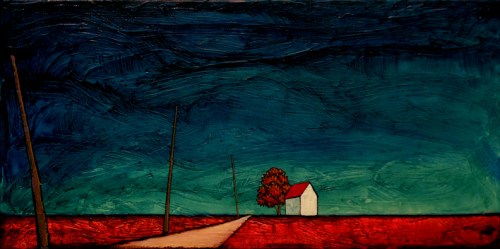
The painting at the top is a new piece that I call Memory of Night, inspired by Wiesel’s book, Night.

Read Full Post »
Even though this post only ran last August, I thought it was worth replaying, if only to remind us to maintain some semblance of civility and sanity in this bitter election season.  I was reminded of this post because the painting featured in it, Raised Up, went with me to the Principle Gallery for my talk there this past Saturday.  It’s a piece that I like very much as is the song at the end from John Prine.  Hope you’ll enjoy them as well…

GC Myers- Raised Up

Practice kindness all day to everybody and you will realize you’re already in heaven now.

Jack Kerouac

****************

I am not sure what to do with these words from Jack Kerouac but I do like them and think they deserve to be passed along.  I am a firm believer of kindness in all forms and believe that it is a pathway to a better life here in this world.

When I was waiting tables I found that my own attitude and demeanor often dictated how others responded to me.  If I smiled and acted congenially, more often than not the person I was dealing with responded in the same manner.  We are reactionary creatures and we instinctively respond according to the tone we encounter– rudeness with rudeness and anger with anger.

And kindness with kindness.

It’s our choice.  If we can fight against our reactionary nature and choose to act and react with kindness, we can shape our world and then perhaps realize that a form of heaven might be within our grasp.

I have never had the faith or certainty of those who believe that there is an actual heaven waiting beyond this world.  I would like to but I just don’t have it within me.  So, for me, if there is to be a heaven it is something to be sought in the here and now.  By that, I mean creating an environment that is honest, kind and gentle.  A life that is peaceful and quiet–that would be heaven to me.

So, when you’re out there today and face rudeness and anger, make the choice to react in a gentler manner and be kind.  Your world might be one small step closer to heaven.

This quote reminded me of a song from one of my favorites, John Prine.  The title pretty much sums it up: He Was In Heaven Before He Died.

Read Full Post »

GC Myers- Come TogetherThe reason why the world lacks unity, and lies broken and in heaps, is, because man is disunited with himself.
Ralph Waldo Emerson

***********************

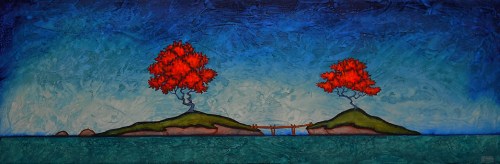
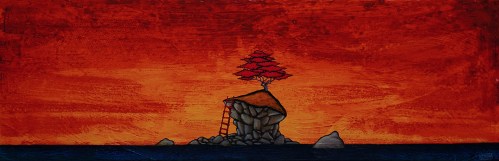
This new painting, a 12″ by 36″ canvas, that is headed to the Principle Gallery with me this weekend is called Come Together.  It’s a continuation of the island theme that has been running through my work as of late.

I think the words of Emerson above fit very much with what I see in this painting.  Though it appears to be two separate islands with trees linked by a bridge, I see them as having been once united and have somehow been separated.  In this case, it may have been the tumult of time where the seabeds rise and the mountaintops fall– many of the high peaks that we know are sedimentary rock, after all, raised from the bottoms of the oceans.

The disunity Emerson was writing about was man separating himself from nature instead of realizing that he is part of nature and operates best when he is united with it through order and reason in a sort of partnership.  It makes sense especially when you consider the way that nature reacts when we try to exercise our belief that we have dominion over it.

In the same essay, Emerson also wrote the following  that I think better puts this into context:

Nature is not fixed but fluid. Spirit alters, moulds, makes it. The immobility or bruteness of nature, is the absence of spirit; to pure spirit, it is fluid, it is volatile, it is obedient. Every spirit builds itself a house; and beyond its house a world; and beyond its world, a heaven. Know then, that the world exists for you. For you is the phenomenon perfect. What we are, that only can we see. All that Adam had, all that Caesar could, you have and can do. Adam called his house, heaven and earth; Caesar called his house, Rome; you perhaps call yours, a cobbler’s trade; a hundred acres of ploughed land; or a scholar’s garret. Yet line for line and point for point, your dominion is as great as theirs, though without fine names. Build, therefore, your own world.

We all have the ability to live within nature and to build our own world that reflects our spirit.  If only we can find unity with the nature that desires to be our partner.

Just remember, your world is what you make it.

***********

This painting will be with me at the Gallery Talk this Saturday, September 17, at the Principle Gallery.  It starts at 1 PM and  should be a good time.  There will be a drawing for the painting, Defiant Heart, which has been shown in the past couple of  posts. Plus there will be a few other surprises as well.  Hope to see you there!

Read Full Post »

GC Myers- WatchmanFor thus hath the Lord said unto me, Go, set a watchman, let him declare what he seeth.
Isaiah 21:6

******************

The biblical verse above is of course the one which was the basis for the title for Harper Lee‘s sequel, to her classic To Kill A Mockingbird.  In the books, Scout regarded her father, Atticus Finch, as such a watchman, a moral and righteous sentinel looking out for injustice and evil.

And that is kind of how I see the central figure of this new painting, the lone Red Tree set high on rocky outcropping in what seems to be an endless sea.  Maybe it is the red of the sky that sets such a tone.  I don’t know.

I’ve been fascinated by small islands in my work lately.  The isolation of them gives these pieces a brooding quality and reminds me a bit of working as an artist.  I’ve often felt that the job of an artist is to act as a sort of watchman.

It is very much a job of isolation, one that is often formed in the solitariness of youth when one always felt like an outsider, observing the world quietly and mostly unseen from the edges of life.  The work itself is done and grows in isolation but is very much influenced by one’s observations of the world around them.  And much of the work, if it reaches the level of art, is based on a sensitivity to what that artist has observed and felt.

And maybe that is the real purpose of artists, to act as a watcher, looking to warn us of our own straying from reason and to keep our humanity intact.  Maybe that is what I see in this painting.

gc-myers-defiant-heart-smThis painting is 8″ by 24″ on canvas and is titled, of course, Watchman.  It is coming with me to the Principle Gallery this Saturday, September 17, when I give my Gallery Talk there beginning at 1 PM.  There will be a group of new paintings including this piece as well as a group of selected pieces from my studio that will only be available for that day.  And there is, of course, the drawing at the end of the talk for the painting, Defiant Heart.

Should be a good time and I hope you can make it to the Principle Gallery this Saturday!

Read Full Post »

GC Myers- Doubt the DarknessIf you would be a real seeker after truth, it is necessary that at least once in your life you doubt, as far as possible, all things.

Rene Descartes

**********************

As it neared completion, this new painting felt like it was about a questioning of some sort.  The Red Tree here seems to be casting doubt over the reality that is before it and even its own reality.  The question might be: Shall I hide in the darkness or stand in the light?

I call this 12″ by 12″ canvas Doubt the Darkness and I think it speaks to this question.  Darkness often obscures our perception of things and raises doubts in us as to what is and is not real.  Darkness is an agent of doubt and fear.  But by casting our own doubt and light upon that darkness we come to understand that it only hides that which was already there and does not bring anything more with it.

Its only power over us is our own doubting of what we know is there.

Okay, maybe that’s too much for me to try to make sense of so early in the morning.  But even if it seems like gibberish when you read this, I hope you’ll at least take a look at the painting and try to to find something for yourself in it that makes sense.  Maybe you’ll even see what I was babbling about.

This is a new painting that will be accompanying me to next Saturday’s Gallery Talk at the Principle Gallery in Alexandria, VA.  It runs on September 17th from one until about 2 PM.  There will be some new work along with a select group of older pieces from the studio at this talk and, as has been tradition over the past several years, there will be a drawing at the end of the talk where one of the folks in attendance will win an original painting.  I will be sharing more details in the next few days.

It’s usually a lot of fun and I hope you’ll try to make it to this year’s talk.

Read Full Post »

GC Myers- Suffering MemoryJust remember that the things you put into your head are there forever, he said. You might want to think about that.
You forget some things, don’t you?
Yes. You forget what you want to remember and you remember what you want to forget.”
― Cormac McCarthy, The Road

***********************

 Much of my work concerns itself with our memory, how we perceive our past and how the memory of that past affects our present and our future.  It often seems a treasure, this memory, but it also comes with the price of suffering as well.  After all, the word nostalgia is created from two Greek roots, nostos which means return and algos which means pain or grief.

We suffer in our desire to return.

I see that feeling in this new piece, an 11″ by 15″ painting on paper that I call Suffering Memory.  There is something in the color and the placement of the elements that has a bittersweet quality much like that feeling of looking back through time to a point that you know is long gone and will never come again.

You desire a return but too much has changed–  knowledge gained, the self revealed and innocence lost.

The strong chaos of the texture underneath gives this piece an effect that I think adds to the distance of the memory felt.  The texture acts as a distorting agent which represents the natural distortion that time casts over all of our memories. As we all know, while we would like to think that memory is an absolute truth, time often seems to bend it even further from reality.

The texture here creates areas of light and dark that represent for me the alternating facets of memory’s truthfulness.  While it would be nice to have all memories be completely faithful to the absolute truth of the moment, it is that texture, that flawed recall of our memory that gives it the meaning that it holds for us.

In reality, nothing is seldom as good or as bad as we remember.  But that doesn’t really matter because it is not the truth to which we react.  It is our memory of it, our personal version of that truth with its own color and texture that affects us, that causes us to suffer the memory.

Read Full Post »

Noon hour in the Ewen Breaker, Pennsylvania Coal Co. Location: South Pittston, Pennsylvania.

Noon hour in the Ewen Breaker, South Pittston, Pennsylvania- Lewis Hines

The labor movement was the principal force that transformed misery and despair into hope and progress. Out of its bold struggles, economic and social reform gave birth to unemployment insurance, old-age pensions, government relief for the destitute and, above all, new wage levels that meant not mere survival but a tolerable life. The captains of industry did not lead this transformation; they resisted it until they were overcome. When in the thirties the wave of union organization crested over the nation, it carried to secure shores not only itself but the whole society.

Martin Luther King, Jr.

************************

Another Labor Day.

If you ask someone what the holiday represents they will no doubt say that it is symbolic end of summer.  A last picnic.  One last real summer weekend at the lake or shore. If you push them they might finally say that it honors the workers of this country.

But it really was created to celebrate the American Labor Movement, those unions and organizers that brought about all of the changes that Dr. King pointed out in the quote above from his 1965 speech before the AFL-CIO.

Fair wages, a shorter workday, a safer workplace, pensions, unemployment insurance– all of these things came from the hard and dangerous efforts of union organizers.  As King points out, the owners– the captains of industry—  did not agree willingly to these changes.  No, they fought with every resource at their disposal including the influence they bought from politicians and the use of violence.  The history of the labor movement is littered with bodies of workers killed in skirmishes with the forces of the owners.

Every step of progress throughout our history has been opposed by those in power.  But progress and change has always come thanks to the efforts of  people like those in the labor movement.

The use of children in the workforce was another thing that was ultimately changed by the labor movement.  It’s hard to believe that the scenes shown here in the famed photos of  photographer and social reformer Lewis Hine took place just over a hundred years ago in the coal mines of eastern Pennsylvania.  Harder yet to believe is that federal labor laws for child labor were not fully enacted until 1938.  Earlier attempts at legislation by congress in 1916 and 1922 had been challenged in court by industry and were deemed unconstitutional.

Lewis Hine -Penn Coal Co Ewen Breaker Pittston 1911Imagine your child (or your nephew or grandchild) at age 12.  Imagine them spending 10 or 12 or even 14 hours a day, six days a week in one of the breaker rooms of a coal mine like the one shown here on the right.  Hunched over in the gritty dust of the coal, they picked the coal for differing sizes and to sort out impurities.  Imagine the men who are shown in the photo with sticks poking your child, perhaps kicking him to speed him up.  Imagine all of this for  seven and a half cents per hour.

There was no school books for these kids.  No soccer.  No violin practices.  Just a future filled with misery and drudgery and most likely a black lung.  Imagine that.  And think that it was all taking place less than a hundred years ago and it ended because of the labor unions and the brave people who fought for them.

I know there are problems that arose in the unions over time.  They are not perfect by any means.  But that doesn’t take away from the incredible progress that they provided for our nation’s worker.  Despite their shortcomings, the idea of workers uniting to have one strong voice is as important now as it was a century ago.

So celebrate the day at the shore or in a picnic.  Have a great day.  But take one single moment and think of those kids in that Pennsylvania mine and the people who set them free.

Breaker boys working in Ewen Breaker of Pennsylvania Coal Co. For some of their names see labels 1927 to 1930. Location: South Pittston, Pennsylvania.

Breaker boys working in Ewen Breaker of Pennsylvania Coal Co.Location: South Pittston, Pennsylvania. Photo: Lewis Hine

Group of Breaker boys. Smallest is Sam Belloma, Pine Street. (See label #1949). Location: Pittston, Pennsylvania.

Group of Breaker boys, Pennsylvania 1911  Photo: Lewis Hine

Read Full Post »

GC Myers- Into New Territory smIf your mind is empty, it is always ready for anything, it is open to everything. In the beginner’s mind there are many possibilities, but in the expert’s mind there are few.

Shunryu Suzuki

******************

I was looking for some words to go with this new painting, Into New Territory, that is part of my show now hanging at the West End Gallery.  I came across this quote from the late Zen monk and teacher Shunryu Suzuki that expressed very much what I was seeing in this painting.

I see this painting as being about moving out from that which you know, examining the possibilities that open up to you when you dare to move beyond your comfort zone.

When I read Suzuki’s words, I began thinking about my own experience as a painter.  In the beginning when everything was new and my knowledge consisted of much less than it does today, every day was filled with new discoveries that opened up wider and wider vistas of possibility.  There seemed to be no boundary, no limit to where it might take me.

But as one gains more knowledge and becomes more “expert,” one begins to set limits on their possibility.  They learn hard lessons from failures and often even stop looking in that direction as a future avenue of creativity.  Their focus becomes narrower and narrower.  The possibilities that seemed endless as a beginner seem much more limited and defined.  The “what is” is greater but the “what might be” seems to be fading into the mist.

The trick is in retaining some of that  beginner’s exuberance and its naive openness to all possibility, and to find a way to incorporate the gained knowledge that came to you along the way.  In the context of this painting, it means straying out into the open and daring to look in all directions.  It means setting aside all fear of failure and the encumbrances of the “what is” to move toward an endless horizon.

It’s so simple a thought and so difficult to realize.  But one must try and try and try.

Read Full Post »

« Newer Posts - Older Posts »