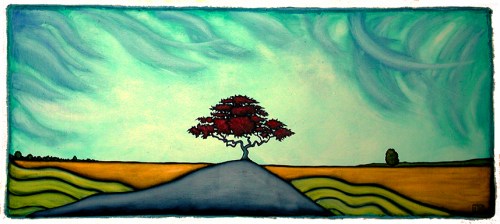
 This is an early Red Tree painting from back in 2001 that is titled Challenger that lives with me now here in the studio. It’s one of a small group of pieces that made the rounds through the galleries over the years yet never found a home. I call them orphans. This particular orphan spent a much longer time in the galleries than most, only coming back to me a couple of years ago. It drew interest a number of times yet never made that final connection.
These pieces always intrigue me. There must be something that can be learned from them or at least that is what my mind tells me. So I find myself going back again and again to look at these pieces, trying to determine what might be lacking in them. Or at least pinpointing a reason why they never fully connected.
With some it’s an easy task. The flaws or weaknesses are obvious and far overshadow the strengths. In fact, I am pleased that they are with me and not hanging on a wall somewhere. Thankfully, there aren’t a huge number of those, which I won’t be showing here anytime soon. and will no doubt ever see a gallery wall again.
Some are with me for external reasons like poor presentation– the frame being too wide, too small or an ugly color that fights against the work. Some are just too big which limited their time on the walls of most galleries which meant they had fewer opportunities to be seen than other smaller paintings. Some are the last pieces of a series that I no longer work in and don’t really fit in with the pieces of current shows. Many of these pieces will emerge at some time in the future when the time is right.
But there are a couple, like the painting above, that fall in the middle. I see strengths in them but I see weaknesses as well. This particular painting is a little big 18″ by 42″ which made it a bit more expensive and harder to place. It is oil on a wood panel with a slightly textured gessoed surface which was not unusual for me at the time it was painted but gives it a slightly different look than my typical work which consists of acrylic paints and inks. This dates it a bit. Plus the effects of my handling of oils are quite different than my handling of acrylics, as is the the overall color to a degree.
Looking at it, there are things in it that I would do differently now. Colors that would be changes just a bit, perhaps made a bit more complex with the addition of another tint. But at the time it was created it represented who I was and what I was doing as an artist so I can’t question it. Nor do I want to change it now.
It is what it is. It feels complete and of a time.
So I now look at it in that way and accept it as it is. I find myself overlooking the small downside and appreciating the essence of the painting without my own bias. And I like it. It’s like looking at an old picture of yourself and accepting that it is a past you, a version that you have long transcended. Despite that, it is still you at its core and that is the part that try to see.
So, this orphan may live with me for a long time but that’s okay by me. It reminds me who I once was.
 Everyone has his own specific vocation or mission in life; everyone must carry out a concrete assignment that demands fulfillment. Therein he cannot be replaced, nor can his life be repeated, thus, everyone’s task is unique as his specific opportunity.
 She had studied the universe all her life, but had overlooked its clearest message: For small creatures such as we the vastness is bearable only through love.
  For me, trees have always been the most penetrating preachers. I revere them when they live in tribes and families, in forests and groves. And even more I revere them when they stand alone. They are like lonely persons. Not like hermits who have stolen away out of some weakness, but like great, solitary men, like Beethoven and Nietzsche. In their highest boughs the world rustles, their roots rest in infinity; but they do not lose themselves there, they struggle with all the force of their lives for one thing only: to fulfill themselves according to their own laws, to build up their own form, to represent themselves. Nothing is holier, nothing is more exemplary than a beautiful, strong tree. When a tree is cut down and reveals its naked death-wound to the sun, one can read its whole history in the luminous, inscribed disk of its trunk: in the rings of its years, its scars, all the struggle, all the suffering, all the sickness, all the happiness and prosperity stand truly written, the narrow years and the luxurious years, the attacks withstood, the storms endured. And every young farmboy knows that the hardest and noblest wood has the narrowest rings, that high on the mountains and in continuing danger the most indestructible, the strongest, the ideal trees grow.
 I’m a little tired, mainly of talking about my work and myself, and want to keep this short today. I thought I’d show another painting from the show at the Principle Gallery and couple it with the song that spawned it. The painting above is titled To the Watchtower which I derived from the old Bob Dylan song All Along the Watchtower.
 Part of the Pattern , which opens tomorrow, June 3, is my 17th solo show at the Principle Gallery in Alexandria, VA. It’s been a great run since that first show back in 2000 that introduced the Red Tree into my body of work. I’m not even sure that I had a body of work at that point.
 The past slips from our grasp. It leaves us only scattered things. The bond that united them eludes us. Our imagination usually fills in the void by making use of preconceived theories…Archaeology, then, does not supply us with certitudes, but rather with vague hypotheses. And in the shade of these hypotheses some artists are content to dream, considering them less as scientific facts than as sources of inspiration.
 This is another new painting headed to the Principle Gallery this weekend for my show there, Part of the Pattern, which opens next Friday, June 3. This piece is 14″ by 34″ on paper and is titled , The Untold Want. The title was taken from the title of a very short poem from Walt Whitman that contained the phrase that spawned and became the title of the Bette Davis movie, Now, Voyager.
 This is another piece from my upcoming June show at the
 This was an interesting piece. I initially laid out the composition in red oxide and began to lay color into the rays in the sky. At that point it felt like the overall color of it was going to go into the blues. A nocturnal scene perhaps. But that didn’t quite ring true for me so I didn’t go forward with it. So for the last couple of months this piece has been sitting in the state shown here at the left, behind me as I work at the easel. Whenever I would turn around, it was there staring me in the face.

 Shakespeare said that art is a mirror held up to nature. And that’s what it is. The nature is your nature, and all of these wonderful poetic images of mythology are referring to something in you. When your mind is simply trapped by the image out there so that you never make the reference to yourself, you have misread the image.
 Redtree Times