Feeds:
Posts
Comments

Posts Tagged ‘Vincent Van Gogh’

Vincent Van GoghWhy does one not hold on to what one has, like the doctors or engineers; once a thing is discovered or invented they retain the knowledge; in these wretched fine arts all is forgotten, and nothing is kept.

Vincent Van Gogh

Letter to his brother Theo 1888

*****************************

When I read this quote from Van Gogh, I flashed back to a conversation I had several years back with an artist friend who was urging me to begin filming my painting process.  He said that a deer could jump in front of my car going home from the gallery that night and nobody would ever know how my  paintings came about.  He  thought would be a loss.

That made me think but I still didn’t follow his advice and protected my process, except for small glimpses here and there, for years like an alchemist greedily withholding their found knowledge.  It was one of several reasons for my lack of enthusiasm for teaching.

But time normally changes all things.  I began to realize that it was a fool’s mission in keeping my process to myself.  The  process was tool for expression– it was not the expression.

An artist often has individual expression that transcends subject, material and technique.  For example, an artist painting exactly like me– same trees and process– would produce work that would be different than my own.  It would have a different soul, if it had one at all.  If this artist’s purpose was mere copying, it would not.  I can say this because I’ve seen this before.

So, after a bit, I came to understand that showing or teaching my process would not diminish my work in any way.  In fact, I began painting the way that I do because I initially wanted to see paintings that I wasn’t seeing anywhere else.  Wouldn’t it be great to spur that same thing in others?

To that end, as I announced earlier, I am teaching my first two day workshop,  September 17 & 18,  at the Arts Center of Yates County in Penn Yan, NY.  It’s a lovely town sitting at the end of scenic Keuka Lake, one of the Finger Lakes, famed for their beautiful vistas and multitude of wineries.

I am pretty excited about this and am starting to put together just how I want to teach this.  I don’t want to spend any more energy  hiding my process and I plan to fill each of the  two days with as much info as I can get across while still making it entertaining and educational.  So if you want to spend a couple of late summer days in a beautiful setting learning a form of expression that might spur other good things for you, contact the Arts Center of Yates County.

Hope to see you there.
Read Full Post »

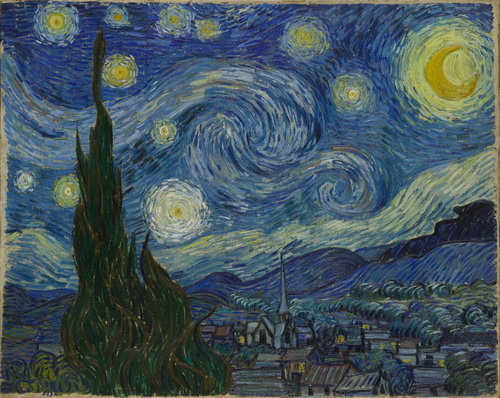
Van Gogh The Starry Night 1889 MOMAThe Starry Night by Vincent Van Gogh is one of the most beloved paintings of all time, stirring all sorts of emotions from a wide spectrum of the population as it presents a paradox of serenity and turbulence in the night sky of Provence.  It has been analyzed to death by art critics, psychologists, theologians and every art history student since it was painted in 1889, each striving to explain the meaning that they pull from it.

And maybe they’re all right.

But recently there has been a different analysis of this work.  It has to do with fluid dynamics and the problem of finding a mathematical equation for turbulence– the sort of turbulence you might see in an eddy in a stream or that which is depicted in the swirling light and color of Van Gogh’s painting.  Russian mathematician Andrei Kolmogorov (1903-1987) came closest to solving this problem in the early 1950’s yet it remains one of the great unsolved problems of physics.

Back in 2004, the Hubble telescope picked up images of eddies of gas and dust around a distant star and scientists were reminded of Van Gogh’s painting.  Scientists from a number of countries collaborated on an analysis of the luminance in his painting and discovered that the structure of his painting was very much patterned like Kolmogorov’s equations for turbulence.

I am not going to say much more.  There is a wonderful short film below from TED-Ed and Natalya St. Clair that much better explains this. But before you watch, I wanted to add one more thing which is the supposed inspiration for Van Gogh’s sky.

Drawing of M51 Whirlpool Galaxy Lord Rosse 19th CenturyThere was a drawing that was well known in Europe in the latter part of the 19th century that was done by William Parsons, also known as Lord Rosse, who had built a large telescope on his Irish castle in the 1840’s.  Called Leviathan, it was the largest telescope in the world until 1918.  With it, Lord Rosse was able to observe the great swirls of the near universe, turning them into drawings which circulated throughout Europe.  This one shown on the left is of  the Whirlpool Galaxy, M51, and is believed to have been the spark for Van Gogh’s sky.

Anyway, watch this great short on the analysis of Van Gogh’s great painting.  Or perhaps you would rather just be content with our own interpretation of the work and what it does for you personally.  Either way is good.

Read Full Post »

Maurice de Vlaminck- Houses at Chatou 1905

Maurice de Vlaminck- Houses at Chatou 1905

When I get my hands on painting materials I don’t give a damn about other people’s painting… every generation must start again afresh.

— Maurice de Vlaminck

********************

I have to admit I don’t know much about French painter Maurice de Vlaminck  (vlah-mink)  who lived from 1876 until 1958.  His work is best known for a short period  in the early years of the 20th century when he was considered one of the leading lights, along with Andre Derain and Henri Matisse, of the Fauve movement.  Fauve translates as wild beast and the style of these painters was very much like  that to the sensibilities of that time.  It was brightly colored with brash brushwork and little attention paid to detail.  It was all about expression and emotion.

I recognize some of his early Fauvist work, mainly for the obvious influence of Vincent Van Gogh  it exhibits, and none of his later which becomes less colorful and exuberant, perhaps shaped by his experiences in WW I.  But his name is one that I have often shuffled over without paying too much time to look deeper.

Maurice de Vlaminck At the Bar 1900

Maurice de Vlaminck- At the Bar 1900

But I came across this quote and it struck me immediately.  It was a feeling that I have often felt  when I immerse myself in my work.  All thoughts of other painters– of their influence, of comparisons and artistic relationships– fade into nothing.  It is only me at that moment faced with the task of pulling something new and alive from the void.  I can’t worry myself at that moment about what other painters are doing.  Their whats and hows and whys  are all moot to me then because I am only trying to express something from within.  It might only exist and live for me in that instant, though I hope it transcends the moment, but that is the whole purpose and all of the works of all the painters throughout time can’t change this singular expression of this moment.

This single, simple quote brought me into kinship with de Vlaminck and made me promise myself to explore more deeply into his work and life so that when I come across his name in the future I don’t simply skim past without a thought.  But when I am painting, rest assured I will not be thinking of Maurice de Vlaminck.  And that is as it should be…

Read Full Post »

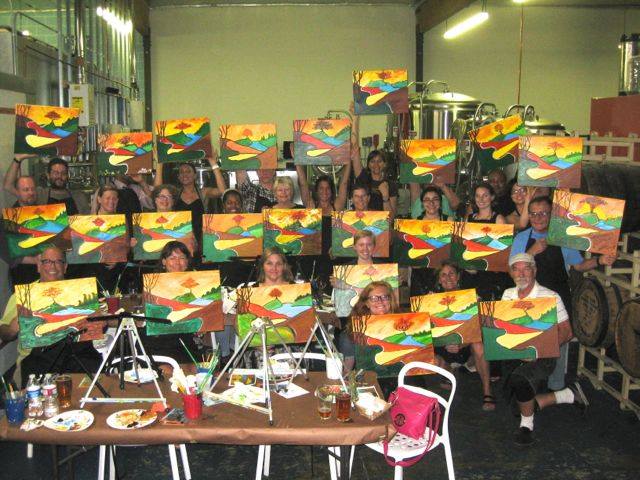
Art on Tap Class at Claremont Craft Ales

Art on Tap Class at Claremont Craft Ales

Sometimes your work physically goes to far distant places, such as those paintings that have went to embassies in Nepal, Uganda and Kuwait that  I wrote about yesterday.  But sometimes your work travels in ways that you can’t predict.

An online acquaintance forwarded the above image to me yesterday.  It was a strange sensation, seeing this mass of what looked to be 25 of my paintings looking out at me.  It took me a few seconds to figure out that I was looking at an art class that had reproduced one of my paintings.

Doing a little research, I discovered that this was an event called Art on Tap that is operated by Otterspace Arts in Claremont, California, east of Los Angeles.  Every several weeks, they hold this event at a local microbrewery, Claremont Craft Ales, where all attendees are instructed in how to paint works that have been selected by online voting.  They have recently chosen to make copies of paintings from Edward Hopper, Georgia O’Keefe, Vincent Van Gogh and Claude Monet.  And me.

Even though I am pretty sure most of those in attendance had never heard of me or my work  before, I was still really flattered by this.  I know that this has taken place on a more local level, at kids classes in my area and one for adults at an Arts Council in the Finger Lakes, but it was gratifying to see my work’s imagery moving outward in this way.  I recognized at an early stage in this journey that creating images that are instantly recognizable as yours is one of the most important , and most difficult, steps in establishing yourself as an artist.  And seeing this photo made me think I was almost there.

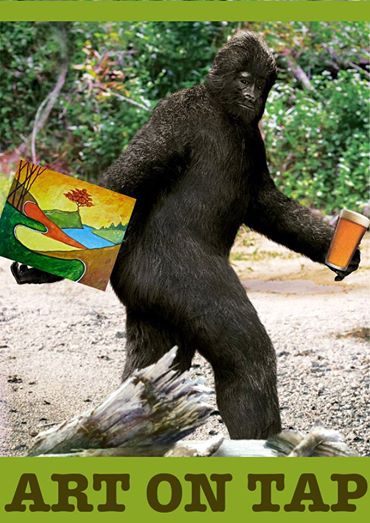
I also liked their Facebook ads for the event.  I would like to think that there is a Sasquatch somewhere enjoying my work.  At the bottom is the original image.  I hope they enjoyed painting this painting and hope that it hangs with pride in their homes.

Claremont CA Art on Tap Otterspace adClaremont Original GC Myers Image

Read Full Post »

The task is…not so much to see what no one has yet seen; but to think what nobody has yet thought, about that which everybody sees.

― Erwin Schrödinger

********************

GC Myers-  New Dimension smI was looking for something to say about this new painting, New Dimension,  when I came across this quote from  physicist Erwin Schrodinger that deals with dimensional perception.

I have to admit to not knowing much about the  quantum physics to which he refers with these words but the sentiment behind it could be describing the driving force behind this painting and much of what I attempt to do as an artist.  I have maintained for some time that art is not about clever ideas or extraordinary subjects but in changing our perceptions of the ordinary, in trying to illuminate those dimensions of the world that remain unseen to us.

The example I often cite is of Van Gogh‘s painting of a vase of irises.  It is an painting of an extremely ordinary subject, a vase filled with flowers,  A common floral painting that has been the subject of perhaps a million or two painters over the ages.  Yet seeing it, one feels that unseen animating energy of nature and the force of Van Gogh’s perceptions of it.  It vibrates with energy.  It is no longer a simple vase of irises but has become a conduit to a new and deeper dimension, one that delivers us closer to the essence our being.  It is now the sacred ordinary.

This piece attempts to go there and does so for me.  But I am too close to it to  judge whether it hits it mark for others.  It is as ordinary as it gets- a horizon, a sky, a sun, a field and a tree.  Yet I am hoping that there is something in it that takes you beyond the mundane, something that sparks and allows your inner self to detect the essential forces at work in this simple scene.  To find the extraordinary in the ordinary, to feel more connected to our essence.  To find a new dimension in our selves.

This painting, New Dimension, is a 12″ by 36″ canvas and will be going with me to the Principle Gallery for my Gallery Talk there on Saturday, September 13th.

Read Full Post »

GC Myers- Shadowsong smWell, it is Sunday morning and time for some music once again.  I thought I’d take this opportunity to show how it is not always the what but the how that is important.  Take for instance the song Oops!… I Did It Again, perhaps one of the best known pop songs of the last fifteen or twenty years, performed by Britney Spears.  Like her or not, you probably have found yourself at some point with that tune in your head.

Myself, I have tried to avoid it in any way possible.

But back in 2003, one of my favorites, Richard Thompson,  did a live album called 1000 Years of Popular Music, where he attempts to summarize the last millennium through musical selections from different eras through that time.  He begins  with Sumer Is Icumen In from the 11th century (this debatable with some saying it is later but for the sake of making the album title work let’s go along with the 11th century) and moves through all forms of traditional and popular music all arranged for his single guitar and  percussion, when needed.  It ends with 2000’s Oops!… I Did It Again.

In Thompson’s hands, the song becomes something quite different.  In painting terms, it would be like two vastly different painters doing the same scene.  Let’s say a simple country cottage painted by Thomas Kinkade and Vincent Van Gogh.  They might be the same whats but the resulting hows would be worlds apart.

Give a listen and see for yourself.  And have a great Sunday…

Read Full Post »

Hokusai Mackerel and Sea Shells 1840

I don’t have much to say today and am running late plus the Russia-Finland hockey matchup in the Olympics is beginning as I speak.  So I am greatly distracted today.  But t came across this image from the Japanese master Hokusai that I wanted to share.  I had a post several years back that featured the famed waves  for which Hokusai is best known.  They are such strong images of the power and rhythm of nature that it is easy to see why they are his signature works.  But when I saw this quiet still-life of a fish with a few shells from 1840 I truly understood how revelatory this work must have been to the western artists,  such as Whistler and Van Gogh among many others,who discovered it a generation later.

It has a wonderful delicacy in its color and it’s also  simple and elegant, maintaining an extraordinary modernity through the past 170 or so years.  It always seems  like it is in the now which is that intangible that most artists , myself included, seek.  It is unlike anything you would have found in the west in 1840 yet seems totally at home now.  Just a wonderful image to ponder.

Read Full Post »

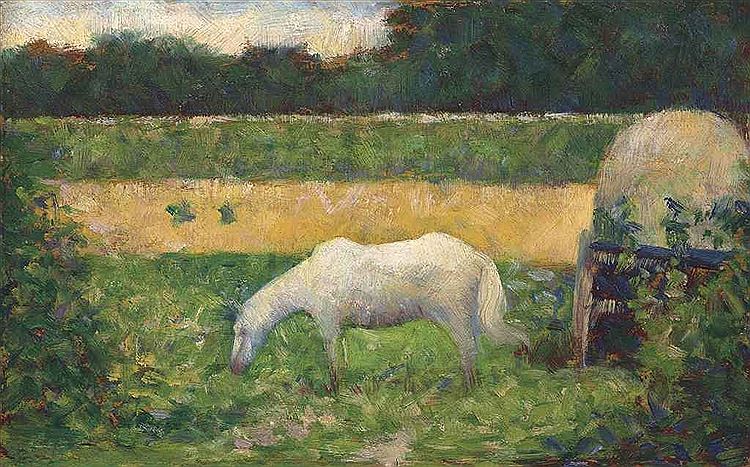
George Seurat -Paysage Avec ChevalI subscribe to a service that provides information such as auction results for artists, both living and dead.  It is always interesting to scan the auction results for my favorite artists, to see how they are currently viewed by buyers.  For example, anything by Vincent Van Gogh still draws huge money, even the work that doesn’t possess the signature brushwork and color of his better known works.  Those pieces that do, go for astronomical sums.  His popularity with the public is as strong as ever.  I guess that is no surprise.

A_Sunday_on_La_Grande_Jatte,_Georges_Seurat,_1884.It’s also interesting to scan the results to see other work from artists than that which we know them by that hangs in museums.  We tend to think of artists by their best work and seldom see the complete chain of work that runs through their career, never really seeing their weak links or developmental work.  The image at the top, Paysage Avec Cheval,  a painting that goes up for auction at Christie’s London, is a good example of this.  It’s a lovely piece but you might not guess the artist.  This is from George Seurat whose work, such as his most famous work shown here on the left,  is forever tied to pointillism.  But scanning through his records, you can get a better sense of the evolution of his work.

I am also looking for consistency in the artists whose work I am scanning through.  Again, we always think of the artists in terms of their best known works and are often unaware of the totality of their body of work.  Some artists are incredibly consistent, even in their early formative years.  Others have high peaks and deep valleys, with a huge disparity between their best and not-so-best work.  I am always encouraged by both types of artists.

I strive for consistency in my own work but have had dips and valleys in my work, particularly in the formative days early on.  In those days, I thought of the great artists only in terms of their best  works that hung in the great museums of the world, thinking that they simply got up each day and turned out incredible work.  I could not fathom the possibility that they had swings and misses.  It’s encouraging to see that those icons whose work I revere often struggled in the same way as me and that the great works we know them for were not created in a vacuum.  They came with great effort and day after day of moving ahead in often small increments.

I think any aspiring artist should take a few minutes to look through the whole of the works of their heroes.  They might be encouraged, as I often have been, to know that the path they are on is not so much different.

Read Full Post »

Van Gogh-- Sorrowing Old Man 1890I am a fan of Vincent Van Gogh and  am always surprised when I come across a Van Gogh painting that I can’t remember seeing, especially one that has that powerful quality for which his work is known.  Such was the case when I stumbled across this painting.  It’s called  Sorrowing Old Man (At Eternity’s Gate) and was painted in 1890, just a couple of months before his death.

His signature use of line is evident here, especially in the way he uses the color blue to outline the old man. the man and the chair have a completeness while the floor and the background are sparsely painted, almost not there.  It’s a bit of a departure from some of his better known pieces which are densely colored throughout but it focuses the energy of the painting completely on the old man’s sorrowful posture.  Its simple elegance makes for a strong and moving image.

Van Gogh-- Worn-Out-- Drawing  1881-2This painting was based on an earlier drawing made by Van Gogh in 1882.  During that year and the one before, Van Gogh had done a number of drawings of men and women in states of sadness or exhaustion as he was learning to make lithographs.  It is beautifully rendered and has all of the same power of the final painting.

However, for me, Van Gogh’s signature use of color in the painting is what makes the painting much more memorable and moving.  The painting is so recognizable as being his that it carries the cache of his entire body of work, links into the continuum of energy that runs through his paintings.

I am glad I stumbled across this treasure.  While I don’t paint in the manner of  Van Gogh, I find there is almost always something to be learned, always something that can be applied to my own when studying his work.  I think I will look at this a bit longer.

Read Full Post »

Charles Burchfield- Sun and Rocks- Albright-Know Art GalleryAn artist must paint not what he sees in nature, but what is there. To do so he must invent symbols, which, if properly used, make his work seem even more real than what is in front of him.

–Charles Burchfield

*********************

I am a big fan of the work of Charles Burchfield (1893-1967), a western  New York painter who lived and painted in the Buffalo area for most of his life.  His work was decidedly visionary in its scope, taking the environment that he knew around western New York and embellishing it with a life force and energy that he sensed beneath the surface.  That’s what he was referring to in the quote above– taking what you see around you and not simply recording it but painting how it moves you emotionally.  To me, his work is as emotionally charged in the same way as that of Van Gogh.

Charles Burchfield- An April Mood- Whitney Museum of American ArtCreating symbols, as Burchfield refers to in the quote, have been a big part of my work.  I have long emulated his use of creating a visual vocabulary that moved through a body of work.  It becomes a sort of language of its own  that people who take it in and understand it find easy to read and absorb as they move from picture to picture.  Those who can’t read it find less in the images and feel less drawn into them.  In an earlier post  about Burchfield I wrote about an artist friend who just didn’t get Burchfield’s work in any sense.  He just one of those people who couldn’t read the language clearly written in the work.

I also have been influenced by the way Burchfield would constantly go back to earlier work and use it as a new starting point, as though the added knowledge gained through the years would take this work in a new direction.  I often do the same thing, constantly revisiting images and motifs from years ago looking for a thread or path to follow anew.

Even this post is a revisitation, going back and looking at an influence, trying to pull that original inspiration from it.  With Charles Burchfield, that’s always an easy thing to accomplish.

Charles Burchfield- Childhood's Garden

Read Full Post »

« Newer Posts - Older Posts »