It’s been about six months since I started writing this blog and in that time I’ve become a lot more familiar with this odd shadow world of blogs.
I’m not so sure it’s a world with which I would want to spend too much time.
Oh, don’t get me wrong. I’ve enjoyed writing about my little world, getting to hear from a lot of diverse people and I often enjoy reading the blogs of others. There are many people who produce wonderful blogs, full of humor and insight. But on the flipside, all too often, it’s a non-stop freakshow of anger and hatred. Idiocy and lunacy. An endless display of moronic babble, people who nitpick and dissect every miniscule detail of whatever happens to piss them off that day. These are people whose idea of reasonable debate is to yell louder and longer than the next guy, throwing all logic aside and spewing venom from the behind the veil of their cyber-anonymity.
As you can see, their rants incite rage.
Hey, I understand anger. I understand rage. But my anger and rage can be quelled with reason and rational thought. Many of these idjits remind me of those poor dogs who are chained to doghouses all alone. They have no contact and become increasingly mad, barking and snarling at everyone and everything.
I don’t know, maybe these people are like those pitiful dogs. Maybe they need some compassion. Perhaps they need some kindness. Maybe they need to shed a tear or two…
Well, here’s a song from Johnny Cash singing his version of the Loudon Wainwright song, The Man Who Couldn’t Cry. Maybe these folks should put down their poison pens and give a listen. Couldn’t hurt…
I recently picked up a book titled Baseball’s Golden Age: The Photographs of Charles Conlon. It is, as it says, a book of photos of baseball players from the first part of the 20th century. The photos are all black and white and give the players a grim, rough edge. Not that they needed the help.
From the time I was a kid I was always interested in baseball from the turn of the century. I read all sorts of books on my heroes and we had an old souvenir-like program from the 40’s that had many of these same photos with short stories and stats of many of these players. I spent hours and hours looking at these faces and names until they took on a talisman-like quality in my mind. Guys like Nap LaJoie, Rabbit Maranville, Wee Willie Keeler, Cy Young and on and on. In reality, many of these guys probably wouldn’t shine in today’s game but in my mind they were magic.
Of course, there was a hierarchy. Shown above, the Bambino, Babe Ruth, was the king. An actual Sultan of Swat accompanied by his prince, the steady Iron Horse, Lou Gehrig. Then there was the nasty tempered Ty Cobb, the Georgia Peach, shown here in one of the most famous of baseball photos of its time. Renowned for sharpening his spikes and using them on waiting fielders as he stole numerous bases, Cobb was always bitter over Ruth’s dominance of the spotlight.
These players always really stuck out in my mind because of the images and stories I encountered as a kid. They were brawny and raw looking. They drank hard. They fought. They had a hardened mythic look in their gray wool uniforms. They didn’t look like the players of my youth. In the 70’s baseball started to be played in awful multi-purpose stadiums with hard artificial turf surfaces, vast cold edifices that sapped all of the organic quality from the game. The uniforms were evolving as well. The 70’s brought these stretchy polyester space suits that only added to the artificial feel of the stadiums. I always think of Willie Stargell, a large first baseman for the Pirates with a big personality who would’ve fit in well with my old-timers) in this god-awful form-fitting spacesuit. He looked ridiculous.
It was easy at that time to drift away from the game that had provided so much magic when I was young. I stayed away for almost twenty years, barely checking the races or stats. I have a huge hole in my knowledge of the game from the 80’s and early 90’s. The return of smaller stadiums built to fit baseball saw a rebirth but it was the Yankees that brought me back. I had grown up despising the Yanks ( the voice of their announcer Phil Rizzuto was like fingernails on a chalkboard to me) but this team in the 90’s was a throwback. They had grit. They fought. They made plays that became mythic. They made me feel like I was 9 years old again, reading the wonderful hyperbole of the old sportswriters as they made mighty pronouncements about the exploits of the Bambino. Baseball was magic again.
So leafing through this book rekindled many memories. With that I leave you with a short piece of film that simply shows the great Big Train, Walter Johnson, throwing. I saw a part of this on Ken Burns’ wonderful documentary series on the game and was mesmerized by his extraordinarily long arms and the whipping action his arms. There is a kind of poetic beauty in the motion.
Maybe that’s the poetry of baseball that people talk of…
For ten years I walked up the road through the woods to my old studio. It was a logging road from the two or so times the forest had been harvested over several decades and ran along a run-off creek that dries up most summers. There were two visible tracks from the tires of vehicles that had climbed the gentle rise over the years and as the years passed, another track formed between them.
This was the path I walked several times a day, up and down the hill. At first I thought nothing of it. It was simply a path. But over the years I began to notice things about it. I could walk the path in the absolute black of night with no problem, each step falling in a natural way directly to this path. If I tried to walk off the path it seemed unnatural and required a degree of attention to my stride so I wouldn’t stumble.
I came to realize that my trail was the path of least resistance. It was the path that carried me with the least effort. Each step fell naturally in place, accounting for the slightest change in the topography and had the same effect as water flowing down a creek.
I began to notice that the trails formed by deer and other animals were the same. When I followed them, they would move slightly in one direction or the other, just when your stride wanted to shift naturally and simply from gravity. There was the same sense of rightness I talk about in my painting. They never veer drastically, always in smooth, subtle curves. They would always run along the grade as though were the elevation lines on a topographical map. Following them required little effort or thought.
Going off the path was a different matter. It took thought, concentration and effort. There were new obstacles to overcome. Branches that crossed the path, blocking your view ahead and slapped the side of your head. Downed trees that had to be climbed over. Roots that rose through the dirt and tripped you. It was real work.
I guess herein lies the point. If I wanted to go where others had went before me, I could follow their trail. This would be the simple and logical way. But if I wanted to go to a different place, one that was fresher and less visited, I might have to set my own path. It wouldn’t be easy. It would require more effort, more thought and the risk of not finding my way. But if I forged ahead and found my way, there would be a new, hard won discovery and the sense of accomplishment that comes with it.
I could blather on a little more but I think my little lesson learned from the land (nice alliteration, eh?) has come to an end. We all choose our paths. Some take the easier trail. Some blaze new trails. And some go into the woods and never come out…
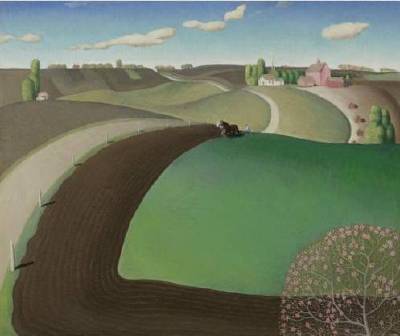
In an earlier post I spoke briefly of my admiration of Grant Wood, primarily for the rhythm of his landscapes. The piece shown to the right, Near Sundown, was a huge influence on my earliest landscapes for this rhythm. The way the hills rolled and the treeline rode them fit perfectly with the way I saw things.
I failed to mention how much I loved his use of color, the way his shapes had a darkness that gave their color a richness that really appealed to my eye. This color coupled with the way his landscapes moved in such a organic, human manner made me see that one could interpret the landscape in new ways. He took what might be considered a mundane Iowa landscape and made it seem alive and moving. It gave me hope and something to aspire for in my own landscapes.
Most people, of course, know Wood primarily for American Gothic, shown here. It is perhaps the most recognizable American painting of the 20th century, widely referenced, and often parodied, in popular culture. I really admire the way the piece is put together, the way the figures come together with the house to form a classic triangular composition. I also like the color blocking with the darkness of the clothing making a base that holds up the lighter colors.
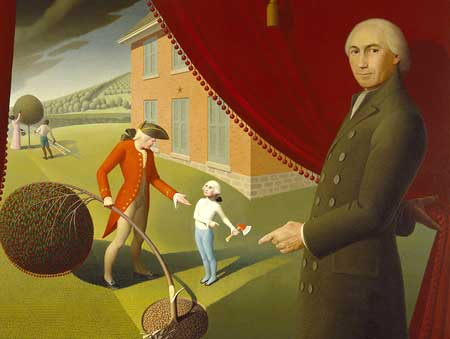
A lot of people see this as being a humorous piece, somewhat ironic. I don’t know but given Wood’s use of humor in other pieces, this may be true. A good example of his humor is Parson Weems’ Fable, below, which illustrates the famous tale of a youthful George Washington chopping down the cherry tree. The Mini-Me Washington always makes me laugh.
About a year ago I received an e-mail from Alicja Mann. She is a writer with an interesting past, living now in Arizona who has a couple of my paintings. She informed me that she was working on a new book of essays and poetry and wanted to use the image from one of the paintings of mine that she owned on the cover. I was honored that she chose to use my work and gave my okay.
It had completely slipped my mind until this morning when I received another e-mail from Alicja with the announcement that her book was out. She explained that she had encountered obstacles in the past year that had slowed her progress in completing her project but had overcome them and was pleased with the final product.
According to the book’s website: “The author writes from the perspective of “the other European” (from Eastern Europe) and “the other American” (an immigrant). She came to the States from Poland at a time when it was still dominated by Soviet-style Communism. In her new country she transformed herself from a scientist to a writer. These essays and poems take the reader on a journey through space and time addressing issues of identity, alienation, belonging, and responsibility. Sometimes funny, sometimes tearful, but always thoughtful, this book charms and provokes. It invites the reader to sit and reflect, as symbolized by the art on the cover.”
As you can see, she deals with many of the same issues as I do with my work. I look forward to reading it soon and am sure it will inspire something new in my own work. You can click on the book cover shown to go the book’s website.
In other publishing news, another painting of mine was used on the cover of Saint Vincent Vitals, the quarterly magazine of the western Pennsylvania based regional health care provider.
Over the years, a number of people associated with Saint Vincent have acquired pieces of mine through the Kada Gallery in Erie. I have met many of them at the gallery so was pleased when the magazine contacted me several months ago for permission to use my work on their cover.
Though I don’t actively seek this type of exposure for my work, it’s always interesting to see the work in a different context. It allows me to see a bit how others view the work, to see what emotion it evokes in them. In both of the cases shown, I think they both see it as I do.
It’s yet another Sunday morning. Time to stop and look back at what has transpired over the past week. Have a cup of tea. Read the paper. Watch the deer walking through my yard.
Just time to stop and release some of the anxiety that builds up in a chaotic world. A time to breathe.
Something we all need, probably more often than the occasional Sunday morning.
I’ve decided to share a little music from the Beatles. This is And I Love Her from their first movie A Hard Day’s Night. I chose it because it always brings back pleasant memories and there’s something calming in those opening notes played on the acoustic guitar. Something very protective and very soothing.
I live in a part of New York state that doesn’t normally get a lot of headlines. We’re somewhat rural with a few smaller cities scattered across what is called the Southern Tier that runs along the NY/Pennsylvania border.
We have Corning which is known for its glass industry including a world-class museum. There’s Ithaca with Cornell and Ithaca College. Then there’s my hometown of Elmira where Mark Twain spent his summers, writing many of his books from his study overlooking the valley, and is buried here. Home of the late, great Ernie Davis. We’re also known for our prisons. I can barely contain my pride.
Then a little east there’s Binghamton.
It was primarily known as the birthplace of IBM but after yesterday will be known in the national mind as the location of yet another murderous rampage.
14 killed.
I don’t know much about the assailant and I really don’t need to hear a lot. I’m sure there will be all kinds of new info today and in the week ahead, all profiling a troubled soul. Unfortunately, we’ve heard it all before. Too many times.
I don’t have any answers to the scourge of mass killings. I have sympathy for the families who lost members. I have empathy for those who witnessed and survived, many immigrants to this country. Their terror and bewilderment that such a thing could happen in their chosen home is palpable.
And I have a degree of sorrow and empathy for the killer. While I can’t understand how a person could be driven to such violence , I can imagine the alienation and rage that ran through his mind. I don’t know his circumstances or what might have possibly tripped that final switch but he obviously lived in a troubled state of mind without the necessary coping mechanisms.
That doesn’t excuse or justify his actions. It only brings to mind the scores of people that live among us with that same anger, that same sense of separation. The vast majority live this side of the line but more and more cross it and we’re left watching the news, horrified.
And you hope and you pray that this time will be the last.
“The 500 richest people in the world, according to a U.N. calculation a few years ago, earned more than the 416 million poorest people. It’s worth bearing in mind that the first group bears a measure of responsibility for the global economic mess but will get by just fine, while the latter group has no responsibility and will suffer the worst consequences.”
-Nicholas Kristof, NY Times, April 2, 2009
You know, you get so tied up with the details and worries of your own life that when you read something like the article from which the clip above was taken, you realize how much our life is spent in pettiness and folly. My problems seem infinitely smaller by comparison with the plight of much of the world and I look at the comforts I am afforded with a greater appreciation.
I know we all must do more and perhaps it is the shame brought by reading such things and seeing the effects of this poverty all over the world that will bring about the needed changes. At least, I hope. The recent past has shown shame to be not so effective in changing bad behavior so I am bit pessimistic.
But give this article by Nicholas Kristof a read and think a bit about how you can help bring about change. Then let someone else know. Let me know. Like the painting above, just reach out…
Be careful what you pretend to be because you are what you pretend to be.
-Kurt Vonnegut
The quote above is from the late writer Kurt Vonnegut, who was one of the writing heroes of my youth. I read his Slaughterhouse Five, a WW II dark comedy novel, over and over during my teens and twenties. I identified strongly with his point of view and the aloofness of many of his main characters. They always seemed slightly out of place in their worlds and times which appealed to the same feeling I have often felt.
I like this quote a lot. It’s very arguable, simple but with aspects that are contradictory and open to debate.
When I first looked at the quote I thought of someone who aspires to a career as an artist or writer. I remember reading many years ago some advice to prospective artists that said to be an artist you must first act like an artist. The writer’s point was that if you thought of yourself of an artist and did all the things an artist did with the same dedication, then eventually you would find you were truly an artist.
I have found this to be true, to a degree and with a few caveats. For instance, I think this only applies if you stick with this for a long period of time. Pretending you’re something for several months or a year only means you tried but couldn’t maintain the dedication that is required. Doing it for a long time means going through the ups and downs of a career, the thrill of success and the abyss of being rejected. Time means going through periods of creativity and periods when there is seemingly nothing. But if you are what you say you are, you forge on.
But before you pretend to be what you wish to be, know what the pitfalls are that accompany your choice.
This is kind of a continuation of yesterday’s blog, The Spiral, where I talked about expanding my horizon and thinking bigger. I hope that more people reach out for what they really want and find the dedication in themselves that is needed to live the life they want.
Progress has not followed a straight ascending line, but a spiral
with rhythms of progress and retrogression, of evolution and dissolution.
– Johann Wolfgang von Goethe
I was looking at a book catalog yesterday, just browsing for something new and I spotted a book on the works of Robert Smithson, who is best known for his monumental earthworks. The most famous is shown here, the Spiral Jetty, which juts out into the Great Salt Lake in Utah. I’ve always been somewhat fascinated by earth-moving on a large scale and have always admired Smithson’s work.
The reason I mention this now is that I found myself thinking smaller lately, painting smaller paintings for a smaller economy. Part of this was a conscious decision but part was the result of just becoming a little more wary with all the turmoil in the world. There has been a period of introversion marked by a noticeable withdrawal from thinking boldly. Seeing this reminded me of the need to think big.
I realized I had become a bit fearful of pushing myself, perhaps afraid of exposing my limitations. I had lost a little faith in my own abilities, including the ability to adapt to new challenges.
I was being safe. It was the retrogression that Goethe talks of in the quote above. I was in the spiral.
This all flashed in my head within a few seconds of seeing the spiral jetty. Funny how a single image can trigger a stream of thought with so many branches off of it.
I had forgotten that I had to trust myself and throw the fear of failure aside, that thinking bold almost always summons up the best in many people. Once you say that you don’t give a damn what anyone says, that if you fail so be it, the road opens up before you and your mind finds a way to get you on it.
 It’s been about six months since I started writing this blog and in that time I’ve become a lot more familiar with this odd shadow world of blogs.








 Redtree Times
